Archive
04/14/2016 – Ephemeris – It’s always a cloudy day on Jupiter, worse than Traverse City in winter.
Ephemeris for Thursday, April 14th. The Sun will rise at 6:59. It’ll be up for 13 hours and 27 minutes, setting at 8:27. The Moon, 1 day past first quarter, will set at 3:50 tomorrow morning.
If one has a large enough telescope, possibly 100 millimeters diameter or larger Jupiter’s cloud detail can be studied. At first appearance the clouds appear simple light and dark stripes. They are caused by Jupiter’s rapid rotation of a bit less than 10 hours. The dark stripes are called belts. The darkest and broadest of these is the North Equatorial Belt. The next darkest belt is the South Equatorial Belt, which actually disappeared for a time in 2010. On the belt’s south side is found the Great Red Spot an anticyclone. The white stripes are called zones. There are more belts and zones at higher latitudes. The Great Red Spot is kinda pink now. In my youth in the 1950s it could be easily spotted in a small telescope and it was brick-red!
Times are for the Traverse City/Interlochen area of Michigan. They may be different for your location.
Addendum
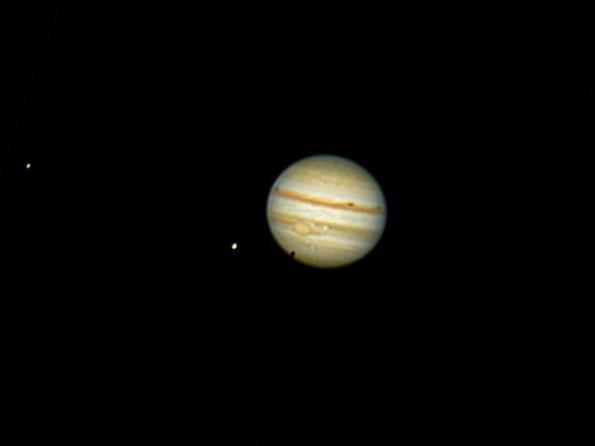
Scott Anttila image of Jupiter from November 14, 2011.
Note how faded the Great Red Spot was.
03/17/2015 – Ephemeris – Jupiter’s cloud stripes
Ephemeris for St. Patrick’s Day, Tuesday, March 17th. The Sun will rise at 7:51. It’ll be up for 11 hours and 59 minutes, setting at 7:51. The Moon, 3 days before new, will rise at 6:37 tomorrow morning.
Jupiter is the one planet that we can see detail on with telescopes in the evening sky. Venus is so bright that it is hard to even see its gibbous phase. Actually the best way to see Venus is during the day with the blue sky around it. Jupiter is a big planet, 11 times the Earth’s diameter and 1,300 times it volume. Despite this it is only 318 times the Earth’s mass, so much of its mass is the atmosphere. It’s rotation rate is just under 10 hours at its equator. This drops with latitude, so its atmosphere is twisted into alternate belts and zones. The belts are dark brown while the zones are lighter. They move around the planet at different speeds causing storms that their boundaries. The Great Red Spot is a anticyclone in the south.
Times are for the Traverse City/Interlochen area of Michigan. They may be different for your location.
Addendum
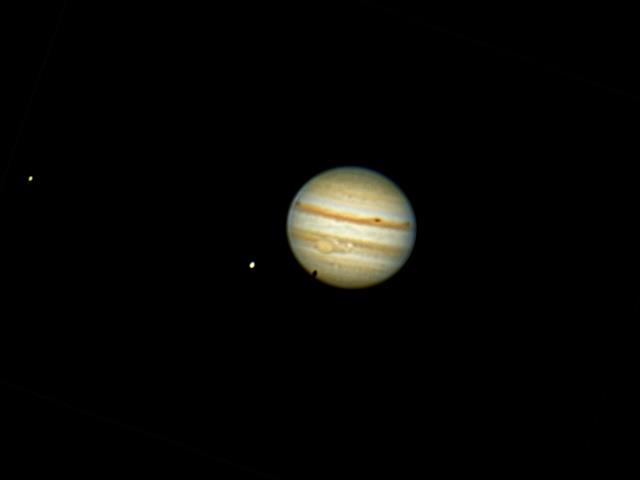
Jupiter by Scott Anttila November 14, 2011. With shadow on the planet and the Great Red Spot.
 Bob Moler's Ephemeris Blog