Archive
Ephemeris: 08/19/24 – Dark Energy
This is Ephemeris for Monday, August 19th. Today the Sun will be up for 13 hours and 50 minutes, setting at 8:41, and it will rise tomorrow at 6:51. The Moon, at full today, will rise at 9:02 this evening.
The Big Bang, nearly 14 billion years ago set the universe to be expanding. All the mass of ordinary matter and the dark matter I talked about last week should be slowing that expansion. However, it was discovered, about 20 years ago, that the universal expansion is not slowing down. It is increasing its expansion rate. Astronomers do not really know why. Since expansion requires energy. This new property is called dark energy. It is actually the expansion of space itself. The galaxies are not fleeing by their own motion through space. They are carried by the expanding space around them. It turns out that objects with mass cannot exceed the speed of light, but the expansion of space itself has no speed limit. At least that’s how I understand it.
The astronomical event times given are for the Traverse City/Interlochen area of Michigan (EDT, UT–4 hours). Times will be different for other locations.
Addendum
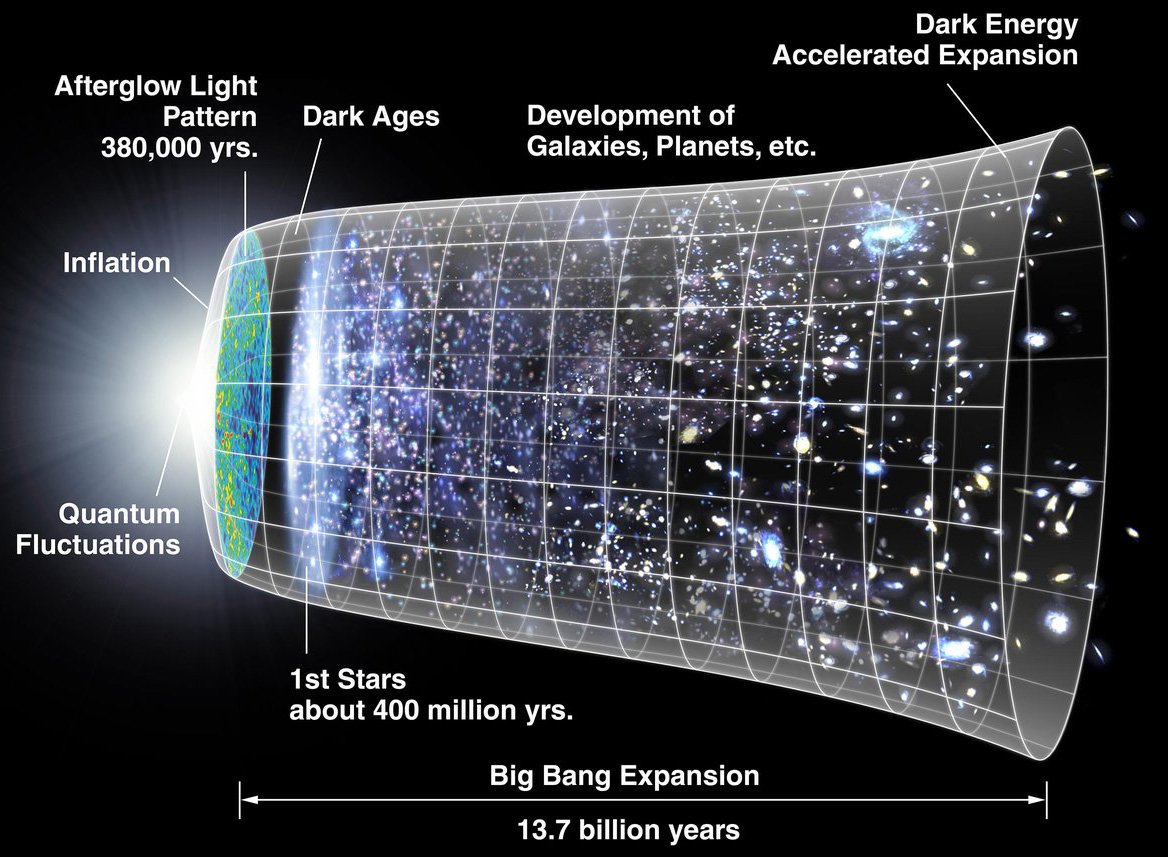
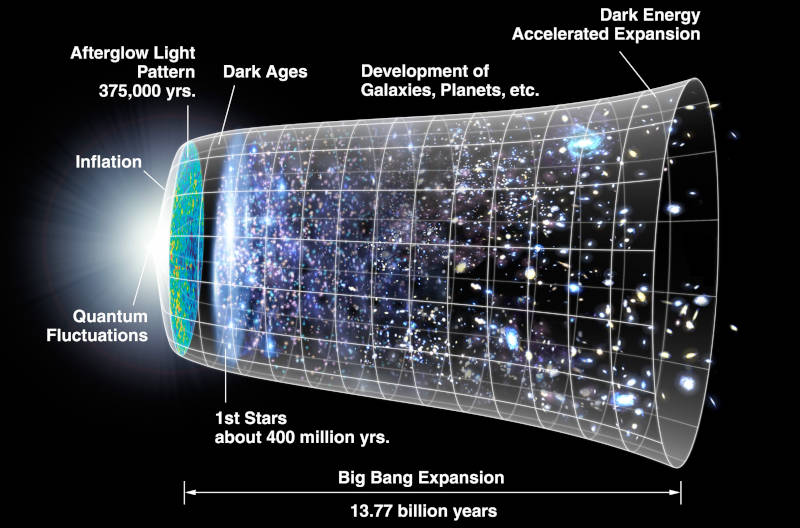
Timeline of the universe. A representation of the evolution of the universe over 13.77 billion years. The far left depicts the earliest moment we can now probe, when a period of “inflation” produced a burst of exponential growth in the universe. (Size is depicted by the vertical extent of the grid in this graphic.) For the next several billion years, the expansion of the universe gradually slowed down as the matter in the universe pulled on itself via gravity. More recently, the expansion has begun to speed up again as the repulsive effects of dark energy have come to dominate the expansion of the universe. The afterglow light seen by WMAP was emitted about 375,000 years after inflation and has traversed the universe largely unimpeded since then. The conditions of earlier times are imprinted on this light; it also forms a backlight for later developments of the universe. Public Domain.
Ephemeris: 01/26/2024 – In astronomy “dark” means we can’t see it
This is Ephemeris for Friday, January 26th. Today the Sun will be up for 9 hours and 33 minutes, setting at 5:42, and it will rise tomorrow at 8:07. The Moon, 1 day past full, will rise at 6:37 this evening.
What does the word “dark” mean? In astronomy the word dark means something we cannot see. In ages before 1959 we could not see the backside of the moon, so people got to calling it the dark side of the Moon. All changed in 1959 when a Soviet spacecraft went around behind the moon it took photographs of it. The two contenders for dark things in astronomy are now dark matter and dark energy. Dark matter is something that has a gravitational effect on the galaxies that it surrounds, but we can’t see it. Also, the expansion of the universe appears to be accelerating, where we would expect it to be decelerating because of gravitational forces of all the galaxies in it. We call that cause dark energy. And we don’t know what either is.
The astronomical event times given are for the Traverse City/Interlochen area of Michigan (EST, UT –5 hours). They may be different for your location.
Addendum
Two possible causes of Dark Matter are in the running, WIMPs, and of course MACHOs. WIMPs are Weakly Interacting Massive Particles, while MACHOs are the bit more tortured acronym Massive Astrophysical Compact Halo Objects. Whatever they are they don’t interact much with themselves or ordinary matter, neither emitting light or any other radiation, or block it. However, they have mass and warp spacetime, distorting the shape of galaxies seen behind them. They also make galaxies seem to be more massive than their starlight would make them appear, and other effects.
07/18/2016 – Ephemeris – A second gravitational wave detection and new thoughts about dark matter
Ephemeris for Monday, July 18th. Today the Sun will be up for 15 hours and 8 minutes, setting at 9:22, and it will rise tomorrow at 6:15. The Moon, 1 day before full, will set at 6:04 tomorrow morning.
A couple of weeks ago a second gravitational wave event was reported. This one was detected on December 26th last year. Scientists determined that it came from the collision of a 14 and a 8 solar mass black holes resulting in a 21 solar mass black hole with one solar mass loss as gravitational wave energy. The event happened 1.5 billion light years away. Some scientists at NASA are speculating that, since no particles with the exotic properties of dark matter have been discovered that this matter might be primordial black holes, created at the time of the Big Bang itself. These primordial black holes can also help solve some other problems of the evolving early universe.
Times are for the Traverse City/Interlochen area of Michigan. They may be different for your location.
Addendum
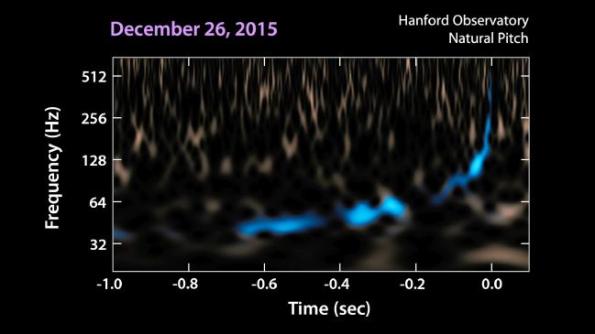
Gravitational wave signal in blue of the December 26, 2015 detection of the second gravitational wave event.
03/26/2013 – Ephemeris – The universe is slightly older than we thought
Ephemeris for Tuesday, March 26th. The sun will rise at 7:34. It’ll be up for 12 hours and 28 minutes, setting at 8:02. The moon, 1 day before full, will set at 7:20 tomorrow morning.
Last week NASA and the European Space Agency announced the findings from the Planck satellite. Along with a sharper map of the Cosmic Microwave Background, created at the moment the Universe became transparent some 380,000 years after the Big Bang, Planck data revealed a slightly older universe of 13.82 billion years. This is with the error thought to be in the last measurement. So it’s a refinement. Also the universe appears to be expanding at a slightly lower rate that had been. Of the three main constituents of the universe, ordinary matter out of which you, me and the stars are made of is 4.9 percent, dark matter that holds galaxy clusters together is at 26 percent, while dark energy is at 68.3 percent, a decrease for it.
Times are for the Traverse City/Interlochen area of Michigan. They may be different for your location.
Addendum
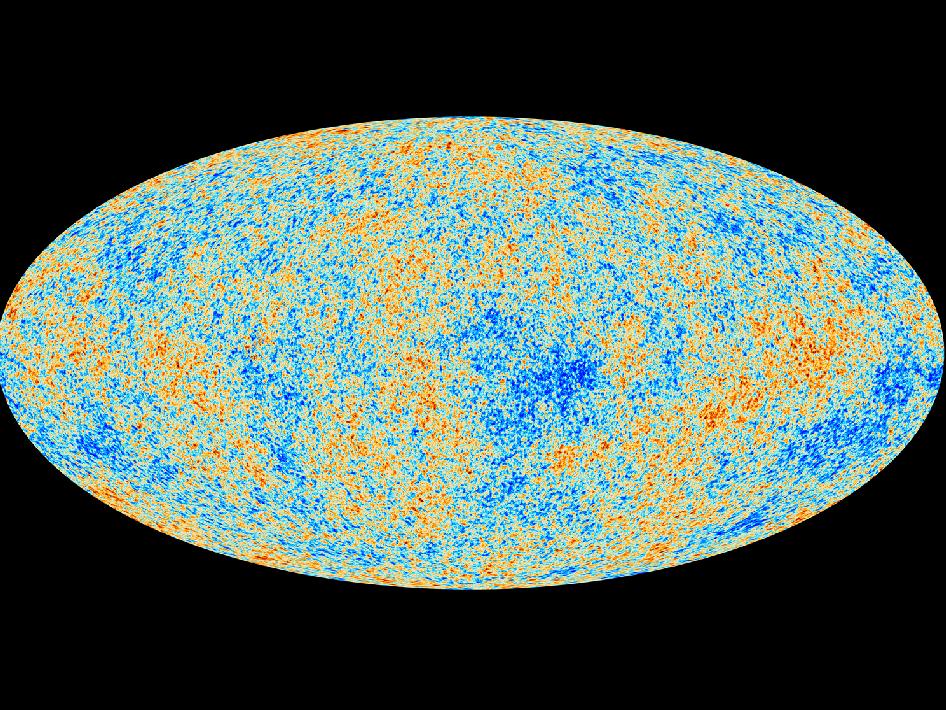
The Cosmic Microwave Background as determined by the Planck satellite. Image credit: ESA and the Planck Collaboration.
 Bob Moler's Ephemeris Blog