Archive
Ephemeris: 08/15/2024 – What’s the matter with dark matter?
This is Bob Moler with Ephemeris for Thursday, August 15th. Today the Sun will be up for 14 hours and 1 minute, setting at 8:47, and it will rise tomorrow at 6:47. The Moon, 3 days past first quarter, will set at 2:23 tomorrow morning.
Over the past century astronomers have come to the realization that we are seeing only about 5% of the mass and energy of the universe. Galaxies in clusters seemed to move too fast to not escape, dissipating the cluster, yet after billions of years they still exist. Also, the stars in galaxies revolve about their centers much faster than expected revealing missing mass. So astronomers have come up with the idea that either there is missing matter that we can’t see, what’s called dark matter or there is something wrong with Newton’s and Einstein’s theories of gravity. Astronomers have come up with up two possible types of dark matter, which they humorously dub WIMPs and MACHOs. More about them tomorrow.
The astronomical event times given are for the Traverse City/Interlochen area of Michigan (EDT, UT–4 hours). Times will be different for other locations.
Addendum
Ephemeris: 01/26/2024 – In astronomy “dark” means we can’t see it
This is Ephemeris for Friday, January 26th. Today the Sun will be up for 9 hours and 33 minutes, setting at 5:42, and it will rise tomorrow at 8:07. The Moon, 1 day past full, will rise at 6:37 this evening.
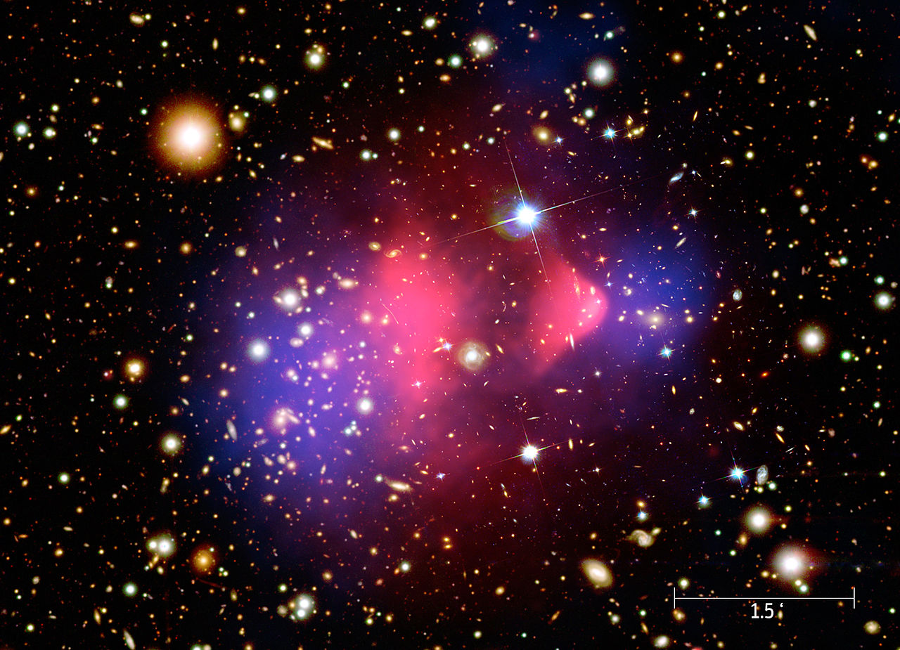
What does the word “dark” mean? In astronomy the word dark means something we cannot see. In ages before 1959 we could not see the backside of the moon, so people got to calling it the dark side of the Moon. All changed in 1959 when a Soviet spacecraft went around behind the moon it took photographs of it. The two contenders for dark things in astronomy are now dark matter and dark energy. Dark matter is something that has a gravitational effect on the galaxies that it surrounds, but we can’t see it. Also, the expansion of the universe appears to be accelerating, where we would expect it to be decelerating because of gravitational forces of all the galaxies in it. We call that cause dark energy. And we don’t know what either is.
The astronomical event times given are for the Traverse City/Interlochen area of Michigan (EST, UT –5 hours). They may be different for your location.
Addendum
Two possible causes of Dark Matter are in the running, WIMPs, and of course MACHOs. WIMPs are Weakly Interacting Massive Particles, while MACHOs are the bit more tortured acronym Massive Astrophysical Compact Halo Objects. Whatever they are they don’t interact much with themselves or ordinary matter, neither emitting light or any other radiation, or block it. However, they have mass and warp spacetime, distorting the shape of galaxies seen behind them. They also make galaxies seem to be more massive than their starlight would make them appear, and other effects.
07/07/2017 – Ephemeris – Tonight’s topic: Dark Matter
Ephemeris for Friday, July 7th. Today the Sun will be up for 15 hours and 24 minutes, setting at 9:29, and it will rise tomorrow at 6:05. The Moon, 2 days before full, will set at 5:48 tomorrow morning.
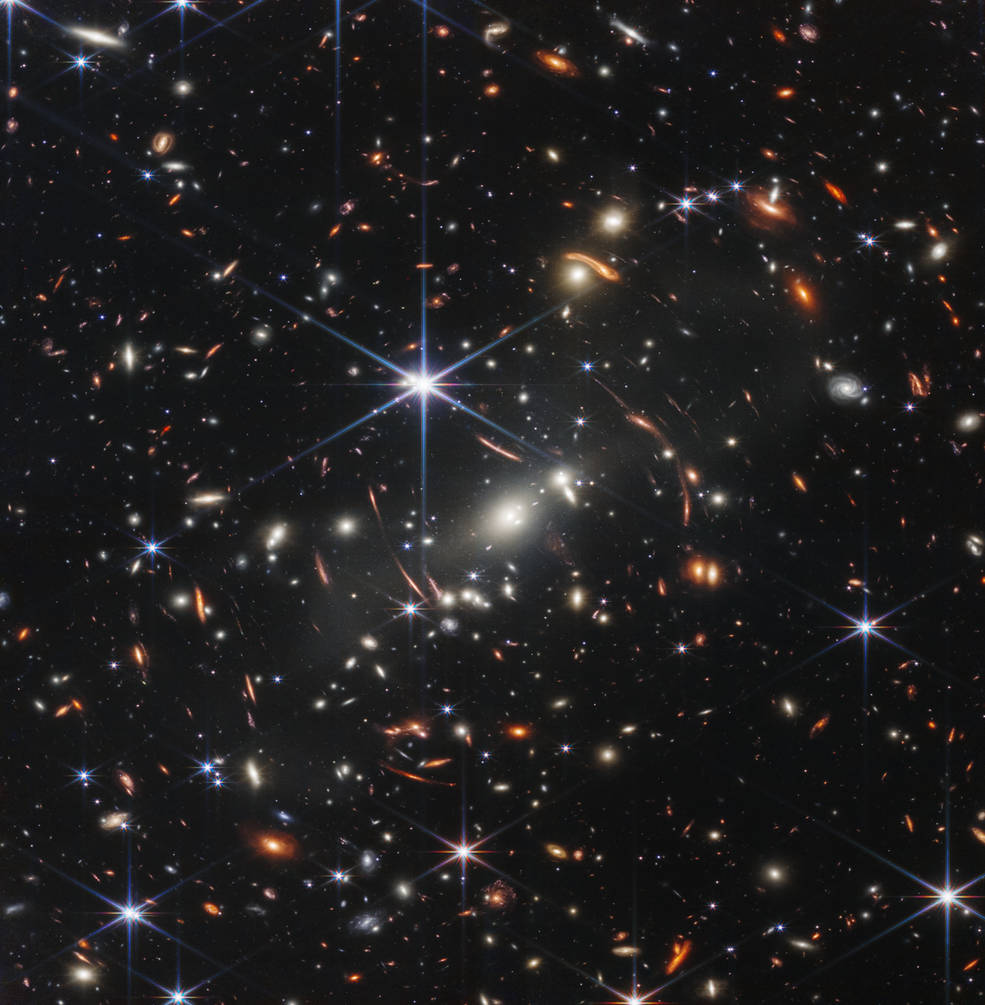
This evening the Grand Traverse Astronomical Society will hold its monthly meeting at the Northwestern Michigan College’s Rogers Observatory at 8 p.m. with a program featuring Dr. David Penney and his talk Dark Matter: What Is It? What Does It Mean? Dark matter, whatever it is appears to be the stuff that holds the universe together. We can’t see it, but we can see its effects in the rotation of galaxies, the motions of galaxies in clusters and their distribution and how it distorts the images of galaxies beyond it. After the talk, at 9 p.m. there will be a star party to view the heavens including the Moon, Saturn and Jupiter. The observatory is located south of Traverse City, on Birmley Road between Garfield and Keystone roads.
The times given are for the Traverse City/Interlochen area of Michigan. They may be different for your location.
Addendum
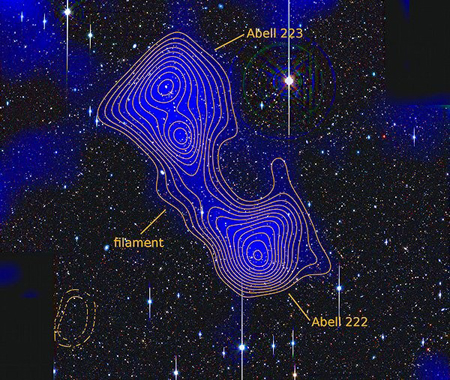
Dark Matter filament bridge between two galaxy clusters, discovered by Jörg Dietrich and his colleagues at the University of Michigan. The blue color is added to show the presence of dark matter. See the text below. Image from http://www.outerspacecentral.com/dark_matter_page.html.
Dark matter is detected by the distortions it creates in the distant galaxies behind it. These galaxies are not visible in the scale of the image shown. The gravitation of dark matter distorts spacetime as predicted by Einstein’s general theory of relativity, which distorts the shapes of the galaxies behind it.
03/26/2013 – Ephemeris – The universe is slightly older than we thought
Ephemeris for Tuesday, March 26th. The sun will rise at 7:34. It’ll be up for 12 hours and 28 minutes, setting at 8:02. The moon, 1 day before full, will set at 7:20 tomorrow morning.
Last week NASA and the European Space Agency announced the findings from the Planck satellite. Along with a sharper map of the Cosmic Microwave Background, created at the moment the Universe became transparent some 380,000 years after the Big Bang, Planck data revealed a slightly older universe of 13.82 billion years. This is with the error thought to be in the last measurement. So it’s a refinement. Also the universe appears to be expanding at a slightly lower rate that had been. Of the three main constituents of the universe, ordinary matter out of which you, me and the stars are made of is 4.9 percent, dark matter that holds galaxy clusters together is at 26 percent, while dark energy is at 68.3 percent, a decrease for it.
Times are for the Traverse City/Interlochen area of Michigan. They may be different for your location.
Addendum
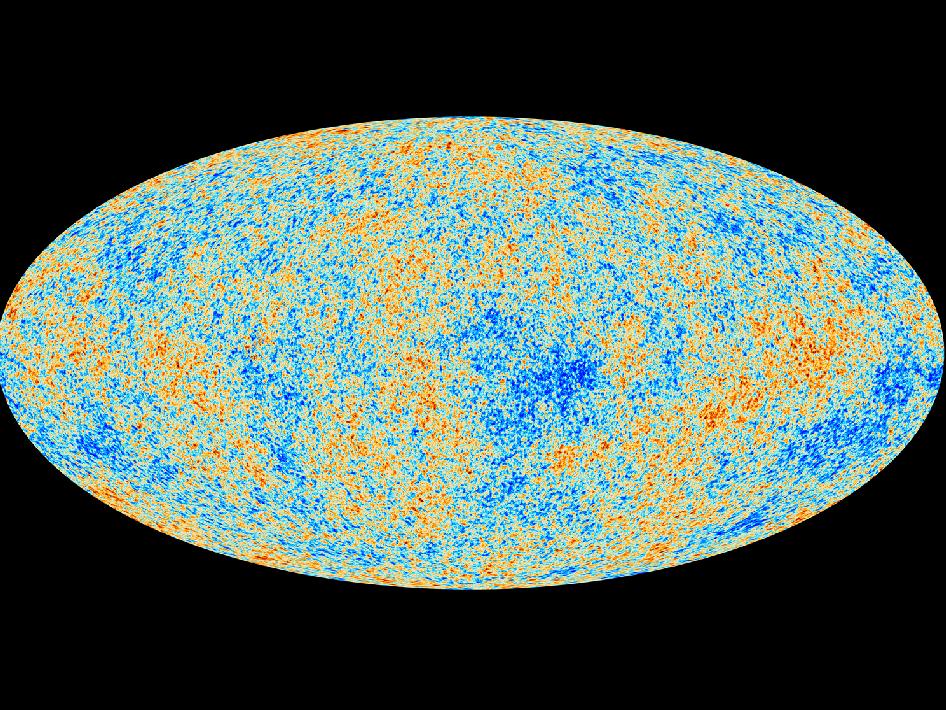
The Cosmic Microwave Background as determined by the Planck satellite. Image credit: ESA and the Planck Collaboration.
04/05/2012 – Ephemeris – Seeing Dark Matter
Ephemeris for Thursday, April 5th. The sun will rise at 7:15. It’ll be up for 13 hours exactly, setting at 8:15. The moon, 1 day before full, will set at 6:44 tomorrow morning.
Astronomers have come to the realization that what we see in the universe as normal matter is only four percent of the universe’s mass and energy. Dark matter makes up about 23 percent, while the totally mysterious dark energy makes up the rest. We do have some clues about what dark matter is. We still can’t see it. However we can detect its presence in distant galaxy clusters. Since whatever it is has mass, it can distort space-time, and the path of light that passes through it. We can detect it because it distorts the shapes of more distant galaxies we see through it. The amount and shape of the distortions point to the location and densest of the dark matter. Whatever this stuff is it has mass, and has and is affected by gravity, but apparently doesn’t interact with ordinary matter of itself for that matter.
* Times are for the Traverse City/Interlochen area of Michigan. They may be different for your location.
 Bob Moler's Ephemeris Blog