Archive
02/26/2021 – Ephemeris – Origin of the Moon
This is Ephemeris for Friday, February 26th. Today the Sun will be up for 11 hours and 1 minute, setting at 6:26, and it will rise tomorrow at 7:23. The Moon, 1 day before full, will set at 7:59 tomorrow morning.
The origin of the Moon is a question that has vexed astronomers for years. Did it break off the molten Earth like a cell dividing? Was it captured by passing too close to the Earth? Neither is satisfactory. Chemical elements have different isotopes depending on the number of neutrons in their nucleus. The rocks brought back by the Apollo astronauts show that the isotopes of the elements in the rocks are the same as for the Earth. We know that Mars and the asteroids have different isotope ratios. The hypothesis that seems most likely is that another planet, the size of Mars collided with the 100 million-year-old Earth in a glancing blow that gave rise to a disk of material that eventually coalesced to form the Moon.
The astronomical event times given are for the Traverse City/Interlochen area of Michigan. They may be different for your location.
Addendum
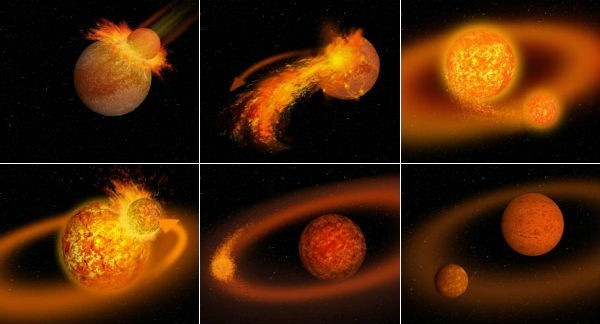
A progression of how the Moon may have formed by a small protoplanet crashed into the Earth. Credit: Brian Koberlein.
11/20/2020 – Ephemeris – Martian Trojan asteroid may have come from our Moon
This is Ephemeris for Friday, November 20th. Today the Sun will be up for 9 hours and 22 minutes, setting at 5:09, and it will rise tomorrow at 7:48. The Moon, 1 day before first quarter, will set at 10:39 this evening.
The way gravity works there are several gravitational sweet spots called Lagrangian points between orbital bodies. Two of those points, 60 degrees ahead of and behind a planet in its orbit, are called L4 and L5. Bodies at these points are called Trojan asteroids. Because the first ones found in Jupiter’s orbit were named after warriors of the Trojan War. What was discovered recently was that one of the planet Mars’ L5 Trojans is not like the others. It has a different composition as analyzed by a spectrograph. It reflects light like the Earth’s Moon, while the others appear to have come from Mars itself. Perhaps an ejected piece of the Moon made it out to Mars orbit. We know small meteoroids can make it planet to planet, maybe huge chunks can make it too.
The event times given are for the Traverse City/Interlochen area of Michigan. They may be different for your location.
Addendum
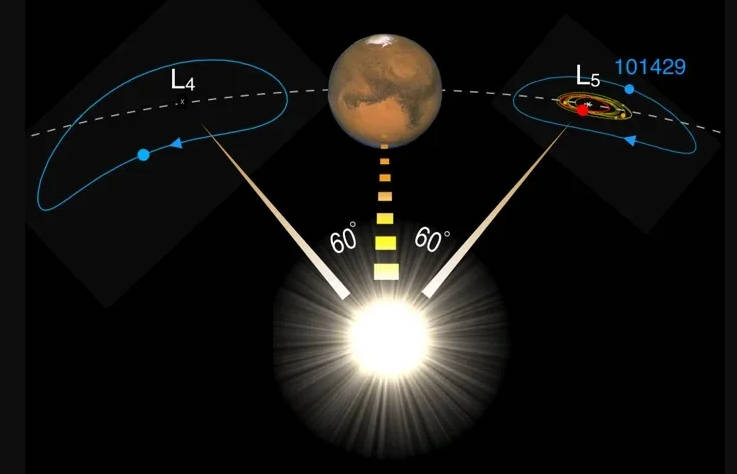
Mars and its Trojan asteroids including 101429 the asteroid that is spectroscopicly like the Moon. The other Trojans appear to have come from Mars itself. I tend to be a stickler for image accuracy: The Mars image is upside down and reversed, while the rest of the diagram is essentially correct other than being way out of scale. Credit Armagh Observatory and Planetarium (AOP) in Northern Ireland.
 Bob Moler's Ephemeris Blog