This is Ephemeris for Thursday, January 16th. Today the Sun will be up for 9 hours and 14 minutes, setting at 5:30, and it will rise tomorrow at 8:15. The Moon, 3 days past full, will rise at 8:37 this evening.
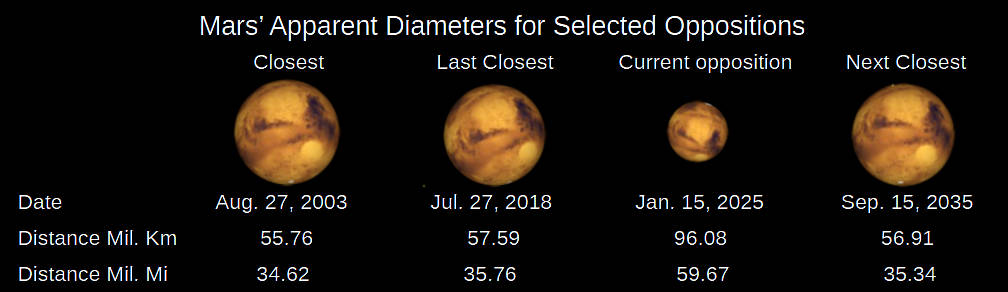
The planet Mars has the second most eccentric orbit of all the planets, after Mercury. But with yesterday’s opposition of Mars it only came down to 59.7 million miles away. At its absolute closest to us, which occurred in 2003, Mars got down to 34.6 million miles away. Since Mars orbits the Sun in little less than two earth years we catch up to it a little farther down in its orbit every time. Mars closest approaches occur every 15 or 17 years. The last close approach was in 2018. The next closest approach will occur in 2035 a span of 17 years. The closest approach before 2018 occurred in 2003 the span between those two was 15 years. Even at closest approach Martian detail is hard to see with a small telescope.
The astronomical event times given are for the Traverse City/Interlochen area of Michigan (EST, UT – 5 hours). Times will be different for other locations.
Addendum
Looking at the apparent size of Mars for four oppositions. The first, in 2003, is the closest Mars has gotten to the Earth for the last 50,000 years according to some astronomers. The next closest approach was in 2018 the next Mars image shows how Mars appears in the current, unfavorable opposition. The last is the next closest appearance opposition which will be in 2035. Martian features are more subtle than they appear here. The large feature on the right side of each image is called Syrtis Major which translates to Great Swamp. The bright round spot below it is what is believed to be a large crater called Hellas. Created using Cartes Du Ciel (Sky Chart), assembled with GIMP, and labeled using LibreOffice Draw.
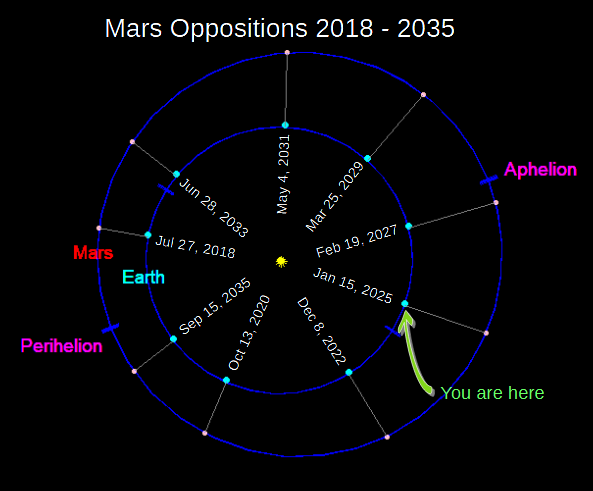
The Mars oppositions from the last closest opposition in 2018 to the next closest opposition in 2035, including tomorrow’s opposition of January 15th 2025. The tick marks on the orbits specify the perihelion or the closest a planet approaches the Sun and aphelion, the farthest. They are labeled for Mars, but they are not for the Earth. Earth’s perihelion comes in early January and aphelion occurs in early July. The difference in Earth’s perihelion and aphelion is only 3 million miles, for Mars it’s 30 million. Created using my LookingUp app, LibreOffice Draw and GIMP.
 Bob Moler's Ephemeris Blog