Archive
07/25/2017 – Ephemeris – Why do solar eclipses happen?
Ephemeris for Tuesday, July 25th. The Sun rises at 6:21. It’ll be up for 14 hours and 54 minutes, setting at 9:15. The Moon, 2 days past new, will set at 10:48 this evening.
We have a day less than 4 weeks before the Great American Total Solar Eclipse on August 21st will occur. Solar eclipses occur at new moon, when the moon is aligned so its shadow falls on the Earth. It doesn’t happen every new moon because the Moon is a long ways away, and its orbit is tipped some 5 degrees from the Earth’s orbit of the Sun, so usually the Moon is north or south of the Sun at new moon. About one in every 6 new moons produces an eclipse. They occur when the Moon is near the crossing point of the two orbital planes, called nodes. The point where the Moon is passing the node in northward direction is called the ascending node, and 180 degrees around the orbit there is the descending node, but you have to be in the right spot to see an eclipse.
The times given are for the Traverse City/Interlochen area of Michigan. They may be different for your location.
Addendum
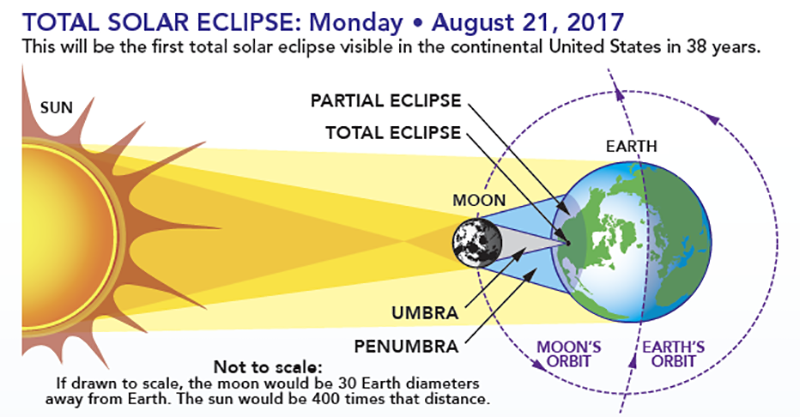
What happens to create a total solar eclipse. Note the Sun’ distance as being 400 times the distance of the Moon. The Sun is also 400 times the Moon’s diameter, so they appear nearly the same size from the Earth. Credit NASA and the Eclipse2017.NASA.gov website.
10/03/2014 – Ephemeris – Sundials and Fall Astronomy Day on tap tomorrow at the NMC Observatory
Ephemeris for Friday, October 3rd. The sun will rise at 7:42. It’ll be up for 11 hours and 36 minutes, setting at 7:19. The moon, 2 days past first quarter, will set at 3:01 tomorrow morning.
Tomorrow is Fall Astronomy Day. To celebrate the Grand Traverse Astronomical Society will move its first Friday of the month meeting and star party to Saturday the 4th. At 8 p.m local landscape architect and sundial expert Dean Connors will talk about, of course, sundials and the myriad of forms they take. Starting at 9 p.m. the star party portion of the night will begin with the moon as the featured celestial object. Members of the society will also provide information on this month’s two eclipses and how to observe a solar eclipse safely. The meeting and star party will be held at Northwestern Michigan College’s Rogers Observatory located south of Traverse City on Birmley Road. Between Garfield and Keystone roads.
Times are for the Traverse City/Interlochen area of Michigan. They may be different for your location.
04/15/2014 – Ephemeris – One eclipse down, what’s next?
Ephemeris for Tuesday, April 15th, Tax Deadline Day. The sun rises at 6:58. It’ll be up for 13 hours and 29 minutes, setting at 8:27. The moon, at full today, will rise at 9:08 this evening.
Since I’m recording this before this morning’s eclipse, I don’t know if it was visible from the northern Lower Peninsula. However we do have a shot at another total lunar eclipse this year. That one is on October 8th. Though it’s in the morning, it’s closer to dawn. One which one can catch by going to bed early and getting up early to enjoy. The weather prospects are somewhat better in October than they are in April. That eclipse we’ll miss a bit of the ending partial phase as the moon sets during that time. As a bonus, 15 days later we will see half of a partial solar eclipse, because the sun will set around mid eclipse. That eclipse will not be total anywhere as the core of the moon’s shadow misses to the north of the Earth.
Times are for the Traverse City/Interlochen area of Michigan. They may be different for your location.
Addendum
There’s another eclipse I didn’t mention due to time. It follows this one by 14 days, on April 29th. It is an odd partial eclipse visible from the Indian Ocean, Australia and a bit of Antarctica. It is an annular eclipse, where the moon is too far away to completely cover the bright ball of the sun. The annular shadow touches the earth in Antarctica, but not the central part, which just misses the earth. It’s truly an odd eclipse. Next year will provide us with two more lunar eclipses. The first one we’ll see a part of before the moon sets, and the second will be an evening eclipse well placed for viewing. None of next years solar eclipses will be visible from North America.
Check out this and next year’s eclipses on the NASA Eclipse website.
 Bob Moler's Ephemeris Blog