Archive
05/01/2014 – Ephemeris – Previewing May skies
Ephemeris for Thursday, May 1st. The sun rises at 6:32. It’ll be up for 14 hours and 14 minutes, setting at 8:47. The moon, 2 days past new, will set at 11:21 this evening.
Today we will start the month when the promise of spring is finally fulfilled, we hope. Daylight hours in the Interlochen/Traverse City area will increase from 14 hours and 14 minutes today to 15 hours 18 minutes on May 31st. The altitude, or angle, of the sun above the southern horizon at local noon will ascend from 60 degrees today to 67 degrees at month’s end. The altitude of the sun in the Straits area will be a degree lower than that but your length of daylight will be a few minutes longer. Local apparent noon this month, when the sun passes due south, will be about 1:38 p.m. The Eta Aquarid meteor shower will reach its peak about 2 a.m. this Sunday morning the 4th. I’ll have more on my blog bobmoler.wordpress.com today.
Times are for the Traverse City/Interlochen area of Michigan. They may be different for your location.
Addenda
The Eta Aquarid Meteor Shower
This shower is associated with Halley’s Comet. We see two meteor showers from Halley’s comet. One in October where the comet debris is crossing the earth’s orbit heading toward the sun, and again as its leaving. This shower is caused by the debris leaving the vicinity of the sun.
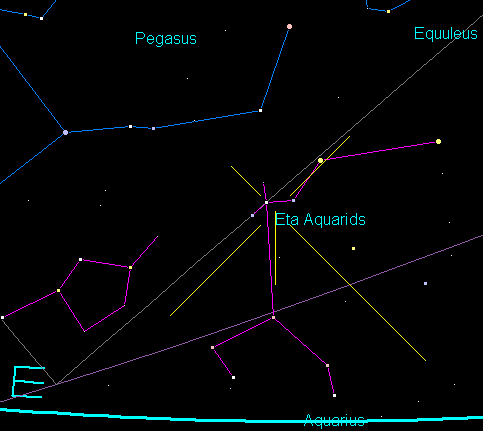
The Eta Aquarid radiant at the peak of the shower. The radiant moves slowly to the east with time. Credit: Bob Moler’s LookingUp program.
The peak of the shower will be at 7 h UT on May 6th. That’s 3 a.m. EDT, about 20 minutes before the radiant will rise. This will give about one hour before astronomical twilight starts to view the meteor shower in completely dark skies.
Possible Meteor Storm – May 24
There will be the possibility of a meteor storm on the morning of May 24th. A meteor storm differs from a meteor shower in the numbers of meteors seen and duration. There is a possibility of up to 400 meteors per hour for the hours of 7h to 8h UT (3 to 4 a.m. EDT).
The body responsible is Comet 209P/LINEAR. It was the 209th periodic comet discovered on February 3, 2004 by Lincoln Near-Earth Asteroid Research (LINEAR). Despite the recent discovery 209P has been orbiting the sun for hundreds of years, maybe longer. This year the comet will come close to the Earth and will allow the Earth to pass through debris that it shed hundreds of years ago.
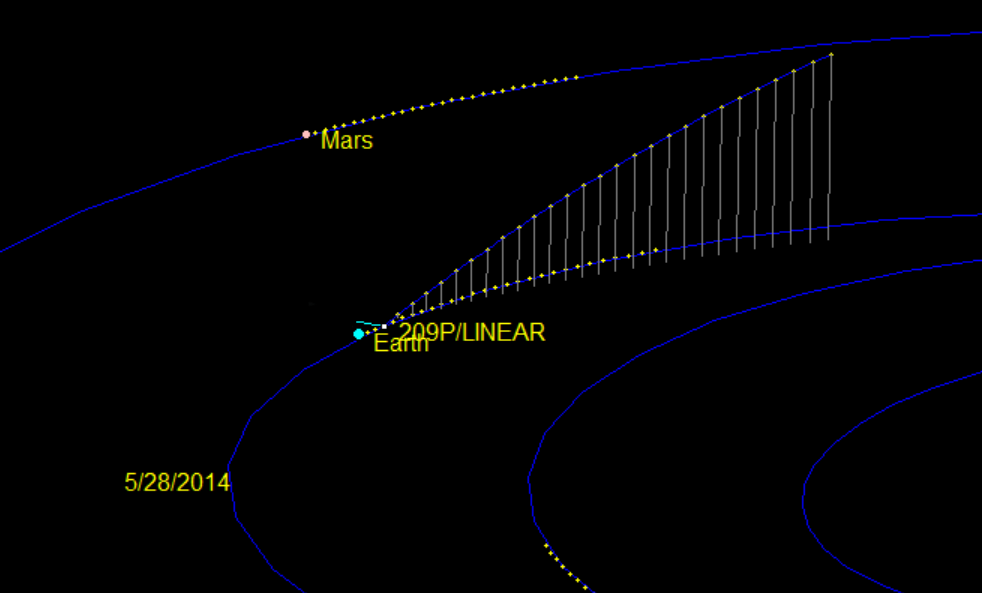
Comet 209P/LINEAR crosses the Earth’s orbit around May 28, 2014. The “stilts” on the comet’s orbit show that it is coming from north of the Earth’s orbital plane. Credit: Bob Moler’s LookingUp program.
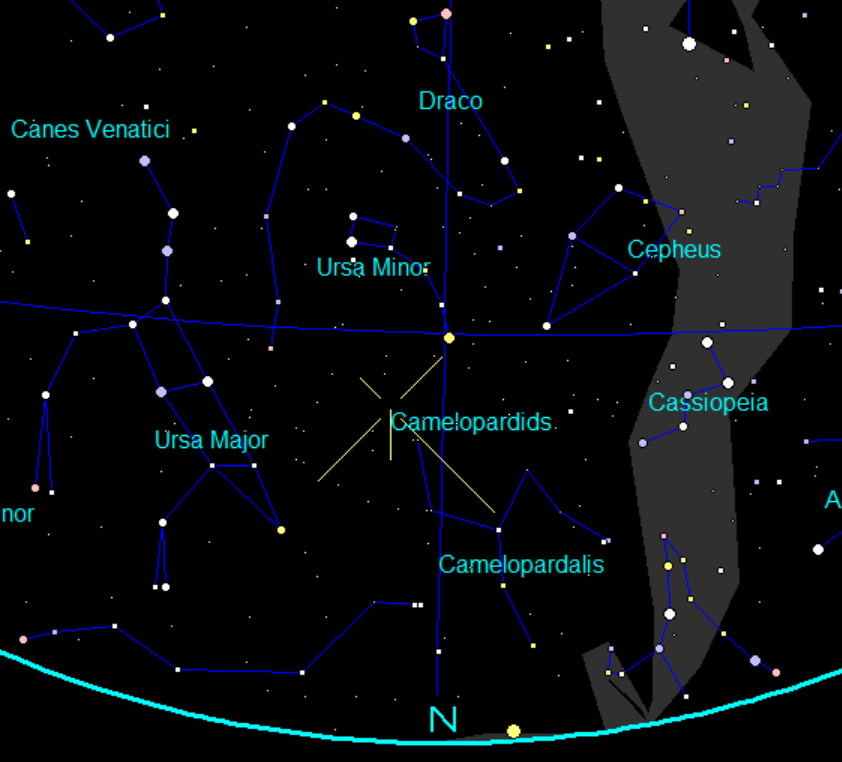
The radiant for the Comet 209P/LINEAR debris. For this purpose I’ve designated it Camelopardids (not official and probably not correct). Credit: Bob Moler’s LookingUp program. Note that the constellation of Camelopardalis is a giraffe.
Astronomical Twilight starts at 3:51 a.m., but the skies should remain dark enough. The 24% illuminated moon will rise about 2:45 or so and may not be much of an impediment in seeing the meteor storm.
May Star Chart
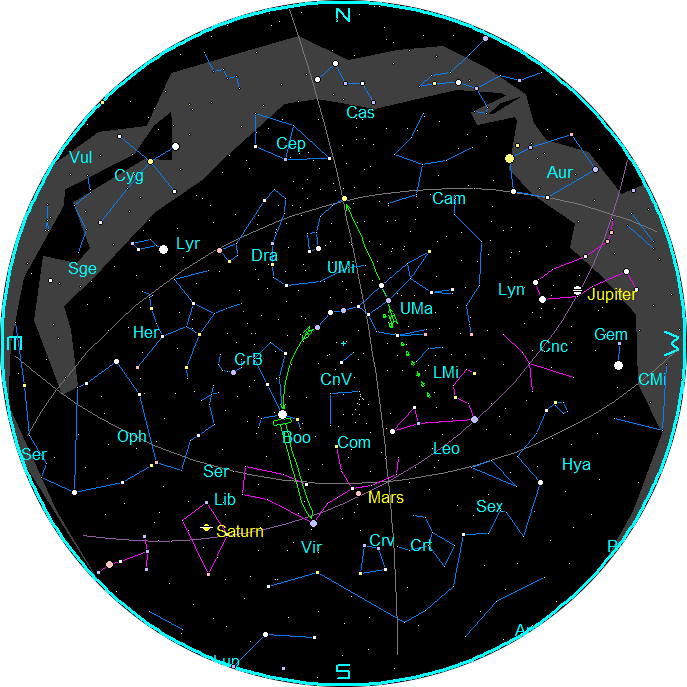
Star Chart for mid-month for May 2014 at 11 p.m. Credit: Bob Moler’s LookingUp program.
Add a half hour to every week before the 15th and subtract and hour for every week after the 15th.
For a list of constellation names to go with the abbreviations click here.
05/02/2013 – Ephemeris – The Eta Aquarid meteors will reach peak this weekend
Ephemeris for Thursday, May 2nd. The sun rises at 6:30. It’ll be up for 14 hours and 17 minutes, setting at 8:48. The moon, at last quarter today, will rise at 3:09 tomorrow morning.
Monday morning will see the expected peak of the Eta Aquarid meteor shower. The meteors will seem to come from the southeast. This shower has a very long peak and can be seen tomorrow morning. This shower’s claim to fame is that the meteoroids that produce this shower are bits shed by Halley’s Comet. The orbits of Halley’s comet and the earth nearly intersect at two points. The inbound Halley’s comet crosses the earth’s orbit where the earth is on October 20th., when we have the Orionid meteor shower. The comet’s orbit then passes between the orbits of Venus and Mercury then crosses the earth’s orbit again near where the earth is on May 6th. The shower has 12 year fluctuations of peak numbers, probably caused by Jupiter.
Times are for the Traverse City/Interlochen area of Michigan. They may be different for your location.
Eta Aquarid radiant
05/05/11 – Ephmeris – The Eta Aquarid meteor shower
Thursday, May 5th. The sun rises at 6:27. It’ll be up for 14 hours and 24 minutes, setting at 8:51. The moon, 2 days past new, will set at 11:35 this evening.
The Eta Aquarid meteor shower is ramping up. The Eta Aquarids are caused by bits of Halley’s Comet, passing the earth’s orbit heading out from the sun. The Orionids of late October are debris of Halley’s comet passing the earth’s orbit heading in toward the sun. It’s the only comet I recollect caused two meteor showers. The Eta Aquarids are named for the star nearest the radiant of the meteor shower. The constellation of Aquarius has many shower radiants, which is why the shower is named for a star in Aquarius. The radiant rises shortly before 3:30 and astronomical twilight begins an hour later. There’s perhaps another half hour of visibility after that. The peak will occur tomorrow morning where up to 20 meteors per hour might be seen.
* Times are for the Traverse City/Interlochen area of Michigan. They may be different for your location.
Addendum
Eta Aquarid radiant
 Bob Moler's Ephemeris Blog