Archive
Ephemeris: 05/05/2025 – A brief early morning meteor shower
This is Bob Moler with Ephemeris for Cinco de Mayo, Monday, May 5th. Today the Sun will be up for 14 hours and 26 minutes, setting at 8:53, and it will rise tomorrow at 6:25. The Moon, 1 day past first quarter, will set at 4:03 tomorrow morning.
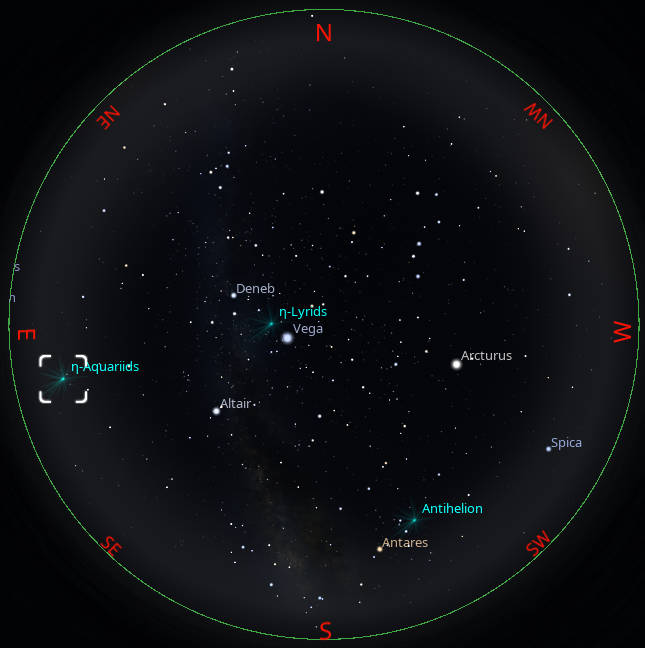
The Earth is now passing through a stream of bits of rock that were shed from Halley’s Comet on its many previous passes through the inner solar system. The Earth gets to pass through this stream twice a year, Once in late October as the stream passes the Earth’s orbit heading in, and in early May as the stream is departing. The peak of this meteor shower, the Eta Aquariids, is this afternoon. Since the meteoroids are coming from nearer the direction of the Sun, there is only a short period when these meteors are visible. Actually less than an hour between moonset at 4:03 AM and nearly 5 AM around here as twilight begins to interfere with the display. The meteors will seem to come from low in the east-southeast, but they will be seen all over the sky.
The astronomical event times given in this blog are for the Traverse City/Interlochen area of Michigan (Lat 44.7° N, Long 85.7° W; EDT, UT – 4 hours) unless stated otherwise. Times will be different for other locations.
Addendum
04/30/2020 – Ephemeris – See bits of Halley’s Comet in the morning crashing into the Earth’s atmosphere
This is Bob Moler with Ephemeris for Thursday, April 30th. Today the Sun will be up for 14 hours and 13 minutes, setting at 8:47, and it will rise tomorrow at 6:32. The Moon, at first quarter today, will set at 3:47 tomorrow morning.
Do you remember seeing Halley’s Comet back in 1986? The actual pronunciation is “Hawley’s”, according to Sir Edmund’s contemporary Samuel Pepys. The reason I asked is whether you saw it in 1986 or are young enough to live long enough to see it in 41 years, we all have a twice yearly chance to see bits of Halley’s Comet, shed in previous returns through the inner solar system and strewn along its orbit, burn up in Earth’s atmosphere as the Eta Aquariid meteor shower going on now, or the Orionids in late October. The time to see the meteor shower is in the early morning after the Moon sets. That’s after 3:47 a.m. tomorrow morning and 4:22 Saturday morning. Astronomical twilight starts about 4:40 a.m. It will probably be 5 a.m. before it really interferes. With the meteors all over the sky, coming from the southeast.
The event times given are for the Traverse City/Interlochen area of Michigan. They may be different for your location.
Addendum
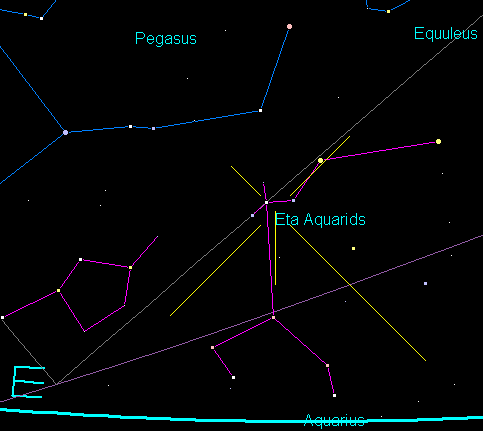
The Eta Aquariid radiant at the peak of the shower. The radiant moves slowly to the east with time. Credit: my LookingUp program.
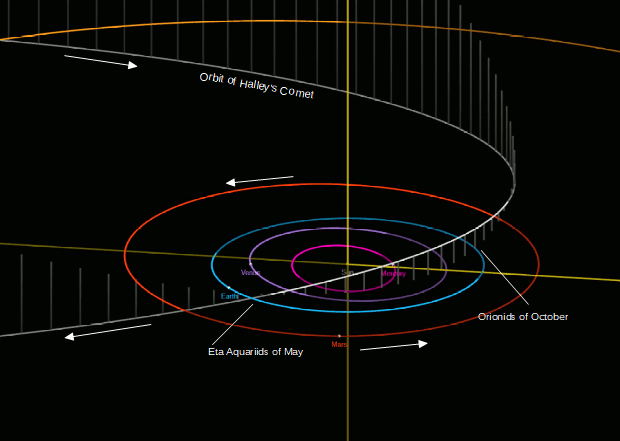
Halley’s Comet orbit with the orbits of the inner planets showing the points at which the debris from the comet intersect with the Earth’s orbit causing meteor showers. Diagram credit JPL Small-Body Database Browser with my annotations.
05/06/2019 – Ephemeris – The Eta Aquariid meteor shower
Ephemeris for Monday, May 6th. Today the Sun will be up for 14 hours and 27 minutes, setting at 8:53, and it will rise tomorrow at 6:24. The Moon, 2 days past new, will set at 10:52 this evening.
The Earth is now passing through a stream of bits of rock that were shed from Halley’s Comet on its many previous passes of the inner solar system. The Earth gets to pass through this stream twice, Once in late October as the stream passes the Earth’s orbit heading in, and in early May as the stream is departing. The peak of this meteor shower, the Eta Aquariids, lasts several days. But since the meteoroids are coming from nearer the direction of the Sun, there is only a short period when these meteors are visible. Actually only an hour between 3:30 a.m. and 4:30 a.m. or a little bit later in the Grand Traverse region as twilight begins to interfere with the display. The radiant, from where the meteors will seem to come will stay low in the east-southeast, but they will be seen all over the sky. The farther south one is on the earth the longer each morning the meteors will be visible. We’re at a disadvantage being 45º north latitude.
The times given are for the Traverse City/Interlochen area of Michigan. They may be different for your location.
Addendum
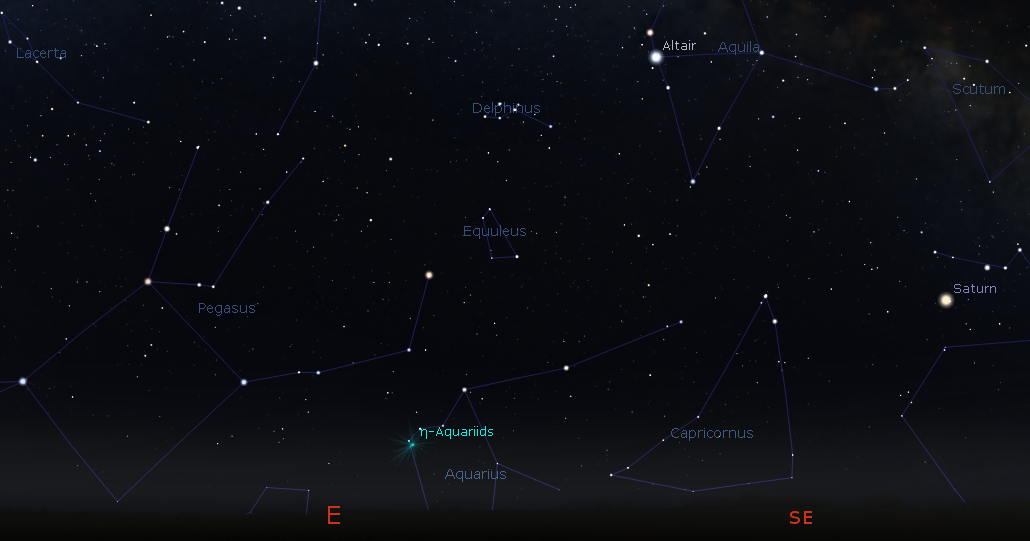
The sky at 4 a.m. tomorrow looking eastward at the Eta Aquariid radiant. Click on the image to enlarge. Created using Stellarium.
05/06/2019 – Ephemeris Extra – The Eta Aquariids – Halley’s Comet never really left
In 1986 Halley’s Comet swam through our skies for the 28th time since the Chinese first recorded it in 240 BCE. It was not especially impressive, considering the week when my family met a group of Leelanau School students in the Florida Keys the week in April 1986 to view and photograph the comet at it’s closest to the Earth of 44 million miles. It turned out that that week the comet lost its tail, probably due to a coronal mass ejection from the Sun. Halley’s Comet was much more impressive a month later. I’ve seen more impressive comets before and since.
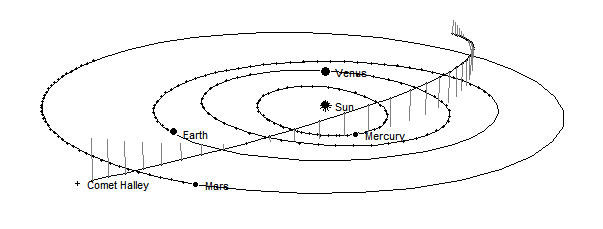
Comet Halley’s path through the inner solar system in 1985-86. Created using my LookingUp program.
Halley’s Comet has been swinging around the Sun countless times before the Chinese first recorded it. The illustration above shows the last time the comet entered the inner solar system in 1986. The comet’s path is from upper right to lower left. When the comet passes within about 3 astronomical units of the Sun, that is 3 times the Earth’s distance from the Sun, the ices in the comet begin to sublimate, escaping from the comet’s nucleus which liberates dust and larger solid material. The gasses and dust form the comet’s ion and dust tails. The larger material, gravel sized bits, end up in and around the comet’s orbit, and over time are spread out around and near the comet’s orbit. Halley’s orbit crosses the Earth’s orbit twice, inbound and outbound. In both cases these crossings are close enough to the plane of the Earth’s orbit to produce meteor showers.
On the inboard leg of the orbit it produces the Orionid meteor shower that peaks on October 22nd. A meteor shower is generally named for the point in the sky they seem to come from, be it a constellation or star. The point, called the radiant, moves during the days or weeks the shower is visible. The Orionids are named for the constellation Orion. The radiant is near his upraised arm.
The center of the outbound meteoroid stream crosses the Earth’s orbit where the Earth is on May 6th. Though they have a broad peak of about 5 days. This meteor shower is visible from April 19th to May28th. During that period the radiant points drifts quite a bit to the east. There are several meteor shower radiants in Aquarius, so they are named for the nearest star at peak.
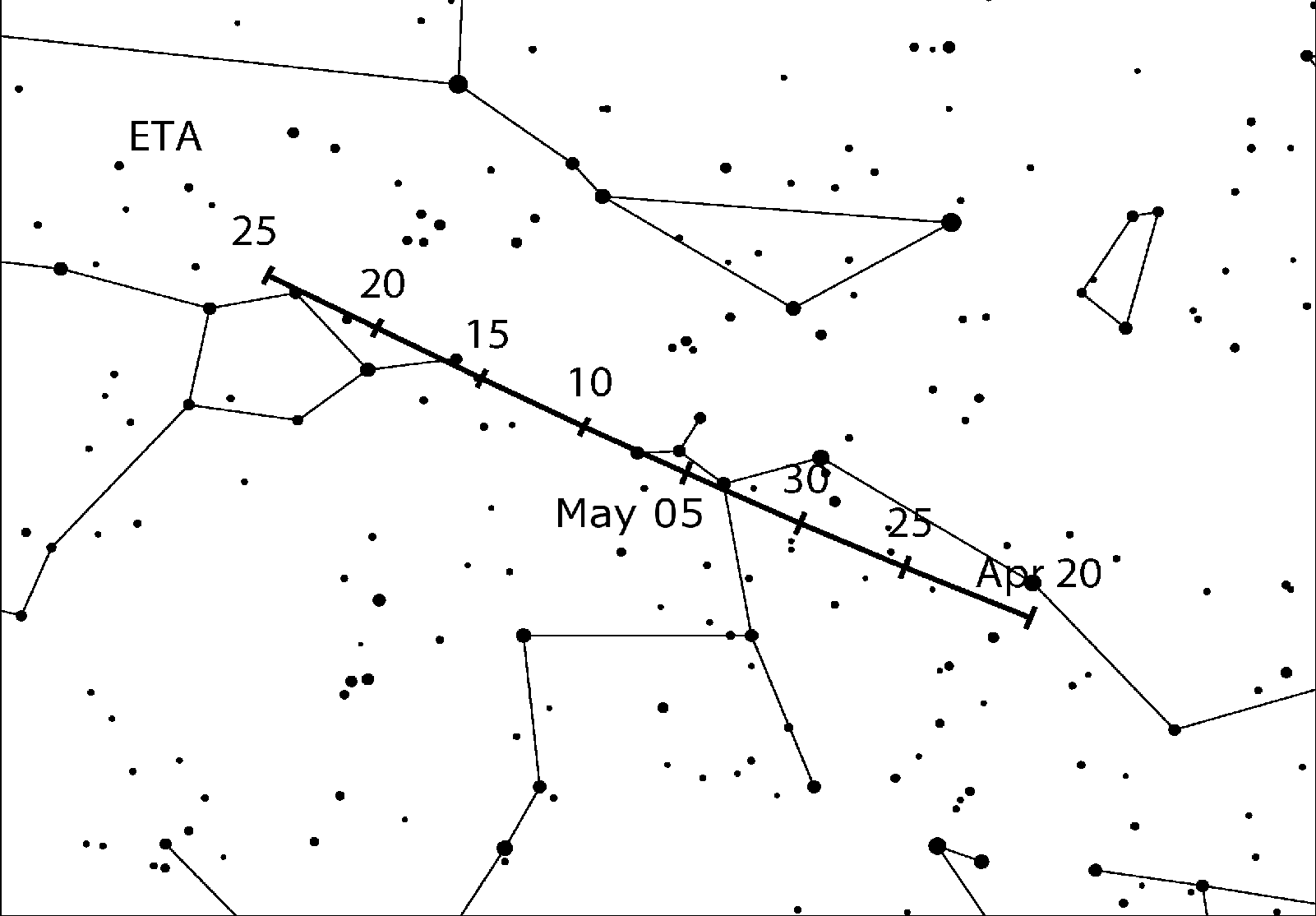
Motion of the Eta Aquariid radiant from April 20 to May 25. The triangle with the star near the center near May 05 is the asterism the Water Jar, a part of Aquarius. Eta Aquarii is the triangle star to the left. Source: PDF version of the International Meteor Organization 2019 Meteor Shower Calendar: https://www.imo.net/resources/calendar/
Though the Moon is new for this shower, the meteoroids are coming from near the direction of the Sun, so there is only an hour where the Eta Aquariids are best seen. For Northern Michigan the radiant rises at 3:30 a.m. on May 6th. Astronomical twilight begins at 4:30 a.m. when the sky begins to brighten. This meteor shower is best seen from the southern hemisphere.
 Bob Moler's Ephemeris Blog