Archive
Ephemeris: 12/16/2024 – The Europa Clipper mission
This is Bob Moler with Ephemeris for Monday, December 16th. Today the Sun will be up for 8 hours and 48 minutes, setting at 5:03, and it will rise tomorrow at 8:14. The Moon, 1 day past full, will rise at 6:09 this evening.
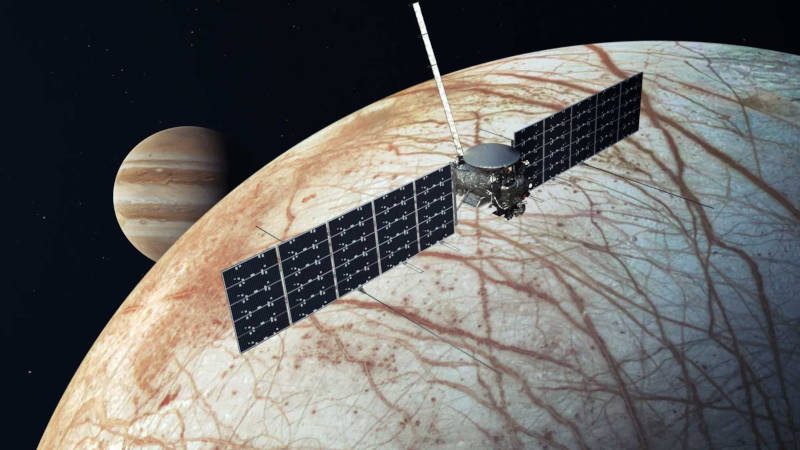
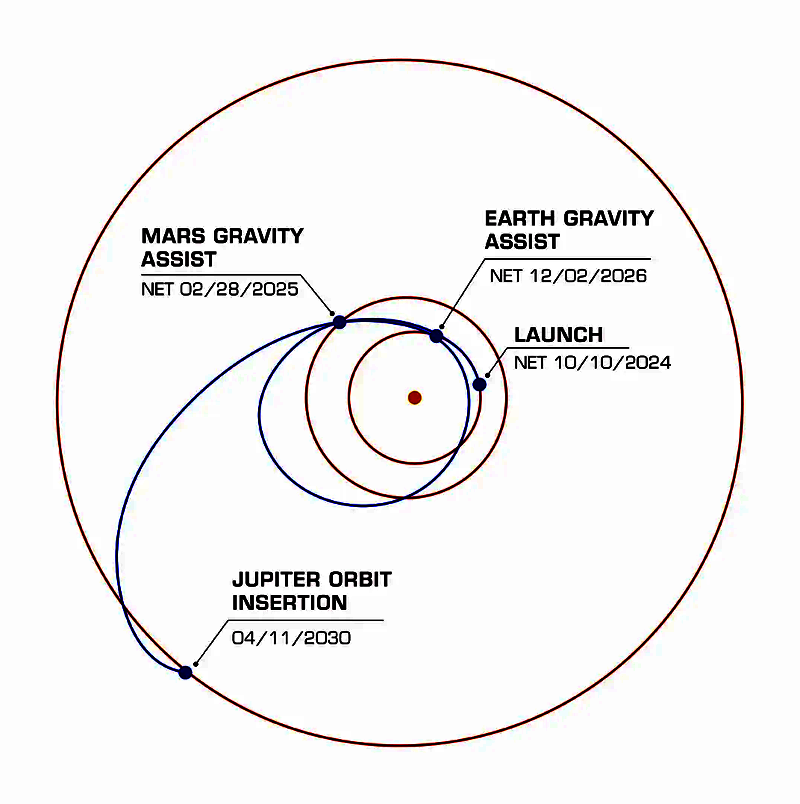
Just two months ago the satellite to closely study Jupiter’s second Galileo moon Europa was launched from Cape Canaveral on a Falcon Heavy rocket. The satellite’s name is Europa Clipper. It was originally scheduled to be launched by the SLS rocket but this rocket which is used for the Artemis program was not going to be ready for the mission so they dropped back to the somewhat less powerful SpaceX Falcon Heavy rocket. Europa Clipper will take 5 1/2 years to travel out to Jupiter with first a gravitational boost from a flyby of Mars and then another one a flyby of Earth to gain enough speed to make it to Jupiter. There it would orbit Jupiter in such a way as to fly by Europa multiple times. Jupiter’s radiation is harsh at Europa’s distance, so the satellite has to get in and get out quickly.
The astronomical event times given are for the Traverse City/Interlochen area of Michigan (EST, UT – 5 hours). Times will be different for other locations.
Addendum
Ephemeris: 12/12/2024 – Jupiter’s moon Europa
This is Bob Moler with Ephemeris for Thursday, December 12th. Today the Sun will be up for 8 hours and 51 minutes, setting at 5:02, and it will rise tomorrow at 8:12. The Moon, 3 days before full, will set at 6:24 tomorrow morning.
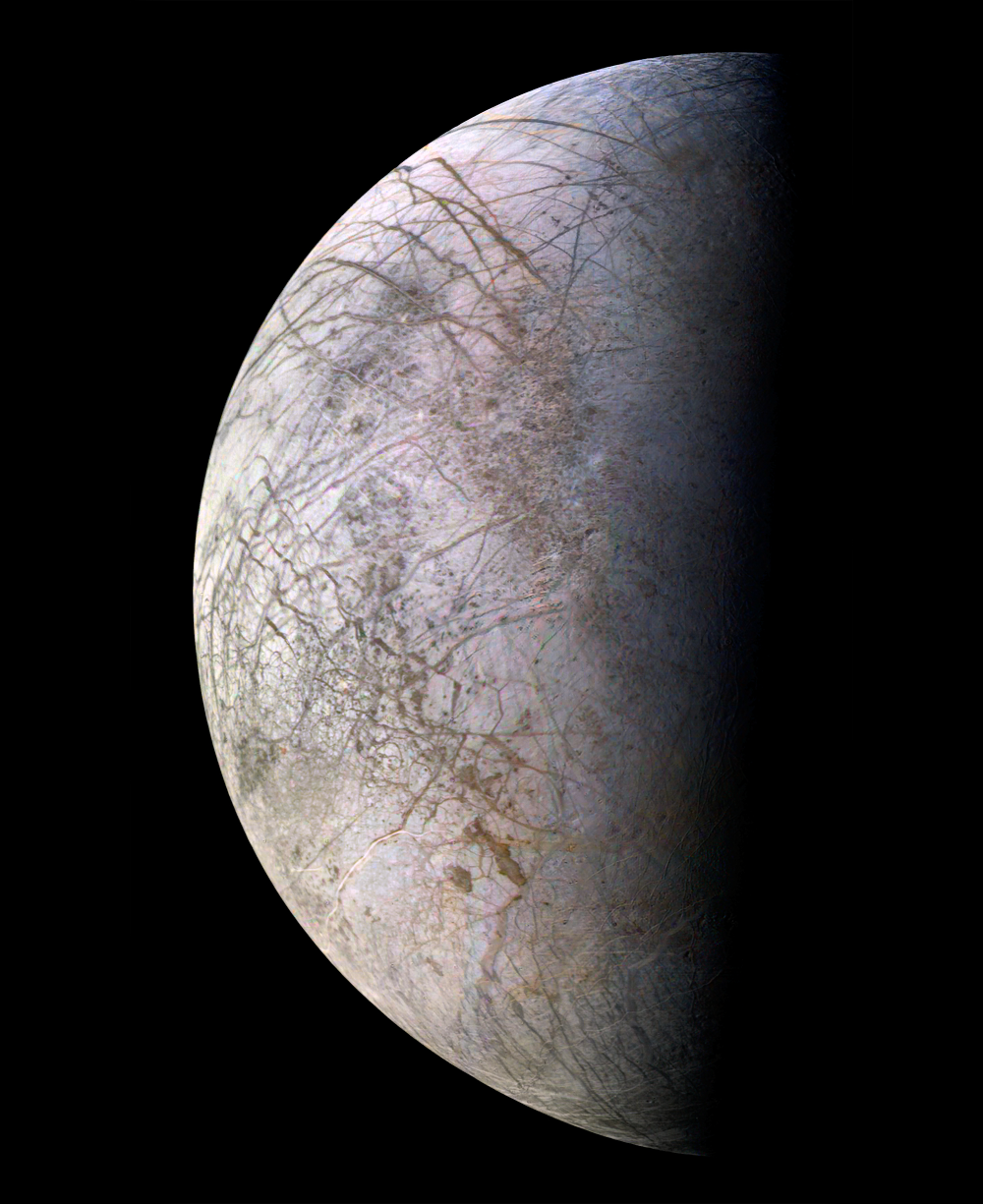
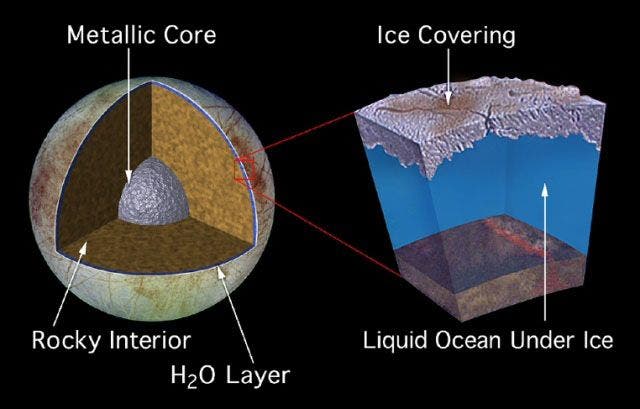
Jupiter’s four bright Galilean moons are nearly planet size. In fact Ganymede, the third one out, is larger than Mercury. But the most interesting moon to NASA and to scientists looking for life in the solar system, is the second moon out, Europa. When the Voyager spacecraft flew past Jupiter in the late 1970s they photographed a rather smooth surface on it with a lot of cracks and grooves, but very few craters. This meant Europa surface is quite young and has been evolving over time kind of like the Earth’s surface. The reason is that it appears Europa has a vast ocean under a thick crust of ice. Europa is heated by both radioactivity in its core and tidal forces caused by Jupiter and the other moon’s gravitational pull on it.
The astronomical event times given are for the Traverse City/Interlochen area of Michigan (EST, UT – 5 hours). Times will be different for other locations.
Addendum
On Earth, wherever there’s water there’s life. Can the same be said of Europa?
08/30/2022 – Ephemeris – The Space Launch System (SLS) will evolve over time
This is Ephemeris for Tuesday, August 30th. Today the Sun will be up for 13 hours and 20 minutes, setting at 8:22, and it will rise tomorrow at 7:04. The Moon, 3 days past new, will set at 10:02 this evening.
The Space Launch System or SLS rocket that’s used for Artemis I is not the final configuration of the rocket to be flown. For Artemis I and II, which will take astronauts around the Moon and back, the SLS is in its Block 1 configuration with an Interim Cryogenic Propulsion Stage, or ICPS as the upper stage. After the Moon landing by Artemis III, the upper stage will be replaced by the Exploration Upper Stage with nearly four times the thrust of the other. That’s Block 1B. After Artemis VIII, or the eighth launch of the SLS, NASA will have run out of solid booster segments left over from the Shuttle program and will have them replaced with more powerful boosters, making it Block 2. With Block 1 the ICPS needs the core stage to get into a highly elliptical orbit, to send the Orion capsule to the Moon. The ICPS cannot do it by itself.
The astronomical event times given are for the Traverse City/Interlochen area of Michigan (EDT, UT – 4 hours). They may be different for your location.
Addendum
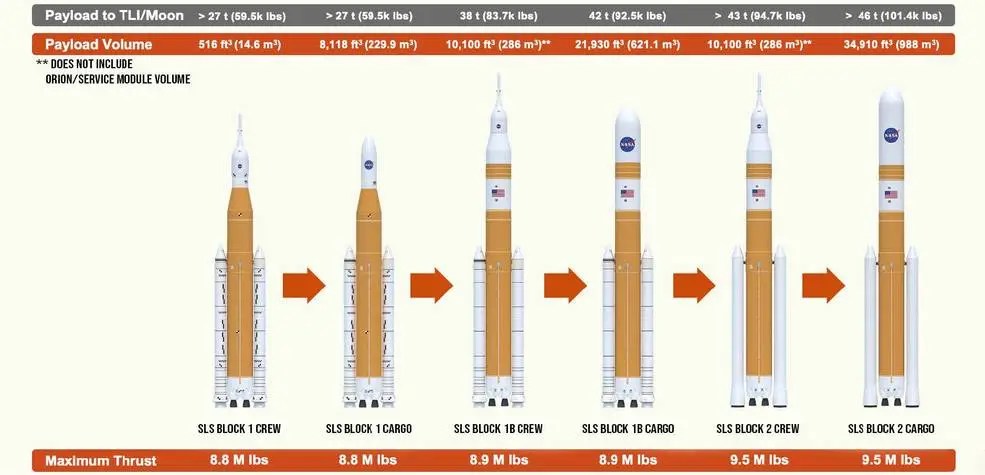
Diagram comparing SLS variants. The chart also shows the cargo variant, one of which was supposed to launch the Europa Clipper mission to Jupiter’s icy moon Europa. That launch has since been reassigned to a SpaceX Falcon Heavy rocket, due to SLS delays. The Falcon Heavy is not as powerful as the SLS, so the Europa Clipper spacecraft will take longer to reach Jupiter’s vicinity (6 vs. 3 years), but will save $2 billion in launch costs. Click on the image to enlarge it. Credit: NASA.
 Bob Moler's Ephemeris Blog