Archive
Ephemeris: 08/19/24 – Dark Energy
This is Ephemeris for Monday, August 19th. Today the Sun will be up for 13 hours and 50 minutes, setting at 8:41, and it will rise tomorrow at 6:51. The Moon, at full today, will rise at 9:02 this evening.
The Big Bang, nearly 14 billion years ago set the universe to be expanding. All the mass of ordinary matter and the dark matter I talked about last week should be slowing that expansion. However, it was discovered, about 20 years ago, that the universal expansion is not slowing down. It is increasing its expansion rate. Astronomers do not really know why. Since expansion requires energy. This new property is called dark energy. It is actually the expansion of space itself. The galaxies are not fleeing by their own motion through space. They are carried by the expanding space around them. It turns out that objects with mass cannot exceed the speed of light, but the expansion of space itself has no speed limit. At least that’s how I understand it.
The astronomical event times given are for the Traverse City/Interlochen area of Michigan (EDT, UT–4 hours). Times will be different for other locations.
Addendum
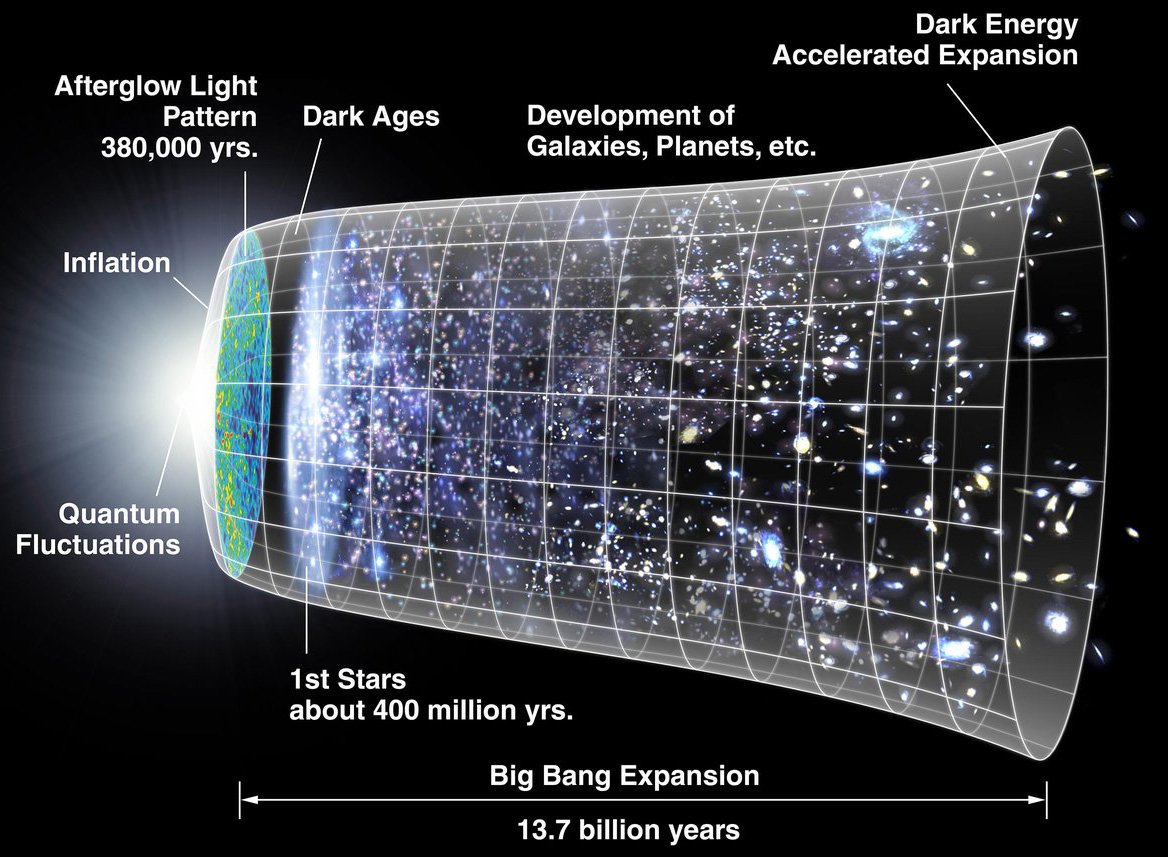
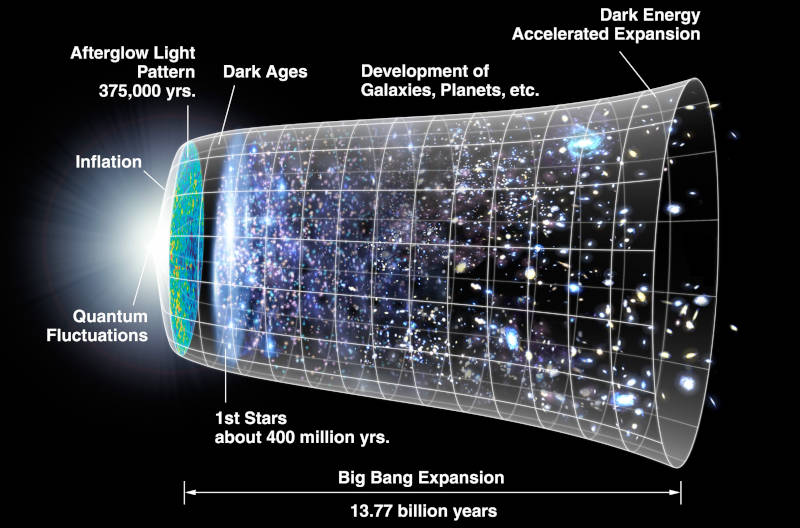
Timeline of the universe. A representation of the evolution of the universe over 13.77 billion years. The far left depicts the earliest moment we can now probe, when a period of “inflation” produced a burst of exponential growth in the universe. (Size is depicted by the vertical extent of the grid in this graphic.) For the next several billion years, the expansion of the universe gradually slowed down as the matter in the universe pulled on itself via gravity. More recently, the expansion has begun to speed up again as the repulsive effects of dark energy have come to dominate the expansion of the universe. The afterglow light seen by WMAP was emitted about 375,000 years after inflation and has traversed the universe largely unimpeded since then. The conditions of earlier times are imprinted on this light; it also forms a backlight for later developments of the universe. Public Domain.
Ephemeris: 02/12/2024 – Darwin Day
This is Bob Moler with Ephemeris for Darwin Day, Monday, February 12th. Today the Sun will be up for 10 hours and 18 minutes, setting at 6:06, and it will rise tomorrow at 7:46. The Moon, 3 days past new, will set at 9:53 this evening.
Today we commemorate the birthday of Charles Darwin, whose Origins of the Species produced a revolution in biology, that is the Theory of Evolution. Back then, in the 19th century, the Earth was thought to be fairly young. By then geologists had figured out that the Earth was at least millions of years old. Astronomers working on the amount of energy that the Sun put out calculated that if it were made of coal it would burn out in about 3000 years. So there was a definite problem with the age of the Sun and the Earth. With the discovery of radioactivity and the beginnings of Quantum Theory, at the turn of the last century, astronomers and physicists figured out that the conversion of matter into energy, according to Einstein, was energetic enough to fuel the Sun for billions of years. Enough time for evolution to work. In fact the entire universe is evolving!
The astronomical event times given are for the Traverse City/Interlochen area of Michigan (EST, UT –5 hours). They may be different for your location.
Addendum
Biology isn’t my thing… too messy. Astronomy is mainly physics and chemistry, with the addition, relatively recently of astrobiology. However, not only living things evolve, the universe itself has been evolving for the last 13.8 billion years from the origin of the Big Bang to the present day.
 Bob Moler's Ephemeris Blog