Archive
01/16/2023 – Ephemeris – Orion’s great nebula
This is Bob Moler with Ephemeris for Dr. Martin Luther King Jr. Day, Monday, January 16th. Today the Sun will be up for 9 hours and 13 minutes, setting at 5:29, and it will rise tomorrow at 8:15. The Moon, 2 days past last quarter, will rise at 3:52 tomorrow morning.
The brightest interstellar cloud visible in our skies is the Great Orion Nebula. The word nebula is related to the Latin “nebulum” for cloud. The constellation of Orion is filled with nebulae, most of it are dim or dark. The Great Orion Nebula is in Orion’s sword. The sword is what looks like three stars that look dimmer than the three belt stars hanging from the belt. And there are more than three stars here. Around the stars that appear as the center of the sword stars, to the eye, can be seen a haze in binoculars. A telescope with a wider aperture and low power can see detail in the cloud. With more magnification, a clutch of four baby stars can be spotted in the brightest part of the nebula. They light up the nebula and are called the Trapezium.
The astronomical event times given are for the Traverse City/Interlochen area of Michigan (EST, UT –5 hours). They may be different for your location.
Addendum
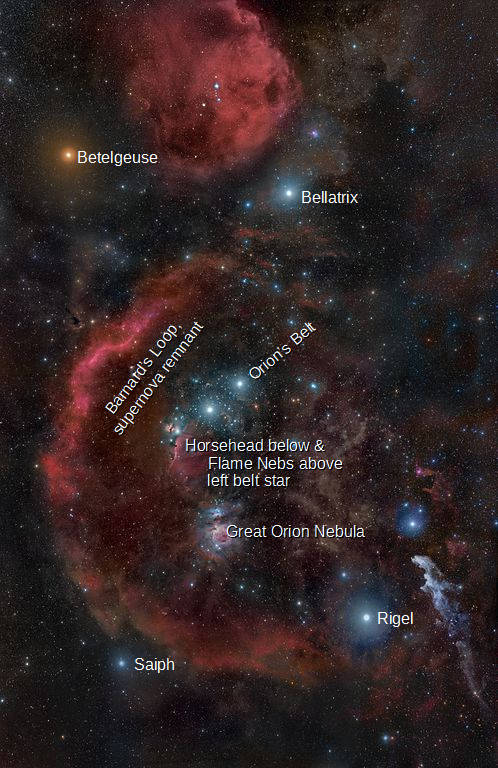
Orion is lousy with gas and dust. A regular star factory, or nursery. The red nebulae show the predominance of hydrogen in here. In actuality, the Great Orion Nebula vastly outshines all the other nebulae in Orion. The white nebulosity to the right of Rigel is the Witches Head nebula, probably the reflection of Rigel’s light off a dust cloud. Base image by Bernal Andreo, via Wikipedia. Annotations were created by myself.
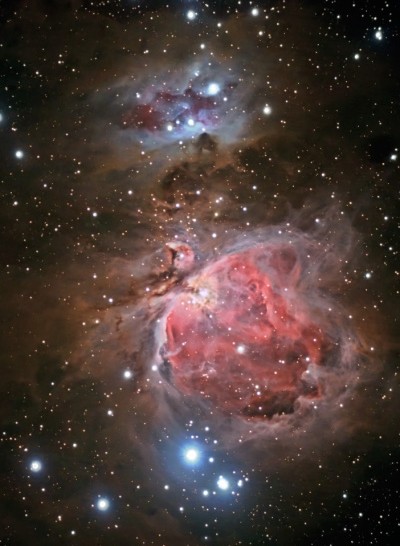
The Great Orion Nebula (M42) long exposure photograph by Scott Anttila. Includes all the sword stars.
02/21/2014 – Ephemeris – Some nebulae in Orion
Ephemeris for Friday, February 21st. The sun will rise at 7:33. It’ll be up for 10 hours and 46 minutes, setting at 6:19. The moon, 1 day before last quarter, will rise at 1:31 tomorrow morning.
With the moon out of the sky, it’s a good time to get those binoculars or small telescope out to view at least one nebula in the constellation Orion the hunter and maybe even more. Orion is in the south with those belt stars lie in a straight line. Below the belt are three fainter stars, vertically arranged: Orion’s sword. In binoculars each of those stars are multiples. Around what looks like a center star there is a haze, which is the Great Orion Nebula, the nearest star forming region to us at around 1,400 light years away. Some of its gasses envelop the stars that make up the top star of the sword. Orion hosts the famous Horse head Nebula, which unfortunately can only be seen in photographs, It is right below the left star of the belt.
Times are for the Traverse City/Interlochen area of Michigan. They may be different for your location.
Addendum
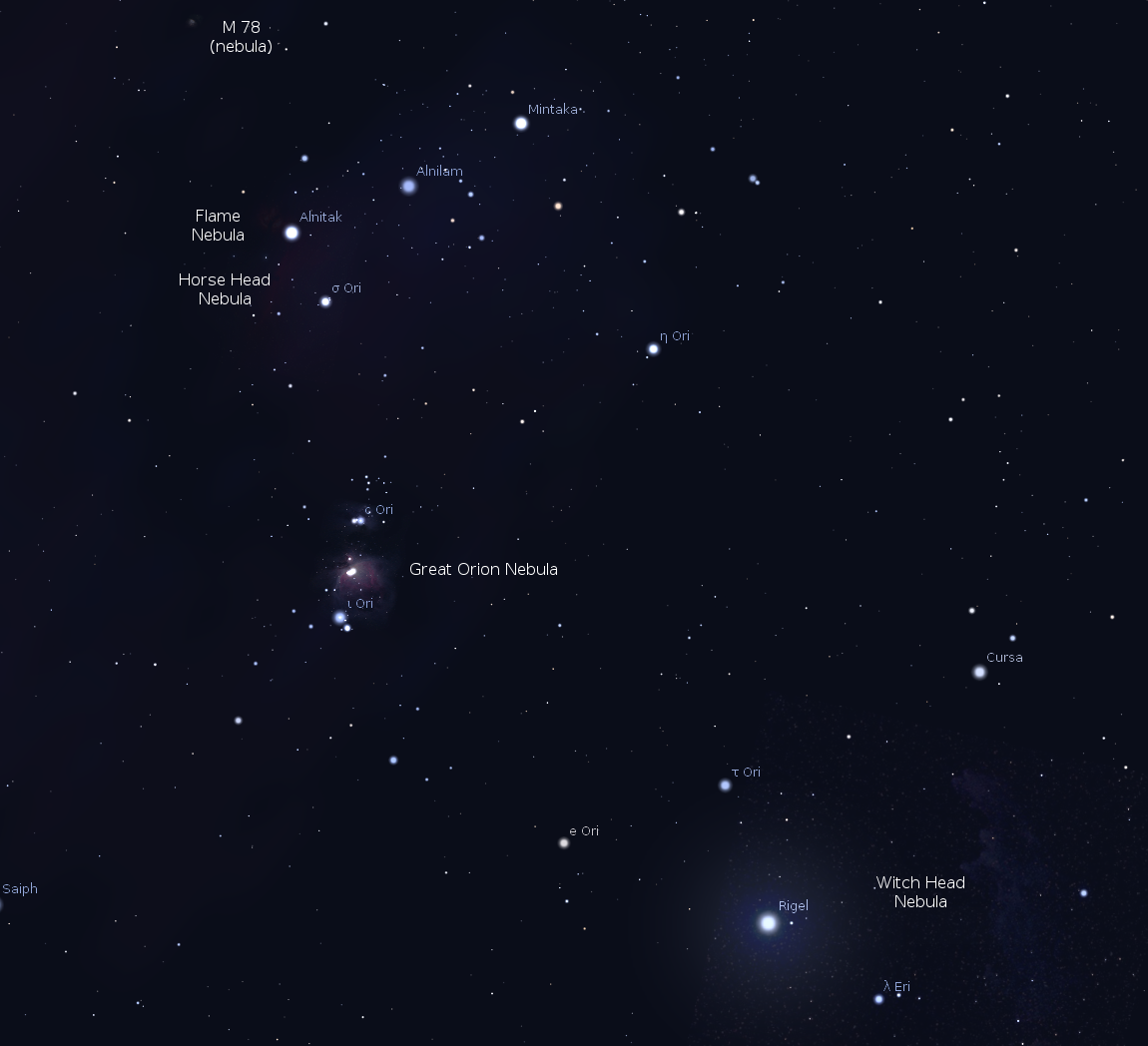
Orion’s Nebulae in the southern part of the constellation as displayed by Stellarium.
A couple of nebulae are seen here that are not in the text above. M78 is a small nebula north of the belt star Alnitak. It is visible in a telescope. The Witch Head Nebula, another large nebula, shining by the reflected light of Rigel. It’s officially in the neighboring constellation of Eridanus, and I believe strictly a photographic nebula. The witch head is best seen if the image is turned upside down.
 Bob Moler's Ephemeris Blog