Archive
12/08/2014 – Ephemeris – Looking forward to the Geminid meteor shower next weekend
Ephemeris for Monday, December 8th. The sun will rise at 8:06. It’ll be up for 8 hours and 55 minutes, setting at 5:02. The moon, 2 days past full, will rise at 7:28 this evening.
This upcoming weekend is the weekend of the greatest annual meteor shower of the year. They’re the Geminids. I confess to never having seen a Geminid. The reason is that it’s generally too cloudy, and for me too cold. They are now twice as active as the Perseid meteors of August with a 120 per hour peak, when the radiant point in Gemini is overhead. The body that was discovered to produce these meteors doesn’t appear to be a comet. It is designated as an asteroid 3200 Phaethon. Phaethon gets extremely close to the sun at 13 million miles (21 million km) and one of the STEREO Sun monitoring satellites caught it developing a tail when close to the Sun. Phaethon may then be the first known rock comet. I’ll have more later this week.
Times are for the Traverse City/Interlochen area of Michigan. They may be different for your location.
Addendum
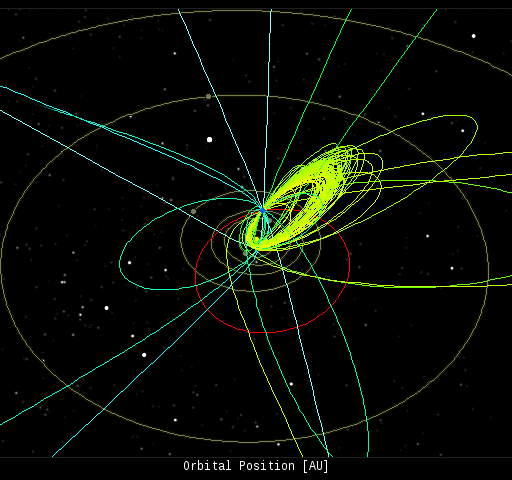
Orbits of last year’s fireballs on the night of December 13-14 as recorded by NASA’s All Sky Cameras. The preponderance of fireballs (bright meteors) are Geminids. These are published daily on Spaceweather.com. Credit: NASA and Spaceweather.com
12/13/2012 – Ephemeris – The Geminid meteor shower reaches its peak tonight.
Ephemeris for Thursday, December 13th. The sun will rise at 8:11. It’ll be up for 8 hours and 51 minutes, setting at 5:02. The moon is new today, and won’t be visible.
Tonight will be the peak of the Geminid meteor shower. This is one of the most active showers of the year. Some say it’s even more active than the Perseid meteor shower of August with up to 100 meteors or shooting stars visible an hour. They will seem to come from near the star Castor in the constellation Gemini which is rising high towards midnight. The moon will not interfere because it’s new. The radiant point is highest at 2 a.m. But will be in the sky from 8 p.m. on All you’ll need then is clear skies. If it does clear up, make sure you dress warmly. It will take up to 10 minutes or even more for your eyes to get accustomed to the darkness to be able to see the meteors. The meteors are related to a body called Phaethon, a dead comet nucleus.
Times are for the Traverse City/Interlochen area of Michigan. They may be different for your location.
Addendum
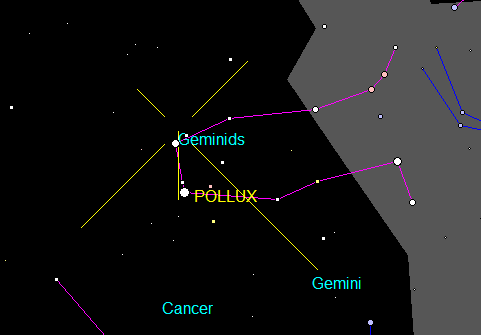
Geminid Radiant
 Bob Moler's Ephemeris Blog