Archive
10/10/2019 – Ephemeris – Saturn’s moon Enceladus may have the building blocks of life
Ephemeris for Thursday, October 10th. Today the Sun will be up for 11 hours and 15 minutes, setting at 7:07, and it will rise tomorrow at 7:52. The Moon, 3 days before full, will set at 5:23 tomorrow morning.
Even though the Cassini mission to Saturn ended two years ago its data will be will be studied for decades by scientists around the world. One of Cassini’s discoveries were geysers of water ice being ejected from the small moon Enceladus, that creates Saturn’s tenuous E ring. Two instruments aboard Cassini, a mass spectrometer and a cosmic dust analyzer, discovered organic compounds in the geysers and the E ring. Further analysis by German geologists found nitrogen-oxygen molecules among the ice grains. These are like the constituent compounds that make up amino acids which on Earth make up the proteins of life. Currently both NASA and the Europeans are considering return missions to Enceladus.
The times given are for the Traverse City/Interlochen area of Michigan. They may be different for your location.
Addendum
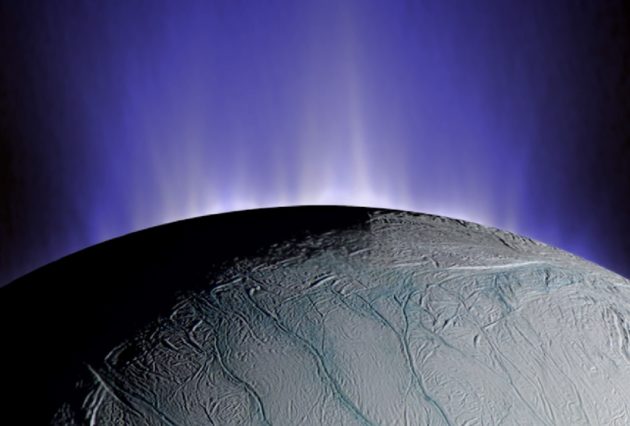
Enceladus, a small moon of Saturn spews continues to geysers of water rom cracks in its south polar region indicating an ocean below its frozen icy exterior. Sampling the plumes with the right instruments may detect life on this small world without the need for drilling. Credit: NASA/JPL – Caltech
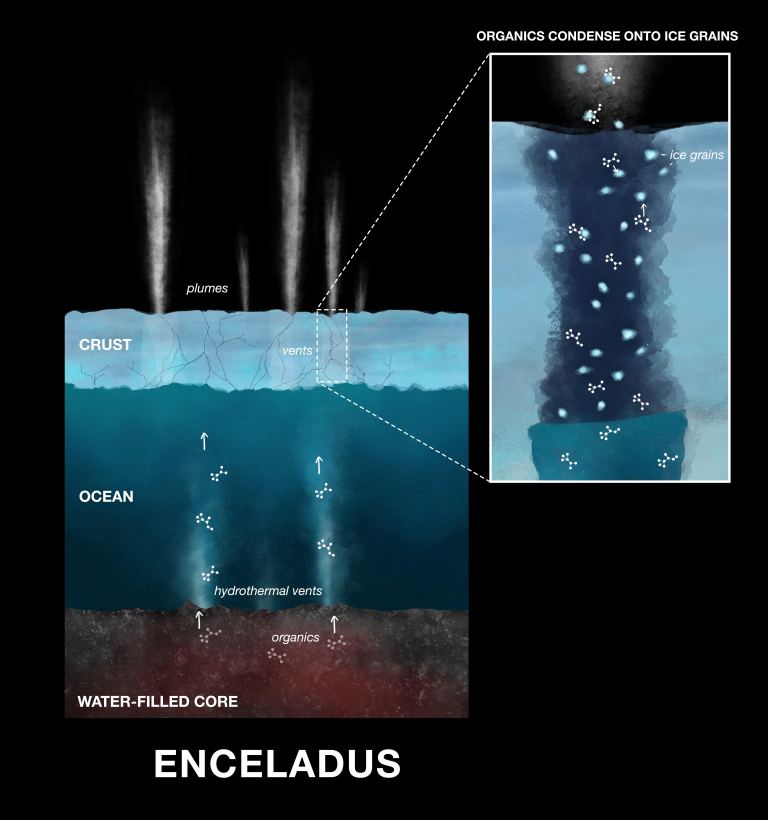
How organic compounds are attached to ice grains and ejected from Enceladus. Credit: NASA/JPL – Caltech.
10/13/2016 – Ephemeris – Europa appears to have water geysers like Enceladus
Ephemeris for Thursday, October 13th. The Sun will rise at 7:56. It’ll be up for 11 hours and 4 minutes, setting at 7:00. The Moon, 3 days before full, will set at 5:48 tomorrow morning.
On September 26th NASA announced that the Hubble Space Telescope has confirmed earlier observations that Europa, Jupiter’s second large moon is venting water vapor. It is pretty much known that Europa has a moon girdling ocean many tens of miles below its icy surface. The surface is devoid of craters, showing that there is some interaction with the ocean below and the cracks we see on the surface. Having plumes or geysers will allow spacecraft and landers to sample the ocean below without having to drill down to the ocean. NASA has okayed a mission to Europa. This could change the mission and instruments and maybe add a lander to probe the geysers, though first the have to find them.
Times are for the Traverse City/Interlochen area of Michigan. They may be different for your location.
Addendum
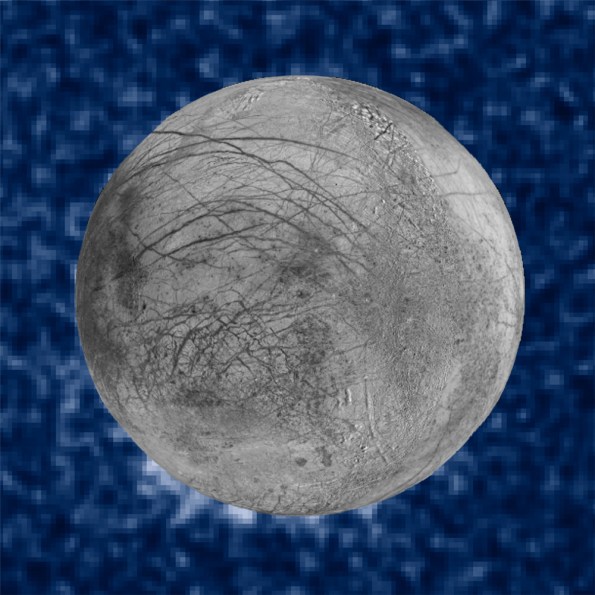
Composite photograph of plumes at the bottom of Europa with a Galileo image of Europa. Credit: NASA/Hubble/Galileo.
 Bob Moler's Ephemeris Blog