Archive
Ephemeris: 11/15/2023 – Other possible contact binary solar system bodies
This is Ephemeris for Thursday, November 16th. Today the Sun will be up for 9 hours and 32 minutes, setting at 5:13, and it will rise tomorrow at 7:42. The Moon, 3 days past new, will set at 7:34 this evening.
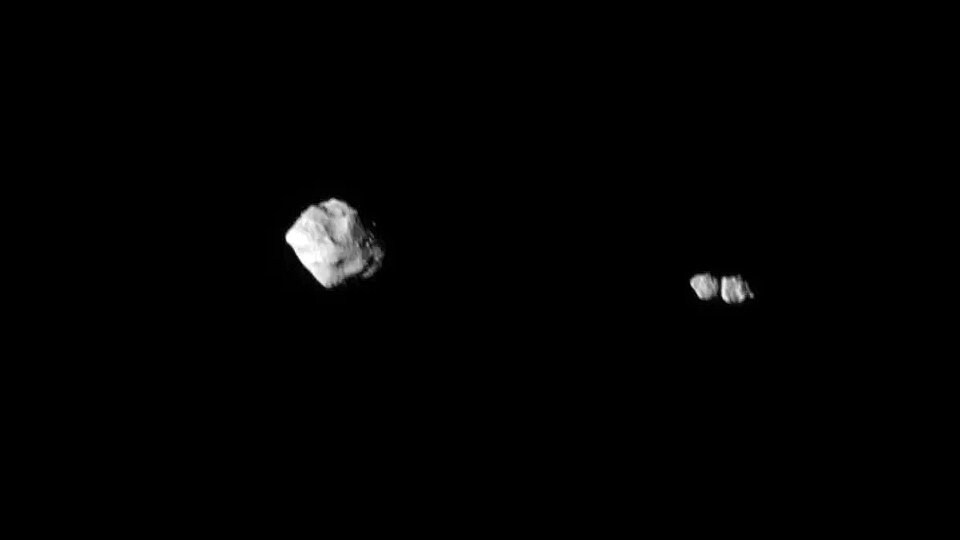
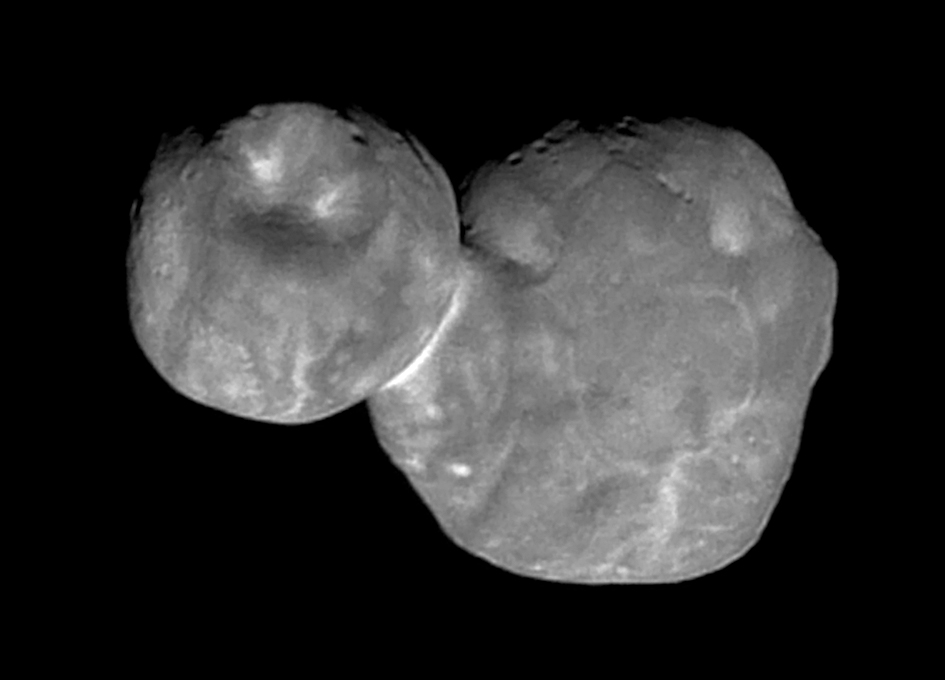
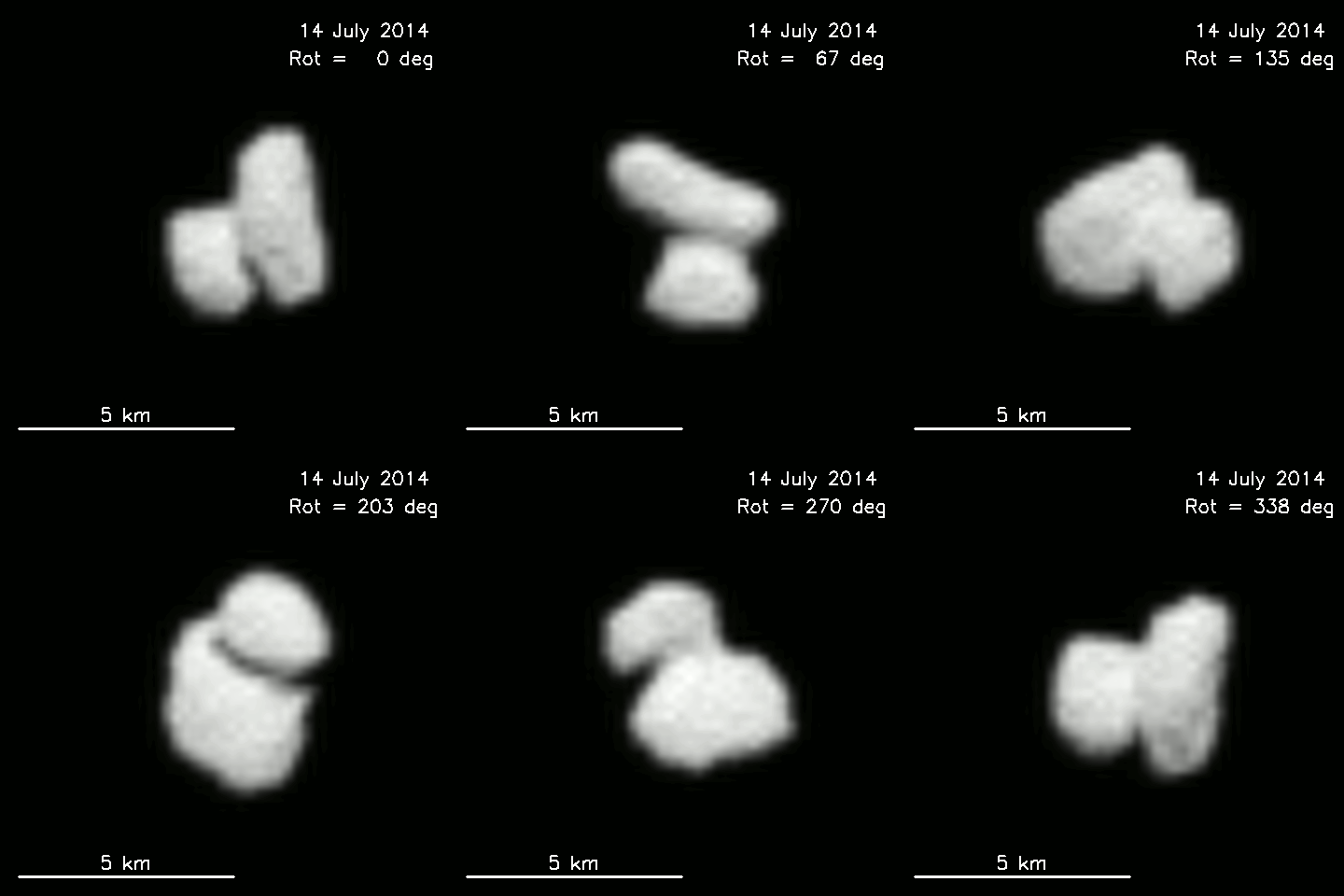
Thinking about it after seeing the contact the binary satellite of the asteroid that the Lucy spacecraft just flew by I have memories of several other bodies that could be contact binaries. The first one is that the New Horizons spacecraft passed four years ago which looked like two bodies stuck together, actually two pancakes because they weren’t spherical, but they were rather flattened. That Kuiper Belt Object now has the name Arrokoth. Comet 67 P, I won’t try to pronounce its name (Churyumov-Gerasimenko), that the Rosetta spacecraft orbited a few years ago, kinda looked like a rubber ducky with a small part attached to a larger part. It could be a contact binary. Again and there are a couple of comet nuclei that look like bowling pins. They may be contact binaries too.
The astronomical event times given are for the Traverse City/Interlochen area of Michigan (EST, UT –5 hours). They may be different for your location.
Addendum

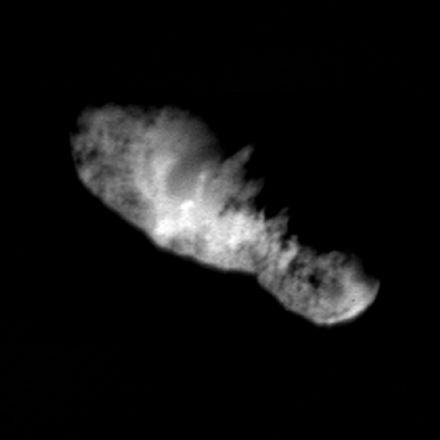

The biggest dog bone I’ve ever seen.
On November 4th the Deep Impact spacecraft passed inside of 500 miles from the nucleus of Comet Hartley 2. The image below is the first of 5 images released by NASA after the close pass. There are more images to come including some high resolution images. Thanks to Arecibo radio telescope radar images last week we knew this comet had a nucleus with an odd shape. That wasn’t the half of it.
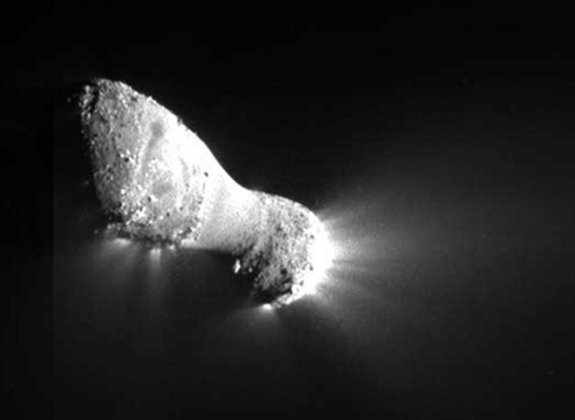
Comet Hartley 2 Medium resolution image. Image credit: NASA/JPL-Caltech/UMD
Emily Lakdawalla of the Planetary Society Blog has some more images and some thoughts on the origin of this celestial “dog bone” Here, here and here.
11/04/10 – Ephemeris – Comet Hartley Intercept
Thursday, November 4th.* The sun will rise at 8:24. It’ll be up for 10 hours and 3 minutes, setting at 6:27. The moon, 2 days before new, will rise at 7:52 tomorrow morning.
The Deep Impact spacecraft, which witnessed the impact of its Impactor into Comet Tempel 1 in 2005 has been redirected to Comet Hartley 2. At 10:01 this morning it will pass its closest to that comet at 434 miles. This is the EPOXI mission, the retargeting of the spacecraft to a new comet. The Arecibo radio telescope on Puerto Rico has already reached out and touched the Nucleus of Comet Hartley 2 and has released its images, showing the nucleus to be a skinny bowling pin shape a bit less than a mile and a half long and tumbling slowly at a rate of 13 to 18 hours. The spacecraft will be positioned to protect itself from the escaping particles of the comet and to photograph the comet, so will not have its antenna pointed to the earth until after the encounter.
Times, as always are for the Traverse City/Interlochen area of Michigan.
10/04/10 – Ephemeris – Comet Hartley 2
Monday, October 4th. The sun will rise at 7:43. It’ll be up for 11 hours and 33 minutes, setting at 7:17. The moon, 3 days before new, will rise at 5:02 tomorrow morning.
Comet 103P/Hartley 2 is visible all night, but it’s visible only in binoculars or a small telescope It’s cruising past the W shaped constellation of Cassiopeia in the northeast in the evening. Looking at the W in the evening it’s standing on one end, and looks like the number 3. The comet is moving down just to the right of it. Since it is seen against the Milky Way there are some other fuzzy spots to confuse you. The comet will stay fuzzy in a telescope. Discovered in 1986 by Malcolm Hartley in Australia, the comet has a 6 and a half year orbit of the sun. It will be closest to the earth on October 20th. The Deep Impact spacecraft renamed EPOXI will pass close to the half mile diameter nucleus on November 4th.
Times are for the Grand Traverse Area of Northern Michigan, USA.
 Bob Moler's Ephemeris Blog