Archive
Ephemeris: 01/02/2025 – Today we have the latest sunrise
This is Bob Moler with Ephemeris for Thursday, January 2nd. The Sun will rise at 8:20. It’ll be up for 8 hours and 54 minutes, setting at 5:14. The Moon, 3 days past new, will set at 8:20 this evening. | As an amateur astronomer I am fascinated by time, the so-called 4th dimension. For example, being at the right place at the right time such as to view a total solar eclipse. The universe isn’t going to wait for you if you’re off in the three dimensions of location or of the time. But today is a different story. Today is the day of the latest sunrise, which is at 8:20 AM. From today to June 15th, the day of the earliest sunrise, is on average about 165 days. That’s about 5 ½ months. We had our earliest sunset back on December 9th. That was 24 days ago so it’s got a head start from there to the latest sunset that it will need because the latest sunset will be on June 26th. So the sunrise times will decrease faster than the sunset times will increase into the June summer solstice period.
The astronomical event times given are for the Traverse City/Interlochen area of Michigan (EST, UT – 5 hours). Times will be different for other locations.
Addendum:
Ephemeris: 01/02/2024 – We’re closest to the Sun today
This is Ephemeris for Tuesday, January 2nd. The Sun will rise at 8:20. It’ll be up for 8 hours and 53 minutes, setting at 5:13. The Moon, 1 day before last quarter, will rise at 12:01 tomorrow morning.
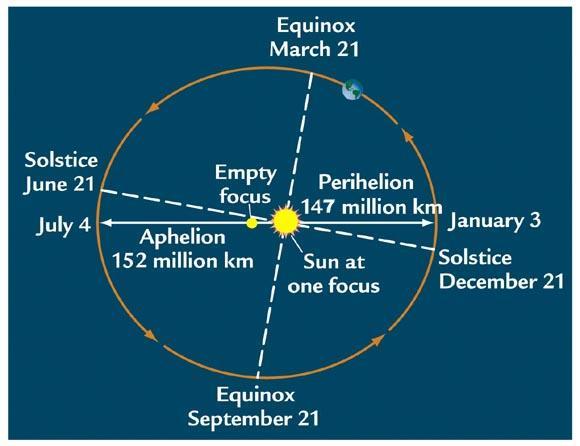
We start off the year with the Earth being really close to the Sun. As a matter of fact at 6:59 pm the Earth will reach perihelion, that is as close as it gets to the Sun for the entire year at 91.41 million miles (147.10 million kilometers). It’s not as big a deal as it seems, because the Earth varies only plus or minus a million and a half miles from the Sun over the year out of 93 million miles. It doesn’t make much difference in the amount of heat we get from the Sun. However, it’s much less than what the tilt of the Earth’s axis does to give us our seasons, but what it does do is alter the length of the seasons, and makes winter the shortest season. It’s shorter by about four days than summer, even though in Northern Michigan it doesn’t really seem like it. Today is also the date of the latest sunrise of the year.
The astronomical event times given are for the Traverse City/Interlochen area of Michigan (EST, UT –5 hours). They may be different for your location.
Addendum
12/09/2019 – Ephemeris – Tomorrow is the earliest sunset
Ephemeris for Monday, December 9th. Today the Sun will be up for 8 hours and 54 minutes, setting at 5:02, and it will rise tomorrow at 8:08. The Moon, 3 days before full, will set at 6:15 tomorrow morning.
In twelve days we will have the shortest day in terms of daylight hours. But the change isn’t uniformly distributed in the morning and evening. Tonight we will have the earliest sunset. Sunset times have been within the same minute for the last few days and will continue for the next few. The latest sunrise will occur on January second. The reason is that the Sun is traveling faster eastward than average because the Earth is closer to it now, so the Earth’s rotation takes a little longer each day to catch up with it. Near the solstice the Sun is at a higher latitude, where the longitude lines are closer together so it crosses them faster. A smaller effect exists in June because the Sun is farther away and its slowness subtracts from the higher latitude effects.
The times given are for the Traverse City/Interlochen area of Michigan. They may be different for your location.
Addendum
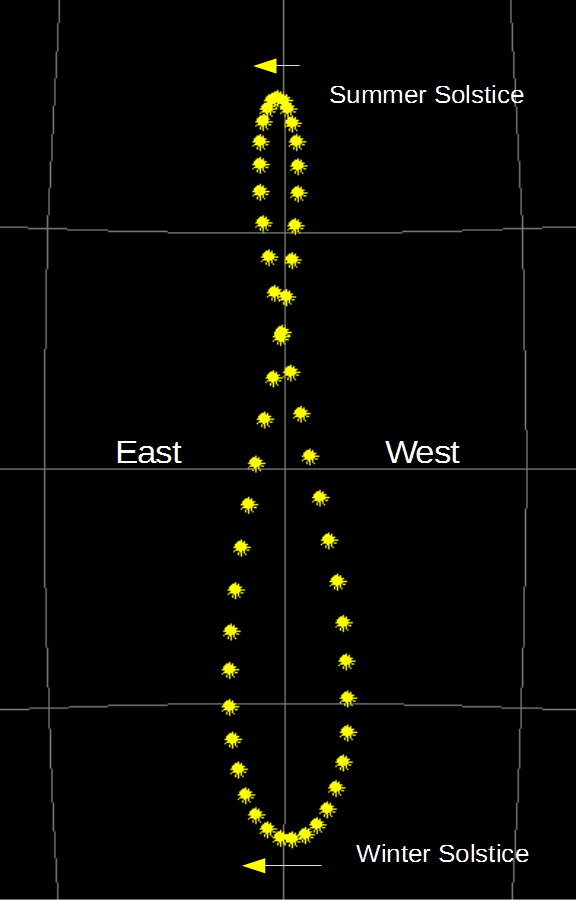
This figure 8 is called an analemma. One can find it on old globes in the Pacific Ocean. Explanation below. Created using my LookingUp program.
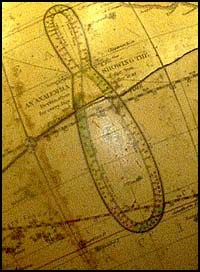
An Analemma graphically demonstrating the actual Sun’s relation to the mean Sun during the year.
From my December 2nd 2014 post with updates:
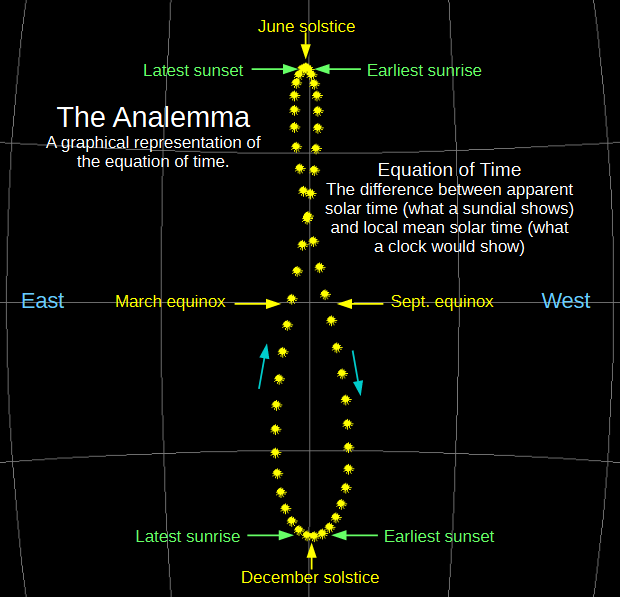
The analemma is a graphical representation of a daily value called the Equation of Time. It’s best known use is in corrections to sundial time. The vertical axis is the sun’s declination or north-south position. It is highest at summer solstice and lowest at winter solstice. It is the result of two effects: the tilt of the Earth’s axis to the plane of the Earth’s orbit around the Sun, and the change in the Earth’s velocity around the Sun as the Earth moves from perihelion, its closest to the Sun in early January to aphelion, its most distant in July.
If the Earth’s orbit were circular, and it orbited the Sun at the same speed. The analemma would be skinnier and the north and south lobes would be of equal size. Since we’re closer to the Sun in the winter, we move faster than average around the Sun, so it appears to move faster eastward. That combines with the faster appearing movement of the sun crossing the closer hour lines at higher and lower declinations (latitudes). In the diagram above note that the vertical hour lines are slightly closer together at the bottom and the top, so the Sun, moving eastward each day crosses them quicker. Near the winter solstice the two effects work together making sunrise and sunset trending to be later than normal. For the summer solstice the eastward speed of the sun is slower than normal, because we’re farther from the Sun. This works against the effect of the earth’s tilt but cannot completely negate it, making the top of the loop smaller than the one at the bottom. The arrows show the speed and direction of the Sun at the solstices.
In my month preview posts I generally mention the time of local noon for mid month. I didn’t do it for this month. If the equation of time is zero our local solar noon, in the Interlochen/Traverse City area, the Sun is due south at 12:43 p.m. during Eastern Standard Time, because that time meridian of 75 degrees longitude runs through Philadelphia PA. During daylight time it’s 60 degrees longitude, which clips the eastern edge of Nova Scotia. On the top figure of the analemma, if the Sun is west of center, the Sun is fast and to the east is slow. It changes rapidly in December, at the bottom end of the figure 8 when the Sun is farthest south. Local solar noon on the first is at 12:31 p.m., and it will slow to 12:45 p.m. on the 31st.
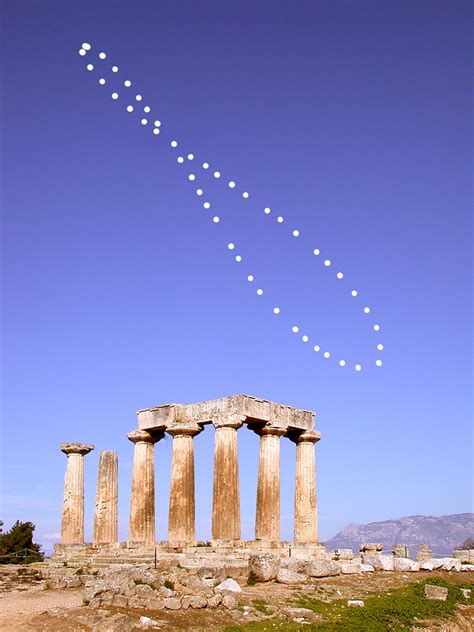
To see real analemmas in the sky search for analemma images on the Internet. It takes a year to photograph one.
 Bob Moler's Ephemeris Blog