Archive
Ephemeris: 11/14/2025 – The Leonid meteor shower peaks Monday morning
This is Ephemeris for Friday, November 14th. Today the Sun will be up for 9 hours and 36 minutes, setting at 5:15, and it will rise tomorrow at 7:40. The Moon, 2 days past last quarter, will rise at 3:02 tomorrow morning.
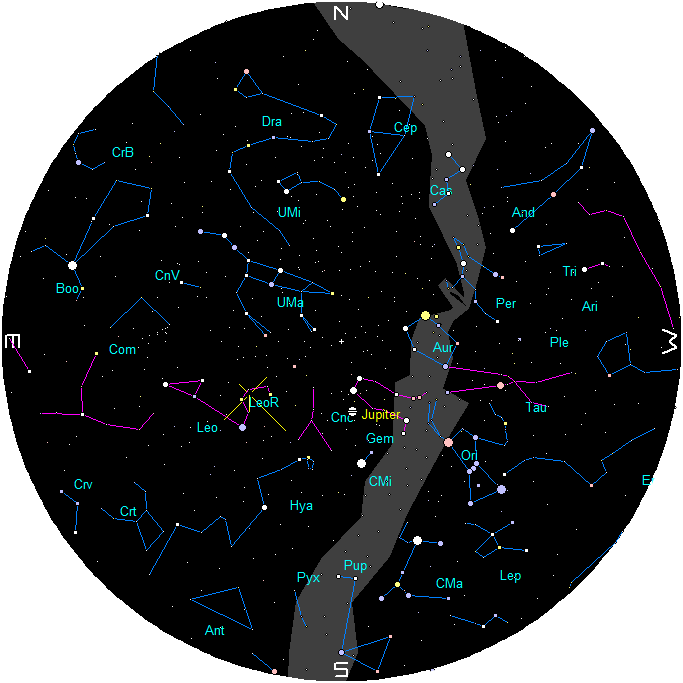
This coming Monday morning after midnight we’ll see the peak of the Leonid meteor shower. It is called the Leonids because the meteors appear to come from the head of Leo the lion, which will rise about midnight. This meteor shower is mediocre most years. However, every 33 or so years it can be spectacular with thousands of meteors per hour appearing in the sky for a short time. The meteoroid particles that produce the shower come from the comet 55P/Tempel-Tuttle which comes into the vicinity of the Sun in the inner solar system every approximately 33 years. The next peak year is predicted to be 2031, though it is expected to be not as active as recent peak years.
The astronomical event times given in this blog are for the Traverse City/Interlochen area of Michigan (Lat 44.7° N, Long 85.7° W; EDT, UT – 4 hours) unless stated otherwise. Times will be different for other locations.
Addendum
Ephemeris: 11/17/2023 – Observing this weekend’s Leonid meteor shower
This is Ephemeris for Friday, November 17th. Today the Sun will be up for 9 hours and 30 minutes, setting at 5:12, and it will rise tomorrow at 7:43. The Moon, 3 days before first quarter, will set at 8:45 this evening.
The Leonid meteor shower will reach peak this weekend. The normal peak will be actually this evening before the radiant, where the meteors seem to come from, rise which they will do at 11 pm. So tomorrow morning it would be a good time to see them. We only expect about 15 meteors an hour at peak. There is a possibility of another peak on the 21st which is Tuesday morning just before dawn composed of supposedly bright meteors from the passage of the comet crossed Earth’s orbit in 1767. So if it’s clear, and you’re willing to go outdoors and see what you can see of the Leonid meteor shower. The Leonids get really spectacular about every 33 years, and we’re about 8 or 9 years from now.
The astronomical event times given are for the Traverse City/Interlochen area of Michigan (EST, UT –5 hours). They may be different for your location.
Addendum
11/17/2022 – Ephemeris – The peak of the Leonid meteor shower
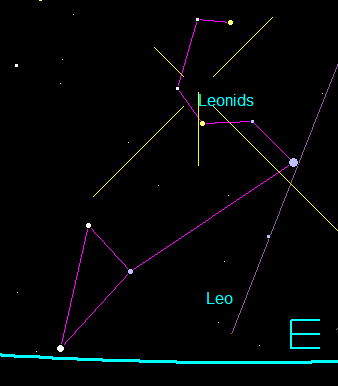
This is Bob Moler with Ephemeris for Thursday, November 17th. Today the Sun will be up for 9 hours and 30 minutes, setting at 5:12, and it will rise tomorrow at 7:43. The Moon, 1 day past last quarter, will rise at 1:25 tomorrow morning. | The Famous Leonid meteor shower, which has had spectacular displays about every 33 years, is forecast to reach its normal peak this year, near 6 pm our time, with another smaller peak around 2 am tomorrow. The numbers of meteors, forecast during those peaks, of only about 10 per hour. The Moon will interfere after 1:25 am. And no meteors will be seen before 11:30 p.m. when the radiant rises. The last great 33 year peak was in 1998, so we’re a ways away from the next one. The responsible body for these meteors is the Comet Tempel-Tuttle. Every time the comet passes through the inner solar system, the Sun’s heat liberates gas, dust and small grains of rock. These small grains end up following and trailing the comet.
The astronomical event times given are for the Traverse City/Interlochen area of Michigan (EST, UT -5 hours). They may be different for your location.
Addendum
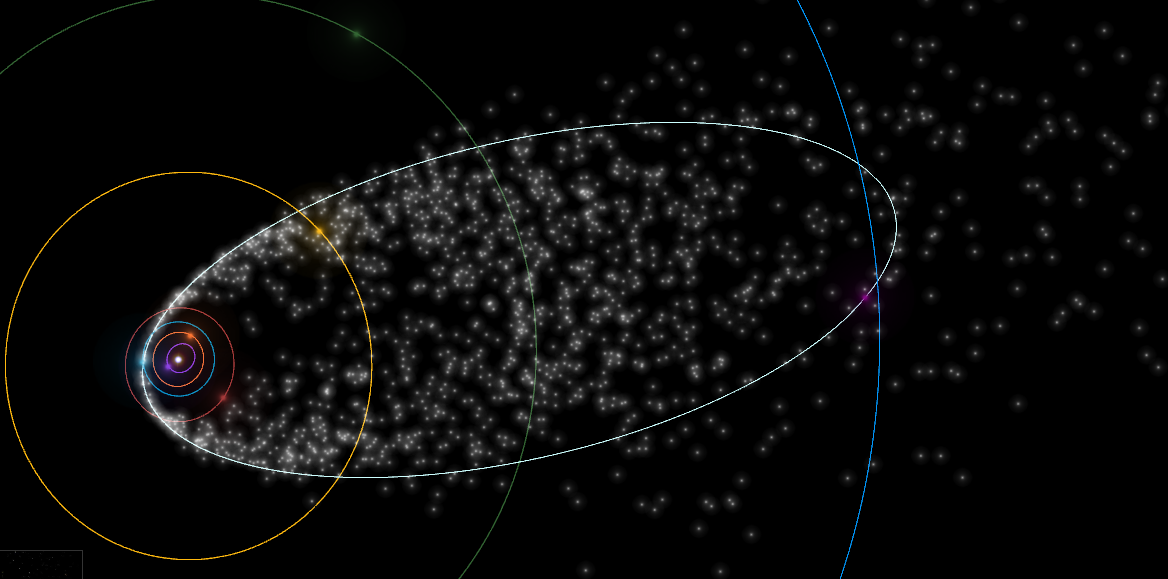
The Leonid meteor shower as seen from space. The time is set for today, so the Earth’s blue dot is lost in the stream of meteors crossing the Earth’s orbit (3rd one out from the Sun) just above 9 o’clock. The long ellipse is the orbit of Comet Tempel-Tuttle and the purple dot near the aphelion neat Uranus’ orbit is the calculated current position of the comet. The flurry of dots is the calculated positions of meteors whose orbits have been calculated. Click on the image to enlarge. Credit: NASA’s CAMS video camera surveillance network, and were calculated by meteor astronomer Peter Jenniskens of the SETI Institute and NASA Ames Research Center. This visualization is developed and hosted by Ian Webster.
11/16/2018 – Ephemeris – The Leonid meteor shower will have several peaks in the next few days
Ephemeris for Friday, November 16th. The Sun will rise at 7:41. It’ll be up for 9 hours and 32 minutes, setting at 5:13. The Moon, 1 day past first quarter, will set at 1:19 tomorrow morning.
We are coming into an extended period where the Leonid meteor shower will be at its peak, or rather there is a chance of up to maybe four peaks as the Earth passes through the debris left by Comet Tempel-Tuttle on past trips through the inner solar system. We are having a pretty bright Moon now, but the best displays of the meteors are going to be occurring in the early morning hours after the Moon sets. The meteors will appear to come from the top of a backward question mark that is the head of the constellation Leo the lion. They will be seen all over the sky, but can be traced back to that point, if it’s a Leonid meteor. The Leonids are most numerous about every 33 years, which is about 15 years from now. Otherwise we get about 15 meteors an hour at peak.
The times given are for the Traverse City/Interlochen area of Michigan. They may be different for your location.
Addendum
11/17/2016 – Ephemeris – The Leonid meteor shower will be hampered by the Moon tomorrow morning
Ephemeris for Thursday, November 17th. The Sun will rise at 7:43. It’ll be up for 9 hours and 29 minutes, setting at 5:12. The Moon, 3 days past full, will rise at 8:39 this evening.
The Leonid meteor shower, which reaches peak activity today is going to be washed out by the bright Moon. The International Meteor Organization doesn’t have anything specific on it this year. On most years, it produces only 15 meteors an hour tops. However about every 33 years or so all heaven breaks loose. From the predictions I’ve seen the fun starts in 2034 and lasts a few years. The reason for the spectacular meteor storms, as they call them, is that the responsible comet, 55P Tempel-Tuttle, has a debris clump that hasn’t fanned out much along its orbit, so we get intense meteor activity when the comet again enters the inner solar system. It’s expected back in 2031 with its main cloud of meteoroids a couple of years later.
Times are for the Traverse City/Interlochen area of Michigan. They may be different for your location.
Addendum
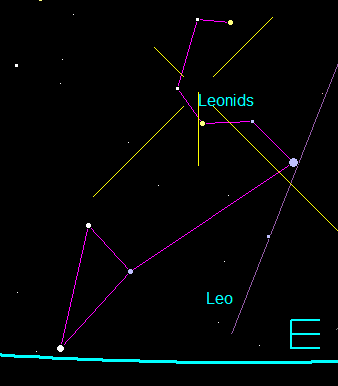
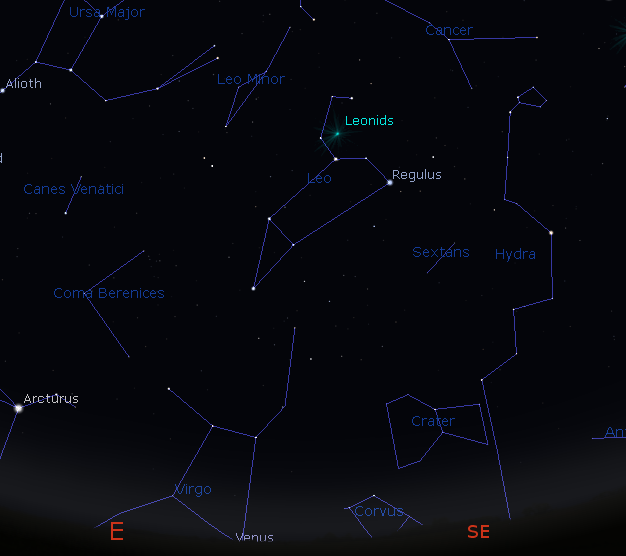
Leonid meteor radiant at about 2 a.m. from Traverse City. Credit: My LookingUp program.
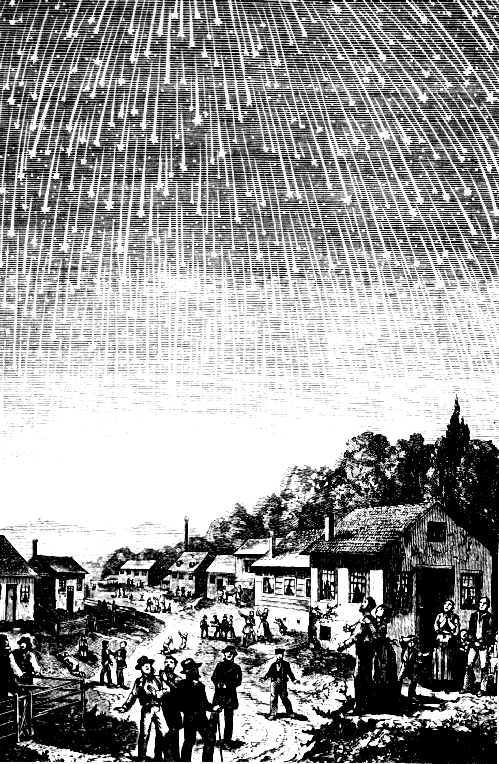
A famous woodcut of the 1833 Leonid meteor storm.
11/16/2015 – Ephemeris – The Leonid meteors are expected to reach their peak tomorrow
Ephemeris for Monday, November 16th. The Sun will rise at 7:40. It’ll be up for 9 hours and 33 minutes, setting at 5:13. The Moon, 3 days before first quarter, will set at 9:45 this evening.
Tomorrow night is the expected peak of the Leonid meteor shower. The expected peak will be at 11 p.m. (4 hr UT November 18). Problem is that the radiant won’t rise until just after midnight for northern Michigan. For the best visible numbers the peak of the meteor shower should coincide with the time the radiant is highest in the sky. For the Leonids, that’s when morning twilight starts. There’s another possible peak for those in Asia at 21 hr UT November 17. It’s afternoon for us. The Leonids generally produce their meteor storms of thousands of meteors an hour about every 33 years, when the comet is back near the Earth and the Sun. That next time would be around the year 2031 give or take a year. I personally missed the meteor storm of 1966 by a couple of hours. I missed the one in the late 90s by more than that. The next around 2031 may be a bridge too far for me.
Times are for the Traverse City/Interlochen area of Michigan. They may be different for your location.
Addendum
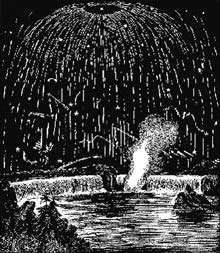
The 1933 Leonid meteor storm depicted over Niagara Falls in this woodcut. Public Domain. by A Pickering.
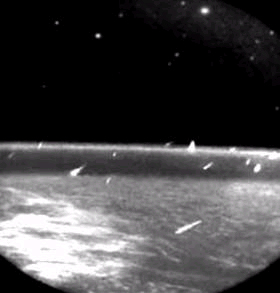
The 1997 Leonid meteor shower as seen from orbit. Credit NASA.
Leonid meteor radiant
 Bob Moler's Ephemeris Blog