Archive
11/18/2019 – Ephemeris – More about the Leonid meteor shower that just reached peak this morning
Ephemeris for Monday, November 18th. Today the Sun will be up for 9 hours and 28 minutes, setting at 5:12, and it will rise tomorrow at 7:44. The Moon, 1 day before last quarter, will rise at 10:56 this evening.
The Leonid meteor shower should have reached its peak early this morning hindered by a bright waning gibbous Moon. In past years, usually every 33 years the Leonid meteors have a super peak, called a meteor storm, where thousands of meteors streak through the skies. These appear for a brief period over a rather small geographic area. In 1966 it occurred principally over the Rocky Mountains. The comet responsible is 55P/Comet Tempel-Tuttle, independently discovered by two astronomers Tempel and Tuttle in 1865 & 1866. The comet has a 33 year orbit of the Sun, and its orbit crosses very close to the Earth’s orbit. Comets are notorious litter bugs, shedding gas, dust and pebble sized debris as they come close to the warming rays of the Sun.
The times given are for the Traverse City/Interlochen area of Michigan. They may be different for your location.
Addendum
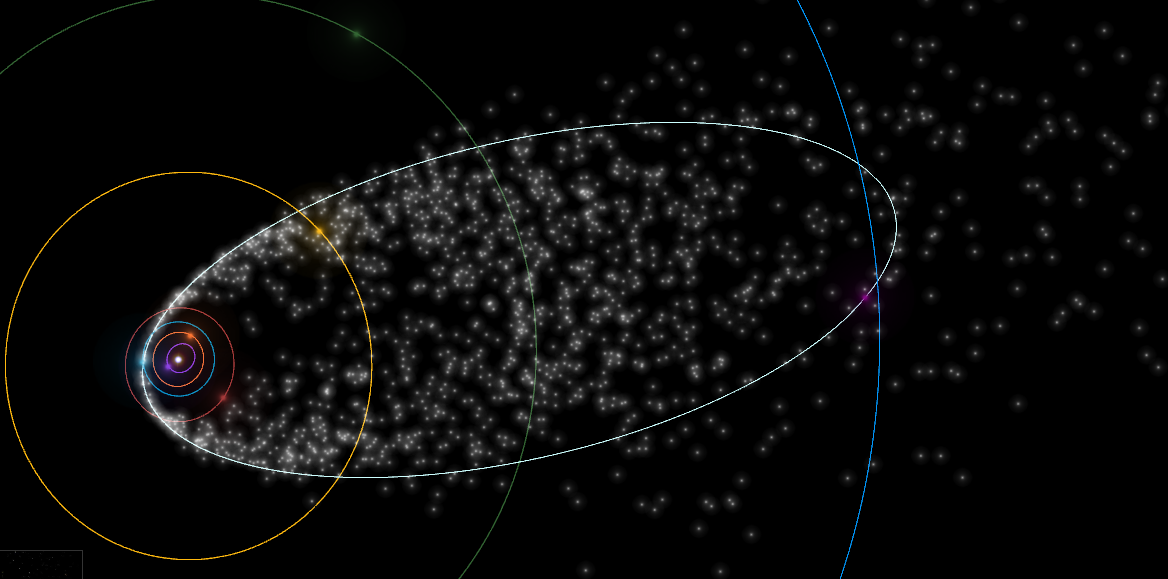
The Leonid meteor shower as seen from space. The time is set for today so the Earth’s blue dot is lost in the stream of meteors crossing the Earth’s orbit (3rd one out from the Sun) just above the 9 o’clock position. The long ellipse is the orbit of Comet Tempel-Tuttle and the purple dot near the aphelion near Uranus’ orbit is the calculated current position of the comet. The flurry of dots are the calculated positions of meteors that whose orbits have been calculated. Click on the image to enlarge. Credit: NASA’s CAMS video camera surveillance network, and were calculated by meteor astronomer Peter Jenniskens of the SETI Institute and NASA Ames Research Center. This visualization is developed and hosted by Ian Webster.
These interactive animations can be found on the International Meteor Organization website: https://www.imo.net. under Resources and Meteor Shower Calendar.
11/15/2019 – Ephemeris – The Leonids in the moonlight
Ephemeris for Friday, November 15th. Today the Sun will be up for 9 hours and 35 minutes, setting at 5:14, and it will rise tomorrow at 7:40. The Moon, 3 days past full, will rise at 7:45 this evening.
We are coming into a period where the Leonid meteor shower will be at its peak, as the Earth passes through the debris left by Comet Tempel-Tuttle on past trips through the inner solar system. We are having a bright Moon now which will diminish their numbers. The Leonids are only visible after midnight, and that’s when the Moon is highest in the sky. The meteors will appear to come from the top of a backward question mark that is the head of the constellation Leo the lion. They will be seen all over the sky, but can be traced back to that point. The Leonids are most numerous about every 33 years, which is about 13 years from now. Otherwise we get about 15 meteors an hour at peak when the Moon isn’t out.
The times given are for the Traverse City/Interlochen area of Michigan. They may be different for your location.
Addendum
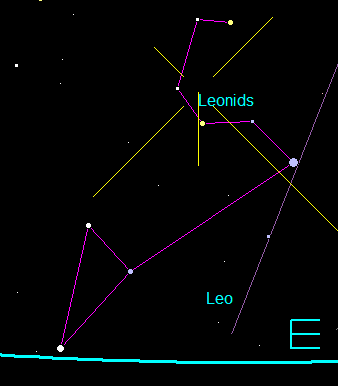
Leo rising at around 2 a.m. on the morning of November 18. Note the radiant in the sickle asterism of Leo. Created using Looking Up, my own program.
New Meteor News!
I’ll have more next week, but we may be able to witness a meteor storm on the evening of the 21st and morning of the 22nd. It is the Alpha Monocerotids. They will seem to come from the constellation of Monoceros the unicorn. That constellation lies in the blank spot in the triangle between Orion, Canis Major and Canis Minor. The radiant will rise at 10:30 p.m.
Check this out: https://www.syfy.com/syfywire/will-the-unicorn-give-us-a-meteor-storm-on-november-22
11/16/2017 – Ephemeris – The Leonid meteors will reach their peak numbers tonight and tomorrow
Ephemeris for Thursday, November 16th. The Sun will rise at 7:40. It’ll be up for 9 hours and 32 minutes, setting at 5:13. The Moon, 2 days before new, will rise at 6:33 tomorrow morning.
The Famous Leonid meteor shower, which has had spectacular displays about every 33 years is forecast to reach two peaks this year, near noon our time, today and tomorrow. So the numbers of meteors, forecast during those peaks, of about 10 per hour near dawn our time probably won’t pan out, but you never know. None of these meteors will be seen before midnight. The last great 33 year peak was in 1998, so we’re a ways away from the next one. The responsible body for these meteors is the comet Tempel-Tuttle. Every time the comet passes through the inner solar system the sun’s heat liberates gas, dust and small grains of rock. These small grains end up in close orbits to the comet, and like the comet, return again and again.
The times given are for the Traverse City/Interlochen area of Michigan. They may be different for your location.
Addendum
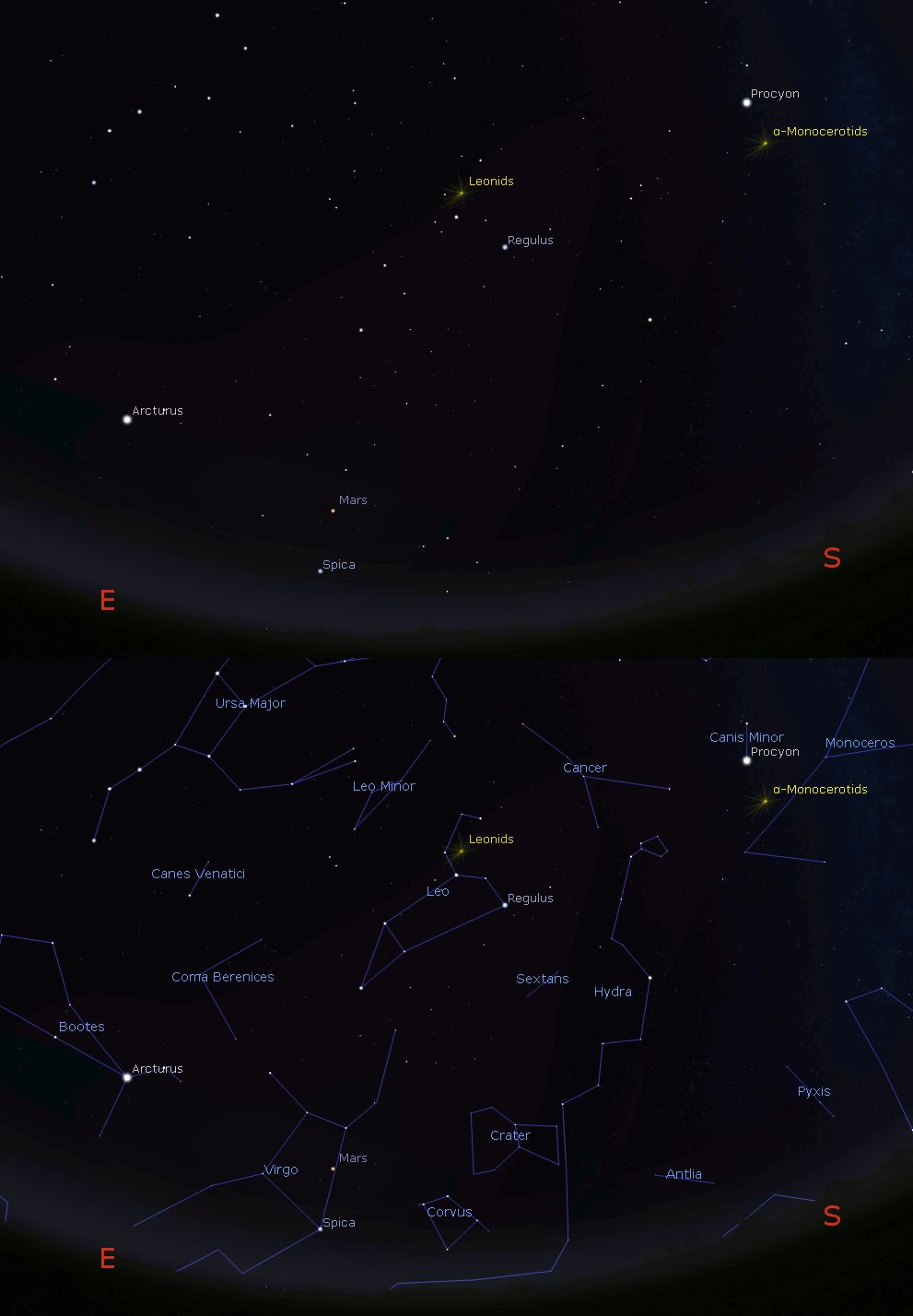
Leonid Meteor Shower Radiant finder chart fir 6 a.m., November 17, 2017. Click on image to enlarge. Created using Stellarium ans GIMP.
Note that there is another meteor shower radiant in the image, below the star Procyon. It’s the Alpha Monocerotids. It will reach its peak on the 21st. with an expected zenithal hourly rate (ZHR) of only 5 meteors an hour. By the way the zenithal hourly rate is the expected rate if the radiant was directly overhead, at the zenith. In 1995 this shower had for five minutes an estimated ZHR of 460, which was within a 30 minute outburst. The next big outburst isn’t expected until 2043, but not very much is known about this meteor shower. So keep an eye out, it could surprise us.
The radiant point wasn’t well known before the 1995 outburst, when it was thought to be closer to α Monocerotis, the unnamed bottom star in Monoceros the unicorn. There was a meteor shower called the Monocerotids listed before this shower was identified. So even though the radiant is actually in Canis Minor we are stuck with its name.
Much of the above information comes from the International Meteor Organization 2017 Meteor Shower Calendar. This and next years calendars are located at https://www.imo.net/resources/calendar/.
11/13/2015 – Ephemeris – The Leonid meteor shower will reach peak next week
Ephemeris for Friday, November 13th. The Sun will rise at 7:36. It’ll be up for 9 hours and 40 minutes, setting at 5:16. The Moon, 2 days past new, will set at 7:02 this evening.
I’m talking about meteors a lot this week. Well this is about next week’s peak of the Leonid meteor shower. The Leonid meteor shower has spectacular peaks about every 33 years when the responsible litter bug, er… comet is near us and the Sun. The last time the comet names 55P/Tempel-Tuttle passed perihelion, its closest to the Sun was 1998. We are about half way between that and the next perihelion in 2031, so we’d expect it to be a dull year with 15 meteors an hour expected tops, but either the Leonids are getting more unpredictable, or astronomers, both professional and amateur are paying better attention. The main peak is expected Tuesday night around 11 p.m. (4 hr UT Wednesday, November 18), with another peak prior to that in the afternoon (21 hr UT Tuesday, November 17). The radiant, however, will rise just before midnight in northern Michigan. The timing will be better for Europe
Times are for the Traverse City/Interlochen area of Michigan. They may be different for your location.
Addendum
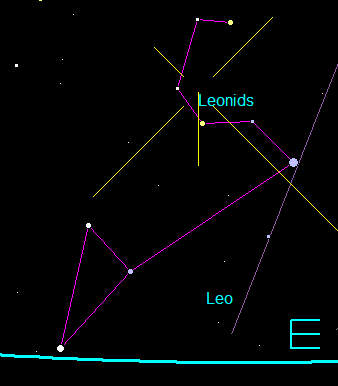
Leonid meteor radiant
11/17/2014 – Ephemeris – The Leonid meteor shower peaks this week
Ephemeris for Monday, November 17th. The sun will rise at 7:41. It’ll be up for 9 hours and 30 minutes, setting at 5:12. The moon, 3 days past last quarter, will rise at 3:30 tomorrow morning.
This week the Leonid meteor shower will again be seen. This is an unremarkable shower most years, but about every 33 years can be spectacular. This year we could see two peaks to the shower. Problem is that the peak activity for the Leonids last only an hour of so. The first is in the afternoon our time today. The radiant rises at midnight and one may be able to spot a few meteors after that. There is another peak calculated to be centered on 4:17 a.m. on Friday the 21st. It is supposed to be debris left by the comet responsible for the Leonids, Tempel-Tuttle back in 1567. Every once in a while the Leonids surprise us. Meteors are the streaks we see when grain sized particles shed by comets zip through the atmosphere at interplanetary speeds.
Times are for the Traverse City/Interlochen area of Michigan. They may be different for your location.
Addendum
Leo rising at around 2 a.m. on the morning of November 20. Note the radiant in the sickle asterism of Leo. Created using Looking Up, my own program.
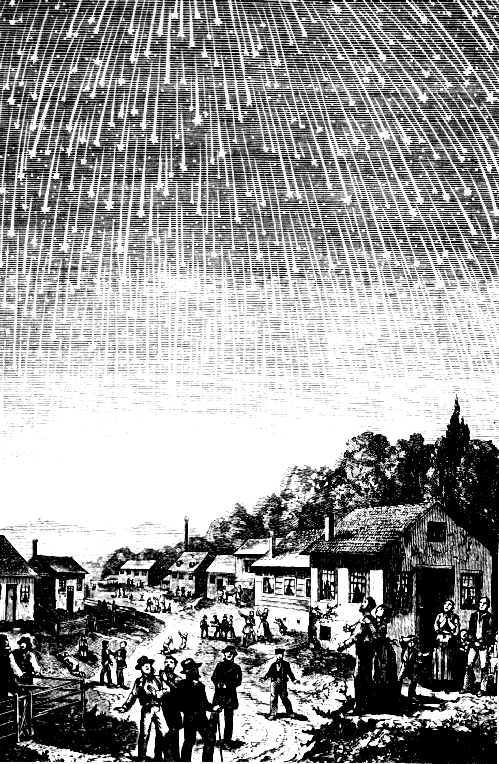
A famous woodcut of the 1833 Leonid meteor storm.
10/30/2014 – Ephemeris – Previewing November’s skies
Ephemeris for Thursday, October 30th. The sun will rise at 8:17. It’ll be up for 10 hours and 16 minutes, setting at 6:34. The moon, at first quarter today, will set at 12:49 tomorrow morning.
Let’s look at the skies for the month of November a couple of days early. The sun is still moving south rapidly. Daylight hours in the Interlochen/Traverse City area and will drop from 10 hours and 11 minutes i\on the 1st to 9 hours 6 minutes on the 30th. The altitude, or angle, of the sun above the southern horizon at local noon will be just under 31 degrees Saturday and will descend to 23 and a half degrees on the 30th. The altitude of the sun in the Straits area will be a degree lower. Local noon, this month, will be about 12:30 p.m. when we go back to standard time this weekend. The Leonid meteors have two possible dates this month, the 17th and the 21st. Those on the 21st seem to be best timed for our location on the Earth.
Times are for the Traverse City/Interlochen area of Michigan. They may be different for your location.
Addendum
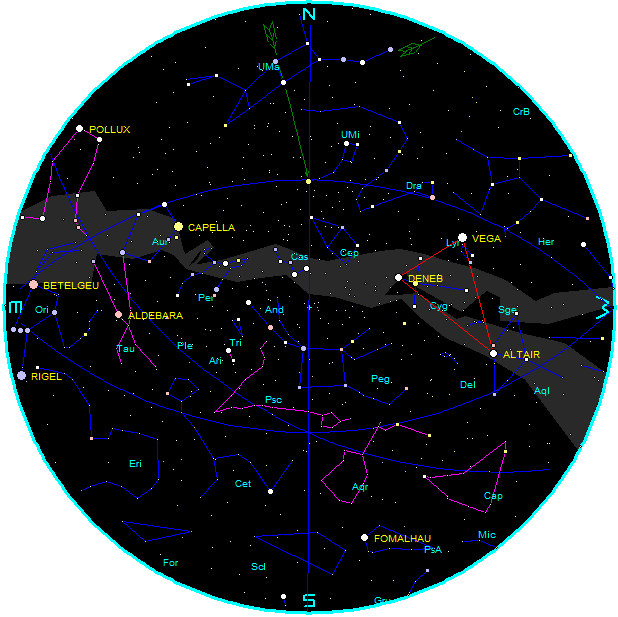
Star Chart for November 2014. Created using my LookingUp program. Created using my LookingUp program.
The Moon is not plotted. The planets and stars are plotted for the 15th at 9 p.m. That is chart time.
Astronomical twilight ends at 7:08 p.m. on November 2nd, decreasing to 6:48 on the 31st.
Add a half hour to the chart time every week before the 15th and subtract and hour for every week after the 15th.
For a list of constellation names to go with the abbreviations click here.
Also shown is the Summer Triangle in red. Clockwise from the top star is Deneb in Cygnus, Vega in Lyra and Altair in Aquila.
The green pointers from the Big Dipper are:
- Pointer stars at the front of the bowl of the Big Dipper point to Polaris the North Star.
11/19/2012 – Ephemeris – A Leonid meteor peak at 1 a/m/ EST tomorrow morning.
Ephemeris for Monday, November 19th. The sun will rise at 7:45. It’ll be up for 9 hours and 25 minutes, setting at 5:10. The moon, 1 day before first quarter, will set at 11:43 this evening.
There is expected to be a peak of the Leonid meteor shower at around 1 tomorrow morning. By then the radiant of the meteor shower will have risen in the east in the head of Leo the lion in the curve of the backwards question mark that denotes the front end of the beast. The Leonids do not have the same numbers every year. Great meteor storms occur, on average every 33 years because they are associated with a comet of the same period, Comet Tempel-Tuttle. It last came through the inner solar system in 1998, so this is not a great year for them. However astronomers are getting better at predicting where the debris streams are that were liberated by the comet in its passes of the sun, giving observers a heads up on the best times to look.
Times are for the Traverse City/Interlochen area of Michigan. They may be different for your location.
Addendum
Leo rising at around 2 a.m. on the morning of November 20. Note the radiant in the sickle asterism of Leo. Created using Looking Up, my own program.
At 1 a.m. the triangle of stars at his haunches will not have risen yet. The maximum number of meteors per hour will be 10-20. However this is if the radiant is overhead. The numbers are expected to be lower. This will not be as visible west to here (Michigan).
11/01/2012 – Ephemeris – Previewing November Skies
Ephemeris for Thursday, November 1st. The sun will rise at 8:20. It’ll be up for 10 hours and 9 minutes, setting at 6:30. The moon, 3 days past full, will rise at 8:21 this evening.
Tonight Jupiter will appear above the moon. The month of November is one early sunsets, especially with the return to standard time this Sunday, and shortening of day light hours. Daylight hours will decrease from 10 hours 9 minutes today to 9 hours 5 minutes at month end. The altitude of the sun above the southern horizon at local noon, will drop from 31 degrees to 23½ degrees over the month. The Leonid meteor shower will have two peaks this year, but the best for us will be at 2 a.m. on the morning of the 20th. Up to 15 meteors per hour are expected. These are from Comet Tempel-Tuttle’s 1400 AD passage through the inner solar system. It won’t be until the late 2030’s when the comet will come around again.
Times are for the Traverse City/Interlochen area of Michigan. They may be different for your location.
Addendum
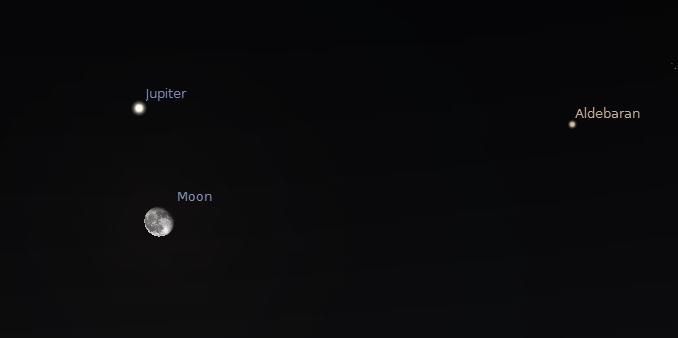
Jupiter and the moon at 10 p.m. November 1, 2012. Created using Stellarium.
Leo rising at around 2 a.m. on the morning of November 20. Note the radiant in the sickle asterism of Leo. Created using Looking Up, my own program.
11/15/11 – Ephemeris – Prospects for the Leonid meteor shower
Tuesday, November 15th. The sun will rise at 7:38. It’ll be up for 9 hours and 36 minutes, setting at 5:14. The moon, 3 days before last quarter, will rise at 9:22 this evening.
This is an off peak year for the Leonid meteor shower but astronomers are finding more and more Leonid dust streams. These dust streams are created when the comet, in this case Tempel-Tuttle passes its closest to the sun. They end up preceding or following the comet near its orbit but are affected by the tiny force of sunlight and end up diverging more and more from the comet itself. Three dust streams are expect to be encountered by the earth this year. The stream from the1800 passage of the comet is expected to pass the earth tomorrow afternoon to be picked up as radio echos only. Also Thursday and Friday afternoon there are also expected peaks. All invisible from here, but possibly visible from Asia.
* Times, as always are for the Traverse City/Interlochen area of Michigan.
Information gleaned from the International Meteor Organization Meteor Shower Calendar 2011: http://imo.net/calendar/2011.
Leonid meteor radiant
 Bob Moler's Ephemeris Blog