Archive
09/08/2016 – Ephemeris – The Moon tonight: Two mountain ranges
Ephemeris for Thursday, September 8th. The Sun will rise at 7:14. It’ll be up for 12 hours and 51 minutes, setting at 8:05. The Moon, 1 day before first quarter, will set at 12:07 tomorrow morning.
The planet Saturn will appear below the nearly first quarter Moon tonight. The southern part of the Moon shows lots of craters in a pair of binoculars or small telescope. The area is called the lunar highlands. Most of the northern part of the Moon contains the lunar seas or maria. There is some interesting terrain there for the small telescope, including the mountain range the Alps to the North and the Apennines south of them. Lunar mountain ranges are named after Earthly ones. The two ranges are part of the broken ramparts around Mare Imbrium, the large Sea of Showers. In it are a few large craters that were created by impacts since the sea itself was created by a huge asteroid impact over 3.8 billion years ago.
Times are for the Traverse City/Interlochen area of Michigan. They may be different for your location.
Addendum
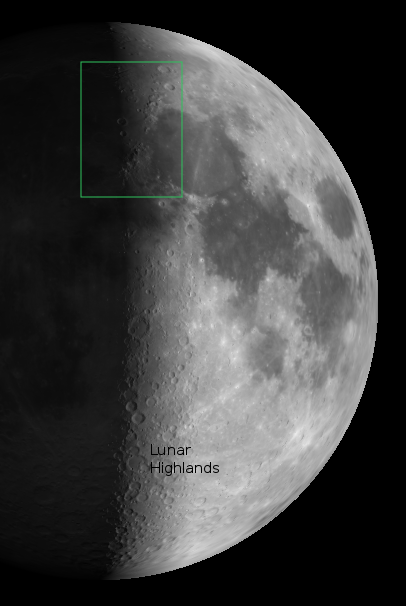
The Moon tonight at 9 p.m. September 8, 2016. Created using Stellarium.
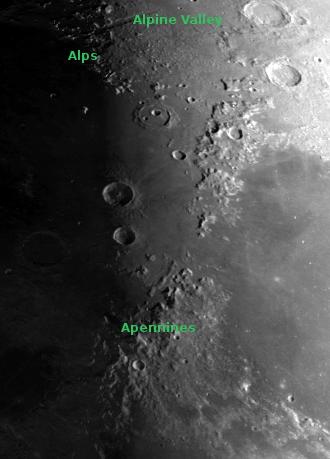
A closer look at the emerging mountains on the Moon at 9 p.m. September 8, 2016. Created using Stellarium.
More of these mountains will be revealed in coming nights.
09/02/2014 – Ephemeris – Viewing the first quarter Moon
Ephemeris for Tuesday, September 2nd. The sun will rise at 7:06. It’ll be up for 13 hours and 11 minutes, setting at 8:17. The moon, at first quarter today, will set at 12:52 tomorrow morning.
Tonight on the moon there are some very prominent craters on the terminator or sunrise line that’s cutting the moon in half. From the top or north of the moon there’s Plato, which is also called a ringed plain because it has a flat floor. South of there is Eratosthenes, at the end of the arc of the Apennines mountain chain. At the south or bottom end of the moon are two other of my favorite craters. First is the crater Tycho, that doesn’t look spectacular now, but will when the Moon is full with its rays of ejecta crossing a long way across the face of the moon. A little bit farther south, partially entering sunlight is the large crater Clavius. On my blog, bobmoler.wordpress.com, I’ll illustrate what the Moon’s image looks like in different types of telescopes.
Times are for the Traverse City/Interlochen area of Michigan. They may be different for your location.
Addenda
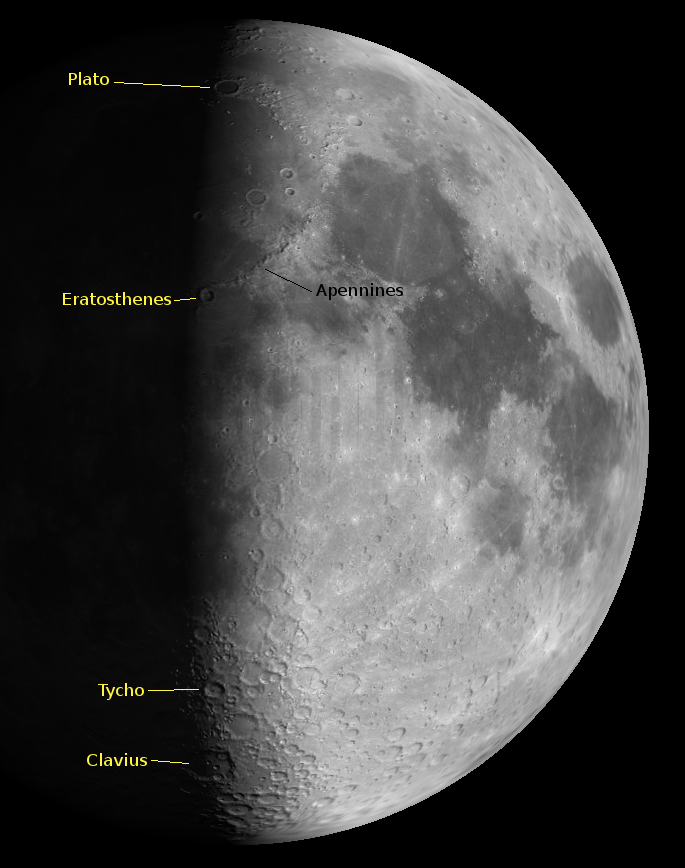
The Moon tonight at 9 p.m. (September, 2, 2014). Created using Virtual Moon Atlas.
Image orientation in telescopes
The orientation of what one sees in an astronomical telescope depends on the type of telescope and the placement of the eyepiece. The orientations shown are for observers in the northern hemisphere. For the images below the moon shown is due south.
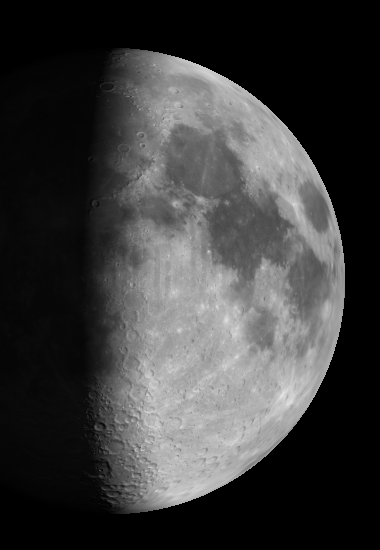
The orientation of the Moon as seen with the naked eye, binoculars, spotting scopes and telescopes with an erecting eyepiece.
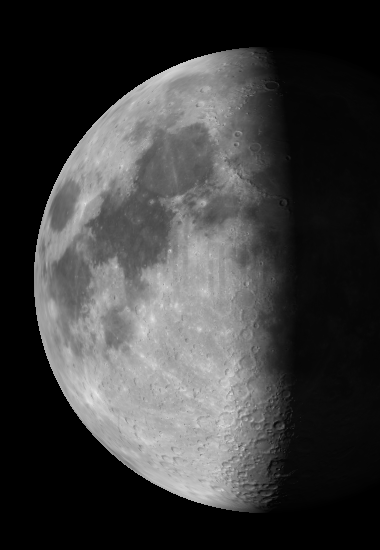
The orientation of the Moon as seen in a refractor or a Schmidt-Cassigrain or similar type reflector with a diagonal at the eyepiece end, and the eyepiece pointing up. This is a mirror image due to an odd number of mirror reflections in the telescope.
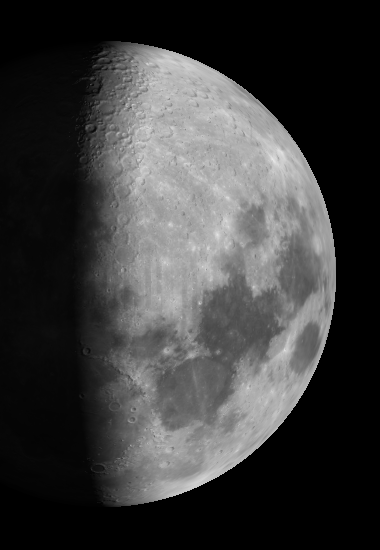
The orientation of the Moon as seen with a refractor or Schmidt-Cassigrain and diagonal with the eyepiece oriented horizontally. It is a n inverted mirror image.
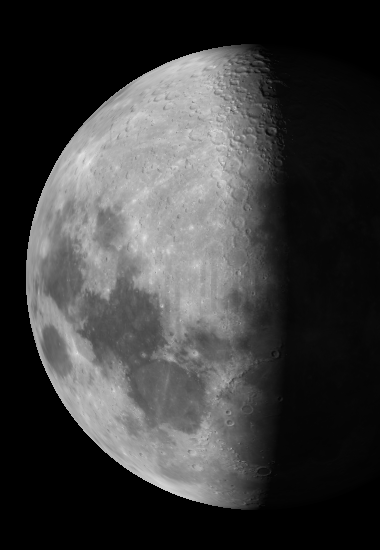
The orientation of the moon through a Newtonian reflector or a refractor without an eyepiece diagonal. It is an inverted image, an image rotated 180 degrees.
For southern hemisphere observers for these images to work the moon would be due north and all the images would have to be upside down.
Correction 09/02/2014 11:07 p.m.
All images created using Virtual Moon Atlas.
09/12/2013 – Ephemeris – A look at the first quarter moon
Ephemeris for Thursday, September 12th. The sun will rise at 7:18. It’ll be up for 12 hours and 40 minutes, setting at 7:58. The moon, at first quarter today, will set at 12:36 tomorrow morning.
By this evening the moon will be just past first quarter and the terminator will bulge a bit to the east. Through binoculars or the naked eye the scallop shell shaped sea will be visible at the upper right part of the moon, the man in the moon’s left eye. In telescopes the moon will be inverted and even also reversed, so Serenity could appear in any other quadrant depending on what your telescope does to the image. Toward the terminator from Serenity are two mountain ranges The south part is the Apennines, and the northern part is the Alps. The Alps is cut by a gash called the Alpine Valley. There’s also a triangle of distinctive craters also visible near the terminator.
Times are for the Traverse City/Interlochen area of Michigan. They may be different for your location.
Addendum
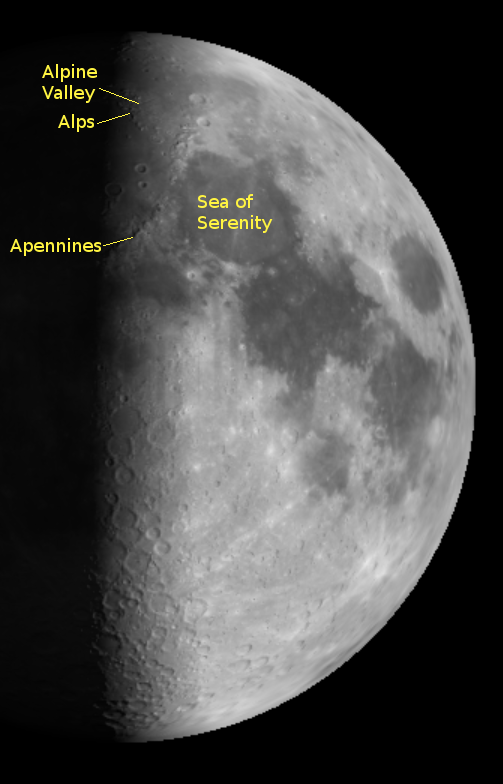
First quarter Moon with some of the features on its northern hemisphere. Created using Virtual Moon Atlas.
 Bob Moler's Ephemeris Blog