Archive
08/28/2018 – Ephemeris – Water on the Moon
Ephemeris for Tuesday, August 28th. The Sun will rise at 7:00. It’ll be up for 13 hours and 26 minutes, setting at 8:26. The Moon, 2 days past full, will rise at 9:47 this evening.
Ten years ago India launched its lunar orbiting Chandrayaan-1 spacecraft. On it was a NASA instrument the Moon Mineralogy Mapper to study the composition of the Moon’s crust. With it they discovered signatures of water at the Moon’s high latitudes, probably in water-bearing minerals. Water was also confirmed in craters near the Moon’s south pole by the LCROSS probe that was launched with the Lunar Reconnaissance Orbiter in 2009. It crashed near the Moon’s south pole in a crater following a centaur stage which it was observing. Though the expected visual show wasn’t visible from Earth the LCROSS satellite saw and returned its observations before it too crashed. It relayed that the Moon had ice near the south pole.
The times given are for the Traverse City/Interlochen area of Michigan. They may be different for your location.
Addendum
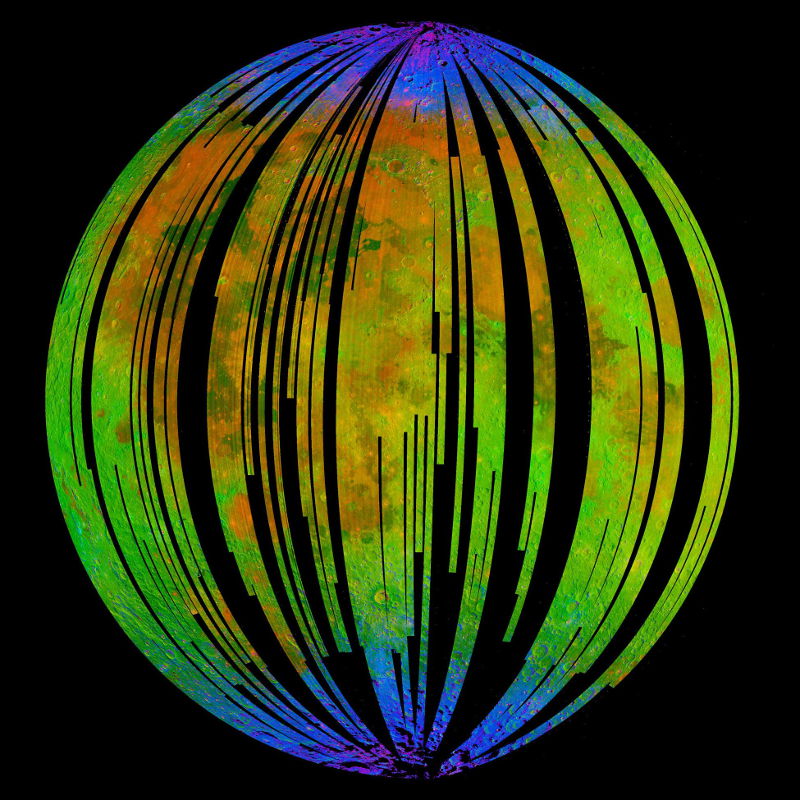
Water Detected at High Latitudes on the Moon by the Moon Mineralogy Mapper The water-bearing minerals are colored blue. Credit ISRO/NASA/JPL-Caltech/Brown Univ./USGS
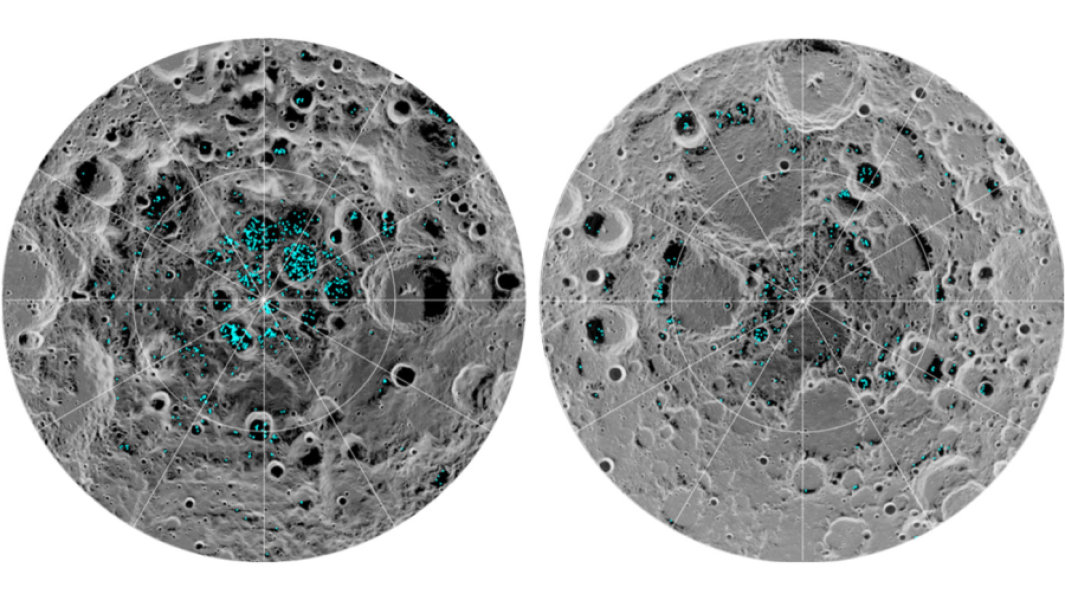
The Moon’s south pole area on the left and north pole on the right. The cyan color shows shadowed areas where ice is located. From data gathered by the Moon Mineralogy Mapper, and instruments on the Lunar Reconnaissance Orbiter, and LCROSS. Click on image to enlarge. Credit NASA.
Finding water is a big deal. It helps Moon colonists live off the land, so to speak. While the poles on Earth are foreboding places, those of the Moon could give colonists an advantage. First, that’s where the water is. The Moon has very little axial tilt so deep craters never see the sunlight, and high peaks see eternal sunlight, a great place to place solar panels for just about continuous energy production.
09/06/2016 – Ephemeris – The prominent lunar crater Theophilus
Ephemeris for Tuesday, September 6th. The Sun will rise at 7:11. It’ll be up for 12 hours and 57 minutes, setting at 8:09. The Moon, 3 days before first quarter, will set at 10:55 this evening.
The Moon’s terminator, the sunrise line, is half-way across the Sea of Tranquility on our satellite’s equator. Below that is a distinctive crater just coming into light. It’s prominent enough to spot in binoculars. It’s name is Theophilus. The name is familiar with those familiar with the New Testament of the Bible, as the person that the Gospel of Luke and Acts of the Apostles is addressed to. However that isn’t who the crater is named for, but for the Patriarch of Alexandria of the late 4th century. The two other large craters south of Theophilus that will be visible tomorrow are named for two other Orthodox saints of Alexandria. They were named by Giovanni Riccioli a 17th century astronomer and priest, who named many other craters.
Times are for the Traverse City/Interlochen area of Michigan. They may be different for your location.
Addendum
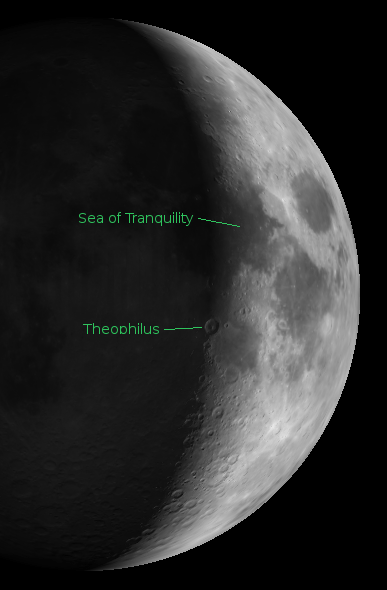
The Moon at 9 p.m. September 6, 2016 showing the crater Theophilus. Created using the Virtual Moon Atlas.
When Theophilus is on the terminator as it is tonight the Sun may touch the crater rim and the central peaks, while the crater floor is still in shadow. It’s a cool sight.
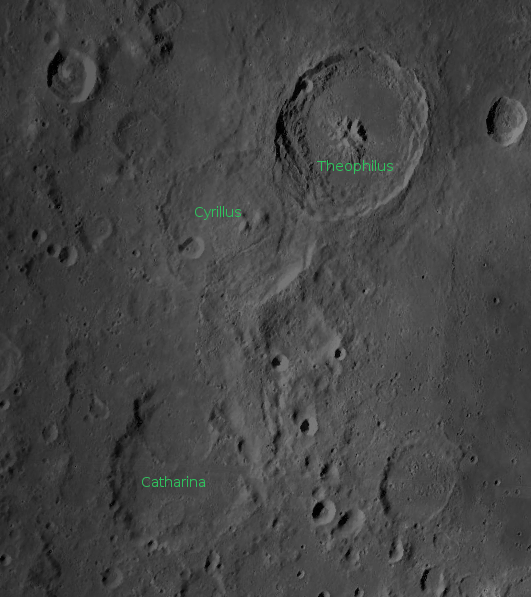
Three Alexandrian saints, Theophilus, Cyrillus, and Catharina (St Catherine) immortalized on the Moon. Created using the Lunar Reconnaissance Orbiter texture on the Virtual Moon Atlas.
Note that Cyrillus has very low crater walls and is hard to see unless the sun angle is low near lunar sunrise of sunset.
08/09/11 – Ephemeris – The moon tonight – musings
Tuesday, August 9th. The sun rises at 6:37. It’ll be up for 14 hours and 19 minutes, setting at 8:57. The moon, 3 days past first quarter, will set at 3:19 tomorrow morning.
The moon tonight is in its gibbous phase, as it has been since first quarter last weekend. This Saturday it will be full. So now most of the moon’s face is in sunlight. Besides the dark, lava filled dry seas of the moon, which give us the dark spots that some of us imagine as the face of the man in the moon, we can spot many craters and other formations in a telescope. Even as the moon has been accumulating spacecraft, rocket parts, rovers and Hasselblad cameras for the last 50 years none can be seen from the earth. The Lunar Reconnaissance Orbiter is taking photographs of the moon in unprecedented detail. They’ve already located the Apollo landing sites, and discovered a lost Soviet lunar rover. Who knows what else they’ll find.
* Times are for the Traverse City/Interlochen area of Michigan. They may be different for your location.
 Bob Moler's Ephemeris Blog