Archive
Ephemeris: 06/17/2024 – China’s mission to get samples from the far side of the Moon
This is Ephemeris for Monday, June 17th. Today the Sun will be up for 15 hours and 34 minutes, setting at 9:31, and it will rise tomorrow at 5:56. The Moon, 3 days past first quarter, will set at 3:16 tomorrow morning.
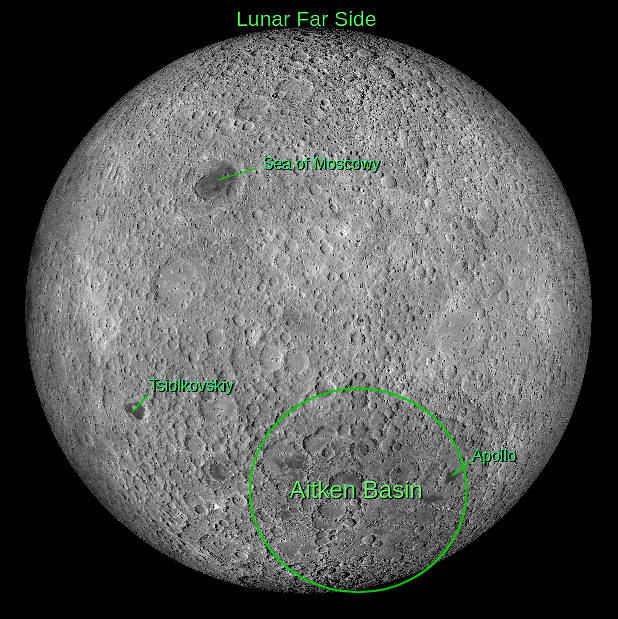
Earlier this month the People’s Republic of China’s Chang’e 6 spacecraft landed on the far side of the Moon to collect samples to return them to the Earth. They had put a satellite in orbit of the moon to act as a relay satellite so they can communicate with their Lander. The collection went according to plan and the spacecraft is now headed back to the Earth. It is my understanding that they landed in the crater called Apollo at the edge of the Aitken basin . Being the far side of the moon the Apollo crater is not named for the Greek god but for the American human Moon program of the 1960s and early 70s. The samples are expected to return to Earth on the 25th. These are the first samples from the far side of the Moon to be returned.
The astronomical event times given are for the Traverse City/Interlochen area of Michigan (EDT, UT–4 hours). They may be different for your location.
Addendum
11/16/2021 – Ephemeris – How China retrieved a sample from the Moon, and what Chang’e 5 is up to next
This is Ephemeris for Tuesday, November 16th. Today the Sun will be up for 9 hours and 31 minutes, setting at 5:13, and it will rise tomorrow at 7:42. The Moon, 3 days before full, will set at 5:49 tomorrow morning.
China’s Chang’e sample return mission of late last year was quite a feat. The spacecraft had an orbiter that orbited the Moon, and sent a lander with an ascent rocket. After the lander secured its samples, it put them in the ascent rocket, which launched back up to the orbiter. The samples were placed in a reentry capsule attached to the orbiter, which left the Moon’s orbit and headed back to the Earth. Near Earth, it ejected the reentry capsule and swung past Earth and headed out to the Earth-Sun Lagrangian point 1 between the Earth and Sun. There are already several satellites in halo orbits around L1, because it’s a great spot to be to study the Sun unobstructed by the Earth, and detect Coronal Mass Ejections (CMEs) about an hour before they reach Earth. NASA, NOAA and the European Space Agency all have satellites out there.
The astronomical event times given are for the Traverse City/Interlochen area of Michigan (EST, UT – 5 hours). They may be different for your location.
Addendum
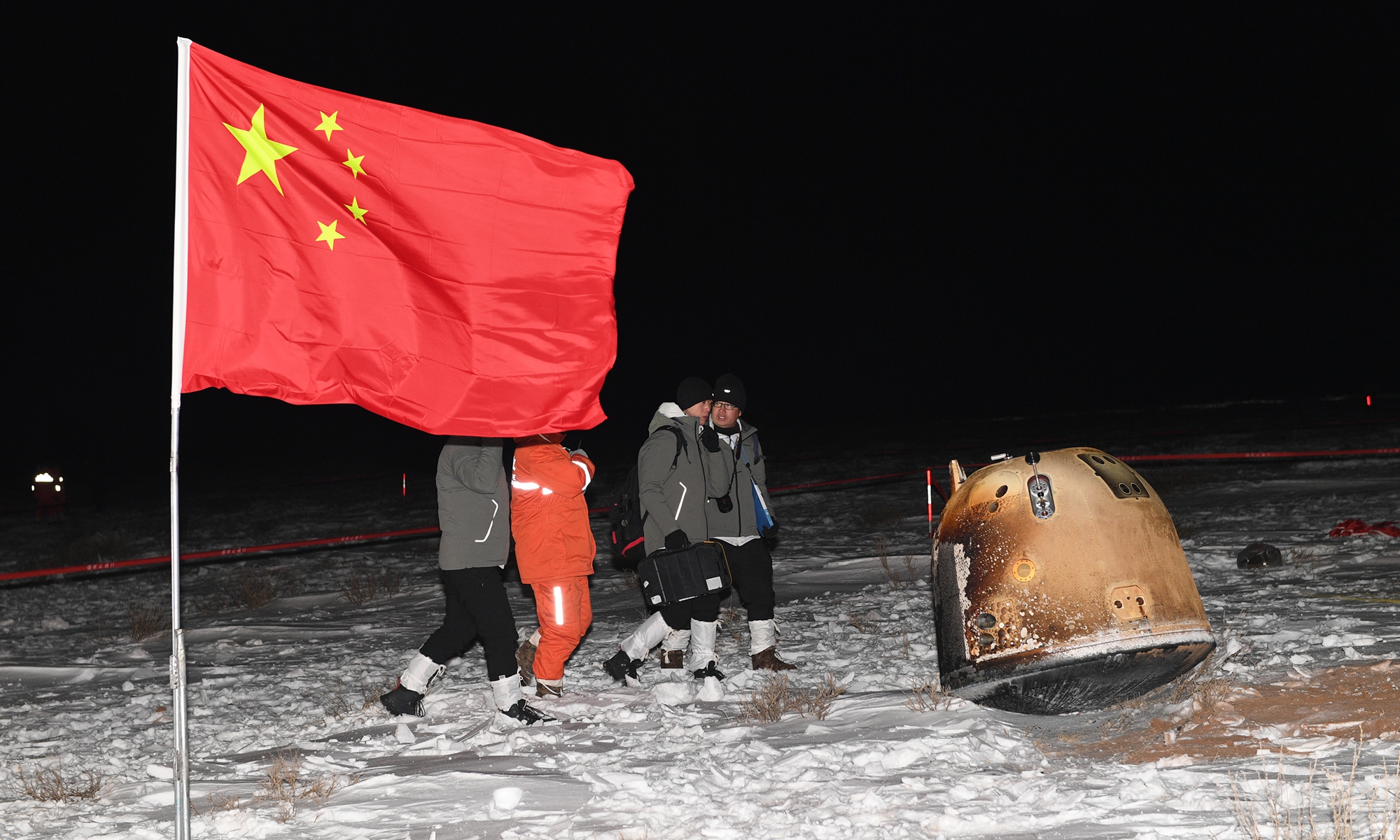
Chang’e 5 Descent Capsule lands. It looks like a miniature Russian Soyuz Descent capsule. Credit Chinese Space Agency via Global Times.
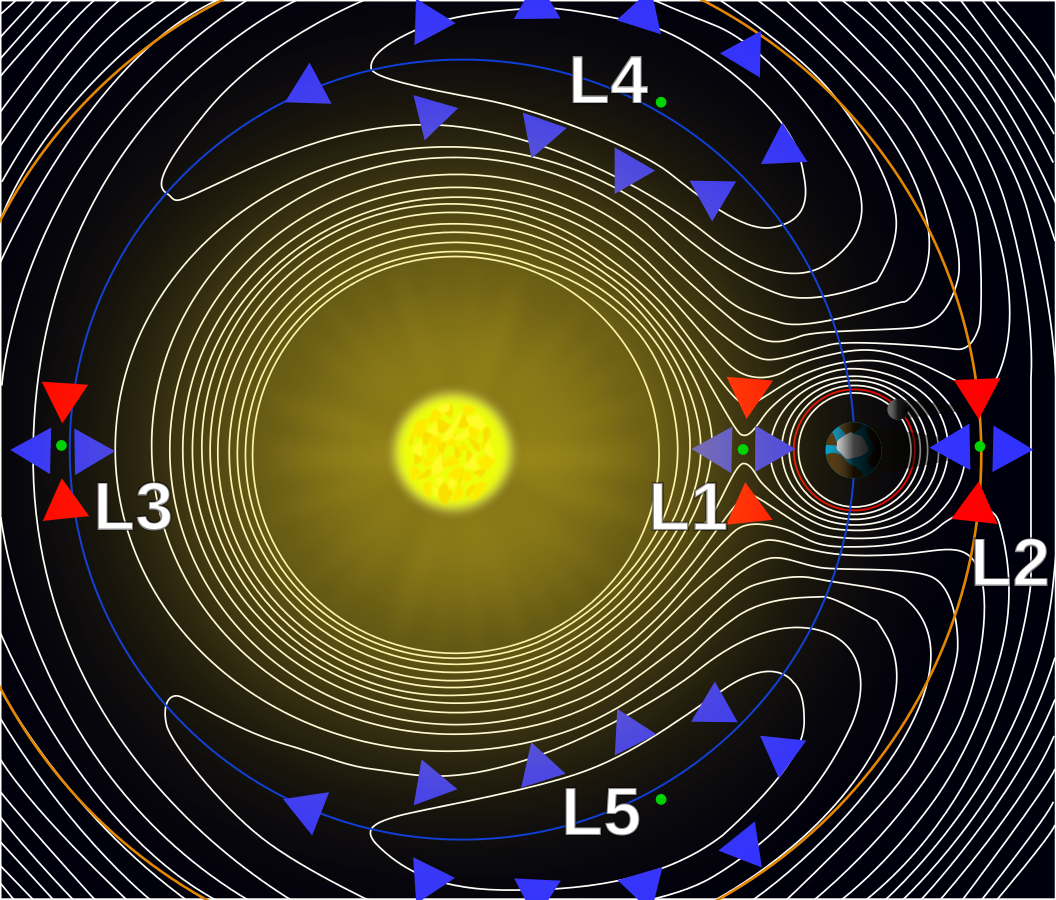
Earth-Sun Lagrangian Points. These are where a small body can stay. L1, 2 and 3 are unstable, so some little effort is needed to keep a spacecraft near there. L4 and L5 are stable. Source: Wikimedia Commons, Xander89. Click to enlarge.
1/15/2021 – Ephemeris – What the Chinese Chang’e 5 lunar mission found
This is Bob Moler with Ephemeris for Monday, November 15th. Today the Sun will be up for 9 hours and 34 minutes, setting at 5:14, and it will rise tomorrow at 7:41. The Moon, halfway from first quarter to full, will set at 4:45 tomorrow morning. | Late last year, the Chinese sent an uncrewed spacecraft to the Moon to collect samples of the surface material. That material is called regolith, and they drilled down at least a meter, which they returned to the Earth. An international team of geologists has been studying the material, and we have the first reports. Apparently the material they picked up was dated at 2 billion years, which is an intermediate age to the material picked up by the Apollo missions that dates either 3 billion years or older or 1 billion years. That helps fill gaps in the Moon’s history. Of course, all the material in the solar system is 4.5 billion years old. But the radioactive dating clock is reset when a rock is melted and solidifies.
The astronomical event times given are for the Traverse City/Interlochen area of Michigan (EST, UT – 5 hours). They may be different for your location.
Addendum
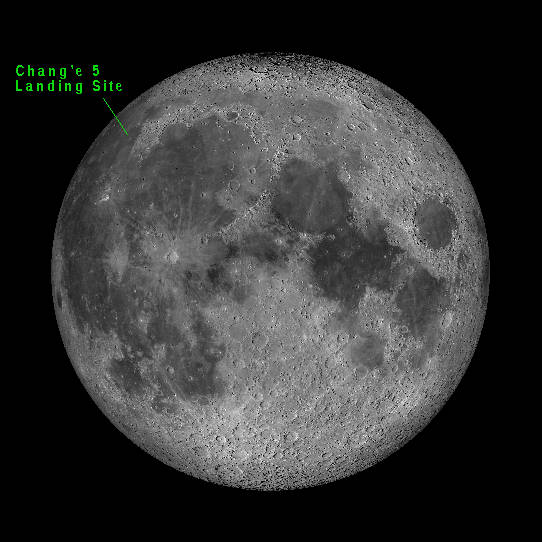
Chang’e 5 Landing-Site on full moon map. Created using Virtual Mon Atlas.
 Bob Moler's Ephemeris Blog