Archive
04/21/2022 – Ephemeris – The Lyrid Meteor Shower reaches its peak tomorrow afternoon
This is Bob Moler with Ephemeris for Thursday, April 21st. Today the Sun will be up for 13 hours and 47 minutes, setting at 8:35, and it will rise tomorrow at 6:46. The Moon, 2 days before last quarter, will rise at 2:54 tomorrow morning.
The second major meteor shower this year will reach its peak tomorrow afternoon around 2 pm (~19h UT). One of the best times to see it will be tonight from about 10 pm to near 3 am when the Moon rises. The other is tomorrow night. The meteor shower is called the Lyrids, because they seem to come from near the constellation Lyra the harp and the bright star Vega. At 10 p.m. Vega is the brightest star low in the northeastern sky. By 3 a.m. Vega will be high in the east. The radiant of the meteors is to the west of Vega, between Lyra and the dim constellation of Hercules. The most meteors will be visible just before the Moon begins to brighten the sky before 3 a.m. Though a major shower, the peak hourly rate is expected to be less than 20 meteors an hour.
The astronomical event times given are for the Traverse City/Interlochen area of Michigan (EDT, UT – 4 hours). They may be different for your location.
Addendum
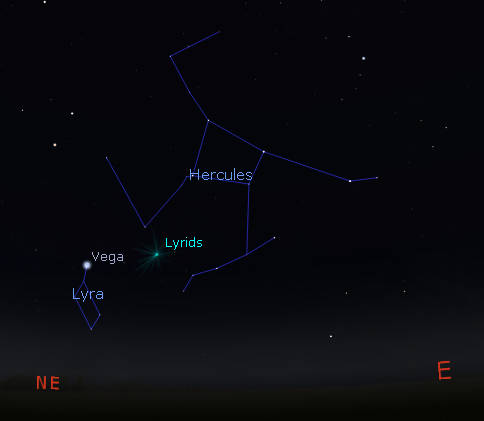
The Lyrid radiant at 11 pm, looking to the east-northeast. The meteors will be seen all over the sky, but their tracks can be traced back to the radiant point, like the parallel rails of a train track recede to a point in the distance. Click on the image to enlarge it. Created using Stellarium.
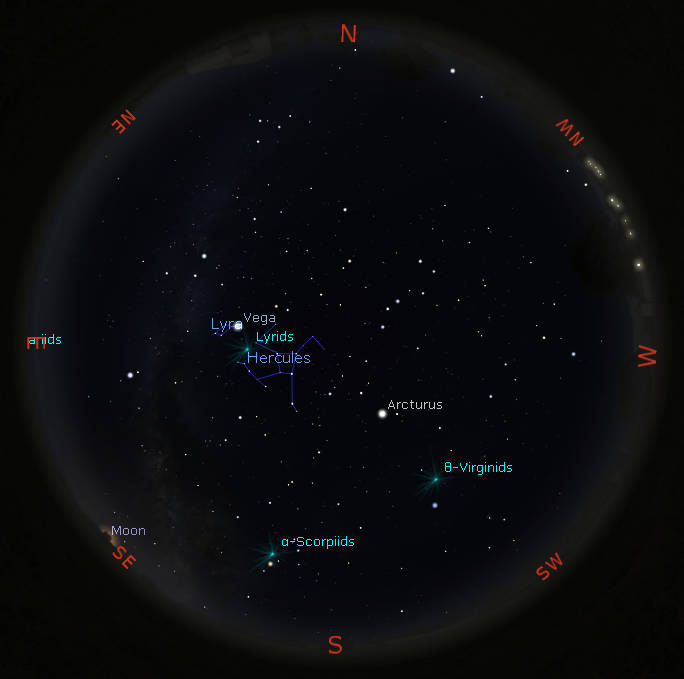
The Lyrid radiant at 3 am, looking in this all-sky view. Vega will be very high in the east and Hercules will be almost overhead. The meteors will be seen all over the sky, but their tracks can be traced back to the radiant point, like the parallel rails of a train track recede to a point in the distance. There are two other minor meteor showers happening at the same time, though neither is at peak, providing only a few meteors per hour. Click on the image to enlarge it. Created using Stellarium.
 Bob Moler's Ephemeris Blog