Archive
05/27/2016 – Ephemeris – Alkaid, the star at the end of the Big Dipper
Ephemeris for Friday, May 27th. Today the Sun will be up for 15 hours and 14 minutes, setting at 9:17, and will rise tomorrow at 6:02. The Moon, 2 days before last quarter, will rise at 1:40 tomorrow morning.
The star at the end of the handle of the Big Dipper is named Alkaid. It is the bright star that’s closest to the zenith at 11 p.m. It is a rare blue-white star. Alkaid and Dubhe, at the other end of the Big Dipper are stars that do not belong to the Ursa Major Association. And thousands of years from now these two stars will leave the central stars of the dipper behind, and deform the Big Dipper. Over the millennia the Big Dipper would look like a tin cup. Near Alkaid are two popular deep sky objects. And being this far from the hazy band of the Milky Way one would guess that they would be galaxies. And they are. The Whirlpool Galaxy and the Pinwheel Galaxy. Two gorgeous spiral galaxies.
Times are for the Traverse City/Interlochen area of Michigan. They may be different for your location.
Addendum
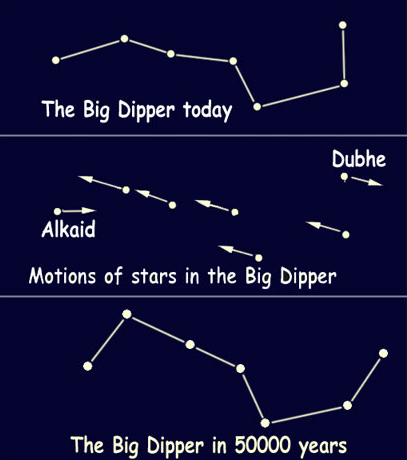
The change in the Big Dipper over time. Source: stargazerslounge.com. Ultimate source: Stellarium.
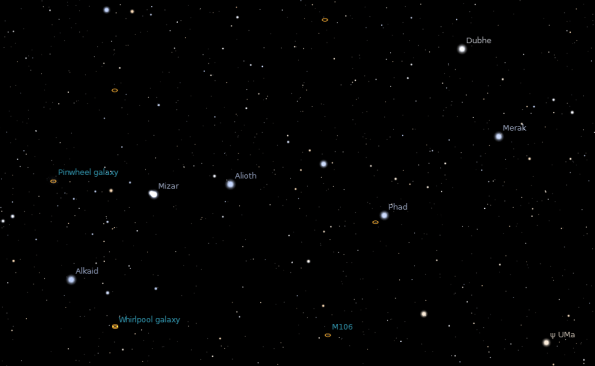
The Big Dipper and Alkaid with the Whirlpool (M51) and Pinwheel (M101) galaxies. Created using Stellarium.
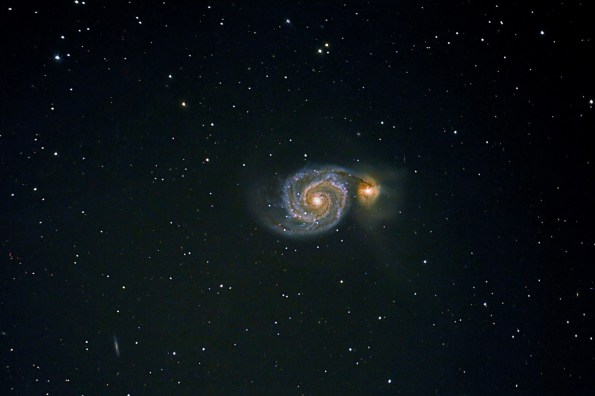
The Whirlpool Galaxy, M51. Credit Scott Anttila.
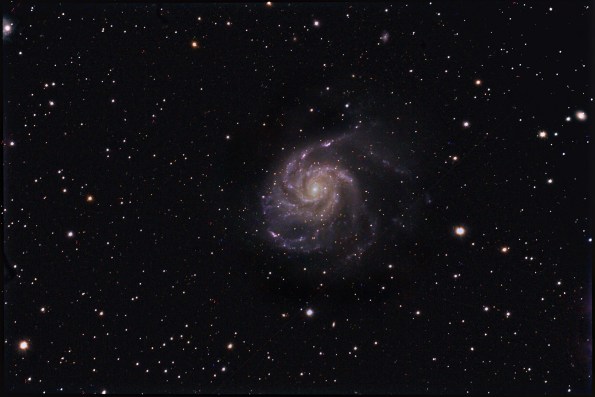
The Pinwheel Galaxy, M101. Credit Scott Anttila.
09/13/11 – Ephemeris – Supernova in the Pinwheel Galaxy
Tuesday, September 13th. The sun will rise at 7:18. It’ll be up for 12 hours and 38 minutes, setting at 7:57. The moon, 1 day past full, will rise at 8:05 this evening.
There is currently a supernova in a galaxy near the handle of the Big Dipper. The bright moon is interfering with its visibility in telescopes. It’s in a galaxy called M101 or the Pinwheel galaxy, a difficult to spot galaxy between and above the two end stars of the handle of the Big Dipper. The galaxy is 21 million light years away, relatively close as galaxies go. It is being intensely studied because it is of a type, 1a, that is used for distance measurements of far more distance galaxies. This kind of Supernova is thought to be the destruction of a white dwarf star in a close binary relation with a more massive star and is drawing matter off the larger star. When the dwarf reaches 1.38 times the sun’s mass… Kablooey! Astronomers are trying to see if that’s true for this star.
* Times are for the Traverse City/Interlochen area of Michigan. They may be different for your location.
 Bob Moler's Ephemeris Blog