Archive
Ephemeris: 11/07/2023 – How to find the Great Andromeda Galaxy
This is Ephemeris for Election Day for some, Tuesday, November 7th. Today the Sun will be up for 9 hours and 55 minutes, setting at 5:23, and it will rise tomorrow at 7:30. The Moon, 2 days past last quarter, will rise at 2:22 tomorrow morning.
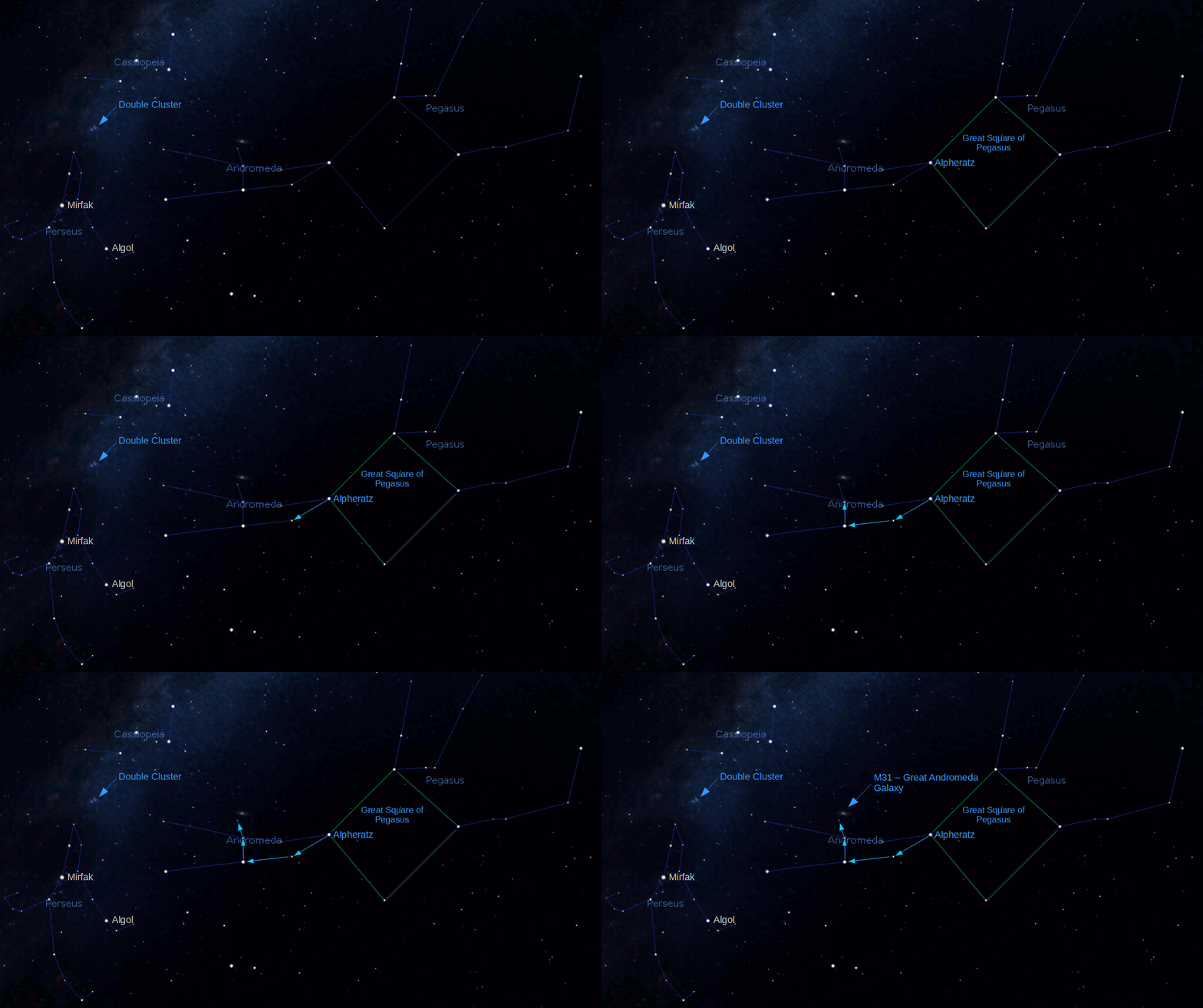
The closest large galaxy to our Milky Way galaxy is the Great Andromeda Galaxy, seen high in the eastern sky when it gets dark. It is barely visible to the naked eye. To locate it, first find a large square of stars high in the east-southeast standing on one corner, the Great Square of Pegasus. The left star of the square is the head of the constellation Andromeda. Follow two stars to the left and a bit downward, then two stars straight up. The galaxy is near that last star as a small smudge of light. Binoculars are the best way to see it as a thin spindle of light. Using a telescope, one can see, besides its nucleus, its two satellite galaxies.
The astronomical event times given are for the Traverse City/Interlochen area of Michigan (EST, UT –5 hours). They may be different for your location.
Addendum
11/13/2014 – Ephemeris – The Great Andromeda Galaxy
Ephemeris for Thursday, November 13th. The sun will rise at 7:36. It’ll be up for 9 hours and 40 minutes, setting at 5:16. The moon, 1 day before last quarter, will rise at 11:36 this evening.
The Great Andromeda Galaxy that we amateur astronomers usually call M31 is the closest spiral galaxy to our own Milky Way Galaxy. It is actually visible to keen-eyed observers to the naked eye. To locate it, first find the Great Square of Pegasus, 4 stars high in the south that make a pretty good square. From the top left star, Alpheratz, direct your gaze to the first two stars in a slightly curved line to the left to Mirach. Then go two stars up. The last one is a bit dim. But just to the upper right of that last star is a little fuzzy spot. That is the core of the Great Andromeda Galaxy. In binoculars it looks elongated. Photographs show the galaxy to span 6 Moon widths. It is somewhat larger than our galaxy and will collide with the Milky Way in about 4 billion years.
Times are for the Traverse City/Interlochen area of Michigan. They may be different for your location.
Addendum
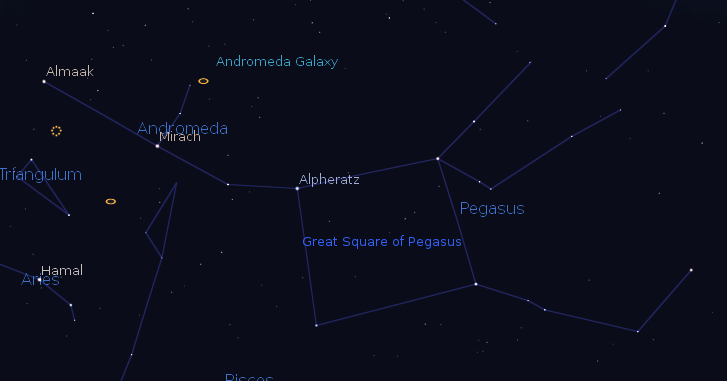
Great Andromeda Galaxy finder chart. Created using Stellarium and GIMP.
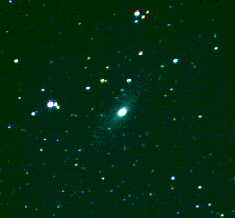
The Great Andromeda Galaxy (M31) as seen in binoculars. Visually even in a telescope the hub of this galaxy is all that is seen. However it also can be seen with the naked eye. My photograph.
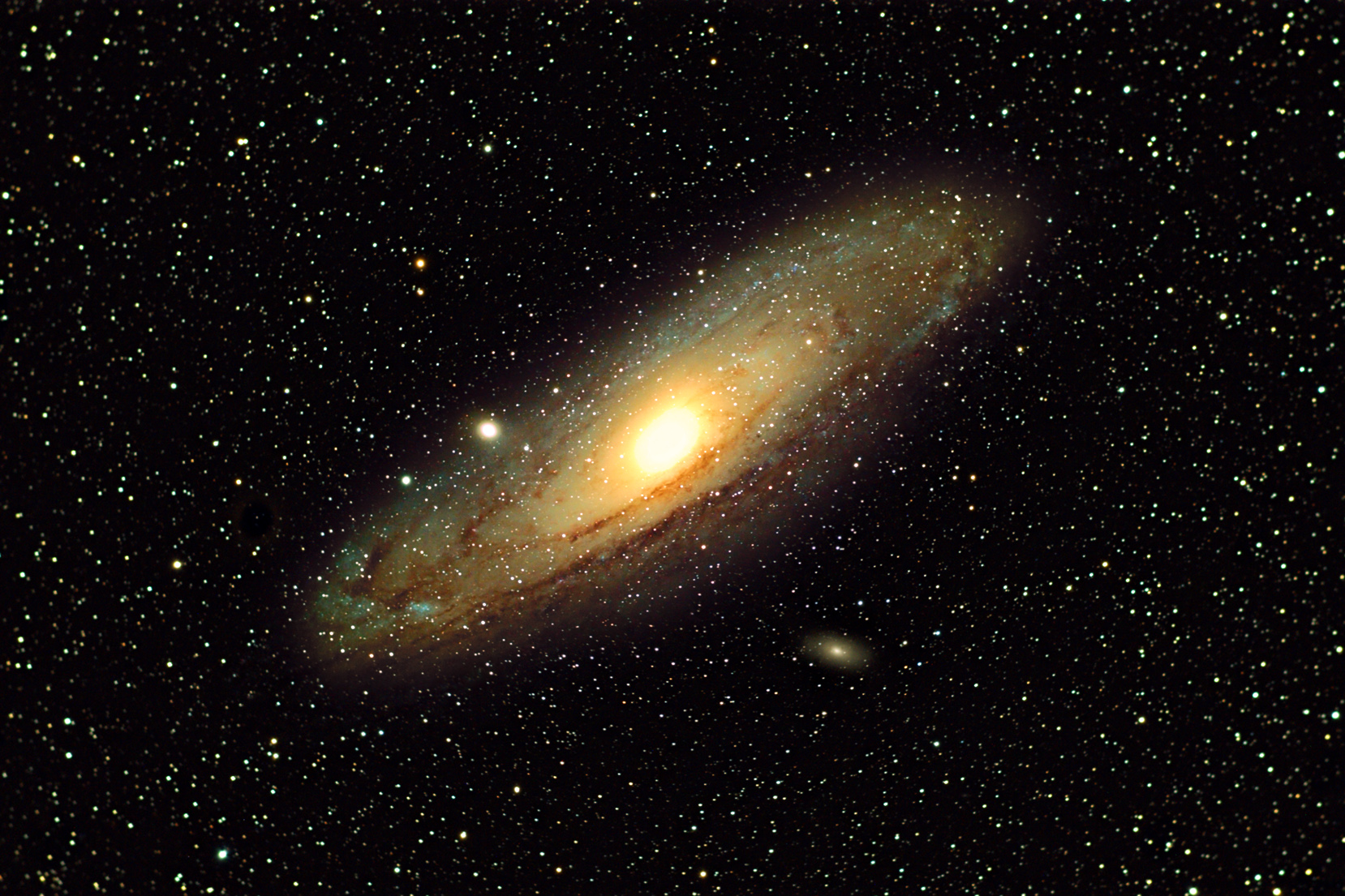
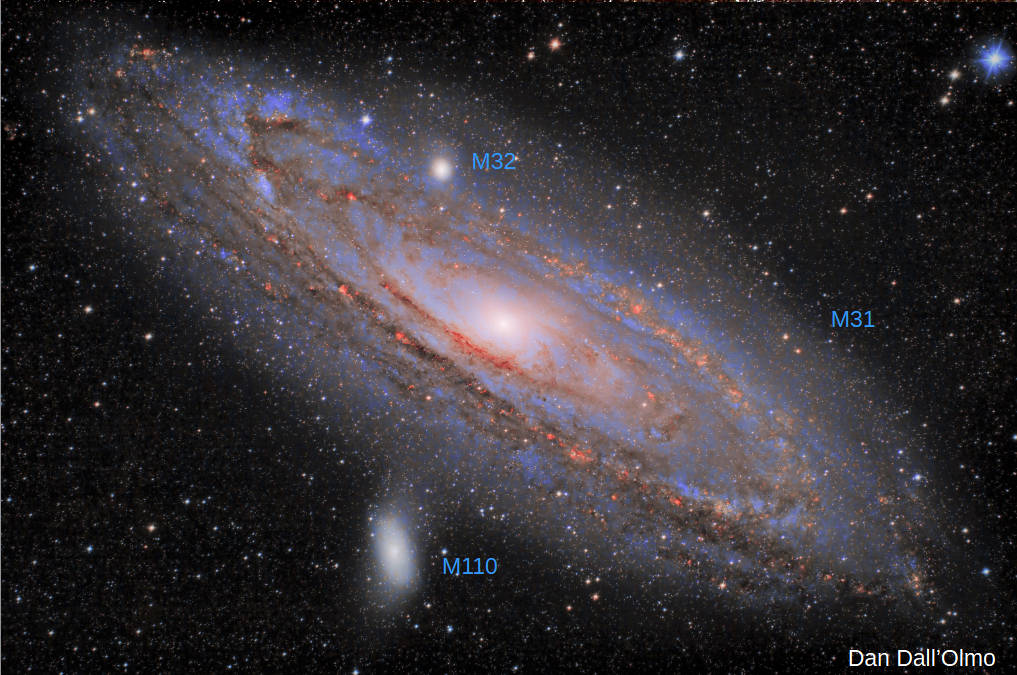
The Great Andromeda Galaxy (M31). Satellite galaxy M32 is located at the edge of the disk at 9 o’clock, and another, M110 is located at 5 o’clock. Both can be seen in telescopes, but some distance from the core of M31 and seen visually. Image taken by Scott Anttila.
 Bob Moler's Ephemeris Blog