Archive
Ephemeris: 03/20/2026 – Spring begins today!
This is Ephemeris for Friday, March 20th. Today the Sun will be up for 12 hours and 9 minutes, setting at 7:55, and it will rise tomorrow at 7:43. The Moon, 2 days past new, will set at 10:21 this evening.
At 10:46 AM today the season of spring will begin. It may or may not feel it in our neck of the woods, but astronomically at that time the Sun will appear to cross a point in the sky called the vernal equinox. Equinox means equal night, when the Sun is up for 12 hours, and set for 12 hours. It does, if you don’t look too closely, and in the old days clocks weren’t that accurate anyway. The vernal equinox is the point in the sky where the Sun crosses the celestial equator, which is above the Earth’s equator heading north. The North Pole will begin 6 months of daylight, while the rest of the Northern Hemisphere will bask in more than 12 hours of sunlight a day. The reverse is true in the Southern Hemisphere where autumn will start.
The astronomical event times given in this blog are for the Traverse City/Interlochen area of Michigan (Lat 44.7° N, Long 85.7° W; EST, UT – 5 hours) unless stated otherwise. Times will be different for other locations.
Addendum
03/20/2020 – Ephemeris – The first full day of spring
Ephemeris for Friday, March 20th. Today the Sun will be up for 12 hours and 11 minutes, setting at 7:55, and it will rise tomorrow at 7:43. The Moon, half way from last quarter to new, will rise at 7:00 tomorrow morning.
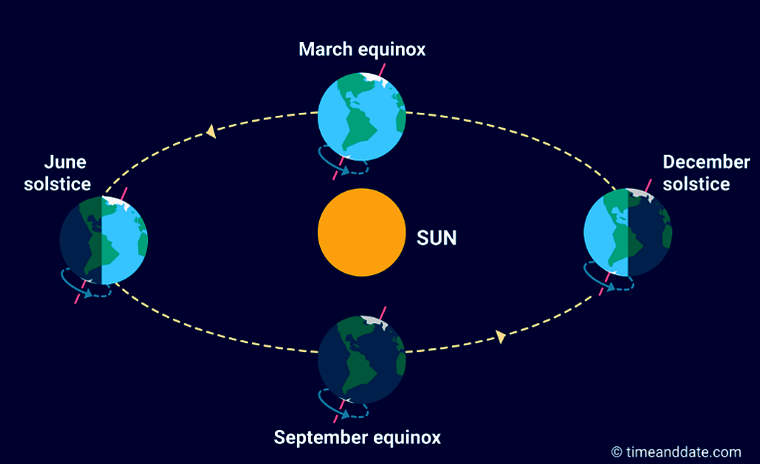
Spring snuck up on us at 11:50 p.m. last night, so this is the first full day of spring. That point in time and the point in the sky where the Sun crossed the celestial equator the imaginary line in the sky above the Earth’s equator heading northward is called the vernal equinox. Vernal means spring and equinox means equal night, meaning that day and night are equal. Since western civilization has spread south of the equator where seasons are reversed, our northern hemisphere spring equinox is the southern hemisphere’s autumnal equinox, so to be fair to both hemispheres we generally say March or September equinox instead. However the point in the sky the Sun crossed last night will always be known as the vernal equinox.
The event times given are for the Traverse City/Interlochen area of Michigan. They may be different for your location.
Addendum
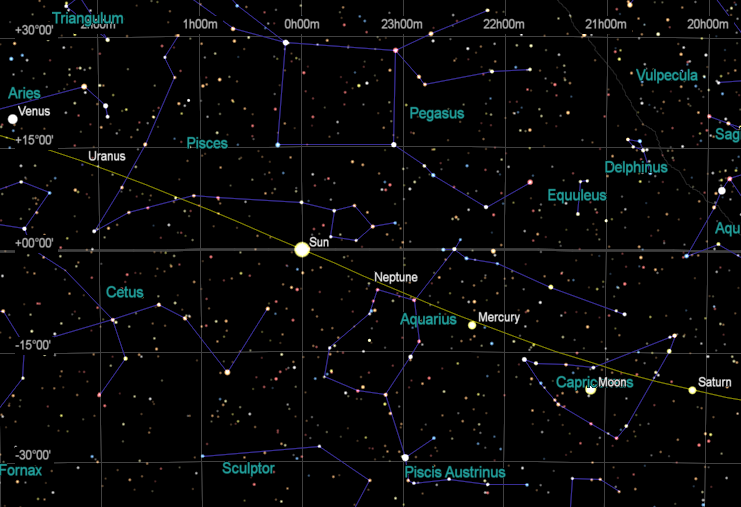
The Sun at the vernal equinox point on the celestial sphere at 11;50 p.m. EDT last night (March 19, 2020). The diagonal yellow line in the ecliptic, the Sun’s path in the sky. The vertical lines marked in hours at the top are lines of right ascension, the analog of earthly longitude. The horizontal lines are lines of declination, the same as latitude on the Earth. I referenced this point in yesterday’s program. Created using Cartes du Ciel *Sky Charts).
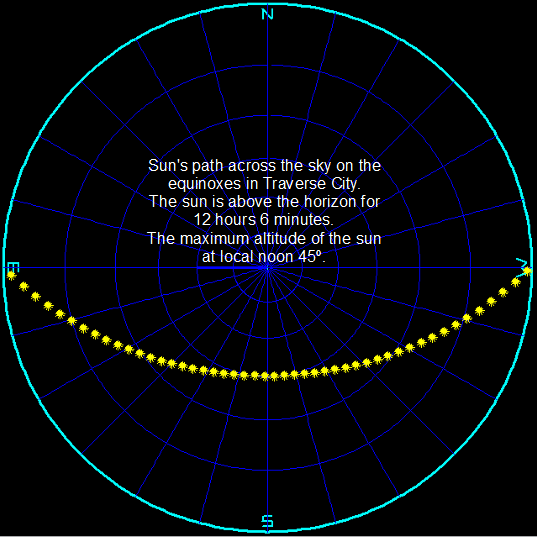
The Sun’s path through the sky on the equinox day from Traverse City, MI. Note that the Sun rises due east and sets due west. Created using my LookingUp program.
03/20/2015 – Ephemeris – Spring will spring forth at 6:44 p.m. EDT
Ephemeris for Friday, March 20th. The Sun will rise at 7:46. It’ll be up for 12 hours and 8 minutes, setting at 7:55. The Moon is new today, and won’t be visible.
The Arctic solar eclipse has just ended. But there is one more event of note today. At 6:44 p.m. The Sun will cross the celestial equator heading northward, the projection of the Earth’s equator on the sky. In doing that the season of spring will return to the northern hemisphere. The Sun is already staying up for just over half the day. That will increase to fifteen and a half hours by the summer solstice three months from now. Not only will the Sun will be out longer, but it will rise higher in the sky, rising from 45 degrees altitude in the south at local noon to 69 degrees on June 21st. If the sun stayed at this location it would get very uncomfortable with the heat. As it is as the Sun is climbing down it will still get warmer. Peak summer heat occurs about a month after the solstice.
Times are for the Traverse City/Interlochen area of Michigan. They may be different for your location.
Addendum
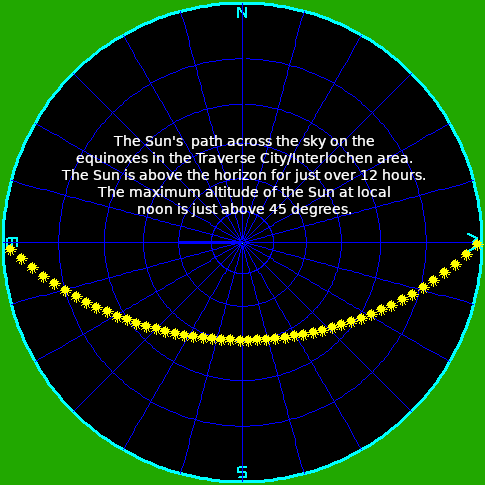
These are whole sky diagrams with the edge at the horizon. The Sun’s motion is from left to right. The Sun is plotted every 15 minutes. The Sun’s motion is constant, however the projection causes squeezing of the positions near the zenith (center of the diagram) and stretching near the horizon.
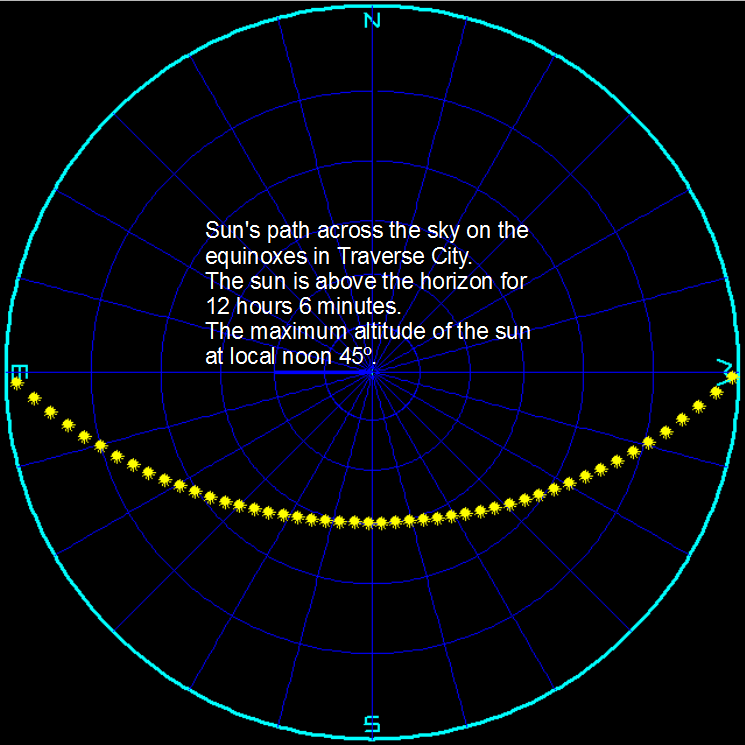
The sun’s daily path through the sky from horizon to horizon on an equinox the first day of spring or autumn. Credit My LookingUp program.
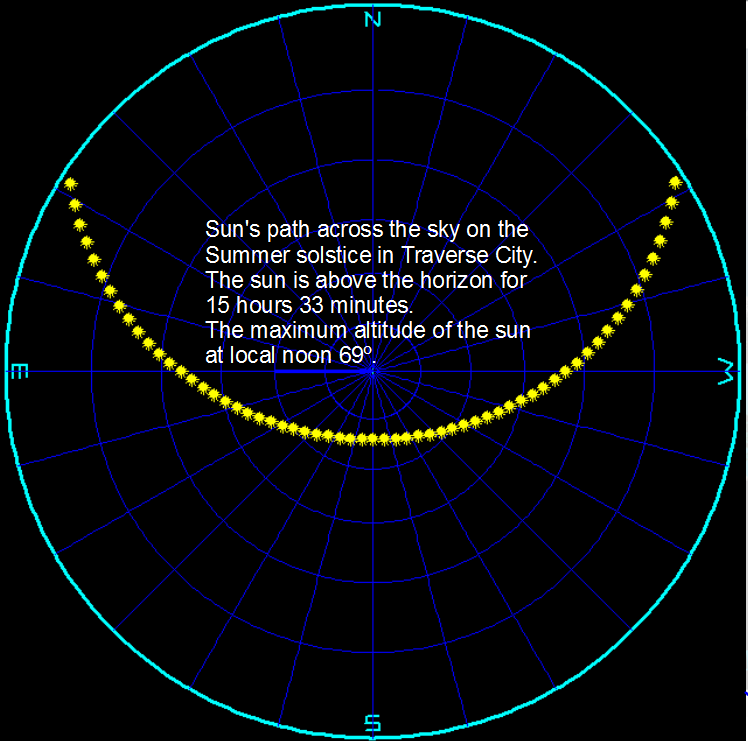
The sun’s daily path through the sky from horizon to horizon on the first day of summer, the summer solstice. Credit My LookingUp program.
 Bob Moler's Ephemeris Blog