Archive
11/18/2014 – Ephemeris – Rosetta, Philae with Comet 67P and Maven’s discovery of the effects of it’s comet encounter
Ephemeris for Tuesday, November 18th. The sun will rise at 7:43. It’ll be up for 9 hours and 28 minutes, setting at 5:11. The moon, half way from last quarter to new, will rise at 4:31 tomorrow morning.
Last week the Philae lander bounced down on Comet 67P/Churyumov-Gerasimenko, its harpoons not able to fire to hold the lander down. “Where is Captain Ahab when you need him?” I Twittered at the time. We were lucky it didn’t bounce off the comet entirely. It ended against a cliff and in a shadow, so it couldn’t recharge its batteries from sunlight. The ESA controllers had it perform all its possible experiments quickly before its batteries died. Philae was still an amazing success. News from last month’s encounter Mars encounter with Comet Siding Spring. The Maven satellite detected the aftermath of a great martian meteor shower when it peaked around the planet from where it was hiding.
Times are for the Traverse City/Interlochen area of Michigan. They may be different for your location.
Addendum
Philae
If I’m understanding the spacecraft controllers at the European Space Agency (ESA) correctly Philae was launched toward the comet with a velocity of something like .7 meters per second (m/s). It would have accelerated to 1 m/s by the time it hit the comet. So it was pushed into the comet at more than the comet’s escape velocity. One meter per second is only 2.2 miles per hour. So to bounce and not escape the comet either the lander, the surface of the comet or both would have to have a lot of give to it. On this comet one could jump faster than escape velocity and go floating off into space.
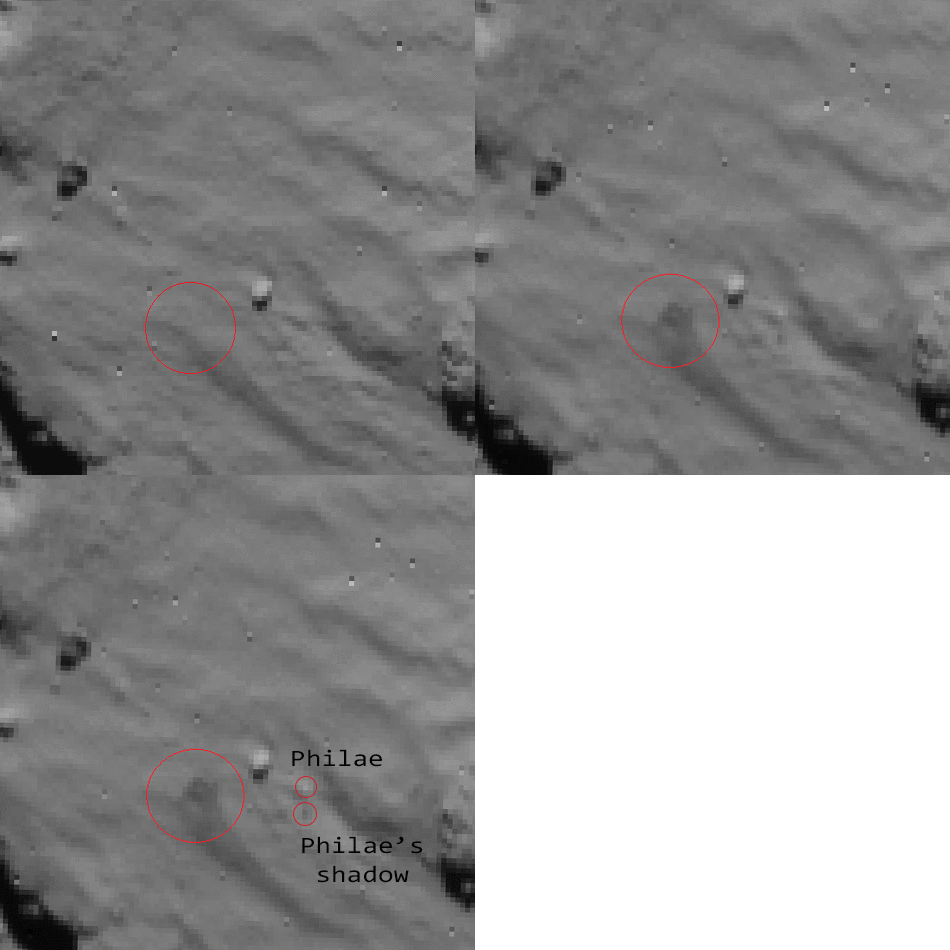
The Rosetta spacecraft spotted Philae and its shadow shortly after the lander touched down on Comet 67P/Churyumov–Gerasimenko and bounced up again. The first image is taken on Nov. 12, 2014 at 10:30 a.m. EDT (3:30 p.m. UTC) and the second five minutes later. Credit: ESA/Rosetta/NAVCAM; pre-processed by Mikel Catania. Hat tip to and credit for the caption to Universe Today.
Maven
Maven detected the aftermath of a meteor storm in the upper martian atmosphere with the signatures of eight metals. It looks like it was prudent to hide all the satellites when Mars came closest to the comet’s path. Here’s a link to Bob King’s post about it in Universe Today blog from 11 days ago.
09/23/2014 – Ephemeris – NASA’s MAVEN satellite is in orbit of Mars
Ephemeris for Tuesday, September 23rd. The sun will rise at 7:30. It’ll be up for 12 hours and 7 minutes, setting at 7:37. The moon, 1 day before new, will rise at 7:53 tomorrow morning.
Last Sunday evening the MAVEN spacecraft fired its six main engines in alternating pairs for 33 minutes and was captured by Mars, entering orbit around the Red Planet. MAVEN is one of those NASA acronyms, it stands for Mars Atmospheric and Volatile EvolutioN Once in a capture orbit, the orbit will be changed from a 33 hour orbit to a 4 ½ hour a science orbit. It will investigate how Mars lost its original atmosphere which was dense enough to support liquid water to the thin carbon dioxide atmosphere it has today. It has several duties October 19th when Comet Siding Spring passes Mars to detect the interaction of the comet’s atmosphere with that of Mars. There are no cameras* on Maven, just hard data will be returned.
Times are for the Traverse City/Interlochen area of Michigan. They may be different for your location.
Addendum
* Actually I was mistaken. There is an Imaging Ultraviolet Spectrograph aboard which will take images in the ultraviolet of Mars upper atmosphere.
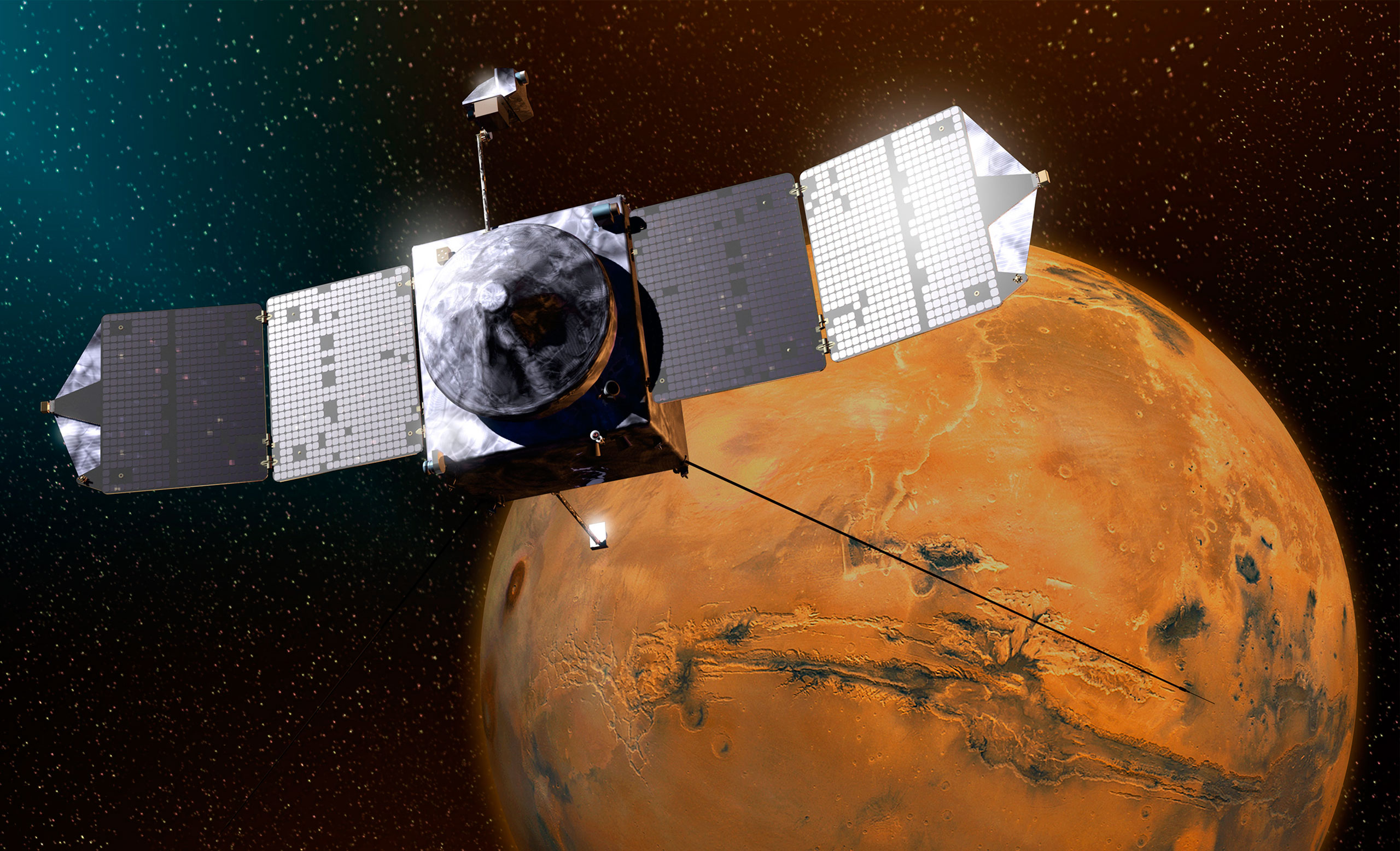
Artist’s rendition of the MAVEN spacecraft in Mars Orbit. Credit: Lockheed Martin/NASA.
 Bob Moler's Ephemeris Blog