Archive
09/11/2014 – Ephemeris – The waning gibbous moon and a strange double crater
Ephemeris for Thursday, September 11th. The sun will rise at 7:16. It’ll be up for 12 hours and 43 minutes, setting at 8:00. The moon, 3 days past full, will rise at 9:30 this evening.
It might be about 10 p.m. before the moon gets high enough to appreciate with a small telescope. The terminator running across the moon is the sunset line. It has gobbled most of the little round Sea of Crises at the upper right of the moon. The Sea of Fertility just below it has two distinctive small craters in it with two parallel streaks of ejecta emanating from the one farthest from the terminator. No one knows exactly what happened here, but it appears that a binary asteroid struck the moon at a low angle coming from the direction of the terminator and gouged out the two small craters, which are elongated in the direction of the streaks. The crater names are Messier and Messier A, named after the French astronomer who cataloged some of the brightest interstellar objects.
Times are for the Traverse City/Interlochen area of Michigan. They may be different for your location.
Addendum
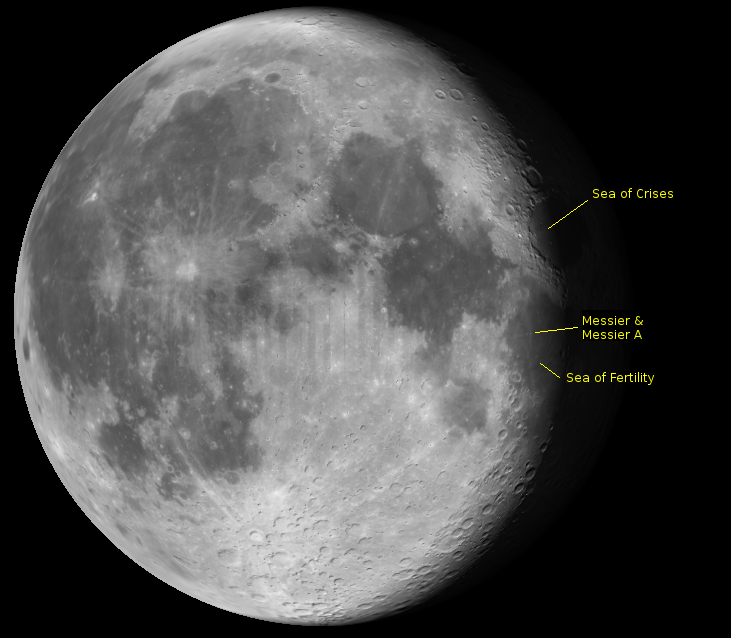
The gibbous Moon at 9 p.m. September 11, 2014. Created using Virtual Moon Atlas.
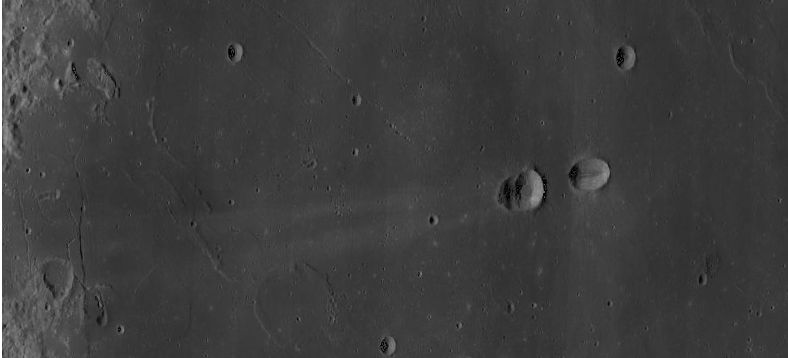
Closeup of Messier (right) and Messier A with the twin ejecta streaks. Credit: Lunar Reconnaissance Orbiter via Virtual Moon Atlas.
These craters were named for the 18th century astronomer Charles Messier whose famous catalog of deep sky objects is a who’s who of the brightest star clusters, nebulae and galaxies for the amateur astronomer. For instance M22 is not only a scenic state road in Michigan, but a beautiful bright globular star cluster in the constellation of Sagittarius. To Messier the objects on his list were a quick check of objects to ignore. He was looking for comets at the Paris Observatory. He found 12 of them.
11/29/11 – Ephemeris – The moon tonight – The craters Messier A and B
Tuesday, November 29th. The sun will rise at 7:56. It’ll be up for 9 hours and 8 minutes, setting at 5:04. The moon, 3 days before first quarter, will set at 10:02 this evening.
The moon tonight is a fat crescent with the small circular Sea of Crises visible near the upper edge. Below that is the larger Sea of Fertility. In a small telescope a double light streak will be visible on the floor of Fertility. At the head of the streaks are two small odd shaped craters named Messier A and B. Named after Charles Messier, comet hunter, and creator of the Messier catalog of some of the best deep sky objects for the amateur astronomer. Anyway, the craters though small are distinctive and relatively new, less than a billion years ago. The pair of small asteroids that hit the moon did so at a low angle to cause the spray of material to form those linear streaks. A most interesting feature to explore on the moon,
* Times, as always are for the Traverse City/Interlochen area of Michigan.
Addendum
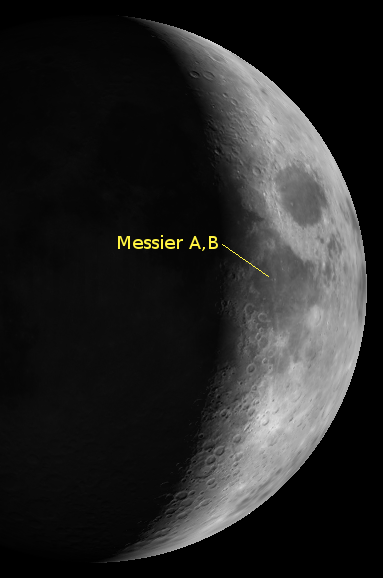
The moon featuring the craters Messier A and B. Chart created using Virtual Moon Atlas
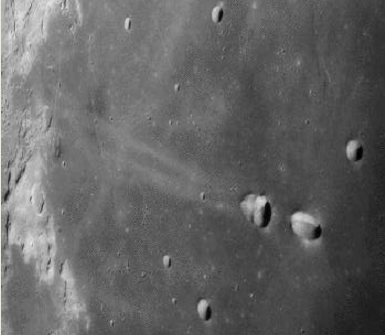
The Craters Messier A and B from Apollo 11. NASA
 Bob Moler's Ephemeris Blog