Archive
03/09/2017 – Ephemeris – More on the definition of a planet controversy
Ephemeris for Thursday, March 9th. The Sun will rise at 7:05. It’ll be up for 11 hours and 35 minutes, setting at 6:41. The Moon, 3 days before full, will set at 6:03 tomorrow morning.
Last Friday’s Weekly Space Hangout, on Google Hangouts featured Dr. Alan Stern, principal Investigator of the New Horizons Mission to Pluto and beyond. Dr. Stern considers himself a planetary scientist, rather than an astronomer, and doesn’t much care for the IAU or International Astronomical Union’s definition of a planet. To him and other planetary scientists: if it’s round and not a star… it’s a planet. They’re are more concerned about what it is than where it is, or what it’s orbiting. Planetary science encompasses geology, climatology, chemistry, and astrobiology among others. For instance astrobiology is looking at the origin of life on the Earth and looking for life on other worlds like the planet Mars and at least three moons, Jupiter’s Europa and Saturn’s Enceladus and Titan.
Times are for the Traverse City/Interlochen area of Michigan. They may be different for your location.
Addendum
Check out last Friday’s Weekly Space Hangout here
For the latest on astronomical, space events and discoveries this is a good place to go.
10/29/2015 – Ephemeris – The blue skies of Pluto
Ephemeris for Thursday, October 29th. The Sun will rise at 8:16. It’ll be up for 10 hours and 19 minutes, setting at 6:36. The Moon, 2 days past full, will rise at 8:40 this evening.
Images from the New Horizons spacecraft are streaming back slowly. It’s like trying to download a modern megapixel camera image using a thousand to two thousand bits per second telephone modem back in the ’90s. That’s why the images are dribbling out. They are released each Thursday or Friday. One of the last images was a colored image of the ring of atmosphere of Pluto backlit by the Sun, showing that the dwarf planet had a blue sky. The reason is still debated because there appear to be minute particles thought to be tholins in Pluto’s atmosphere. These would be colored brown or red. However they seen to preferentially scatter blue light like the nitrogen molecules in our atmosphere.
Times are for the Traverse City/Interlochen area of Michigan. They may be different for your location.
Addendum

Pluto seen in silhouette, backlit by the Sun in color. Released October 10, 2015 by NASA/JHUAPL/SwRI
10/02/2015 – Ephemeris – I talk about Pluto and New Horizons tonight
Ephemeris for Friday, October 2nd. The Sun will rise at 7:41. It’ll be up for 11 hours and 40 minutes, setting at 7:21. The Moon, 2 days before last quarter, will rise at 10:53 this evening.
This evening yours truly will be reviewing the results so far from the New Horizons spacecraft and its close encounter with Pluto and its moons July 14th. This will be at the Grand Traverse Astronomical Society meeting at Northwestern Michigan College’s Rogers Observatory at 8 p.m. If you’ve not been keeping up with the releases of photos of Pluto and its moons be prepared to be amazed by the beauty of this frozen but apparently active world. Afterward from 9 p.m. there will be time to view the wonders of the autumn skies if it’s clear. If not there will be guided tour of the autumn skies via computer simulation. The observatory is located south of Traverse City on Birmley Road between Garfield and Keystone Roads.
Times are for the Traverse City/Interlochen area of Michigan. They may be different for your location.
Addendum
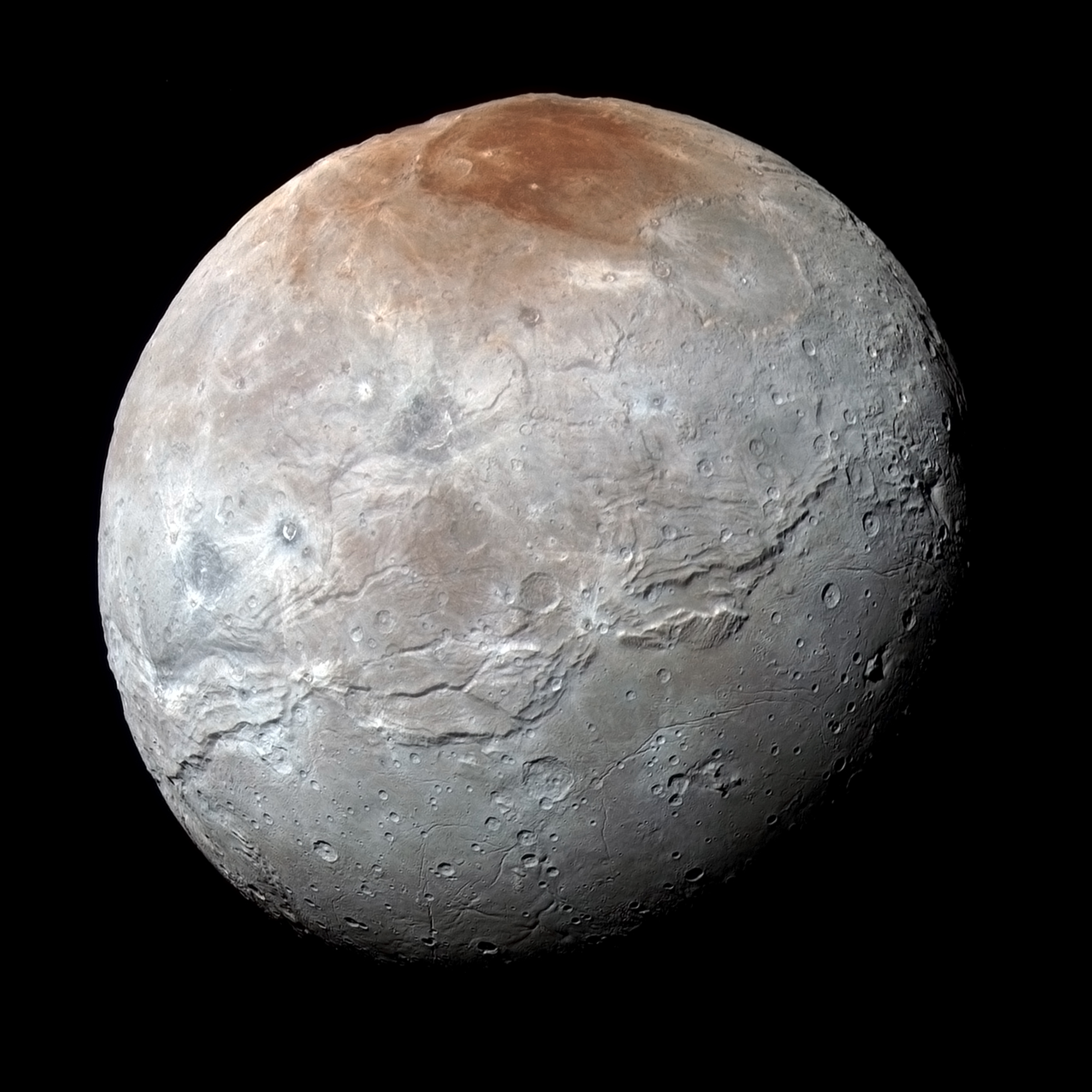
Latest high resolution color image of Charon released yesterday. Credit: NASA/JHUAPL/SwRI.
09/29/2015 – Ephemeris – New Horizons is now downloading some really cool pictures to Earth
Ephemeris for Tuesday, September 29th. The Sun will rise at 7:38. It’ll be up for 11 hours and 49 minutes, setting at 7:27. The Moon, 2 days past full, will rise at 8:38 this evening.
Two and a half months ago the New Horizons spacecraft flew past Pluto, spending the day incommunicado, not wasting any time sending anything back to the Earth. Starting the next day came the flood of data including some highly compressed images. Starting Labor Day weekend the high-resolution, uncompressed images started to come down at one to two thousand bits per second. At that rate a 4 megapixel monochromatic image might take 36 hours to download. Now every Thursday or Friday the New Horizons Team puts several new processed images on the NASA and Johns Hopkins Applied Physics Laboratory websites, along with explanations of what is in the images and the questions they raise.
Times are for the Traverse City/Interlochen area of Michigan. They may be different for your location.
Addendum

This image, taken just 15 minutes after the New Horizons spacecraft flew its closest to Pluto shows a low angle shot of the lands the spacecraft saw really close up. Check out too the many layers of the atmosphere. Credit: NASA/JHUAPL. Click on the image to enlarge.
I’ll be exploring this and the other amazing photos and other results from New Horizons this Friday at the Grand Traverse Astronomical Society meeting at 8 p.m. at Northwestern Michigan College’s Rogers Observatory south of Traverse City on Birmley Road.
08/25/2015 – Ephemeris – Waiting for more images from New Horizons
Ephemeris for Tuesday, August 25th. The Sun rises at 6:56. It’ll be up for 13 hours and 35 minutes, setting at 8:32. The Moon, 3 days past first quarter, will set at 3:16 tomorrow morning.
The New Horizons team is downloading data now from all the instruments gathered from the encounter with Pluto, but in mid-September the pictures again will be flowing down to Earth. What was downloaded in the day and a half after close encounter with Pluto were highly compressed images of an area of Pluto and Charon’s surface showing a wider view than we will see later on and in full resolution. The team is already beginning to name the features that can be seen in sufficient detail. The International Astronomical Union has decided the types of names for Pluto, Charon and the rest of the Satellites. Pluto is set aside for explorers, both human and robotic. Charon, for mythical and fictional space and adventure heroes, vessels and authors.
Times are for the Traverse City/Interlochen area of Michigan. They may be different for your location.
Addendum
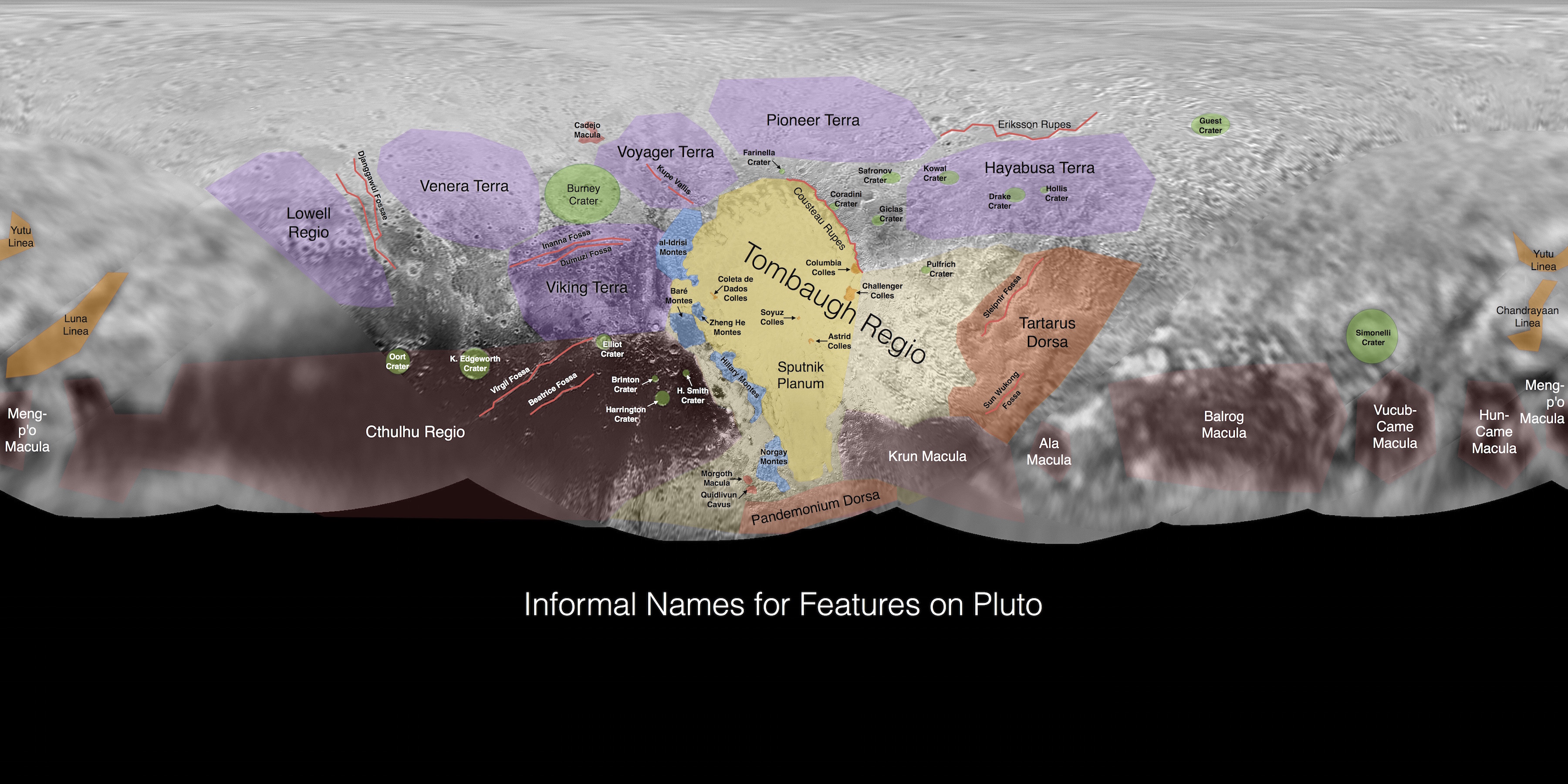
Map of Pluto with unofficial place names so far. Credit NASA/JPL. Click to enlarge.

Map of Charon with unofficial place names so far. Credit NASA/JPL. Click to enlarge.
The International Astronomical Union approves all names of objects off the Earth. Go to either http://www.iau.org or more specifically http://planetarynames.wr.usgs.gov.
07/28/2015 – Ephemeris – The first close up images of Pluto
Ephemeris for Tuesday, July 28th. The Sun rises at 6:24. It’ll be up for 14 hours and 49 minutes, setting at 9:13. The Moon, 3 days before full, will set at 4:32 tomorrow morning.
Two weeks ago the New Horizons spacecraft zipped through the Pluto system gathering a wealth of information including a whole host of images. Due to their large size the images will take some time to be sent back, however some highly compressed images have been returned and yield a tantalizing look at the dwarf planet Pluto and its large moon Charon. Rather than an apparently dead heavily cratered body, the first images presented a young surface with plains and mountains with nary a crater to be found. Young is relative, perhaps 100 million years old or so and implied heating where there appears no source to be found… yet. The first of many mysteries. And we have 16 months more of data and images to be returned.
Times are for the Traverse City/Interlochen area of Michigan. They may be different for your location.
Addendum

First closeup picture the New Horizon Team showed. Two mile high ice mountains, plains, and interesting terrain, but no craters. A young surface. Credit: NASA/Johns Hopkins University Applied Physics Laboratory/Southwest Research Institute. Click on image to enlarge.

Sputnik Planum (Plain) next to the ice mountains showing polygons and troughs, some with hills. This is part of Pluto’s “Heath”. Note the rectangular lossy compression artifacts in the image. An uncompressed version will be downlinked later. Credit: NASA/Johns Hopkins University Applied Physics Laboratory/Southwest Research Institute. Click on image to enlarge.
07/14/2015 – Ephemeris – New Horizons is beginning its encounter with Pluto right now
Ephemeris for Tuesday, July 14th. Today the Sun will be up for 15 hours and 16 minutes, setting at 9:26. The Moon, 1 day before new, will rise at 6:01 tomorrow morning, and tomorrow the Sun will rise at 6:11.
Right now as I speak the New Horizons spacecraft is beginning its pass through the Pluto system of the dwarf planet itself, its huge moon Charon and four smaller moons. It’s nail-biting time, because the spacecraft will be too busy to send anything back immediately. Everything will be stored for playback over the next 16 months. We will expect to hear from it at 9:02 tonight when a brief phone home signal will be sent to confirm the probe’s survival. Already this morning 7 of NASA’s deep space network antennas will have blasted a radio signal to Pluto* in time for the spacecraft to receive the signal as it passes behind first Pluto and Charon to probe their atmospheres. Tomorrow we will expect to receive the first closeup images.
Times are for the Traverse City/Interlochen area of Michigan. They may be different for your location.
*I’ve since found out that the signal will be broadcast from those antennas from 4:30 to 6:30 a.m. EDT, Check with DSN Now: http://eyes.nasa.gov/dsn/dsn.html. DSN Now shows all the antennas of all the DSN sites. Those antennas transmitting or receive data from New Horizons will have the label NHPC.
Addendum
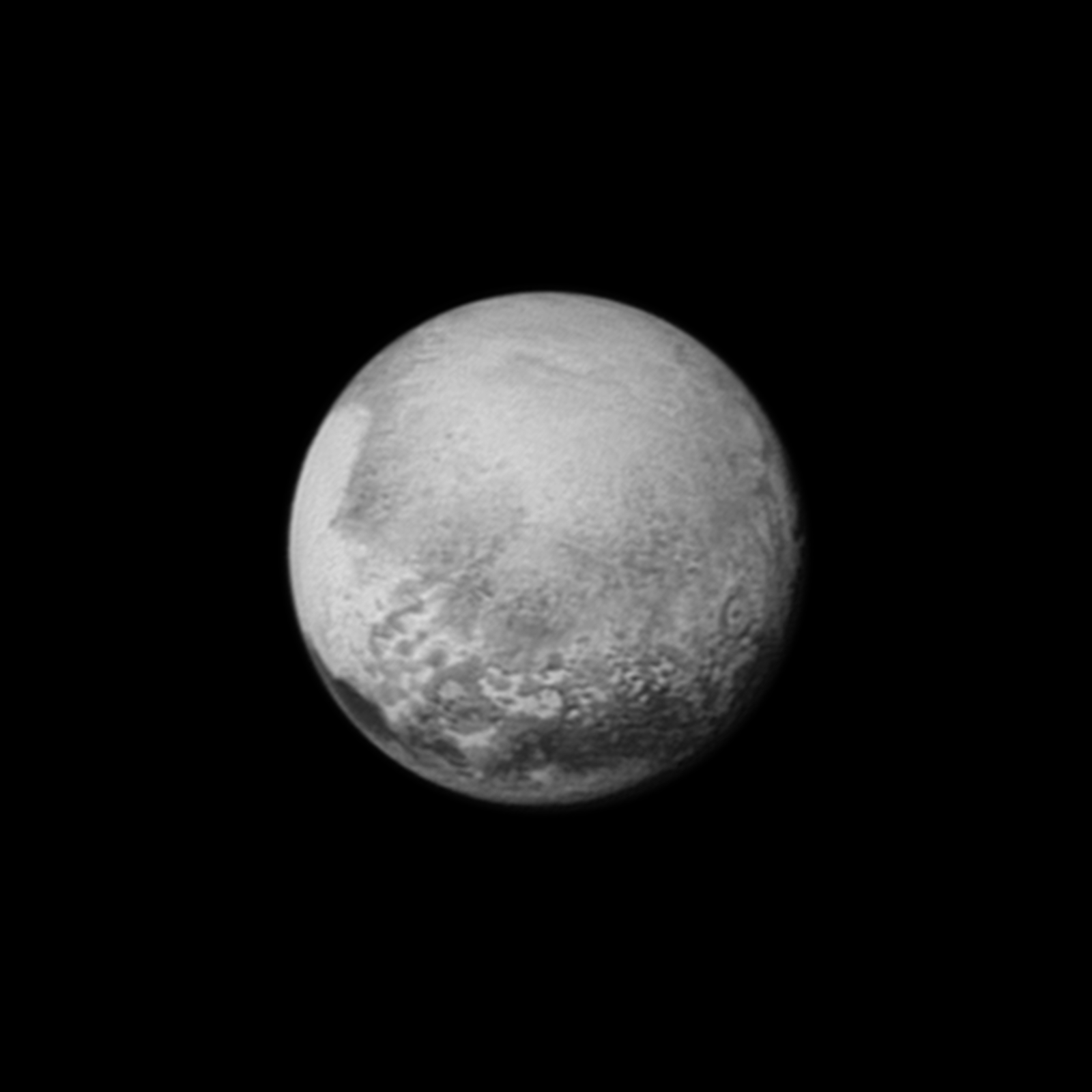
Last image of Pluto posted before the encounter. Note that the “Heart” is rotating into view on the left. Credit: NASA/Johns Hopkins University Applied Physics Laboratory/Southwest Research Institute. Click on image to enlarge.
07/13/2015 – Ephemeris – New Horizons’ encounter with Pluto just 1 day to go!
Ephemeris for Monday, July 13th. Today the Sun will be up for 15 hours and 17 minutes, setting at 9:27. The Moon, 2 days before new, will rise at 5:05 tomorrow morning, and tomorrow the Sun will rise at 6:10.
The New Horizons spacecraft is hopefully Go for its encounter with Pluto and its moons tomorrow morning (July 14, 2015), and tomorrow New Horizons will be working in radio silence because it will be too busy to turn and relay anything to the Earth. Tomorrow evening we should get a signal from the spacecraft with engineering data on its survival of the encounter. Any photographs will be sent starting Wednesday. Pretty pictures are not the only data to be sent back. It will take 16 months to get all the data sent back. A series of highly compressed images will be sent for the next 6 days. Then other data will be taking priority until September 14th when photographs will again be sent. We’ll be feasting on the information for quite some time.
Times are for the Traverse City/Interlochen area of Michigan. They may be different for your location.
Addendum
The following images are shown in chronological order as New Horizons approaches Pluto and Charon. Click on any of these images to enlarge.
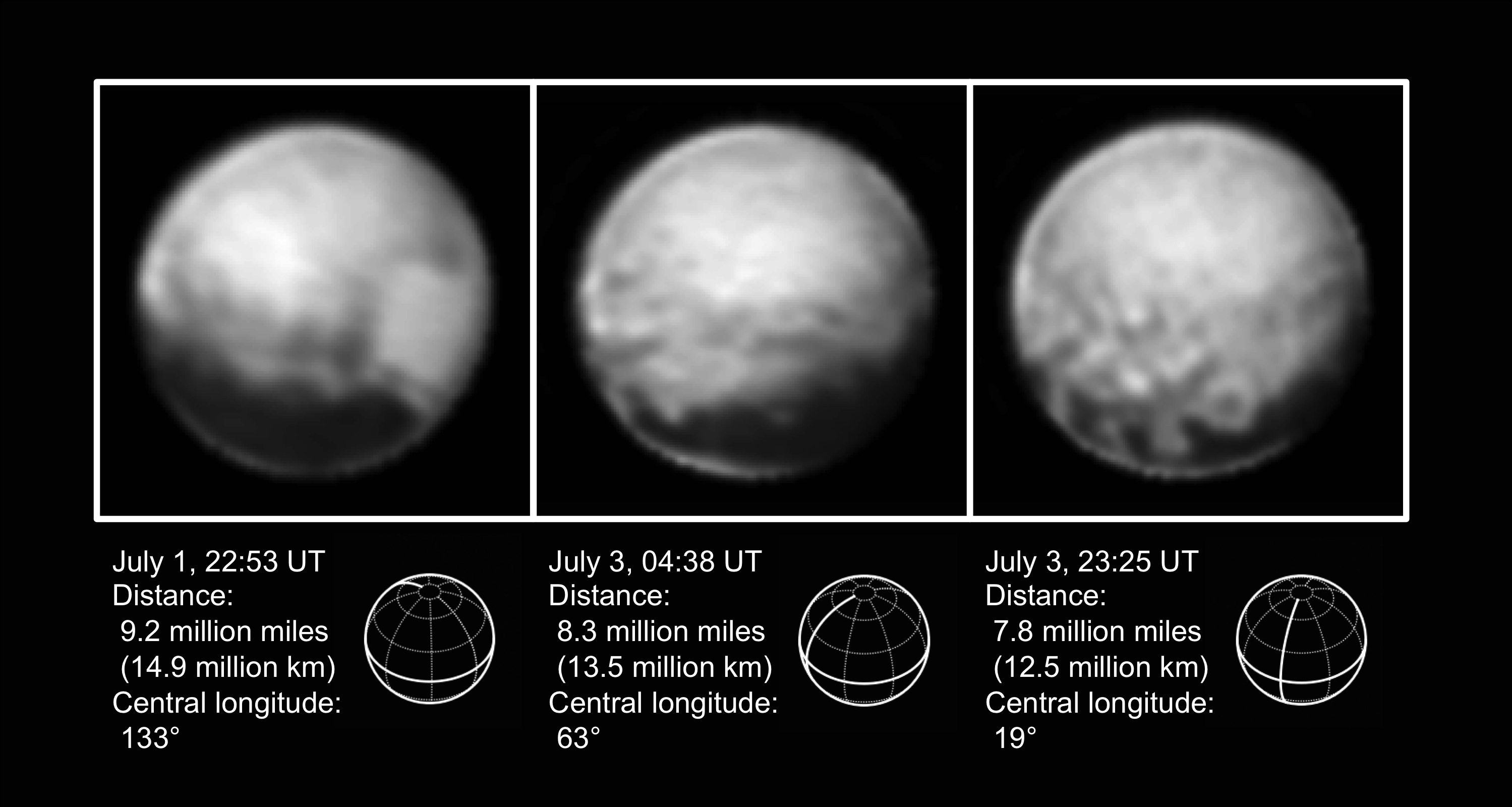
Pluto on three consecutive days: July 2-3 as the Pluto rotates not quite half a rotation. It’s rotation period is 6.4 Earth-days. Credit: NASA/Johns Hopkins University Applied Physics Laboratory/Southwest Research Institute.
On July 4, the spacecraft went into safe mode. Imaging resumed on July 8th.

Pluto on July 8th showing its love for us, or it’s just a heart-shaped feature on Pluto’s lower right edge. This is a back & white image colorized by information captured by “Ralph”, a visible and infrared imager. The detail in all these pictures is provided by LORRI the long-range imager. Credit: NASA/Johns Hopkins University Applied Physics Laboratory/Southwest Research Institute.
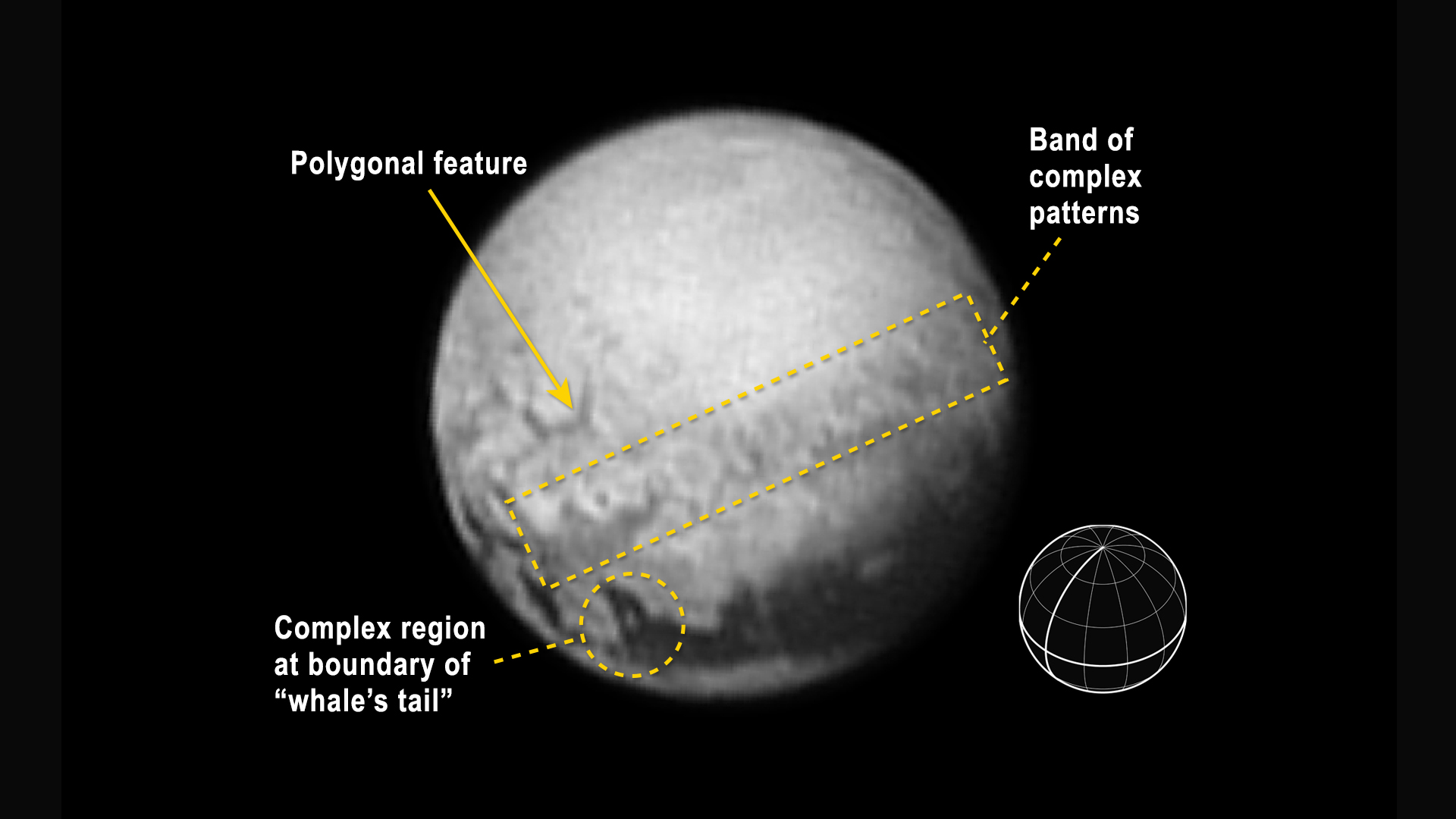
An annotated image from July 10. The rest of the “whale” can be seen impinging on the “heart” in the July 8 image. Credit: NASA/Johns Hopkins University Applied Physics Laboratory/Southwest Research Institute.

Pluto on July 11. Note the four mysterious dark spots along the bottom right of the disk. Credit: NASA/Johns Hopkins University Applied Physics Laboratory/Southwest Research Institute.
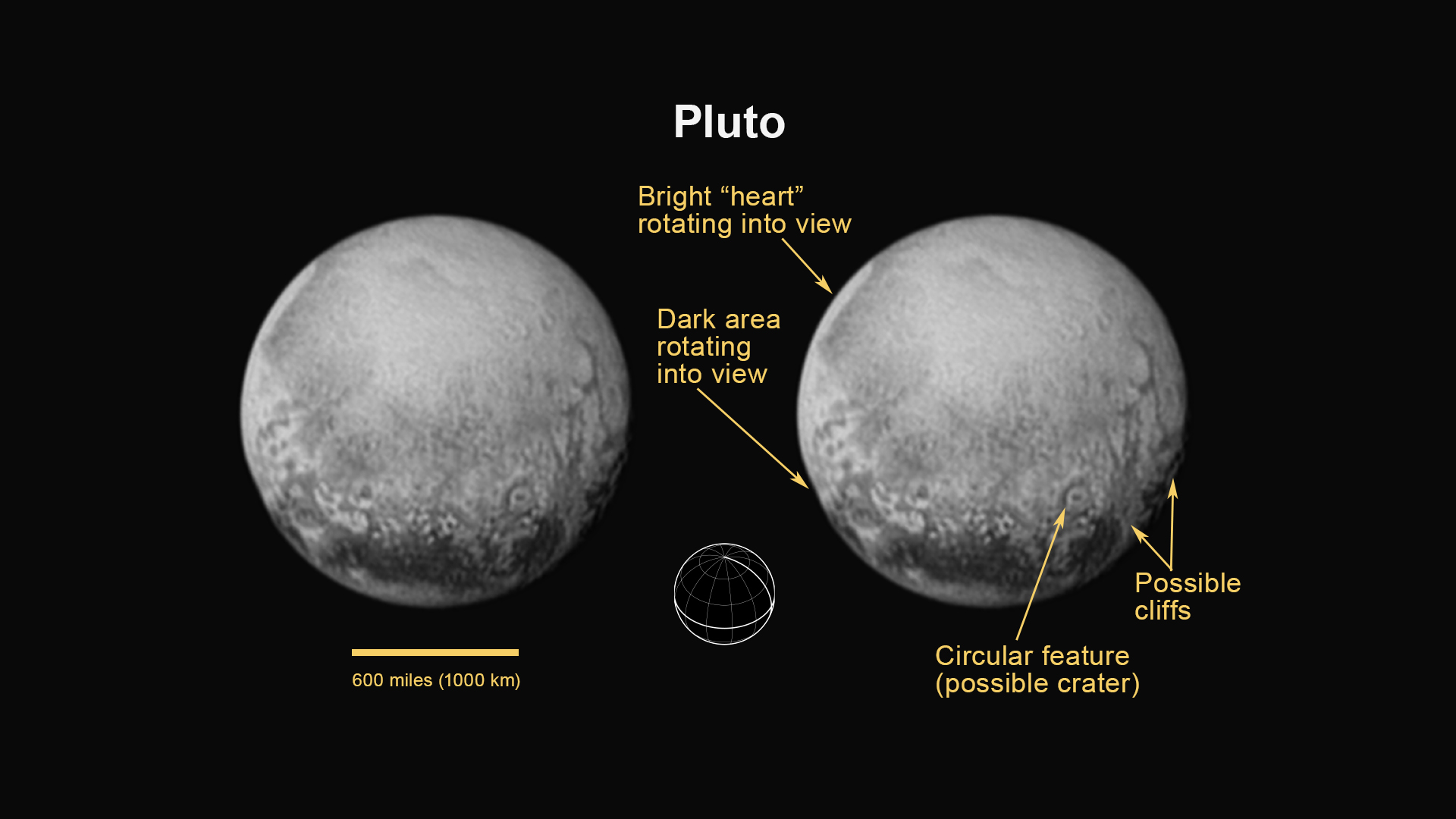
Pluto image annotated for July 12 (2 days before encounter). The features on the right are intriguing, but we’ll have to wait for the next mission to resolve. New Horizons can’t stop. Credit: NASA/Johns Hopkins University Applied Physics Laboratory/Southwest Research Institute.
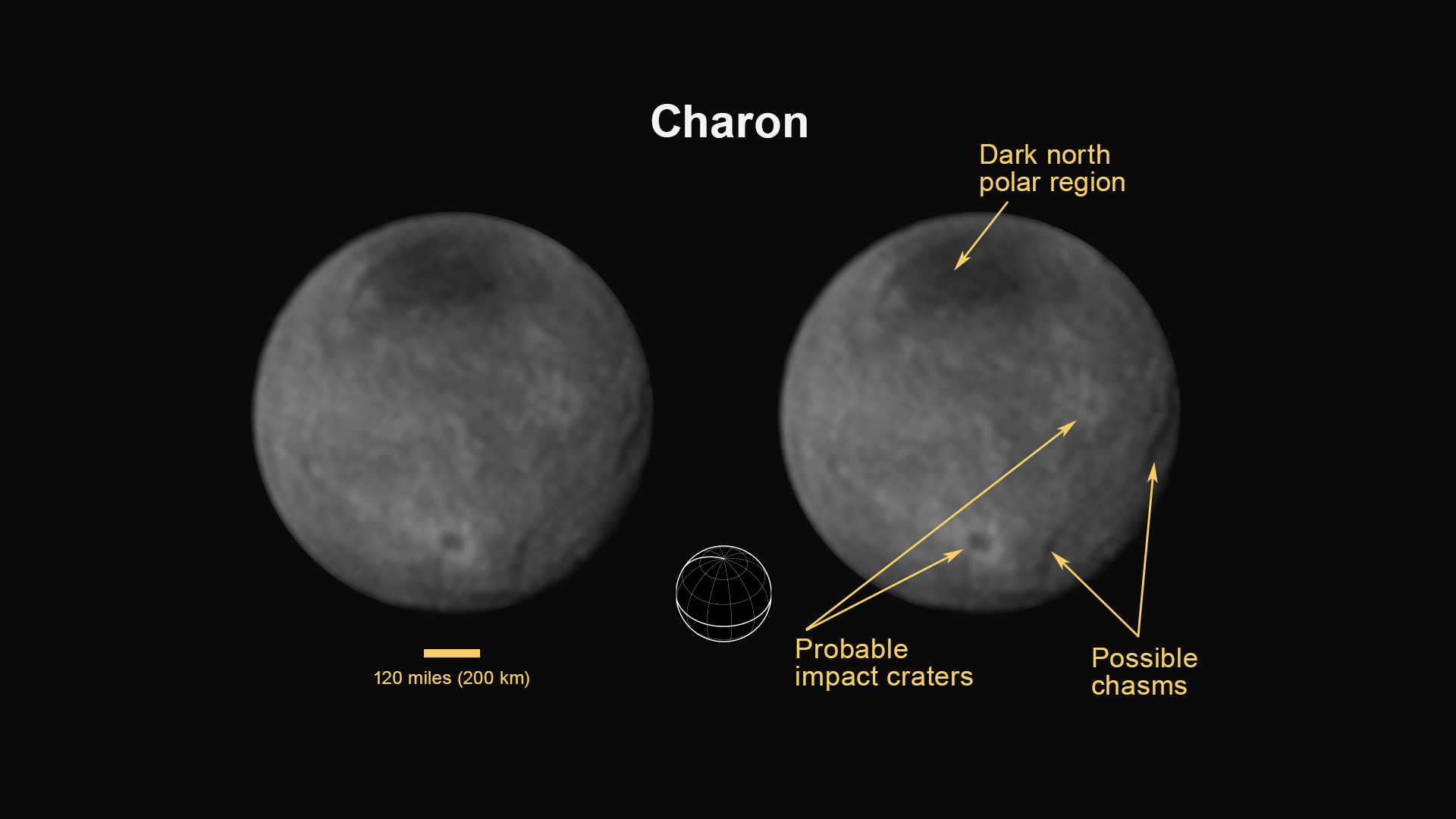
The moon Charon on July 12 with some of its features noted. Credit: NASA/Johns Hopkins University Applied Physics Laboratory/Southwest Research Institute.
07/07/2015 – Ephemeris – New Horizons will resume science gathering after glitch July 4th.
Ephemeris for Tuesday, July 7th. Today the Sun will be up for 15 hours and 25 minutes, setting at 9:30. The Moon, 1 day before last quarter, will rise at 12:56 tomorrow morning. Tomorrow the Sun will rise at 6:05.
On July 4th, the New Horizons spacecraft, now one week from is flyby of Pluto, suffered a glitch and went into safe mode. It, however switched to its backup computer, and is now in contact with the Earth. Sunday night it was determined that the problem was a timing flaw in a command sequence preparing for Pluto encounter. Normal spacecraft operations will resume today. Two way communication time is now nearly 9 hours, almost half a day. Earth day that is. New Horizons is approaching Pluto at 31,000 miles an hour. The spacecraft will have only a few hours to observe Pluto and its moons at their closest next Tuesday. It’s getting down to crunch time for the little spacecraft.
Times are for the Traverse City/Interlochen area of Michigan. They may be different for your location.
Addendum
I wrote Tuesday’s program Sunday night before the announcement that the problem with New Horizons was found and the spacecraft would back to normal on Tuesday. I found that out just before recording the programs, and had to do a quick fix. With New Horizons problems found, I could write the July 13th program I had planned. I write and record 5 programs at a time – Tuesday through Monday.

Artist’s rendition credit NASA.
06/18/2015 – Ephemeris – 26 days to Pluto!
Ephemeris for Thursday, June 18th. Today the Sun will be up for 15 hours and 34 minutes, setting at 9:31. The Moon, 2 days past new, will set at 10:57 this evening. Tomorrow the Sun will rise at 5:56.
I hope everyone’s been following the progress of the New Horizons spacecraft as it nears the Pluto system. It will reach and pass through the Pluto system on July 14th, only 26 days from now after a journey of 9 years. Now, Pluto is more than a dot in the probe’s cameras, which are used to look for possible hazardous rings of debris, more moons and for navigational purposes. New Horizons is aimed for a window less than a hundred miles on a side, and a few minutes in time. All its moves to study Pluto and its moons have been pre-programmed in and actually tested two years ago to make sure everything works. We will not hear from the spacecraft on encounter day, it will be too busy.
Times are for the Traverse City/Interlochen area of Michigan. They may be different for your location.
Addendum
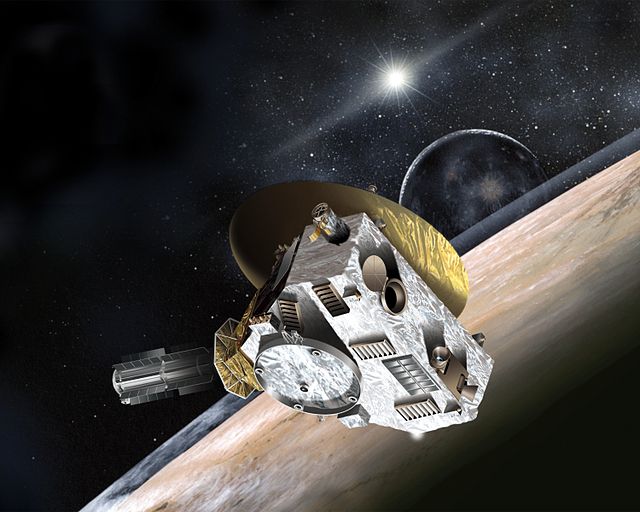
Artist conception of the New Horizons spacecraft at Pluto. Credit: NASA/Johns Hopkins University Applied Physics Laboratory/Southwest Research Institute
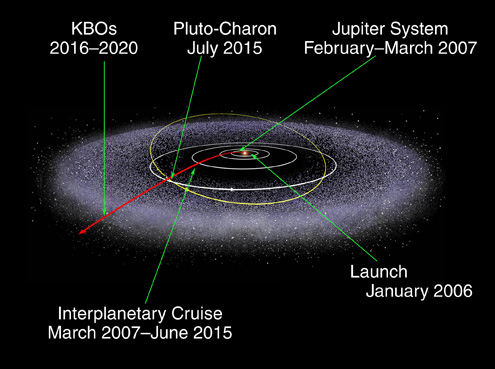
New Horizon’s trajectory through the solar system. Credit: NASA/APL.
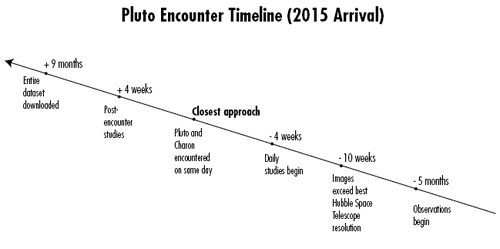
New Horizons Encounter Timeline. Credit: NASA/JHAPL.
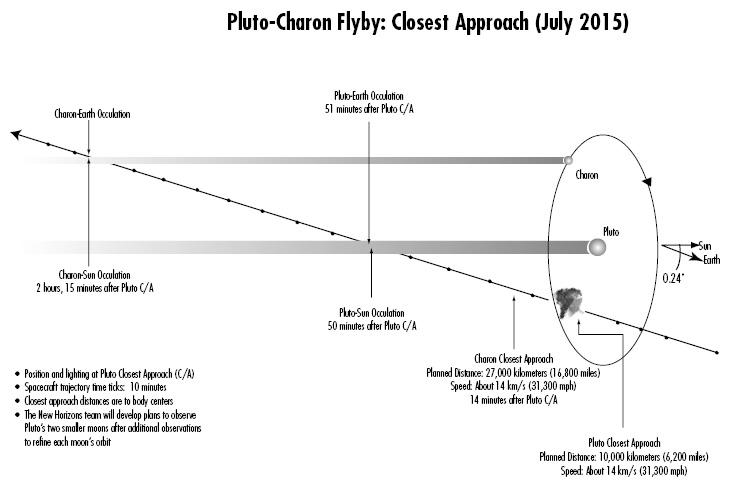
New Horizons at closest approach to Pluto. Credit: NASA/JHAPL.
 Bob Moler's Ephemeris Blog