Archive
06/09/2015 – Ephemeris – What’s Pluto Time?
Ephemeris for Tuesday, June 9th. Today the Sun will be up for 15 hours and 29 minutes, setting at 9:27. The Moon, at last quarter today, will rise at 2:19 tomorrow morning. Tomorrow the Sun will rise at 5:57.
This weekend I received several messages from the New Horizons team and others about Pluto Time. New Horizons is the spacecraft that will pass through the Pluto system in a bit more than 5 weeks from now. Pluto Time is the time of day when the landscape around you is lit up as much as the Sun lights up Pluto’s surface from nearly 33 times the Earth’s distance from the sun. The Sun’s intensity is a bit less than a thousandths that which it appears from the Earth, but still reasonably bright. For around the northern lower peninsula it’s about 6 minutes after sunset or before sunrise. To check out the time for yourself go to solarsystem.nasa.gov/plutotime, or use the link from my blog.
Times are for the Traverse City/Interlochen area of Michigan. They may be different for your location.
Addendum
Header for Pluto Time Page. Credit NASA.
Phil Plait yesterday had a post about Pluto Time and a free iPhone and Android app called Pluto Safari.
Also check out the New Horizons Twitter feed @NewHorizons2015.
04/23/2015 – Ephemeris – New Horizons’ first glimpse of Pluto and Charon in color
Ephemeris for Thursday, April 23rd. Today the Sun will be up for 13 hours and 52 minutes, setting at 8:37. The Moon, 2 days before first quarter, will set at 1:44 tomorrow morning. Tomorrow the Sun will rise at 6:43.
Last week NASA’s New Horizons team running the spacecraft that’s been in flight to the dwarf planet Pluto released their first color of Pluto and it’s moon Charon. The photo doesn’t show any surface features. That’s to come in the next month or two. However, Pluto shows kind of a pale orange-pink color, hinting of the colorful images to come. Charon is a dull gray like the dwarf planet Ceres, which Dawn is approaching, and our own Moon. How could two bodies with a common origin appear so different? Stay tuned. New Horizons will pass through the Pluto system in a couple of hours on July 14th, but will send back the mother lode of its data over the next 16 months.
Times are for the Traverse City/Interlochen area of Michigan. They may be different for your location.
Addendum

First color picture of Pluto and its moon Charon taken by the New Horizons spacecraft. Credit: NASA/Johns Hopkins University Applied Physics Laboratory/Southwest Research Institute. Click to enlarge.
From the NASA website:
“This image of Pluto and its largest moon, Charon, was taken by the Ralph color imager aboard NASA’s New Horizons spacecraft on April 9 and downlinked to Earth the following day. It is the first color image ever made of the Pluto system by a spacecraft on approach. The image is a preliminary reconstruction, which will be refined later by the New Horizons science team. Clearly visible are both Pluto and the Texas-sized Charon. The image was made from a distance of about 71 million miles (115 million kilometers)—roughly the distance from the Sun to Venus. At this distance, neither Pluto nor Charon is well resolved by the color imager, but their distinctly different appearances can be seen. As New Horizons approaches its flyby of Pluto on July 14, it will deliver color images that eventually show surface features as small as a few miles across.”
03/06/2015 – Ephemeris – Learn about this year’s adventures in exploring the soiar system tonight
Ephemeris for Friday, March 6th. The Sun will rise at 7:12. It’ll be up for 11 hours and 24 minutes, setting at 6:36. The Moon, 1 day past full, will rise at 7:47 this evening.
This evening yours truly will be giving a program at the monthly meeting of the Grand Traverse Astronomical Society at 8 p.m. at Northwestern Michigan College’s Rogers Observatory. It’s entitled Asteroids and Dwarf Planets and Comets, oh my! It’s about the three solar system bodies being visited this year by spacecraft from NASA and the European Space Agency. The asteroid is Ceres, which the Dawn spacecraft entered orbit of today. The dwarf planet is Pluto which is the target of a summer flyby by the New Horizon spacecraft. The comet is 67P/Churyumov–Gerasimenko orbited by ESA’s Rosetta spacecraft. There will be a star party at 9 p.m. following the meeting.
Times are for the Traverse City/Interlochen area of Michigan. They may be different for your location.
Addendum

Apologies to MGM.
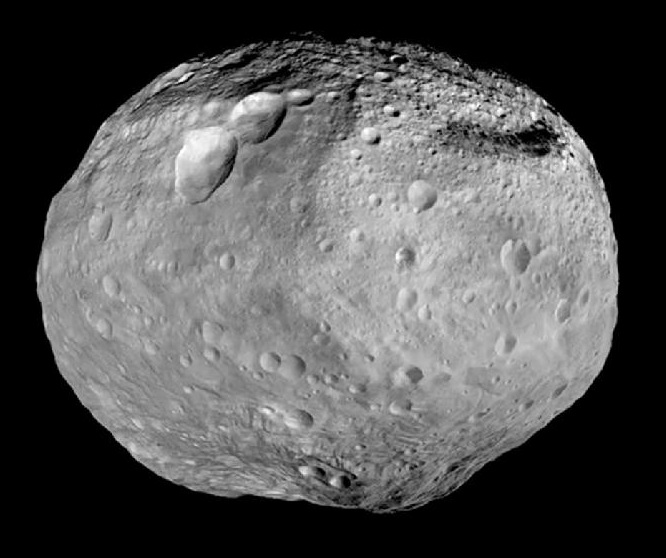
Looking back at Vesta as Dawn headed off to Ceres. Credit: NASA/JPL-Caltech/UCAL/MPS/DLR/IDA
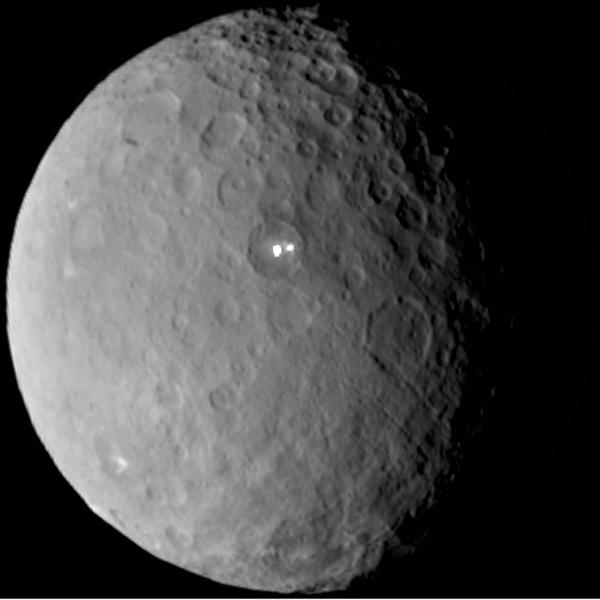
The bright spot is two. Picture taken February 19, 2015 from 29,000 miles (46,700 km). Credit: NASA/JPL-Caltech/UCLA/MPS/DLR/IDA.
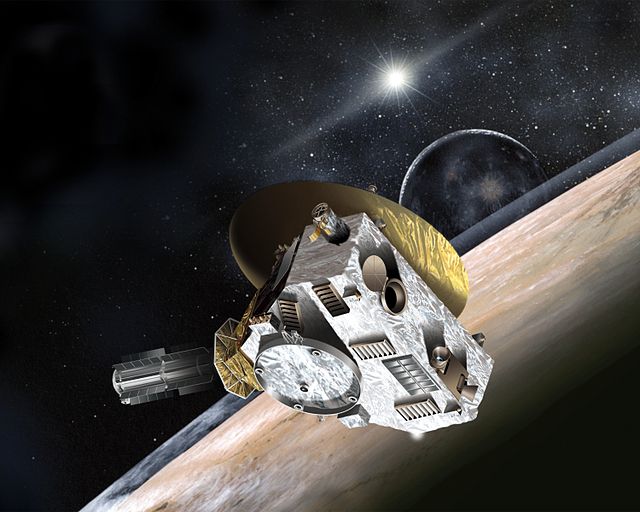
Artist conception of the New Horizons spacecraft at Pluto. Credit: NASA/Johns Hopkins University Applied Physics Laboratory/Southwest Research Institute
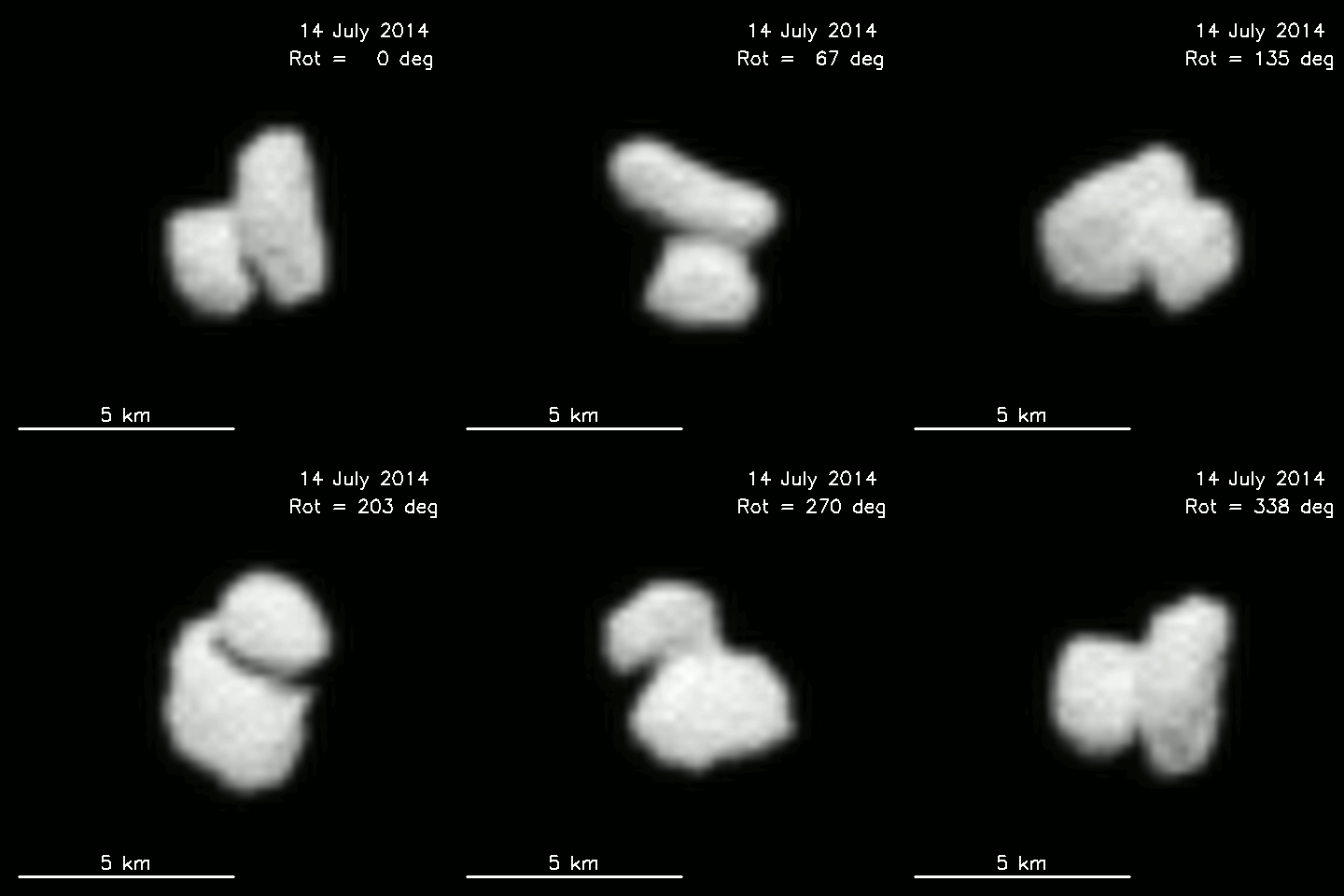
An animation of Comet 67p/Churyumov–Gerasimenko rotation on July 14, 2014. The 30 pixel wide image has been smoothed. The Rotation rate is 1 rotation every 12.4 hours. Credits: ESA/Rosetta/MPS for OSIRIS Team MPS/UPD/LAM/IAA/SSO/INTA/UPM/DASP/IDA
12/30/2014 – Ephemeris – Looking ahead at some local and space astronomical events in 2015
Ephemeris for Tuesday, December 30th. The sun will rise at 8:19. It’ll be up for 8 hours and 51 minutes, setting at 5:11. The moon, 2 days past first quarter, will set at 3:38 tomorrow morning.
Let’s look ahead at a few astronomical and space events that will take place in 2015. Visible for us will be the partial phase of a lunar eclipse in morning twilight of April 4th, plus there’s a total lunar eclipse visible during the evening hours of September 27th. Out in space in the asteroid belt the Dawn spacecraft will enter orbit of Ceres, the largest asteroid and dwarf planet Ceres, a spherical world of rock and ice in April. Further out past the last planet the New Horizons spacecraft will fly by the dwarf planet Pluto and its system of at least 5 satellites: Charon, Nix, Hydra, Styx, and Kerberos on July 14th. It will take several months to transmit the data and images back to Earth after which the spacecraft will be redirected to a new target.
Times are for the Traverse City/Interlochen area of Michigan. They may be different for your location.
Addendum
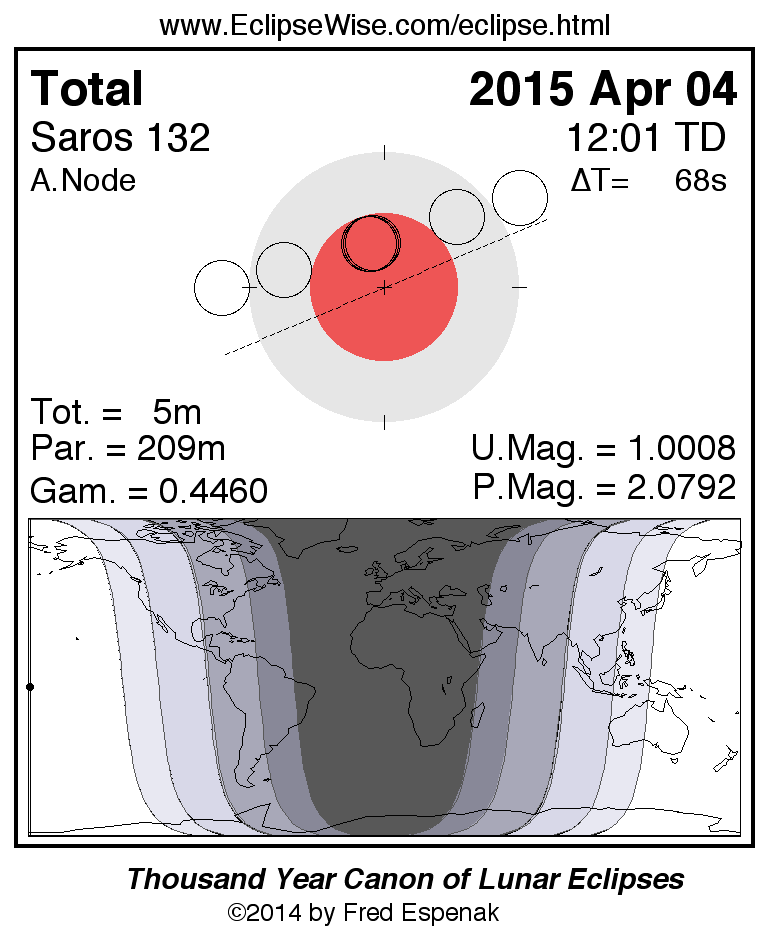
Chart for the total lunar eclipse of April 4, 2015. In Michigan we will see on;y the beginning partial phase in morning twilight. Credit: Fred Espenak, NASA/GSFC
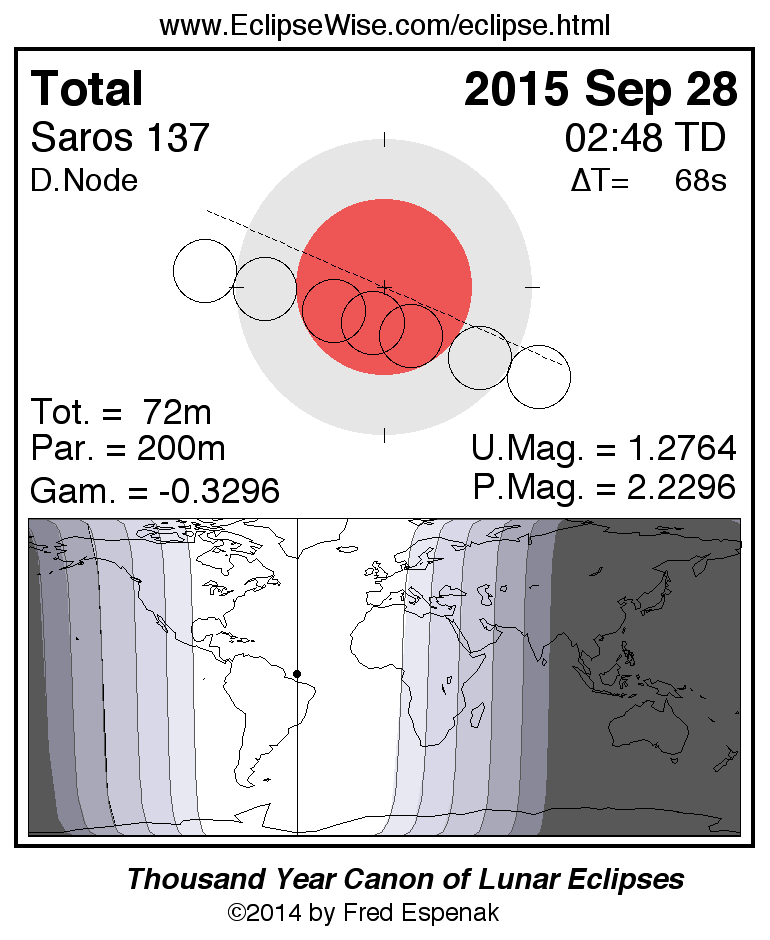
Chart for the total lunar eclipse of September 28, 2015. This is the evening of the 27th, EDT in Michigan. Credit: Fred Espenak, NASA/GSFC.
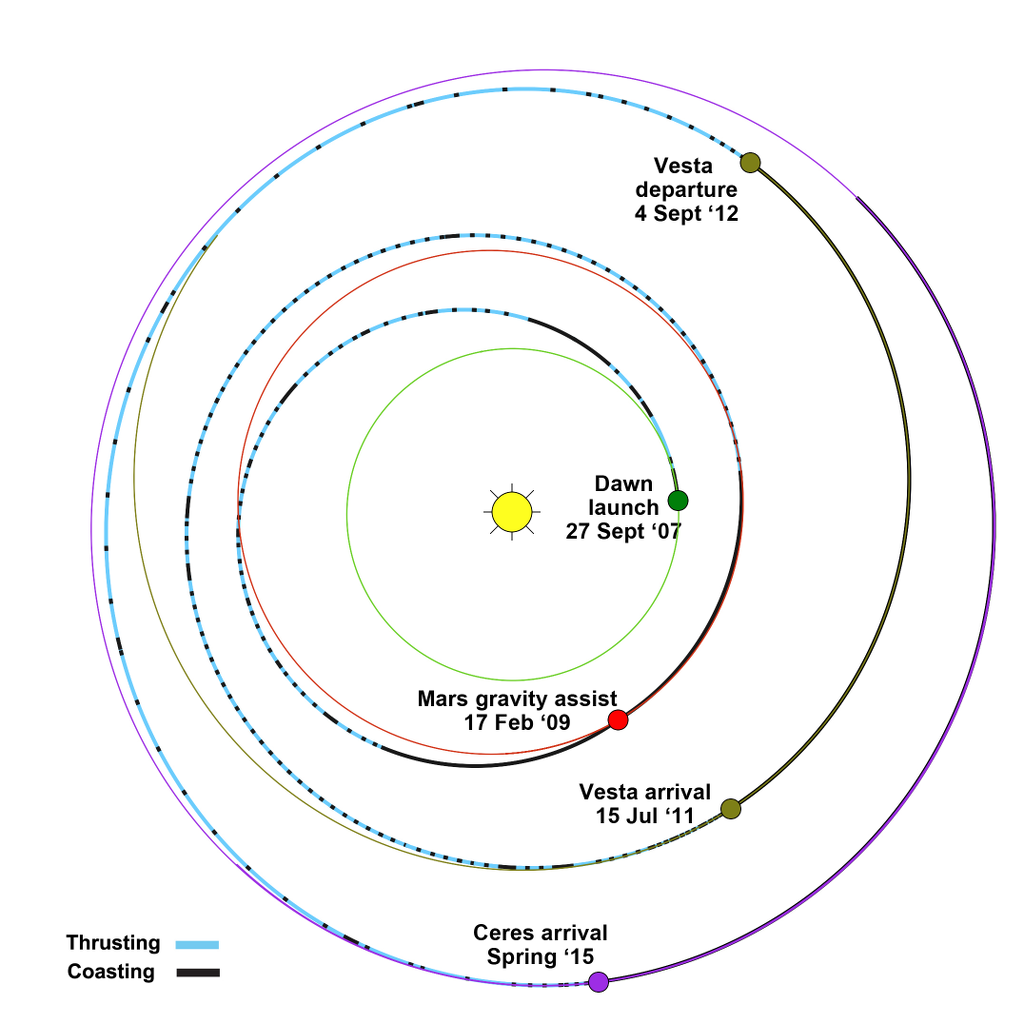
Dawn orbital track past Mars, stopping at Vesta and continuing to Ceres. Credit: NASA/JPL.
Artist conception of the New Horizons spacecraft at Pluto. Credit: NASA/Johns Hopkins University Applied Physics Laboratory/Southwest Research Institute
11/06/2014 – Ephemeris – New Horizons headed toward the 9th planet will pass a dwarf planet instead
Ephemeris for Thursday, November 6th. The sun will rise at 7:26. It’ll be up for 9 hours and 57 minutes, setting at 5:24. The moon, at full today, will rise at 5:32 this evening.
The New Horizons spacecraft is 9 months from reaching the dwarf planet Pluto. After a 9 and a half years journey it will zip past Pluto and its moons in a day. At launch Pluto was designated as planet number 9. In less than a year later Pluto was demoted to a dwarf planet. The authority was the International Astronomical Union. It was a vote taken at the end of the last day of the meeting that year after most members have left. The definitions only pertain to the solar system, and not exoplanets orbiting other stars. Besides we cannot detect anything as small as Pluto orbiting another star…yet. The asteroid Ceres was once a planet too, it was demoted to asteroid 75 years after discovery. It was promoted to a dwarf planet with Pluto.
Times are for the Traverse City/Interlochen area of Michigan. They may be different for your location.
Addendum

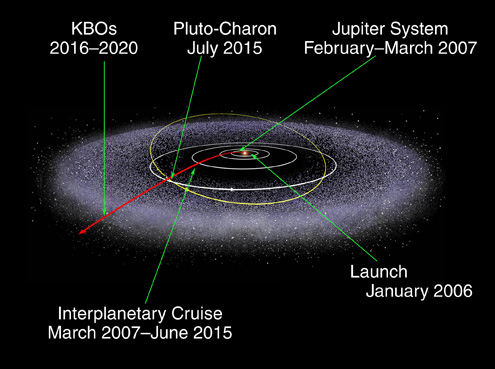
New Horizon’s trajectory through the solar system. Credit: NASA/JHAPL.
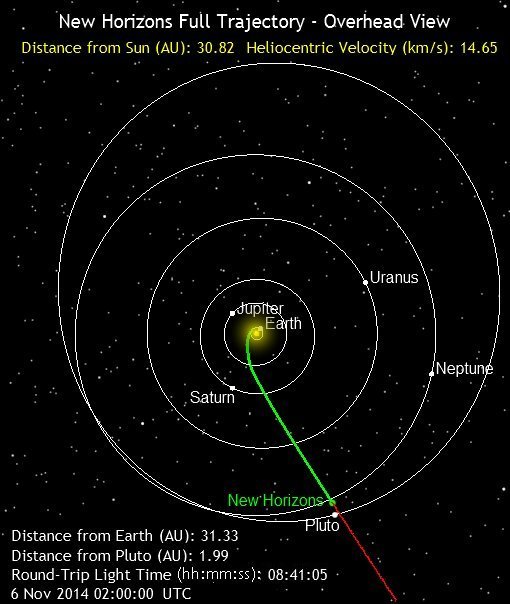
Where is New Horizons on November 6, 2014? Credit NASA/JHAPL.
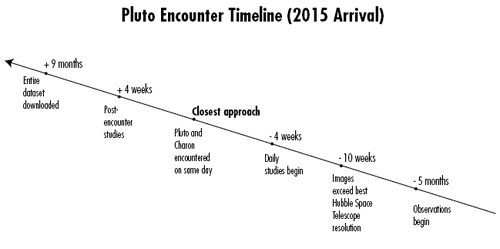
New Horizons Encounter Timeline. Credit: NASA/JHAPL.
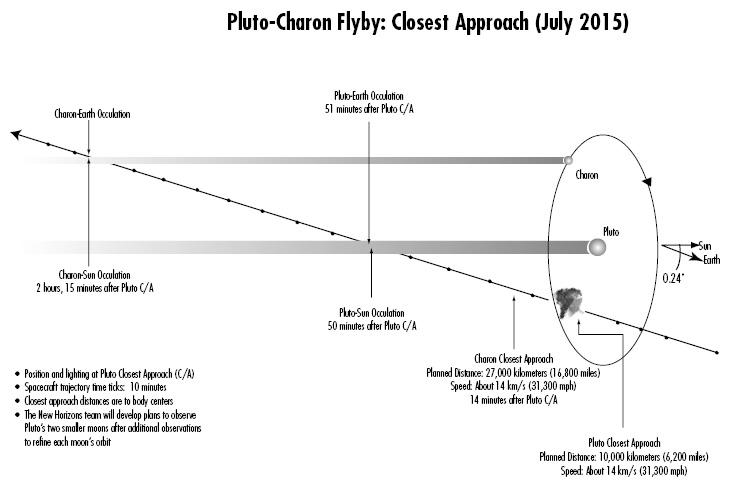
New Horizons at closest approach to Pluto. Credit: NASA/JHAPL.
07/14/2014 – Ephemeris – New Horizons to Pluto: 1 year and counting!
Ephemeris for Monday, July 14th. Today the sun will be up for 15 hours and 14 minutes, setting at 9:25. The moon, 2 days past full, will rise at 10:45 this evening. Tomorrow the sun will rise at 6:11.
Exactly one year from today the New Horizons spacecraft will fly by the dwarf planet Pluto. It will be taking photographs of Pluto and its moons, sniffing out Pluto and its large moon Charon. During most of the close flyby the spacecraft will be too busy to talk to Earth. When past Pluto the spacecraft will be able over the next few months to down-link to us all its information. At that great distance it must send data back to us with a transmission speed will make the old 300 baud modems of three decades ago seem fast. Recently the Hubble Space Telescope has been pressed into service to spot new targets beyond Pluto for New Horizons. It quickly found two, and is looking for more.
Times are for the Traverse City/Interlochen area of Michigan. They may be different for your location.
Addendum
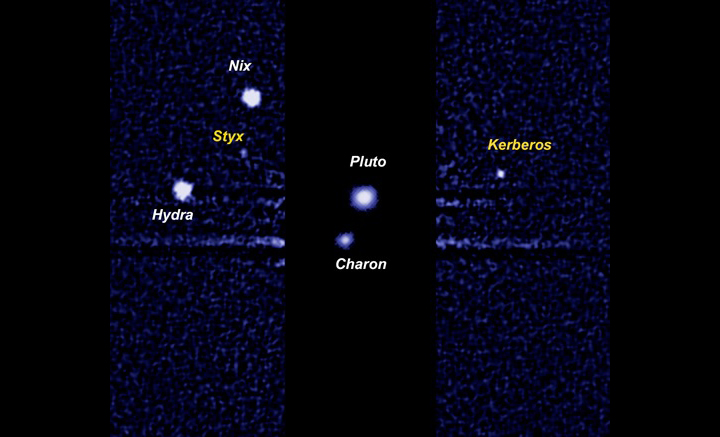
Pluto and its moons as photographed by the Hubble Space Telescope. Pluto and Charon were filtered to reduce their brightness to bring out the other dim moons. Credit: NASA/Hubble.
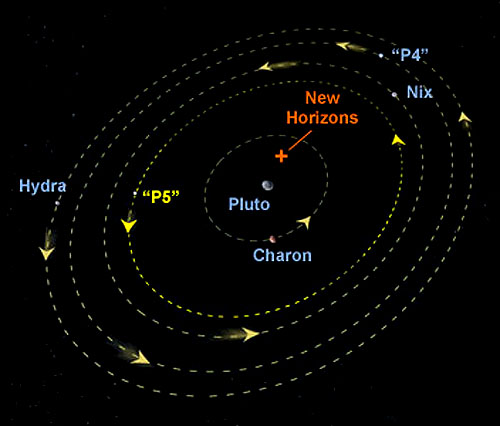
New Horizon’s aim point in relation to the moons. This was created before P4 and P5 received names. P4 became Styx, and P5 became Kerberos. Credit: NASA/GSFC.
When more and more moons were discovered around Pluto serious consideration was given to steer clear of the moon orbits. It is quite possible that there is much debris orbiting Pluto where all these satellites are. They all orbit Pluto in the same plane, along with Charon, above Pluto’s equator. It is thought that any material streaming toward Pluto would be intercepted by Charon, so the space between Charon and Pluto might be clear of debris, so New Horizons can punch through in safety. New Horizons is going like a bat out of heck and has no brakes. New Horizon’s velocity with respect to Pluto at closest approach will be 49,600 kilometers per hour or 30,800 mph according to the New Horizons article on Wikipedia (no citation given). The path of the spacecraft can be altered is a moon or other hazard is detected.
Artist conception of the New Horizons spacecraft at Pluto. Credit: NASA/Johns Hopkins University Applied Physics Laboratory/Southwest Research Institute.
New Horizon’s web page: http://pluto.jhuapl.edu/
 Bob Moler's Ephemeris Blog