Archive
10/18/2022 – Ephemeris – The Great Andromeda Galaxy
Oct 18. This is Bob Moler with Ephemeris for Tuesday, October 18th. Today the Sun will be up for 10 hours and 50 minutes, setting at 6:52, and it will rise tomorrow at 8:03. The Moon, 1 day past last quarter, will rise at 1:22 tomorrow morning.
The closest large galaxy to our Milky Way galaxy is the Great Andromeda Galaxy, seen in the eastern sky when it gets dark. It is barely visible to the naked eye. To locate it, first find the Great Square of Pegasus high in the east, standing on one corner. The left star of the square is the head of the constellation Andromeda. Follow two stars to the left and a bit downward, then two stars straight up. The galaxy is near that last star as a small smudge of light. Binoculars are the best way to see it as a thin spindle of light. Visually through a telescope, one can see only the bright nucleus of the galaxy, that spans six Moon diameters in photographs. M 31* is its most well known catalog designation, and it’s two and a half million light years away.
The astronomical event times given are for the Traverse City/Interlochen area of Michigan (EDT, UT – 4 hours). They may be different for your location.
* M 31 is the 31st entry in French comet hunter Charles Messier’s catalog of fuzzy objects that can be mistaken for comets because they didn’t move in relation to the stars. It is a catalog of some of the brightest, what we call, deep sky objects: star clusters, nebulae, and galaxies. It is not a comprehensive catalog of these objects, since Messier was interested in comets.
Addendum
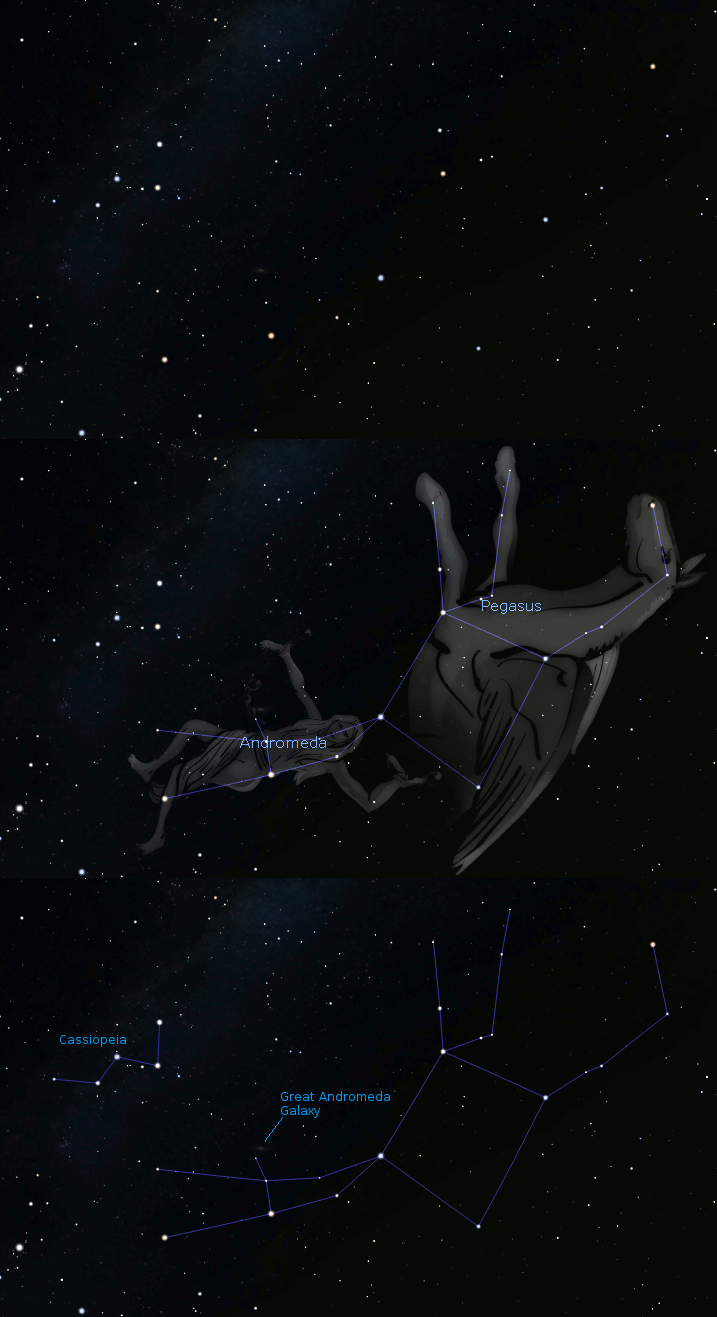
Andromeda animated finder, including the Great Andromeda Galaxy. I’ve added Cassiopeia that some folks use to find the galaxy. I start with the leftmost star of the Great Square of Pegasus that connects to Andromeda. I count off two stars on the lower curve because they are brighter than the upper curve. Then count two stars up. Next to that top star is a little smudge. That is the core of the Great Andromeda Galaxy. Click on the image to enlarge to full size. Created using Stellarium and GIMP.
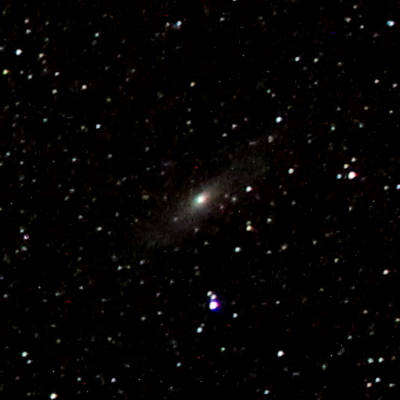
Low resolution and exposure view of M 31, the Great Andromeda Galaxy, simulating what it looks like in binoculars. Credit mine.
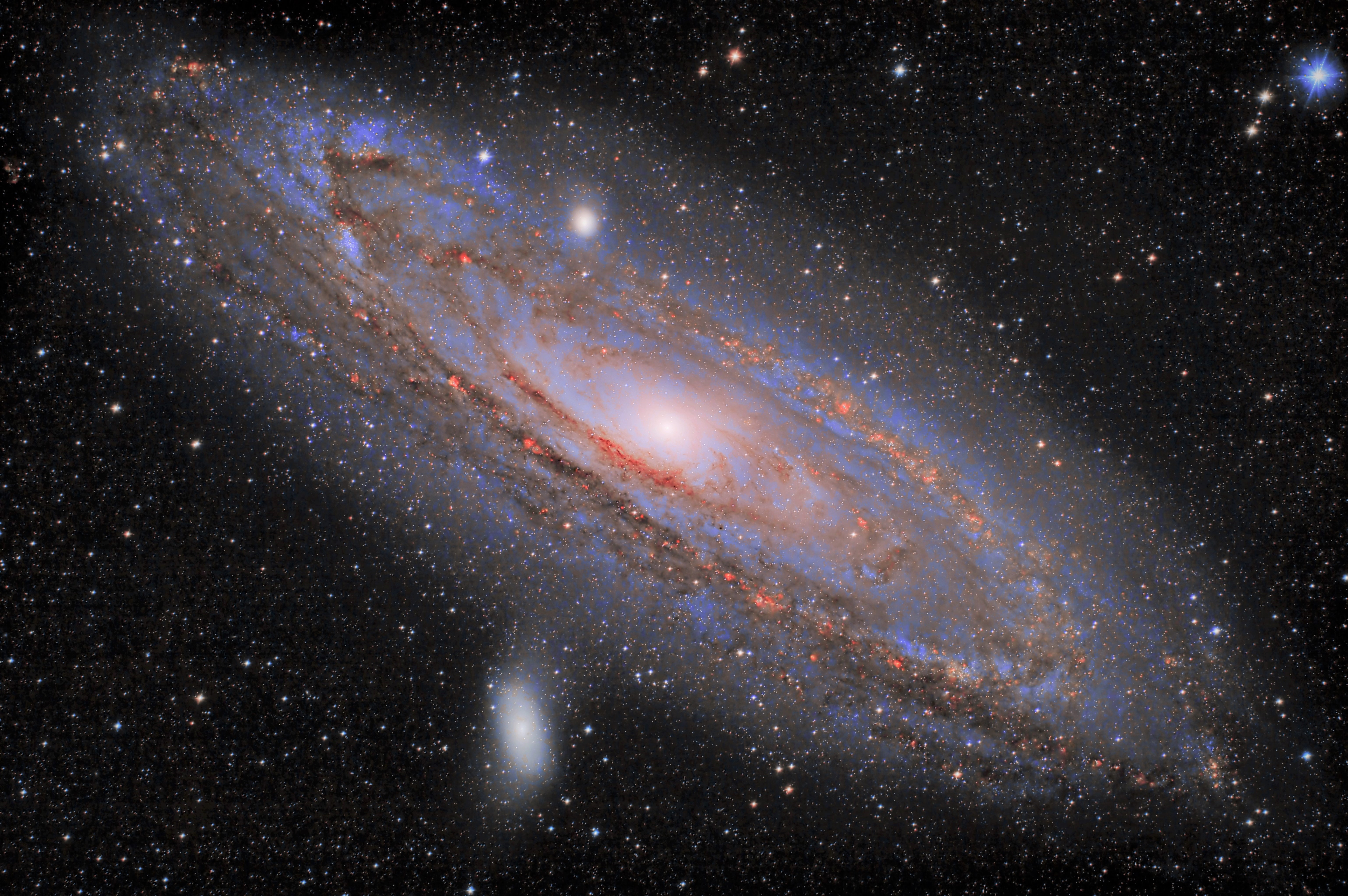
M 31, The Great Andromeda Galaxy. This image really shows the red H II Regions intermixed with the dark dust lanes that delineate the galaxy’s spiral arms. H II or ionized hydrogen regions are illuminated by hot young stars that were born within them. Click on the image to enlarge it. Credit: Dan Dall’Olmo.
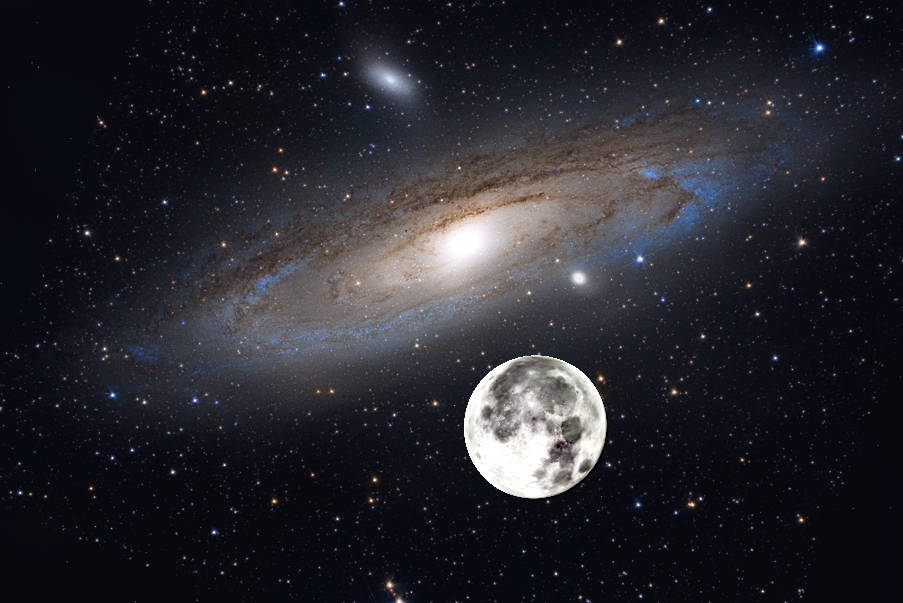
The moon superimposed on the Great Andromeda Galaxy, M31, for apparent size comparison. Created using Stellarium and the embedded image of the galaxy with that of the full Moon of October 31, 2020. M31 Image credit: Herm Perez: http://home.att.net/~hermperez/default.htm License: “Feel free to use these images, if you use them in a commercial setting please attribute the source.”
The Great Andromeda Galaxy is shown with two of its satellite galaxies, both elliptical. The nearly spherical one is M 32. The other one I knew and observed, in the 1950s, as NGC 205**. Even though Messier had described this object in 1773, he didn’t add it to his catalog. The suggestion that it be added as the last entry in Messier’s catalog was made in 1967 by Welsh amateur astronomer Kenneth Glyn Jones***
** NGC is the New General Catalogue of Nebulae and Clusters of Stars, and is not so new. It was published in 1888 by John Louis Emil Dreyer.
*** Source: messier-objects.com
 Bob Moler's Ephemeris Blog