Archive
03/19/2015 – Ephemeris – A remarkable solar eclipse tomorrow, however we, in the US, won’t see it.
Ephemeris for Thursday, March 19th. The Sun will rise at 7:48. It’ll be up for 12 hours and 5 minutes, setting at 7:53. The Moon, 1 day before new, will rise at 7:50 tomorrow morning.
There will be a rare solar eclipse tomorrow. The bad news is that it won’t be visible from here. Be that as it may, it is total for a circle of ocean near Greenland, and because tomorrow is also the vernal equinox the it is also sunrise at the north pole. As it happens the path of the eclipses totality tracks to the north pole, so the eclipse, partial and total will be visible from there. I’m not sure how long it’s been since an eclipse totality was visible at the pole on an equinox. The next solar eclipse visible from the United States will be on August 21, 2017. This is an eclipse, whose path of totality crosses the continental United States. In about 2 weeks we’ll have a lunar eclipse whose first stages can be seen from northern Michigan in morning twilight.
Times are for the Traverse City/Interlochen area of Michigan. They may be different for your location.
Addendum
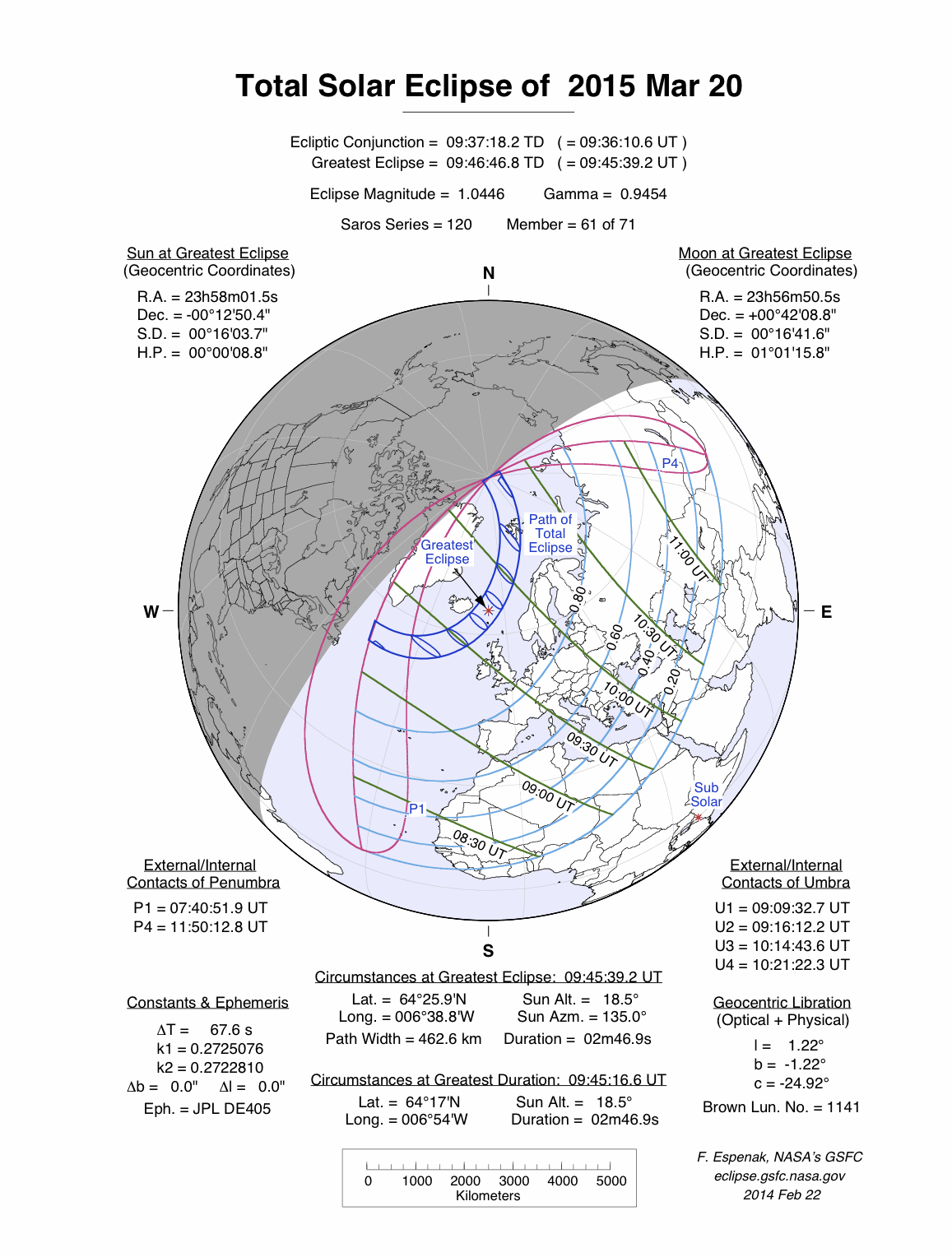
Pertinent section of the March 20, 2015 total solar Eclipse map. Click on image above for the entire image. Credit: Fred Espenak, NASA’s GSFC.
01/12/2015 – Ephemeris – The world’s faorite constellation: Orion
Ephemeris for Monday, January 12th. The sun will rise at 8:18. It’ll be up for 9 hours and 6 minutes, setting at 5:24. The moon, 1 day before last quarter, will rise at 1:02 tomorrow morning.
For people the world over who look up and recognize the brighter constellations Orion is perhaps the odd on favorite. The Big Dipper, a favorite in the northern hemisphere, cannot be easily seen south of the equator. The Southern Cross cannot be easily be seen north of the equator. Orion, or parts of him can be seen from pole to pole because he straddles the equator of the sky. It has 7 bright stars like the Big Dipper, but those seven are brighter than those in the big Dipper. In the early evening Orion is seen is the southeast. The three stars of his belt now tipped diagonally from upper right to lower left. They are in the center of a left leaning rectangle of stars with bright red Betelgeuse to the upper left and bright blue-white Rigel to the lower right.
Times are for the Traverse City/Interlochen area of Michigan. They may be different for your location.
Addendum
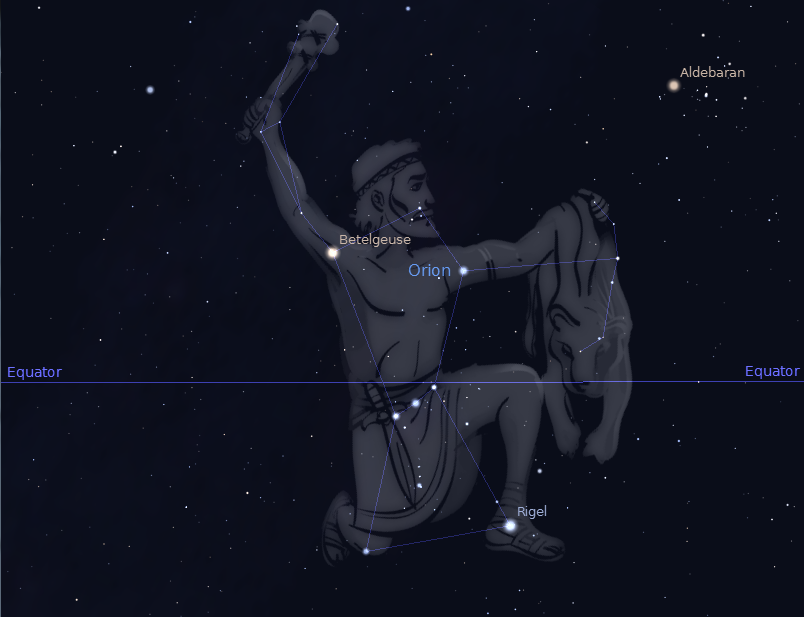
Orion from mid latitudes north of the equator. Orion would be upside down if viewed south of the equator. Created using Stellarium.
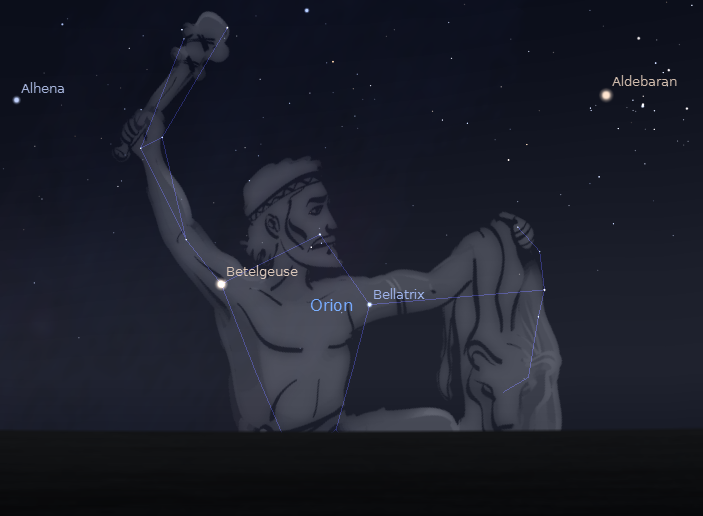
Orion from near the north pole. Created using Stellarium.
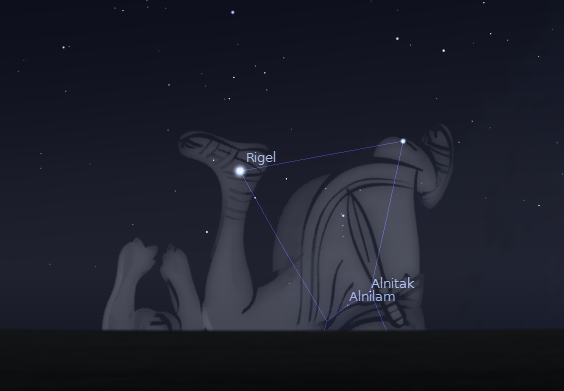
Orion from near the south pole. Created using Stellarium.
 Bob Moler's Ephemeris Blog