Archive
08/21/2018 – Ephemeris – How will the Parker Solar Probe get near to the Sun?
Ephemeris for Tuesday, August 21st. The Sun rises at 6:52. It’ll be up for 13 hours and 46 minutes, setting at 8:38. The Moon, 3 days past first quarter, will set at 3:09 tomorrow morning.
I introduced the Parker Solar Probe yesterday. It’s on its way to Venus to have some of its velocity stolen by that planet as to drop to nearly 15 million miles (24 million km) of the Sun at its first perihelion, before heading almost all the way out to the Earth’s orbit. Its next encounter with Venus will steal even more velocity from the probe to drop even closer to the Sun. It will take nearly 7 years to reach as close as 3.9 million miles (6.2 million km) from he center of the Sun of 3.8 million miles (6.1 million km) from what looks like its surface, the photosphere, the bright ball we see of the Sun. The probe has a huge heat shield that will handle the over two thousand degree heat from the Sun. Even though the corona is several million degrees in temperature, it’s not dense enough to heat the probe.
The times given are for the Traverse City/Interlochen area of Michigan. They may be different for your location.
Addendum
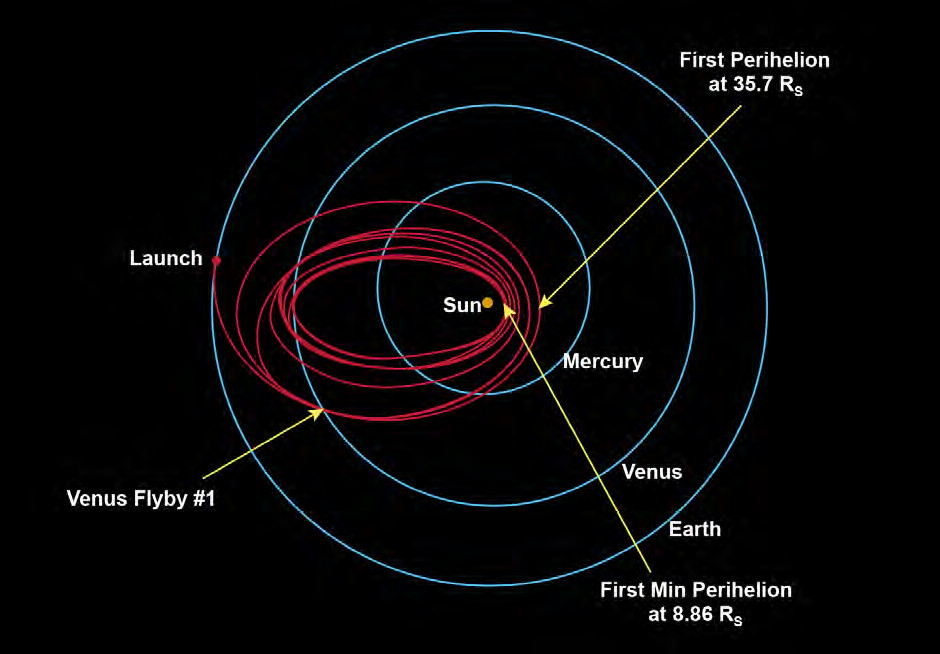
The planned orbits of the Parker Solar Probe. First flyby of Venus will occur on October 3rd 2018. The first perihelion passage a bit more than a month later on November 6th. Credit: NASA
A close look at the Sun
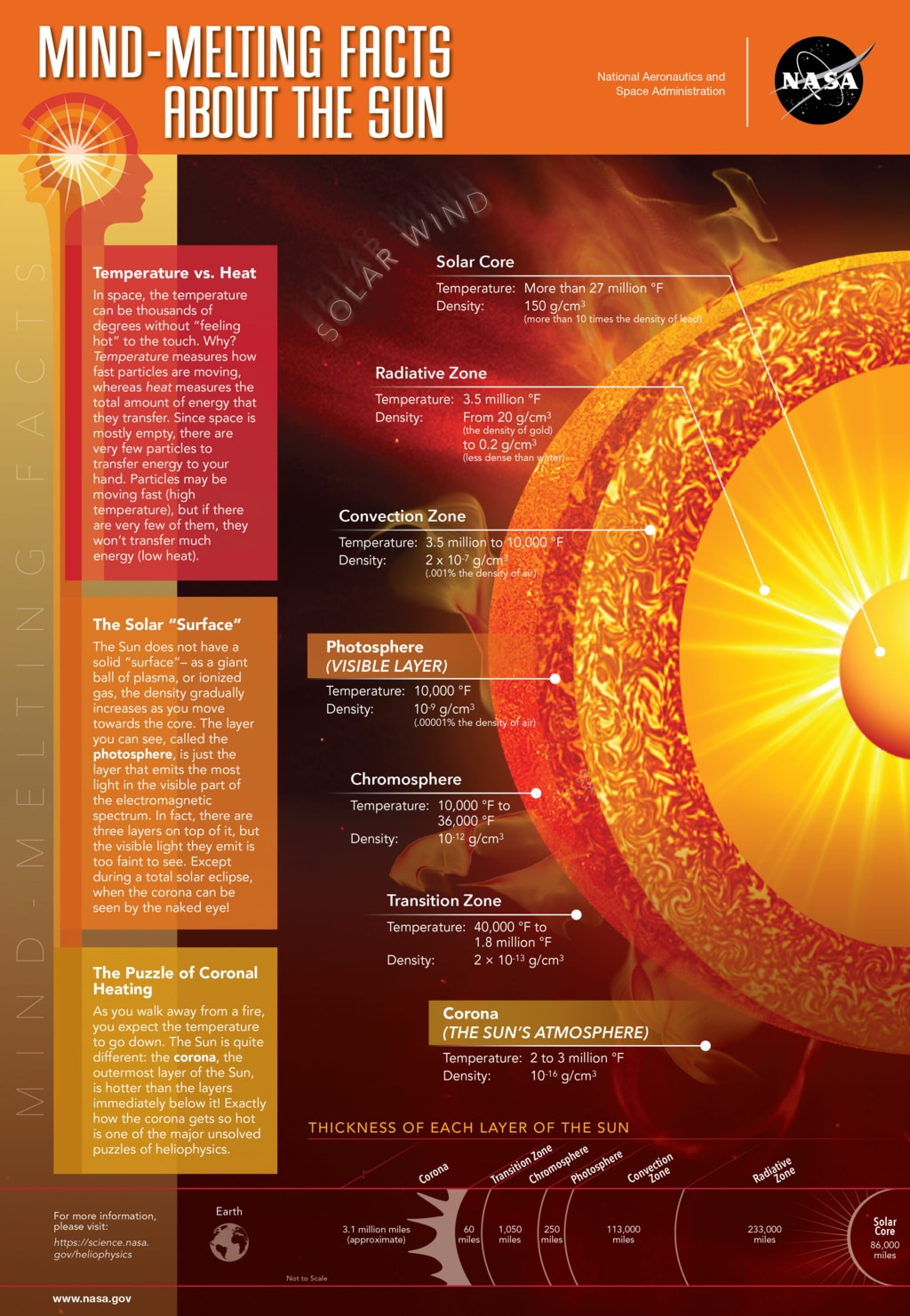
Click on image to enlarge. Credit NASA.
08/20/2018 – Ephemeris – The Parker Solar probe is on its way to skim through the Sun’s corona
Ephemeris for Monday, August 20th. The Sun rises at 6:51. It’ll be up for 13 hours and 49 minutes, setting at 8:40. The Moon, 2 days past first quarter, will set at 2:22 tomorrow morning.
Eight days ago the Parker Solar Probe was launched toward the Sun. It is the first NASA spacecraft named after a living person, Eugene Parker, a Michigander, born in Houghton in 1927, graduated from Michigan State, before moving on to Caltech. He eventually landed at the University of Chicago. In the 1950’s he put forth the theory of the supersonic solar wind of charged particles pervading the solar system. The theory was not initially accepted, but has been verified by satellites. The Parker Solar Probe will make multiple passes of Venus, giving up its velocity to fall closer to the Sun on each pass, taking almost 7 years to inch closer to the Sun at its perihelion until it gets down to about 3.8 million miles of our star.
The times given are for the Traverse City/Interlochen area of Michigan. They may be different for your location.
Addendum
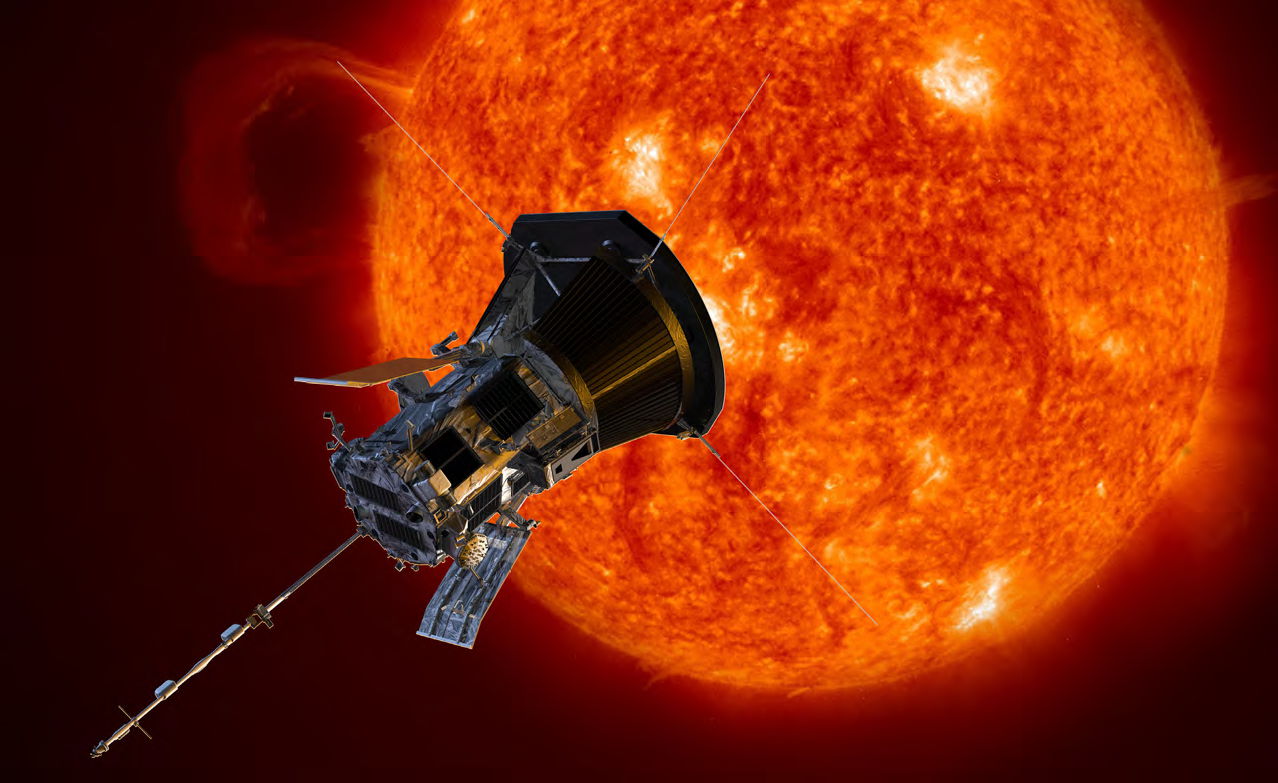
Artist’s visualization of the Parker Solar Probe near the Sun. Credit: NASA/Johns Hopkins APL/Steve Gribben.
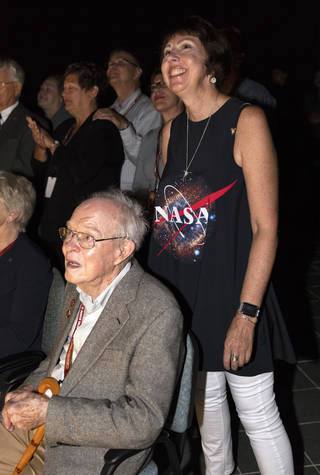
Dr. Eugene Parker (seated in the foreground), a pioneer in heliophysics and S. Chandrasekhar distinguished service professor emeritus for the Department of Astronomy and Astrophysics at the University of Chicago, watches the launch of NASA’s Parker Solar Probe. This is the first agency mission named for a living person. Standing behind Parker is Nicky Fox, Parker Solar Probe project scientist at Johns Hopkins Applied Physics Laboratory. The liftoff took place at 3:31 a.m. EDT on Sunday, Aug. 12, 2018. The spacecraft was built by the Johns Hopkins University Applied Physics Laboratory in Laurel, Maryland. The mission will perform the closest-ever observations of a star when it travels through the Sun’s atmosphere, called the corona. The probe will rely on measurements and imaging to revolutionize our understanding of the corona and the Sun-Earth connection. Credit: NASA/Glenn Benson.
 Bob Moler's Ephemeris Blog