Archive
Ephemeris: 03/28/25 – There’s a partial solar eclipse tomorrow, but not for Michigan
This is Bob Moler with Ephemeris for Friday, March 28th. Today the Sun will be up for 12 hours and 35 minutes, setting at 8:05, and it will rise tomorrow at 7:28. The Moon, 1 day before new, will rise at 7:29 tomorrow morning.
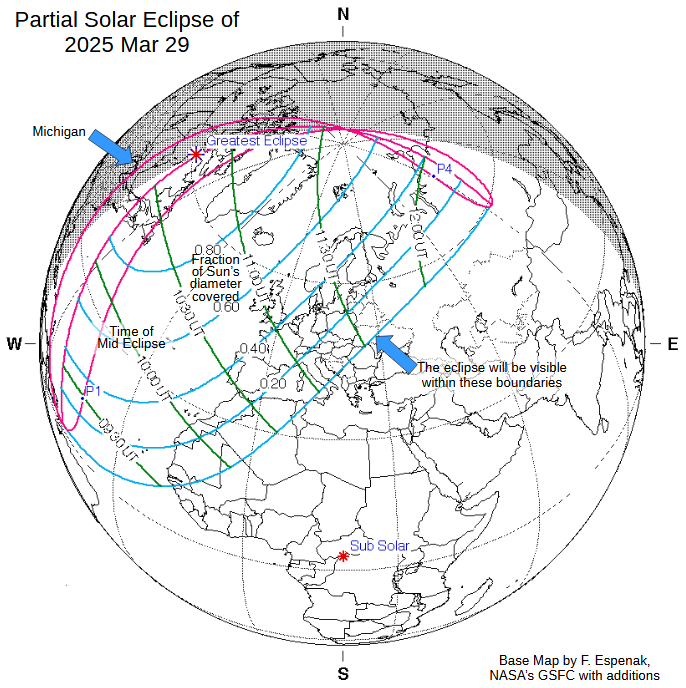
There will be a partial solar eclipse tomorrow morning which will end about 14 minutes before sunrise for Northwestern Lower Michigan. It will be visible to the east and north of here, including all the way to northern Asia. It belongs to the same eclipse season as our total lunar eclipse two weeks ago. Eclipse seasons occur twice a year and last about 35 days. During that time, since it’s a little bit longer than a lunar month, there will be at least 2 eclipses, one of each kind, lunar and solar. There’s a possibility of three, if there is a central lunar eclipse. Then there can be two partial solar eclipses, one to the extreme north, the other to the extreme south of the Earth. The eclipse seasons slip a bit earlier each year. Last year’s total solar eclipse occurred April 8th.
The astronomical event times given are for the Traverse City/Interlochen area of Michigan (EDT, UT – 4 hours). Times will be different for other locations.
Addendum
Ephemeris: 12/26/2023 Some astronomical/space events of 2023
This is Ephemeris for Tuesday, December 26th. Today the Sun will be up for 8 hours and 48 minutes, setting at 5:07, and it will rise tomorrow at 8:19. The Moon, at full today, will rise at 4:30 this evening.
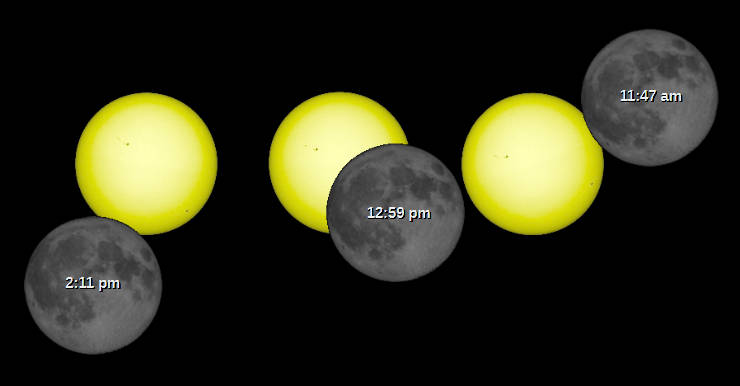
Looking back at 2023 in astronomy: an important event that was visible locally was the partial eclipse of the Sun on October 14th. For most of us it was mostly cloudy. I happened to be in Thompsonville at the Betsie Valley District Library to talk about eclipses and to view that one. We got about 15 minutes of clear skies to see the Sun near the middle of the eclipse, so it wasn’t a total washout. Of course the big event is next year on April 8th, a total solar eclipse whose path is going to be passing quite close to us. The James Webb Space Telescope astronomers have reported their first year findings, some of which have contradicted previous assumptions, or seem to have. The second of SpaceX’s Starship launches came within 4,000 kilometers an hour of achieving orbit.
The astronomical event times given are for the Traverse City/Interlochen area of Michigan (EST, UT –5 hours). They may be different for your location.
Addendum
05/05/2023 – Ephemeris – Learn about the upcoming total solar eclipse tonight
This is Ephemeris for Cinco de Mayo, Friday, May 5th. Today the Sun will be up for 14 hours and 25 minutes, setting at 8:52, and it will rise tomorrow at 6:25. The Moon, at full today, will rise at 9:13 this evening.
Eleven months is not too early to plan for a total solar eclipse. On April 8th next year there will be such an eclipse whose path of totality clips the southeastern corner of Michigan. Indianapolis, Toledo and Cleveland also lie in the path of totality. The path runs from Texas to Maine. Member Dan Dall’Olmo will have all the particulars at this month’s meeting of the Grand Traverse Astronomical Society, starting at 8 pm tonight at Northwestern Michigan College’s Joseph H. Rogers Observatory. For those staying home, the Sun for this eclipse will be a bit more covered by the Moon than the 2017 August solar eclipse. We’ll also have another partial solar eclipse to practice on this October 14th.
The astronomical event times given are for the Traverse City/Interlochen area of Michigan (EDT, UT –4 hours). They may be different for your location.
Addendum
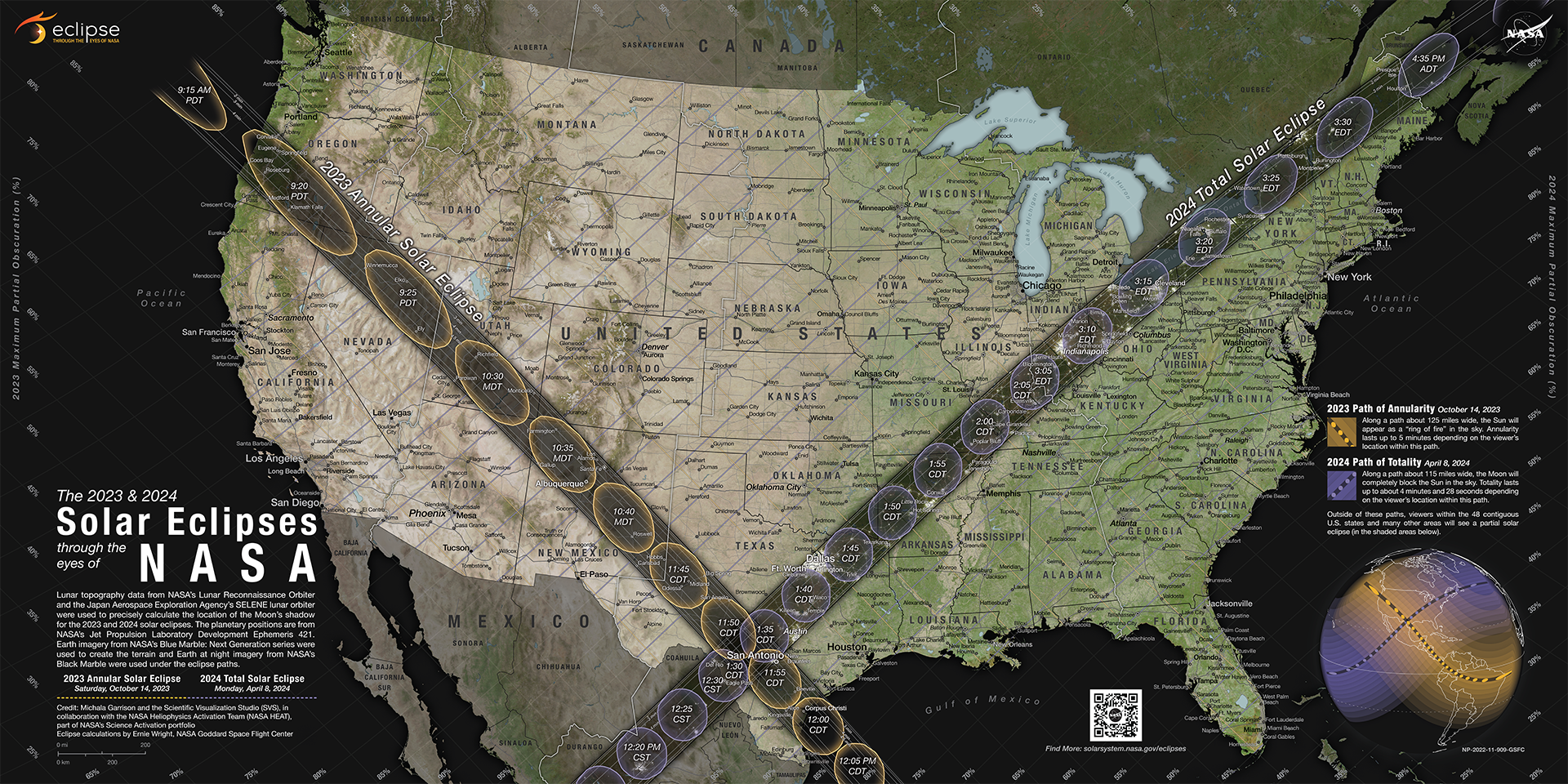
The paths of maximum eclipse of the October 14, 2023, and April 8, 2024. Click or tap on the image to enlarge it. Credit: NASA/Scientific Visualization Studio/Michala Garrison; eclipse calculations by Ernie Wright, NASA Goddard Space Flight Center.
10/23/2014 – Ephemeris – Partial solar eclipse tonight for most of the US
Ephemeris for Thursday, October 23rd. The sun will rise at 8:08. It’ll be up for 10 hours and 36 minutes, setting at 6:44. The moon is new today, and won’t be visible.
This evening there will be a partial solar eclipse, in which we will see only the first part before the sun sets. The eclipse will be visible for all but the extreme eastern part of the country. It will be a partial eclipse for all who can see it because the core of the Moon’s shadow will miss the Earth to the north. For the Interlochen Public Radio listening area (Northwestern Lower Michigan) the eclipse will star a couple of minutes before or after 5:32 p.m. and will end at sunset around 6:44 p.m. The low position of the sun make a lack of cloud cover necessary to be able to see it. Proper approved solar filters, or a projection method are necessary to view the eclipse. Do Not Look Directly at the Sun! The NMC Observatory south of Traverse City will be open, weather permitting starting at 5 p.m. Also the Platte River Point location at the Sleeping Bear Dunes National Lakeshore will also be available.
An added attraction for this eclipse is the appearance of the largest sunspot group to appear on the sun in years.
Times are for the Traverse City/Interlochen area of Michigan. They may be different for your location.
Addendum
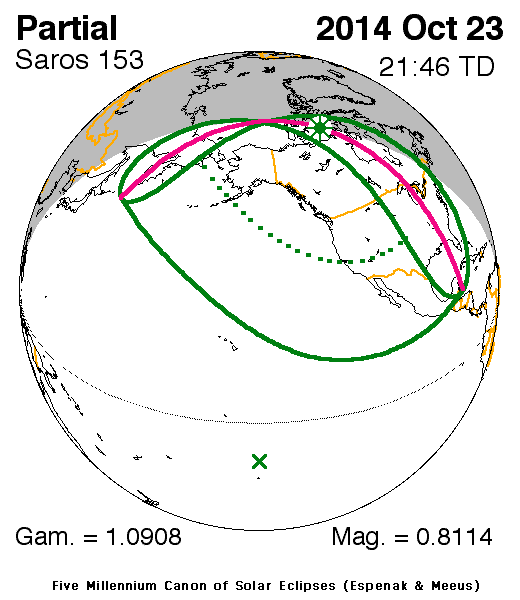
Coverage of the partial solar eclipse of October 23, 2014. Credit: NASA.

The setting partially eclipsed sun from Traverse City. Created using Stellarium.
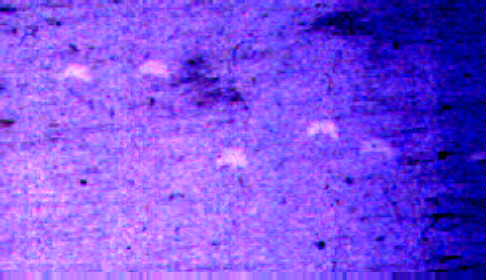
Partially eclipsed sun using a series of pinholes projected on a reasonably white surface.
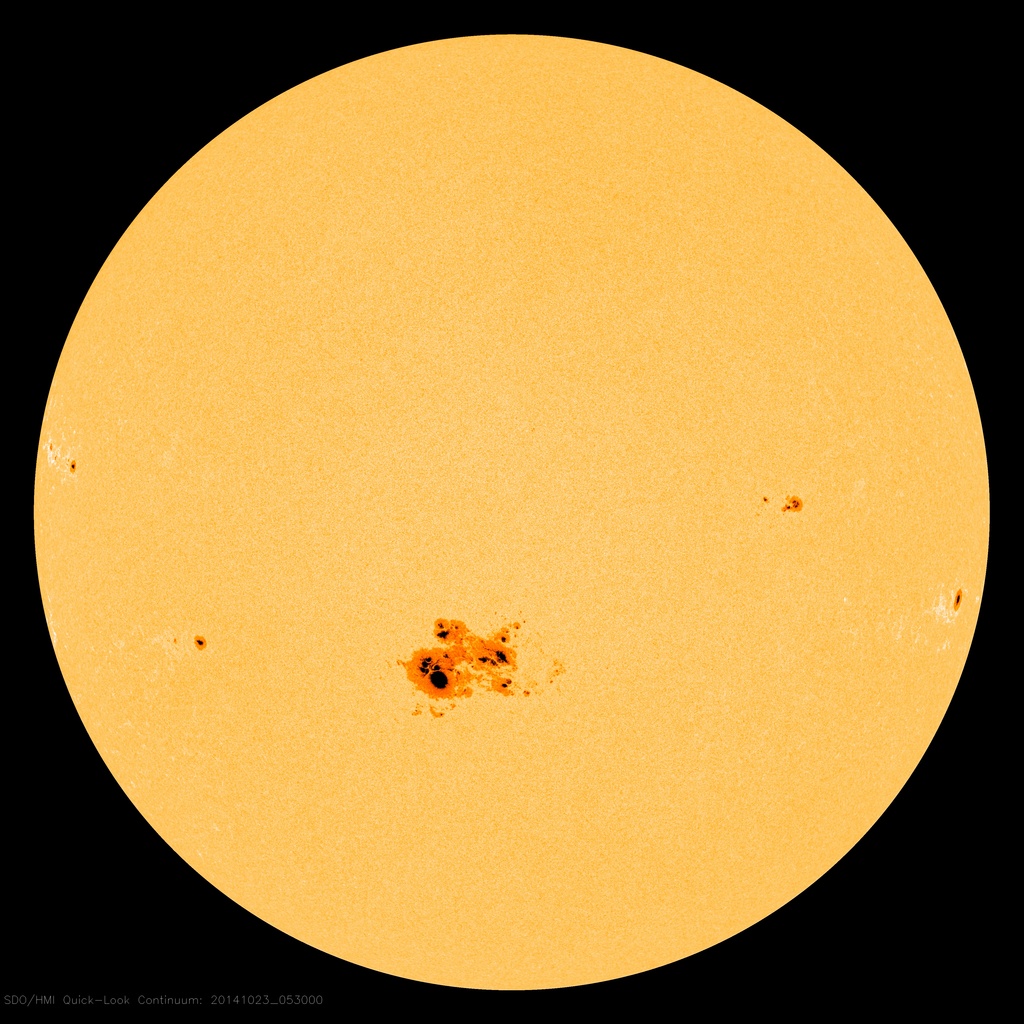
The Sun at 1:30 a.m. 10/23/2014 with large sunspot group AR 2192. Credit NASA – Solar Dynamics Observatory.
This baby gave off a X Class flare yesterday (10/22/2014). Could be more in store. Maybe we’ll see an aurora later this week.
 Bob Moler's Ephemeris Blog