Archive
Ephemeris: 07/22/2025 – It’s Pi Approximation Day!*
* I’d want to call it “Pi Fractured Fraction Day.”
This is Ephemeris for Pi Approximation Day, Tuesday, July 22nd. Today the Sun will be up for 15 hours exactly, setting at 9:19, and it will rise tomorrow at 6:19. The Moon, 2 days before new, will rise at 4:27 tomorrow morning.
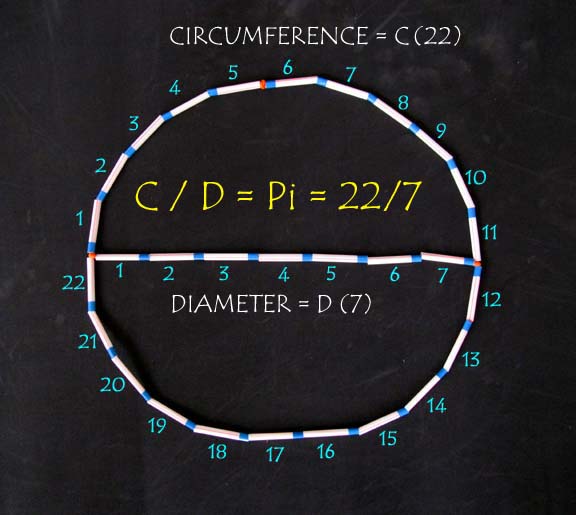
So why is July 22nd Pi Approximation Day? Pi being the Greek letter that represents, mathematically, the ratio of a circle’s diameter to its circumference. Well, we had Pi Day on March 14th or 3.14. Today represents the fractional way of getting to Pi, twenty-two sevenths for July 22nd. In Europe, it’s 22/7, rather how we in America write the date 7/22. I’ve never approximated pi that way. It’s one of those dreaded fractions I learned about in grade school, and to boot it’s an improper fraction. The Bible has a thing for the numbers 7, 40 and a thousand. Also, pi being equal to three. In First Kings, chapter 7, verse 23 it talks about a vessel with a diameter of 10 cubits and a circumference of 30 cubits. A very rough approximation.
The astronomical event times given in this blog are for the Traverse City/Interlochen area of Michigan (Lat 44.7° N, Long 85.7° W; EDT, UT – 4 hours) unless stated otherwise. Times will be different for other locations.
Addendum
Ephemeris: 07/22/2024 – Happy Pi Approximation Day
This is Bob Moler with Ephemeris for Pi Approximation Day*, Monday, July 22nd. Today the Sun will be up for 15 hours exactly, setting at 9:19, and it will rise tomorrow at 6:19. The Moon, 1 day past full, will rise at 10:37 this evening.
The first Pi day of the year for mathematics junkies was March 14th utilizing the three most significant digits of the mathematical value π, the ratio of the circumference of a circle to its diameter, written as 3.14. Today is the second version of π written as the fraction 22/7. We don’t write our date that way, we write it as 7/22. In other parts of the world it is written as 22/7. So whichever way you slice it, it’s a pi day and in Northern Michigan I would imagine it’s a cherry pi. In the sky today the planet Mercury is at its greatest elongation or separation east of the Sun in the western sky. It is preceding the Sun heading southward against the stars and is not easily visible after sunset.
The astronomical event times given are for the Traverse City/Interlochen area of Michigan (EDT, UT–4 hours). They may be different for your location.
* In the radio program I called it Pi Day #2. I have since found out that today has a special name.
Addendum
03/14/2019 – Ephemeris – Happy Pi Day
Ephemeris for Pi Day, Thursday, March 14th. Today the Sun will be up for 11 hours and 49 minutes, setting at 7:47, and it will rise tomorrow at 7:55. The Moon, at first quarter today, will set at 4:09 tomorrow morning.
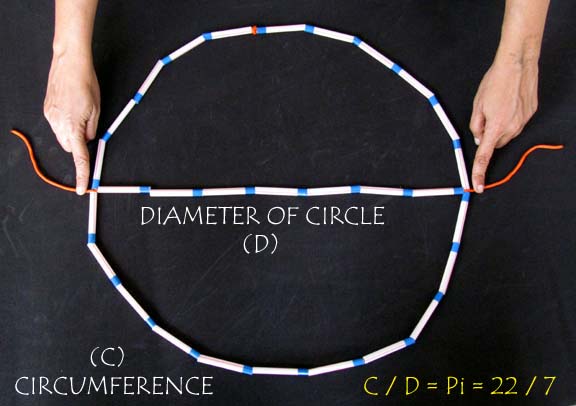
Pi day: the first three digits of the mathematical constant π is 3.14 the ratio of a circle’s circumference to its diameter, so March 14th is Pi day. Why do we use the Greek letter pi? Pi is the first letter of the Greek word perimetros which means circumference. The first Pi Day was celebrated in 1988, organized by Larry Shaw at San Francisco’s Exploratorium. There are other lass known pi related days on the calendar. The fraction used in pi approximations is 22/7ths. So July 22nd is Pi Approximation Day. In many formulae π is multiplied by two, or 2π. 2π to two decimal places is 6.28, so it’s Two Pi Day or Tau (τ) Day, June 28th. So whether you like apple, cherry, or pumpkin, have a happy Pi day. https://www.piday.org/pi-facts/
The times given are for the Traverse City/Interlochen area of Michigan. They may be different for your location.
Addendum

Credit http://www.piday.org.
Check out https://www.piday.org/pi-facts/ for more information on pi.
3.1416 – 03/14/2016 – Ephemeris – When Jupiter hits your eye like a big pizza Pi
Ephemeris for Pi Day 3/14, Monday, March 14th. The Sun will rise at 7:56. It’ll be up for 11 hours and 52 minutes, setting at 7:48. The Moon, 1 day before first quarter, will set at 2:39 tomorrow morning.
We turn again to the giant planet Jupiter which is shining brightly in the southeastern part of the sky in the early evening. The first thing one notices in a small telescope are it’s four moons, generally in a straight line, which move back and forth each night. Notice their plane. It’s the same direction as the cloud bands are aligned. Jupiter has a very small axial tilt, and its large satellites orbit pretty much over Jupiter’s equator. Our Moon doesn’t behave that way, but that’s another story. Jupiter rotates on its axis in a bit less than 10 hours, which whips its clouds into alternating bands of reddish-brown and cream color. Also the rotation rate of these clouds lessens with increasing latitude.
Times are for the Traverse City/Interlochen area of Michigan. They may be different for your location.
Addenda
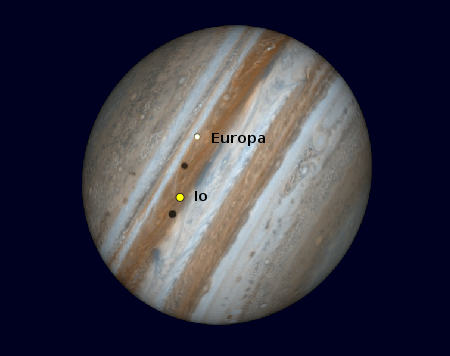
Transits of Europa and Io across the face of Jupiter at 11 p.m. EDT March 14, 2016. The shadows of the moons are hard to see, but the satellites are even harder. Jupiter’s current cloud bands may not be as shown. Image created using Cartes du Ciel (Sky Charts).
| Event | EDT | Universal Time | ||
| Date | Time | Date | Time | |
| Europa Transit Start | March 14 | 09:26 PM | March 15 | 01:26 AM |
| Europa Shadow Start | March 14 | 09:45 PM | March 15 | 01:45 AM |
| Io Shadow Start | March 14 | 10:12 PM | March 15 | 02:12 AM |
| Io Shadow Start | March 14 | 10:21 PM | March 15 | 02:21 AM |
| Europa Transit End | March 15 | 12:12 AM | March 15 | 04:12 AM |
| Io Transit End | March 15 | 12:26 AM | March 15 | 04:26 AM |
| Europa Shadow End | March 15 | 12:33 AM | March 15 | 04:33 AM |
| Io Shadow End | March 15 | 12:36 AM | March 15 | 04:36 AM |
Jovian satellite data from Project Pluto.
Pi Day
Check this out: Pi Day the NASA Way.
Answer to Friday’s Moon phase poser
Of the two representations of the Moon’s terminator last Friday, the Virtual Moon Atlas was the correct representation.
 Bob Moler's Ephemeris Blog