Archive
01/25/2018 – Ephemeris – The Moon tonight: Copernicus on the terminator
Ephemeris for Thursday, January 25th. The Sun will rise at 8:09. It’ll be up for 9 hours and 32 minutes, setting at 5:41. The Moon, 1 day past first quarter, will set at 2:48 tomorrow morning.
Let’s take a look at our slightly gibbous moon, just a day past first quarter with binoculars or a small telescope. The terminator, in this case the sunrise line will appear to cross the crater Copernicus to the right of the Moon’s center if you’re viewing it right side up. To the North across the Sea of Showers, or Mare Imbrium is the large flat floored crater Plato. South of Copernicus is a recently named sea, Mare Cognitum, the Known Sea, after the first successful close photography by the Ranger 7 spacecraft in 1964. South of the is Mare Nubium, the Sea of Clouds. South of that are the lunar highlands with the stark crater Tycho and the huge crater Clavius with an arc of craters of decreasing size within it.
The times given are for the Traverse City/Interlochen area of Michigan. They may be different for your location.
Addendum
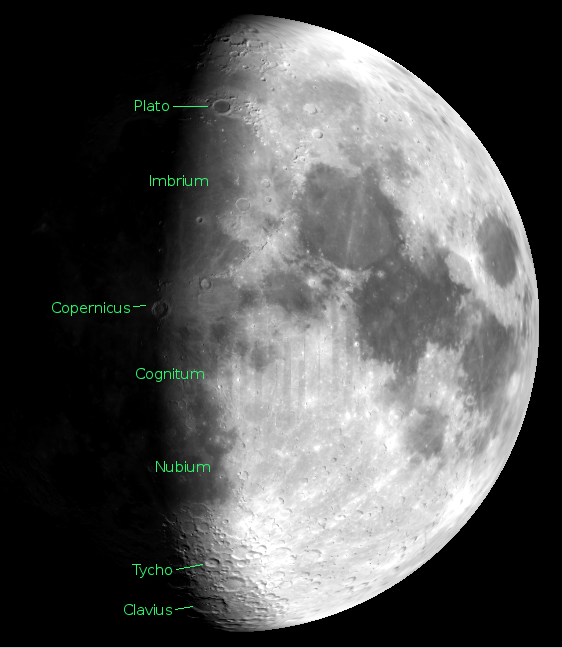
The waxing gibbous Moon tonight at 8 p.m., January 25, 2018. Created using Virtual Moon Atlas.
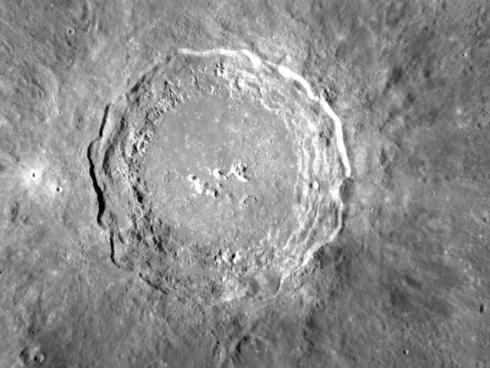
The crater Copernicus. Credit: NASA/GSFC/Arizona State University.
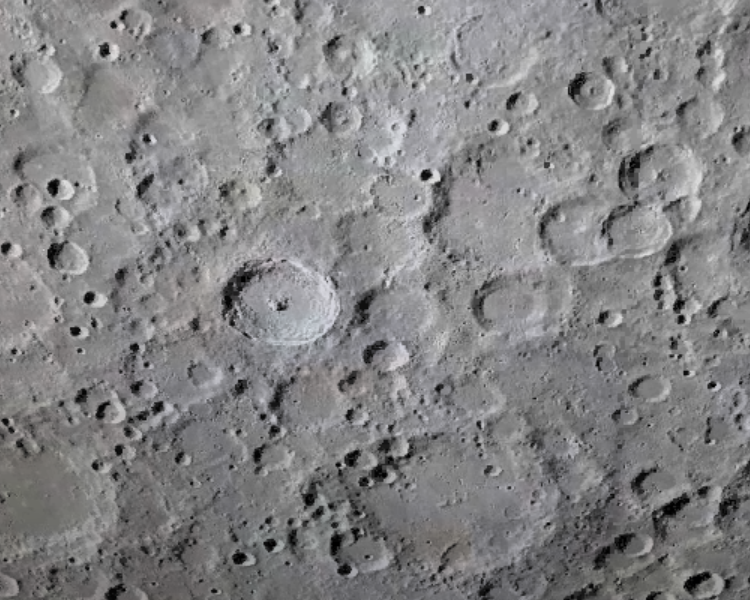
The Lunar highlands near the crater Tycho showing a surface saturated with craters. Credit: Virtual Moon Atlas with the texture from NASA’s Lunar Reconnaissance Orbiter. The lunar phase was omitted.
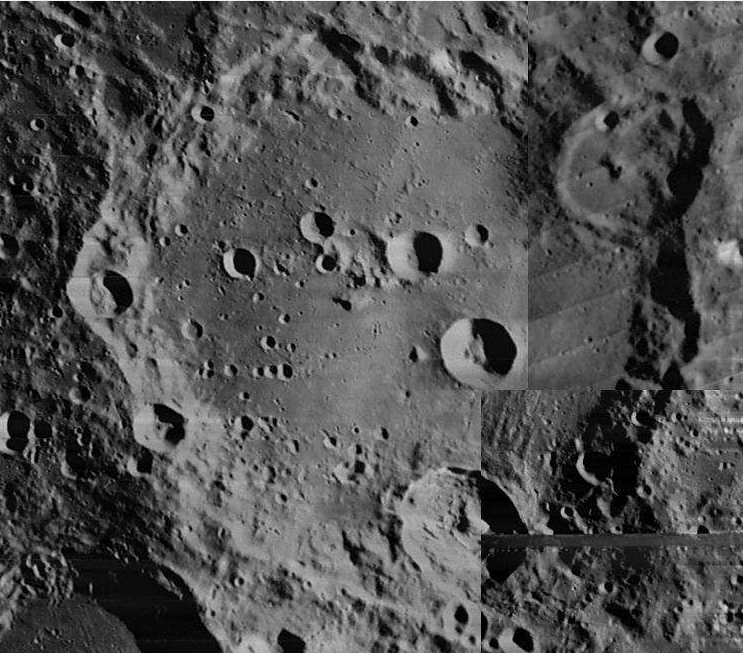
Clavius as photographed by one of the Lunar Orbiter spacecraft in the 1960s From Digital Lunar Orbital Photographic Atlas. Credit Jeff Gillis, Lunar and Planetary Institute.
03/07/2017 – Ephemeris – The Moon tonight – the crater Copernicus
Ephemeris for Tuesday, March 7th. The Sun will rise at 7:08. It’ll be up for 11 hours and 29 minutes, setting at 6:38. The Moon, 2 days past first quarter, will set at 4:39 tomorrow morning.
Looking at the Moon tonight the brightest feature on the left side of the moon is the big splash mark left by the impact that created the crater Copernicus. The proper term is ejecta blanket that can be noticed by the naked eye or binoculars. Although it is most visible during full moon, because it is really made of small craters that are most visible when we see them from the direction of the Sun, so they are not shadow filled and brighter than normal. Copernicus is on the south edge of a great lava plain called Mare Imbrium, the Sea of Showers. There’s a large crater on the north edge named after the Greek philosopher Plato. At the upper left edge is the Laplace promontory the point of the Bay of Rainbows to be revealed tomorrow night.
Times are for the Traverse City/Interlochen area of Michigan. They may be different for your location.
Addendum
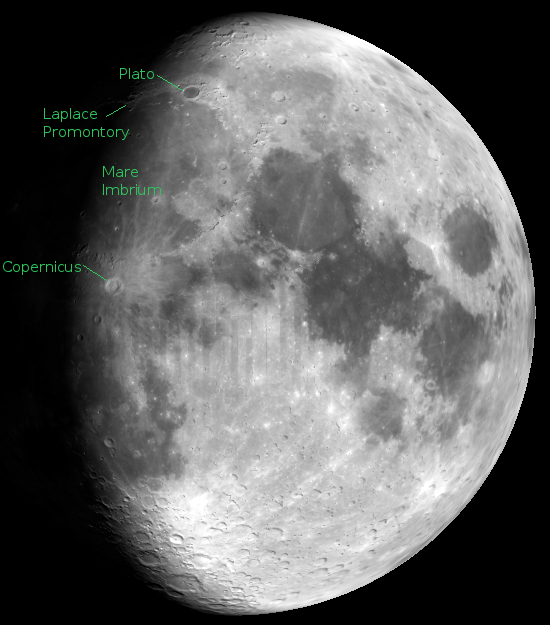
The Moon featuring Copernicus, Plato, Laplace Promontory and Mare Imbrium at 9 p.m., March 7, 2017. Created using Virtual Moon Atlas.
08/15/2013 – Ephemeris – Plato and Copernicus (the craters)
Ephemeris for Thursday, August 15th. The sun rises at 6:45. It’ll be up for 14 hours and 2 minutes, setting at 8:47. The moon, 1 day past first quarter, will set at 1:43 tomorrow morning.
The moon now is slightly gibbous. The term gibbous comes from Latin meaning having a hump or humpbacked. In binoculars or a small telescope look to the upper left where the great Sea of Showers or Mare Imbrium is being revealed by the advance of sunrise. The flat walled plain, actually a crater called Plato is off the top of Imbrium. It is circular and 61 miles in diameter. It looks oval to us because of the curvature of the moon. Below or south at the other edge of Imbrium, just coming into sunlight is the marvelous crater Copernicus with it’s triple central peaks. It’s 56 miles in diameter. In a good enough telescope one can see that the crater walls appear terraced. Copernicus is 2 miles deep.
Times are for the Traverse City/Interlochen area of Michigan. They may be different for your location.
Addendum
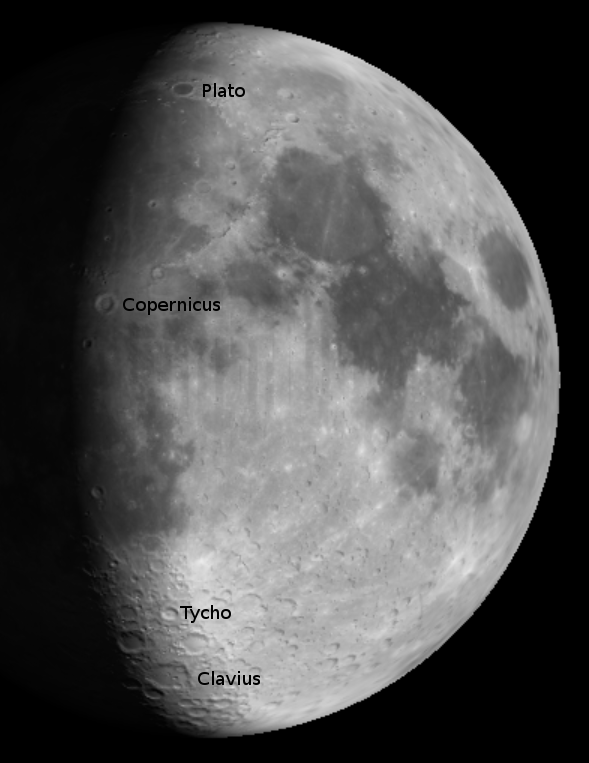
The moon a day after first quarter on August 15, 2013. Created using Virtual Moon Atlas.
The image also includs the craters Tycho and Clavius craters in the southern highlands.
 Bob Moler's Ephemeris Blog