Archive
12/30/2014 – Ephemeris – Looking ahead at some local and space astronomical events in 2015
Ephemeris for Tuesday, December 30th. The sun will rise at 8:19. It’ll be up for 8 hours and 51 minutes, setting at 5:11. The moon, 2 days past first quarter, will set at 3:38 tomorrow morning.
Let’s look ahead at a few astronomical and space events that will take place in 2015. Visible for us will be the partial phase of a lunar eclipse in morning twilight of April 4th, plus there’s a total lunar eclipse visible during the evening hours of September 27th. Out in space in the asteroid belt the Dawn spacecraft will enter orbit of Ceres, the largest asteroid and dwarf planet Ceres, a spherical world of rock and ice in April. Further out past the last planet the New Horizons spacecraft will fly by the dwarf planet Pluto and its system of at least 5 satellites: Charon, Nix, Hydra, Styx, and Kerberos on July 14th. It will take several months to transmit the data and images back to Earth after which the spacecraft will be redirected to a new target.
Times are for the Traverse City/Interlochen area of Michigan. They may be different for your location.
Addendum
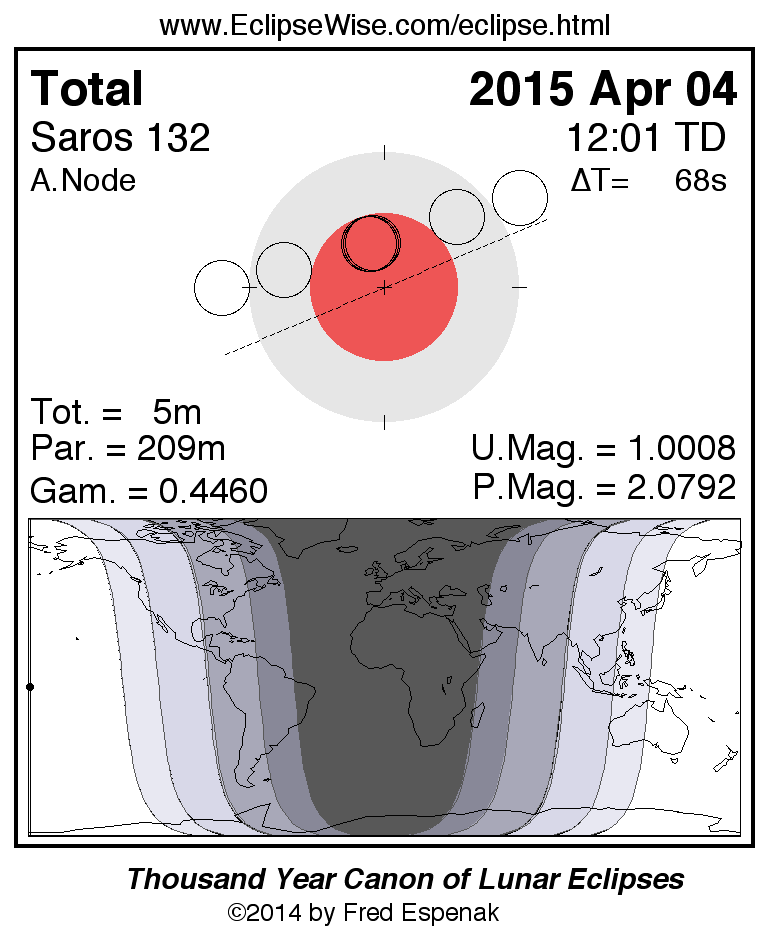
Chart for the total lunar eclipse of April 4, 2015. In Michigan we will see on;y the beginning partial phase in morning twilight. Credit: Fred Espenak, NASA/GSFC
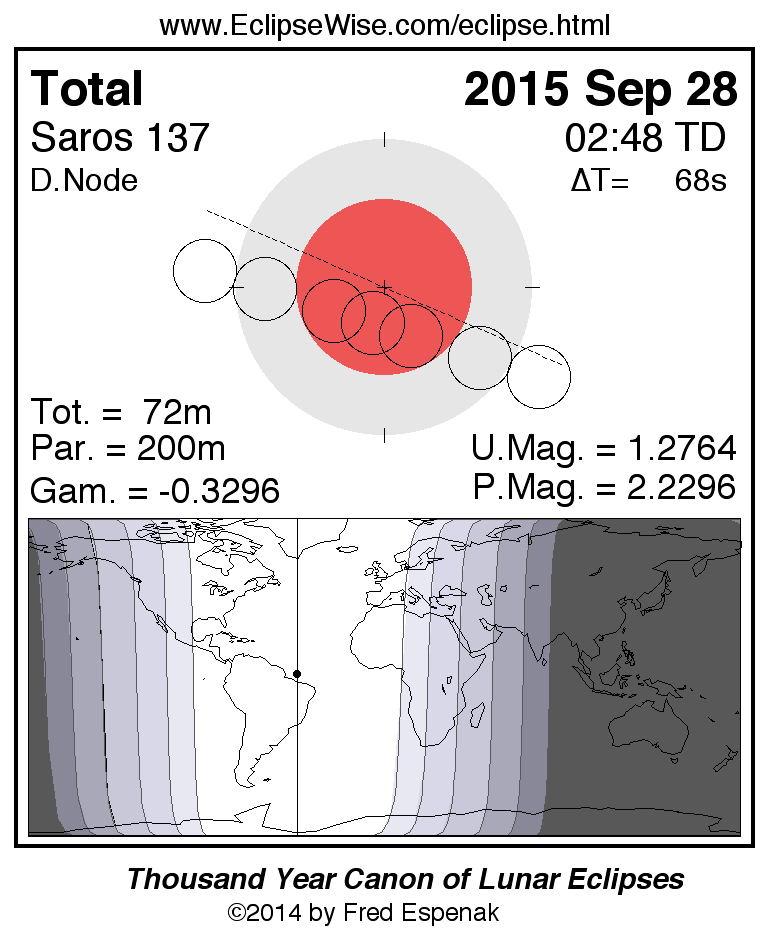
Chart for the total lunar eclipse of September 28, 2015. This is the evening of the 27th, EDT in Michigan. Credit: Fred Espenak, NASA/GSFC.
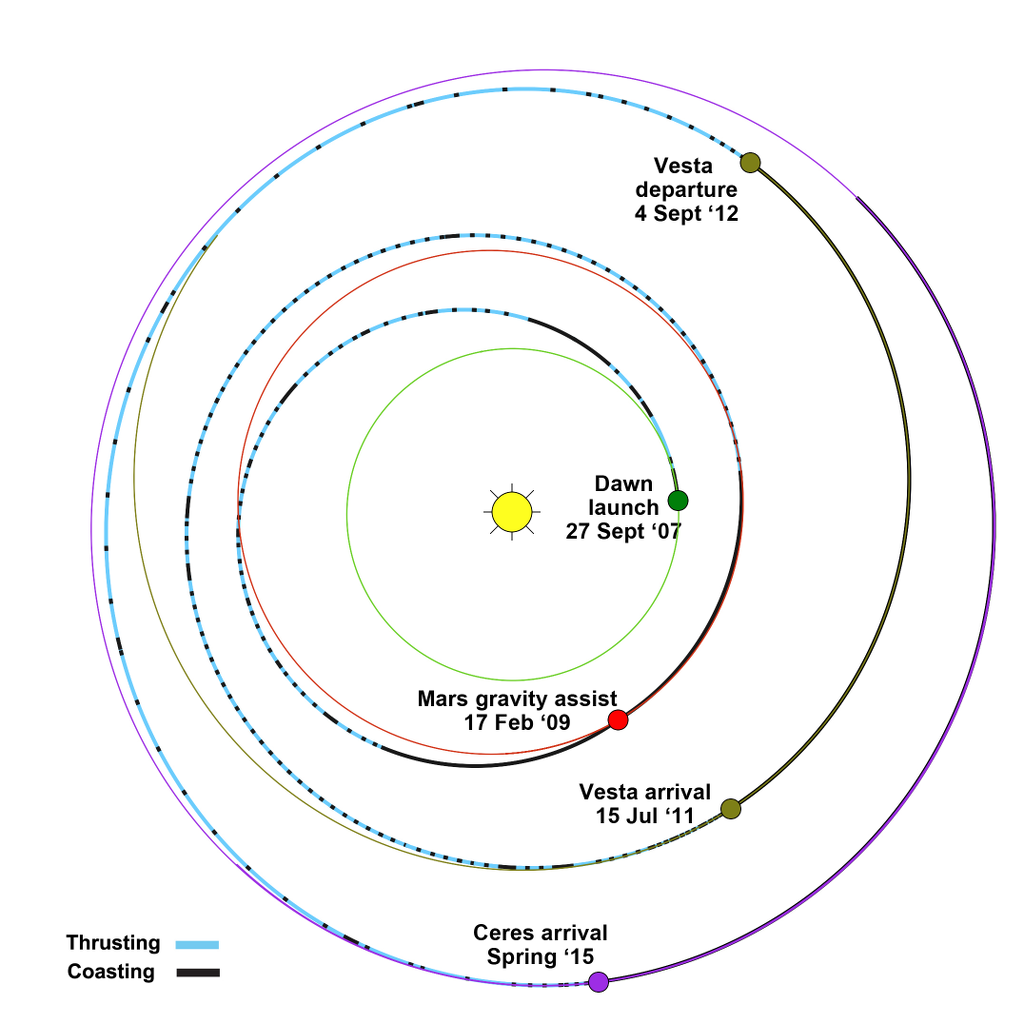
Dawn orbital track past Mars, stopping at Vesta and continuing to Ceres. Credit: NASA/JPL.
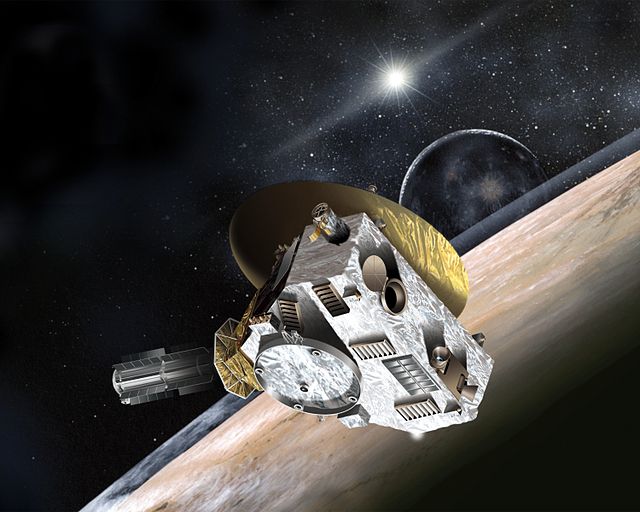
Artist conception of the New Horizons spacecraft at Pluto. Credit: NASA/Johns Hopkins University Applied Physics Laboratory/Southwest Research Institute
11/06/2014 – Ephemeris – New Horizons headed toward the 9th planet will pass a dwarf planet instead
Ephemeris for Thursday, November 6th. The sun will rise at 7:26. It’ll be up for 9 hours and 57 minutes, setting at 5:24. The moon, at full today, will rise at 5:32 this evening.
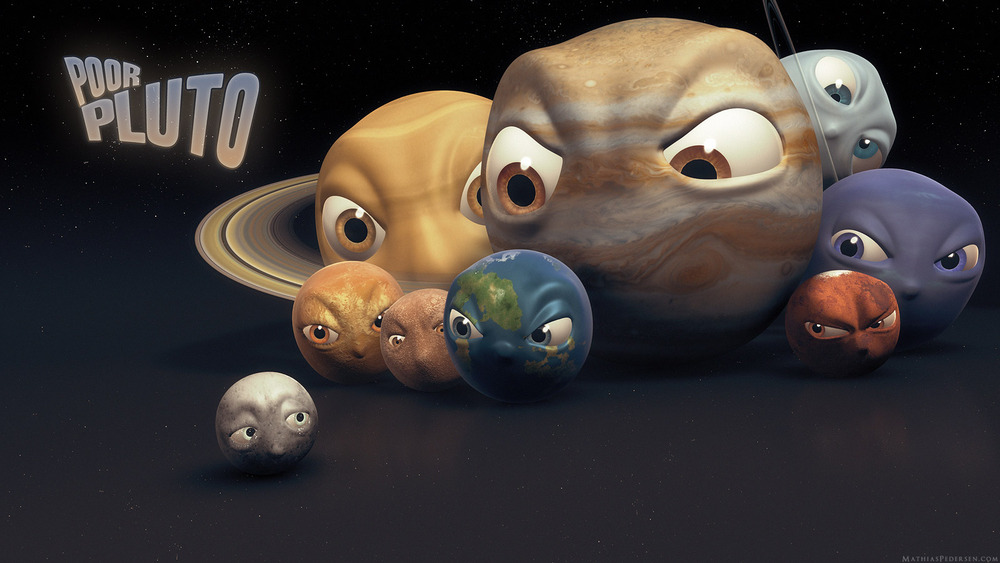
The New Horizons spacecraft is 9 months from reaching the dwarf planet Pluto. After a 9 and a half years journey it will zip past Pluto and its moons in a day. At launch Pluto was designated as planet number 9. In less than a year later Pluto was demoted to a dwarf planet. The authority was the International Astronomical Union. It was a vote taken at the end of the last day of the meeting that year after most members have left. The definitions only pertain to the solar system, and not exoplanets orbiting other stars. Besides we cannot detect anything as small as Pluto orbiting another star…yet. The asteroid Ceres was once a planet too, it was demoted to asteroid 75 years after discovery. It was promoted to a dwarf planet with Pluto.
Times are for the Traverse City/Interlochen area of Michigan. They may be different for your location.
Addendum
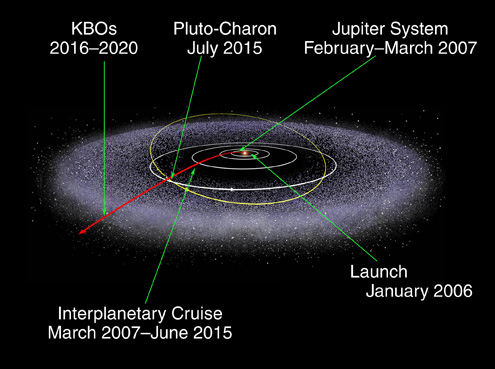
New Horizon’s trajectory through the solar system. Credit: NASA/JHAPL.
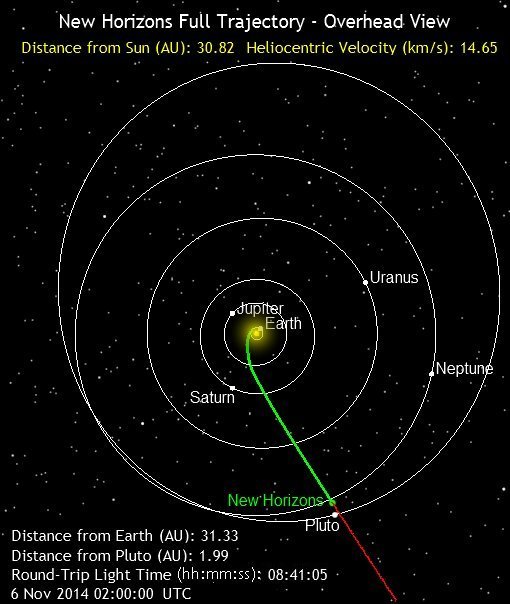
Where is New Horizons on November 6, 2014? Credit NASA/JHAPL.
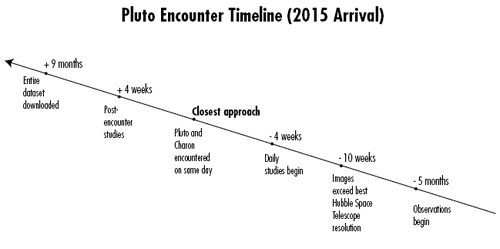
New Horizons Encounter Timeline. Credit: NASA/JHAPL.
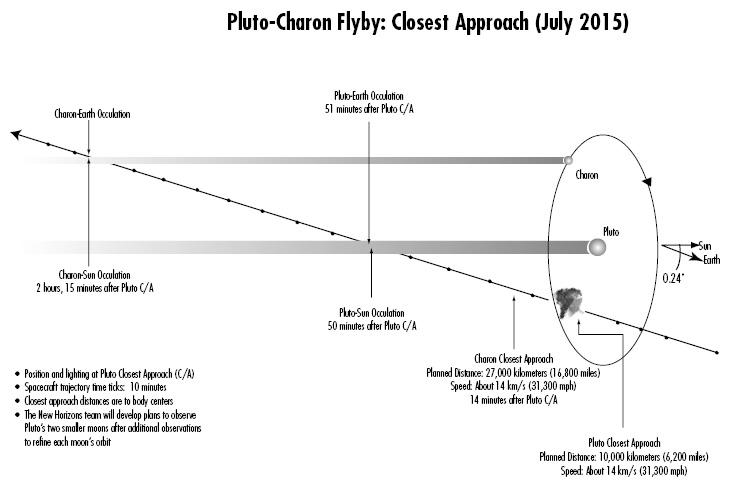
New Horizons at closest approach to Pluto. Credit: NASA/JHAPL.
07/14/2014 – Ephemeris – New Horizons to Pluto: 1 year and counting!
Ephemeris for Monday, July 14th. Today the sun will be up for 15 hours and 14 minutes, setting at 9:25. The moon, 2 days past full, will rise at 10:45 this evening. Tomorrow the sun will rise at 6:11.
Exactly one year from today the New Horizons spacecraft will fly by the dwarf planet Pluto. It will be taking photographs of Pluto and its moons, sniffing out Pluto and its large moon Charon. During most of the close flyby the spacecraft will be too busy to talk to Earth. When past Pluto the spacecraft will be able over the next few months to down-link to us all its information. At that great distance it must send data back to us with a transmission speed will make the old 300 baud modems of three decades ago seem fast. Recently the Hubble Space Telescope has been pressed into service to spot new targets beyond Pluto for New Horizons. It quickly found two, and is looking for more.
Times are for the Traverse City/Interlochen area of Michigan. They may be different for your location.
Addendum
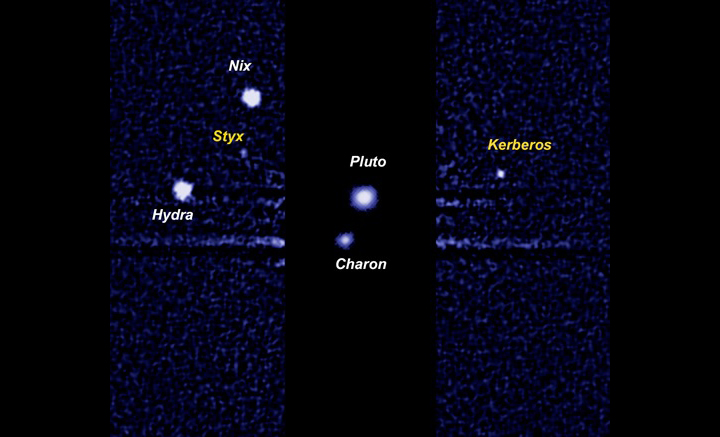
Pluto and its moons as photographed by the Hubble Space Telescope. Pluto and Charon were filtered to reduce their brightness to bring out the other dim moons. Credit: NASA/Hubble.
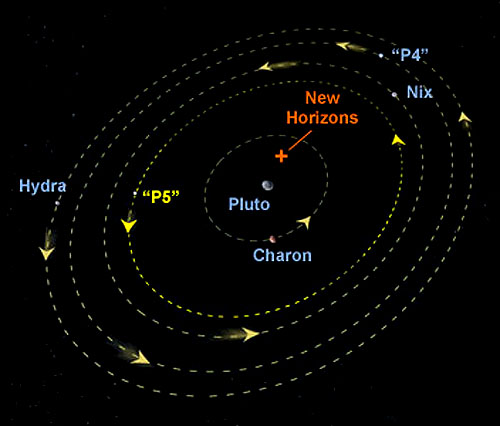
New Horizon’s aim point in relation to the moons. This was created before P4 and P5 received names. P4 became Styx, and P5 became Kerberos. Credit: NASA/GSFC.
When more and more moons were discovered around Pluto serious consideration was given to steer clear of the moon orbits. It is quite possible that there is much debris orbiting Pluto where all these satellites are. They all orbit Pluto in the same plane, along with Charon, above Pluto’s equator. It is thought that any material streaming toward Pluto would be intercepted by Charon, so the space between Charon and Pluto might be clear of debris, so New Horizons can punch through in safety. New Horizons is going like a bat out of heck and has no brakes. New Horizon’s velocity with respect to Pluto at closest approach will be 49,600 kilometers per hour or 30,800 mph according to the New Horizons article on Wikipedia (no citation given). The path of the spacecraft can be altered is a moon or other hazard is detected.
Artist conception of the New Horizons spacecraft at Pluto. Credit: NASA/Johns Hopkins University Applied Physics Laboratory/Southwest Research Institute.
New Horizon’s web page: http://pluto.jhuapl.edu/
11/06/2012 – Ephemeris – Pluto: an example of what happens when you don’t vote
Ephemeris for Election Day, Tuesday, November 6th. The sun will rise at 7:27. It’ll be up for 9 hours and 56 minutes, setting at 5:24. The moon, at last quarter today, will rise at 12:06 tomorrow morning.
Be sure and vote today. I have a tale of what happens when a low turn out leads for many to the wrong result. I’m referring to the vote at the International Astronomical Union meeting in 2006 that demoted Pluto to dwarf planet. It was the last day of the conference and many delegates had already left when the when the matter of defining what a planet was. A hastily formed proposal won the day. I haven’t the time to go into the definition, but Pluto didn’t fit it. Pluto, Eris the Kuiper belt object that caused the furor in the first place and the asteroid Ceres were given the titles dwarf planet because they are round. To add insult to injury Pluto was given an asteroid number 13430. That Pluto has 5 moons doesn’t change anything.
Times are for the Traverse City/Interlochen area of Michigan. They may be different for your location.
Addendum
Here’s the IAU definition of a planet:
(1) A “planet” is a celestial body that: (a) is in orbit around the Sun, (b) has sufficient mass for its self-gravity to overcome rigid body forces so that it assumes a hydrostatic equilibrium (nearly round) shape, and (c) has cleared the neighborhood around its orbit.
(2) A “dwarf planet” is a celestial body that: (a) is in orbit around the Sun, (b) has sufficient mass for its self-gravity to overcome rigid body forces so that it assumes a hydrostatic equilibrium (nearly round) shape2, (c) has not cleared the neighborhood around its orbit, and (d) is not a satellite.
(3) All other objects, except satellites, orbiting the Sun shall be referred to collectively as “Small Solar System Bodies”.
Note the mention of the sun in all three points. Thus this does not apply to exoplanets, those orbiting other stars. We are a long way from seeing and assessing all the bodies orbiting other stars, so it may be that every stellar system will have its own rules.
Oh by the way, I have come to agree with the IAU definition. Sorry, there are only 8 planets in our solar system.
 Bob Moler's Ephemeris Blog