Archive
08/18/2016 – Ephemeris – Viewing the full Moon tonight
Ephemeris for Thursday, August 18th. The Sun rises at 6:49. It’ll be up for 13 hours and 53 minutes, setting at 8:42. The Moon, at full today, will rise at 8:54 this evening.
The full moon, contrary to what you’d think is a poor time to observe it. The moon is essentially gray on gray. And at full moon we are looking at the moon from about the same perspective as the sun, so there are no shadows to delineate its fine features. Since the actual instant of full moon occurred at 5:27 this morning, some shadows will be creeping in on the moon’s upper right face as it is seen in the evening. Full moon is the best time to see the maria or lunar seas, the dark areas that make up the man in the moon. In binoculars can be seen the bright rays* emanating from the crater Tycho near the south end of the moon. Other craters have rays too, but none so long and distinctive. Night by night for the next two weeks the moon’s illuminated landscape will wane.
Times are for the Traverse City/Interlochen area of Michigan. They may be different for your location.
* Rays are caused by the ejecta from the impact that created the crater. They are thought to be small craters themselves which show up best at full moon because they have no shadows in them.
Addendum
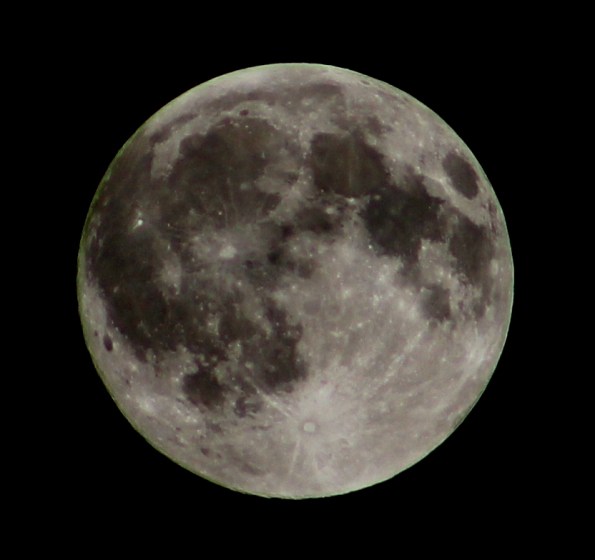
The full Moon taken last night, 7 hours before to was officially full. The contrast was greatly enhanced to bring out Tycho’s ray system. Credit Bob Moler.
02/14/2014 – Ephemeris – This full moon is a bit too cold for lovers.
Ephemeris for St Valentine’s Day, Friday, February 14th. The sun will rise at 7:44. It’ll be up for 10 hours and 25 minutes, setting at 6:09. The Moon, at full today, will rise at 6:15 this evening.
Tonight’s full moon won’t be the type that young lovers would want to look up to because, well it’s February, and it’s cold. Let’s wait until June. But one can bundle up and get the telescope or binoculars out to view the face of our only natural satellite. Even though the actual reflectance is a bit less than 13% of the light that the sun sends its way. If it were snow covered it would really be bright. Looking at it with or without binoculars one can see the man in the moon face. At the bottom of the moon or bottom right as the moon rises is the splashiest crater of all, the crater Tycho. The crater itself seems to have a dark halo around it. Also one can see rays extending great distances across the moon from it.
Times are for the Traverse City/Interlochen area of Michigan. They may be different for your location.
Addendum
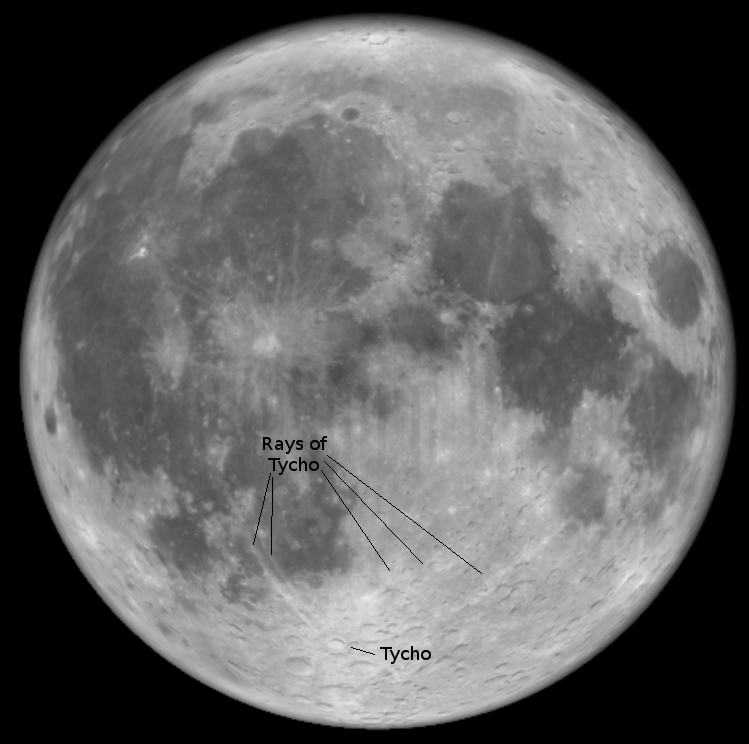
Tycho’s rays at full moon are actually secondary craters thrown by debris from the initial impact. At full moon they are no longer shadow filled so show as being bright. Image created using Virtual Moon Atlas.
 Bob Moler's Ephemeris Blog