Archive
01/18/2015 – Ephemeris – Betelgeuse, a dying star
Ephemeris for Martin Luther King Day, Monday, January 18th. The Sun will rise at 8:15. It’ll be up for 9 hours and 16 minutes, setting at 5:31. The Moon, 2 days past first quarter, will set at 3:47 tomorrow morning.
Now that the Moon is getting brighter and making the fainter tars in the constellations harder to find, let’s look at the bright stars of Winter. Today, let’s look at Betelgeuse the reddish star in Orion the hunter’s shoulder. Lets get the basic facts out first. Betelgeuse is a red giant star 90 thousand to 150 thousand times brighter than the Sun and 7 to 20 times the Sun’s mass. It’s around a thousand times the diameter of the Sun, making it about the diameter of the orbit of Jupiter. It’s about 650 light years away, but that’s a bit uncertain. It is shedding gasses at a prestigious rate. Though only 7 million years old, it may explode as a supernova in the next million years. And yes, we’re far enough away.
Times are for the Traverse City/Interlochen area of Michigan. They may be different for your location.
Addendum
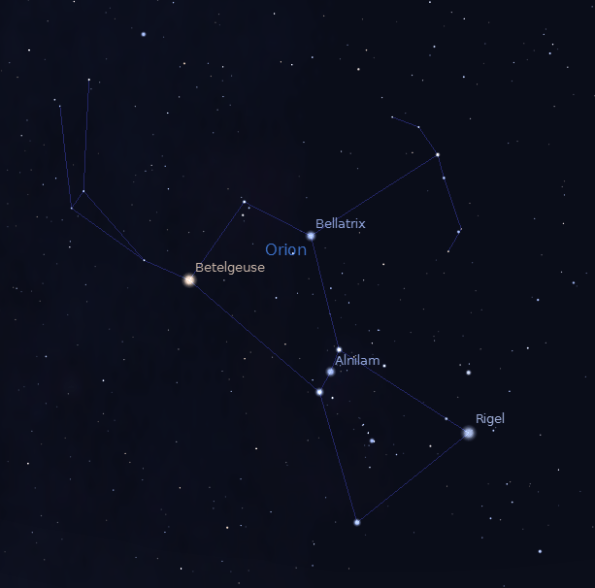
Some of Orion’s named stars, including Betelgeuse. Orion at 8 p.m. Created using Stellarium.
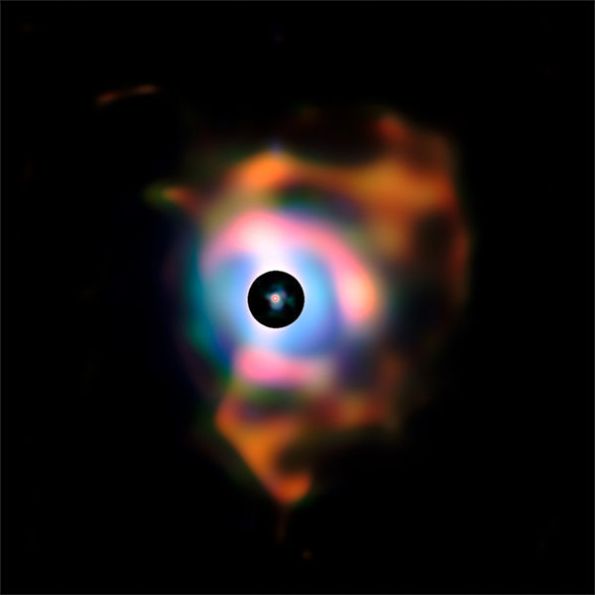
Betelgeuse and its nebula. From ESO’s Very Large Telescope.
05/12/2015 – Ephemeris – Arcturus, a look at the Sun’s future
Ephemeris for Tuesday, May 12th. Today the Sun will be up for 14 hours and 42 minutes, setting at 9:00. The Moon, 1 day past last quarter, will rise at 3:43 tomorrow morning. Tomorrow the Sun will rise at 6:17.
Arcturus, a red giant star is about midway up the sky in the southeast at 10 p.m. It’s visible earlier, being the 4th brightest night-time star and the third brightest star-like object out at that time after Venus and Mars. A pointer to it is the handle of the Big Dipper, following the arc of the handle to Arcturus. Though only 37 light years away, it’s not from around here. It’s passing through the galactic disk from north to south. Arcturus is about 7 billion years old, and is about 8% more massive than our Sun. It appears to be starting its red giant phase, after running out of hydrogen to fuse to helium in its core and is beginning to fuse helium. It’s a preview of coming attractions for our Sun when it gets that old.
Times are for the Traverse City/Interlochen area of Michigan. They may be different for your location.
Addendum
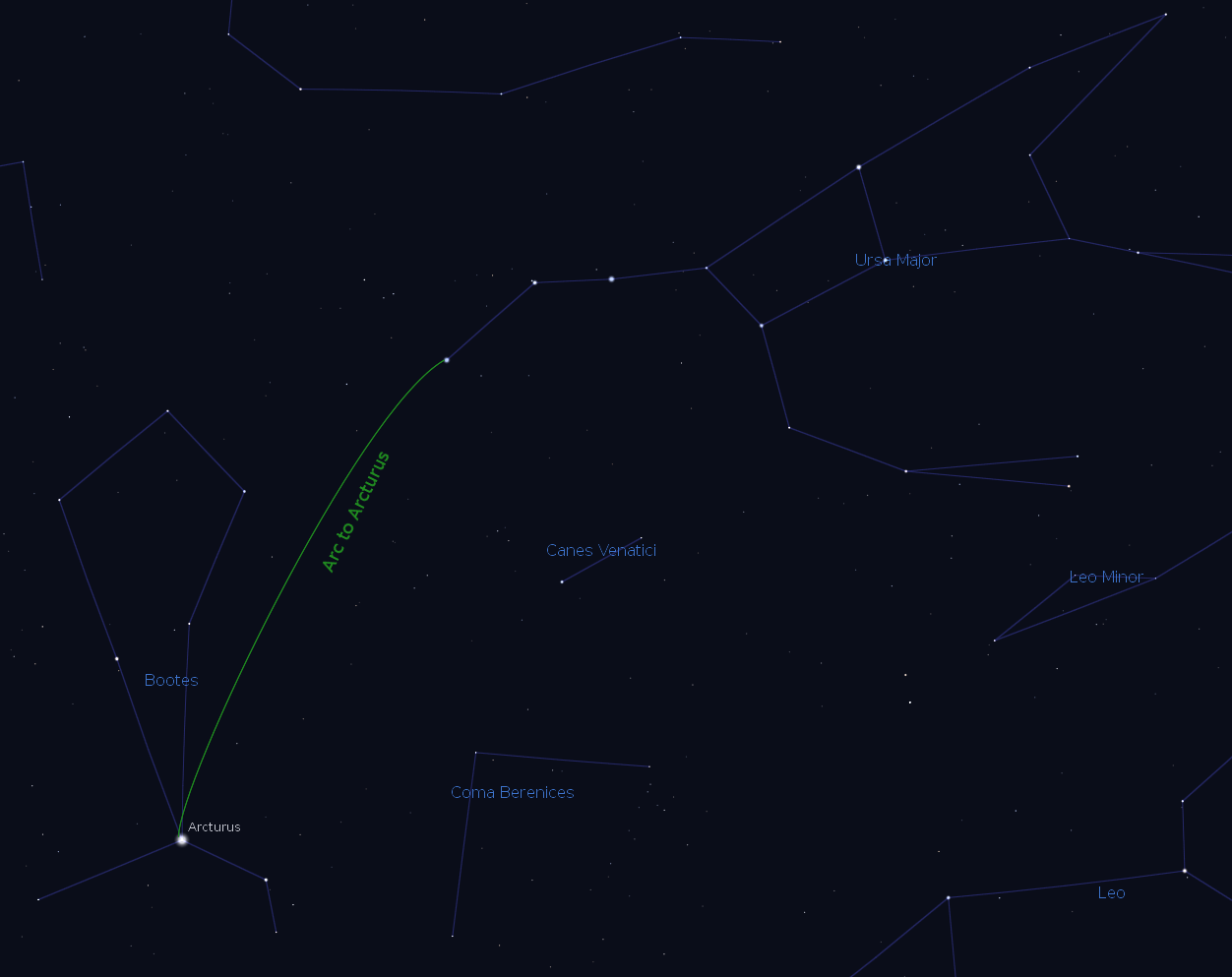
Finding Arcturus. Orientation for 11 p.m. on May 12, 2015. Created using Stellarium.

Evolution of a sun-like star. Note the sizes of the star at the various stages are compressed, also the time line. In the red giant stage the star is possibly a hundred times larger than at the main sequence stage. The white dwarf stage is a hundred times smaller than the main sequence stage. Click to enlarge. Credit: From a NASA/Chandra poster.
 Bob Moler's Ephemeris Blog