Archive
Ephemeris: 09/05/2024 – Looking at the center of the Milky Way
This is Ephemeris for Thursday, September 5th. Today the Sun will be up for 13 hours even, setting at 8:11, and it will rise tomorrow at 7:11. The Moon, 3 days past new, will set at 9:09 this evening.
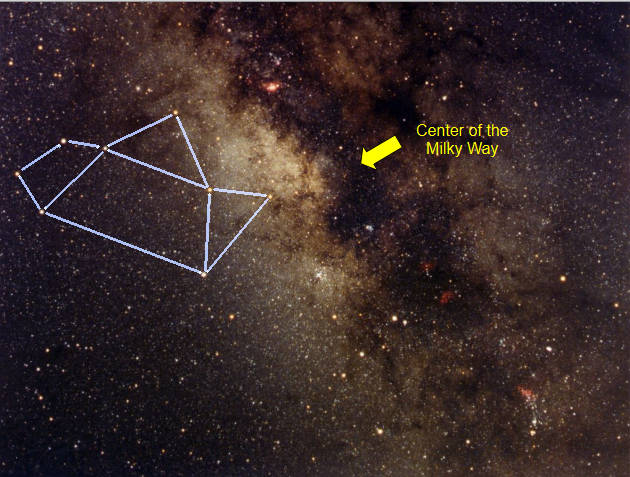
The moon sets in twilight so it will not bother viewing of the Milky Way when it gets dark. Looking to the south and little Teapot asterism of the constellation Sagittarius is the center of the Milky Way. It’s located just off the tip of the spout of that teapot. It’s about 25 to 27,000 light years away and is blocked from our view by clouds of gas and dust. In it lies the Milky Way’s central black hole. Astronomers have found that most galaxies have a black hole in their centers. Ours, it turns out, is a little smallish for our size of galaxy. It has the mass of four million times the mass of the Sun. Imaging of our black hole occurred at the same period of time that the data for the black hole in the galaxy M87. But its image took longer to produce due to the obstruction of that dust and gas.
The astronomical event times given are for the Traverse City/Interlochen area of Michigan (EDT, UT–4 hours). Times will be different for other locations.
Addendum
12/27/2022 – Ephemeris – 2022: We finally saw the black hole at the center of our galaxy
This is Bob Moler with Ephemeris for Tuesday, December 27th. Today the Sun will be up for 8 hours and 49 minutes, setting at 5:08, and it will rise tomorrow at 8:19. The Moon, 2 days before first quarter, will set at 10:30 this evening.
Besides the James Webb Space Telescope coming online in July, beginning, hopefully, twenty plus years of astronomical discovery, the Event Horizon Telescope Collaboration released an image of the black hole at the center of the Milky Way, 26,000 light years away In the direction of the constellation of Sagittarius. The collaboration, which consists of eight radio telescopes spread out from Hawai’i, to Europe, from Greenland to the South Pole, observed the black hole, dubbed Sagittarius A* (Pronounced Sagittarius A Star) for hours at the same time. The signals were recorded on disc drives, synchronized by atomic clocks, and then sent to a central processing center to create the image. The image was released last May of a fuzzy donut of the black hole and its accretion disk.
The astronomical event times given are for the Traverse City/Interlochen area of Michigan (EST, UT –5 hours). They may be different for your location.
Addendum
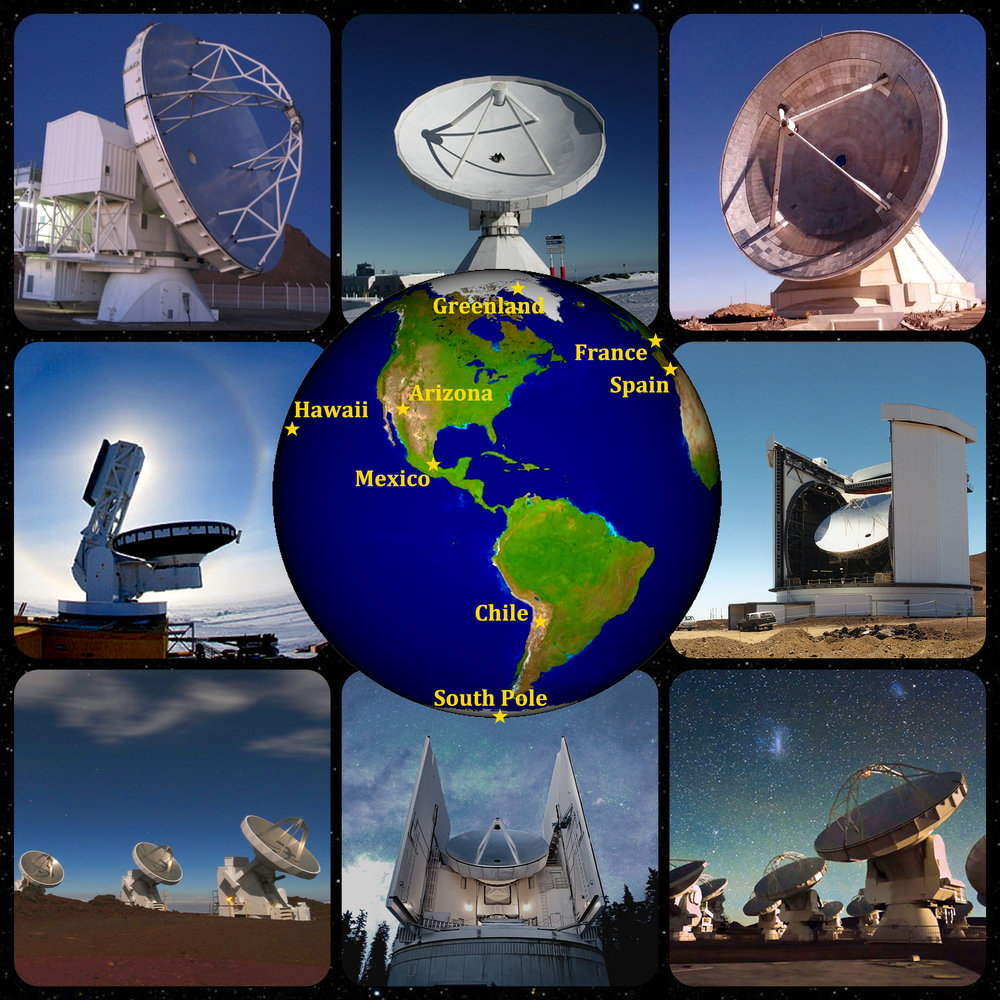
Event Horizon Telescope component radio telescopes. Credits: © APEX, IRAM, G. Narayanan, J. McMahon, JCMT/JAC, S. Hostler, D. Harvey, ESO/C. Malin.
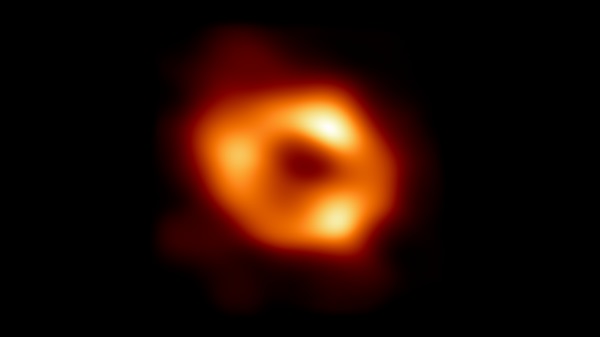
This is the image released May 12, 2022 by the Event Horizon Telescope Collaboration.
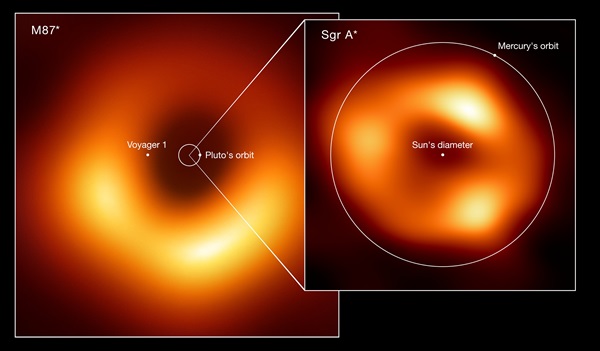
M87* size compared to Sagittarius A*. The size of a black hole is directly related to its mass. M87* has a mass of 6.4 billion times the Sun’s mass. It’s 55 million light years away. The mass of Sagittarius A* is only 4.2 million solar masses, and 26,000 light years away. Image credit: Event Horizon Telescope Collaboration.
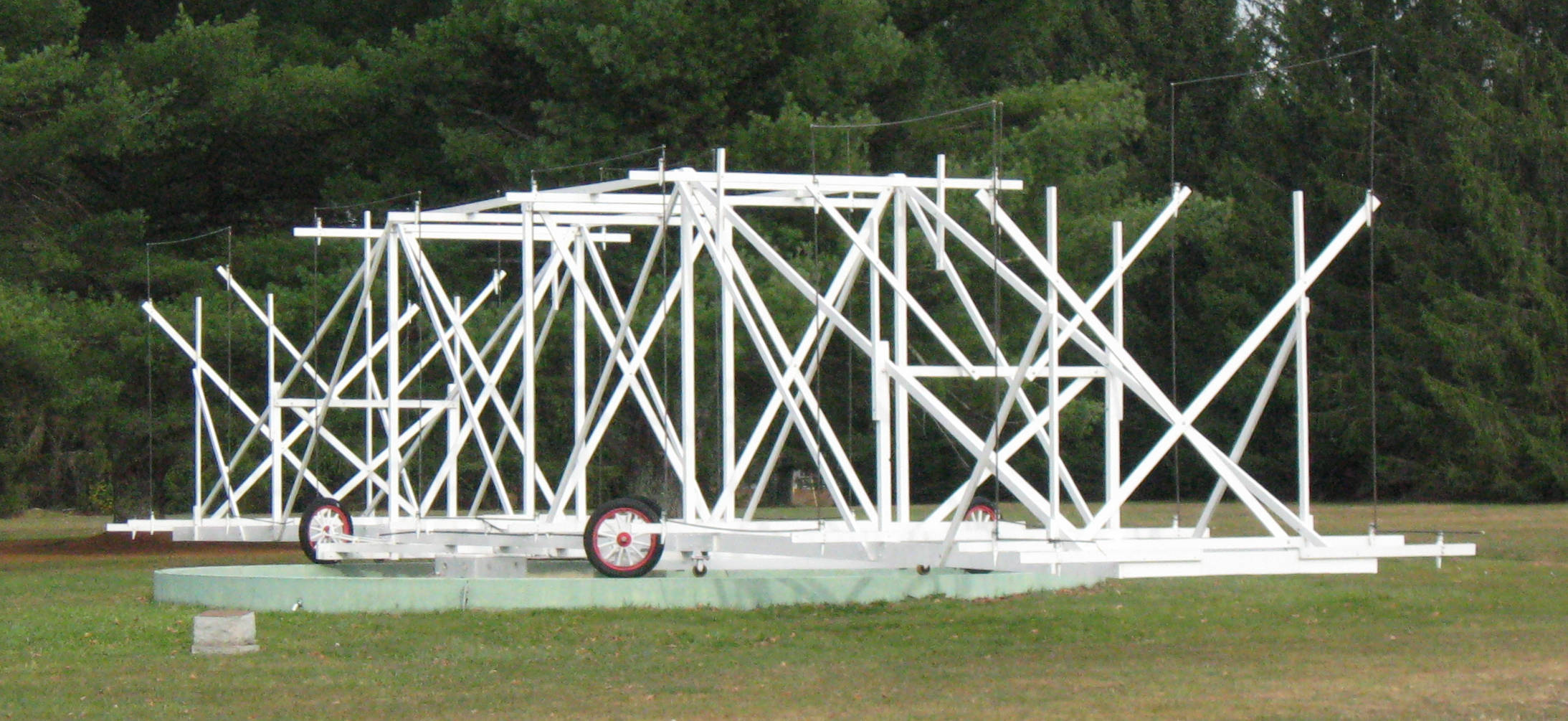
Karl Jansky’s antenna reconstruction at the National Radio Astronomy Observatory, Green Bank, WV. He could rotate the antenna to find the direction of the source. He found that the source rotated with the sky, and the direction was the azimuth of the constellation of Sagittarius the archer. The source was later dubbed Sagittarius A. It is the brightest radio source in the sky. Click on the image to enlarge it. Credit: mine.
When radio astronomy was in its infancy, bright radio sources were labeled with the constellation they were in and a capital letter. Astronomers didn’t know what they really were. Karl Jansky’s discovery of the first celestial radio source in 1933 has been dubbed Sagittarius A, or Sgr A for short. He worked for Bell Labs, and was seeking the source of interference with wireless telephony transmissions. The source was from the general direction of the center of the galaxy, our Milky Way Galaxy, in the direction of the constellation of Sagittarius the archer.
08/25/2022 – Ephemeris – Looking to the heart of the Milky Way
This is Bob Moler with Ephemeris for Thursday, August 25th. Today the Sun will be up for 13 hours and 34 minutes, setting at 8:31, and it will rise tomorrow at 6:58. The Moon, 2 days before new, will rise at 5:52 tomorrow morning.
Behind a dark cloud in the Milky Way, just above the spout of the teapot asterism or informal constellation that we see of the zodiacal constellation of Sagittarius, lies the very center of our Milky Way Galaxy. It cannot be seen in visible light, but can be detected with radio waves and infrared light that can penetrate the clouds of dust between. In 1932 Bell Laboratory physicist and radio engineer, Karl Jansky, discovered a source of radio static that came from that region of sky. It was subsequently given the designation Sagittarius A. It turns out that within that source there is an object called Sagittarius A* (Pronounced Sagittarius A Star), invisible in the near infrared, but with the mass of four million suns. It was recently imaged as the black hole at the center of our galaxy.
The astronomical event times given are for the Traverse City/Interlochen area of Michigan (EDT, UT – 4 hours). They may be different for your location.
Addendum
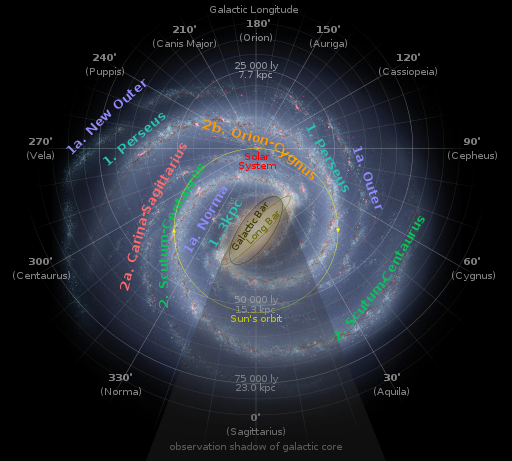
Our place in the Milky Way. Note that we appear to be in a barred spiral galaxy. The arms are numbered and named. 3kpc is the 3 kiloparsec arm. 3kpc = 9,780 light years. The Sun is about 27,000 light years from the center. Credit NASA and Wikimedia Commons, via EarthSky.org
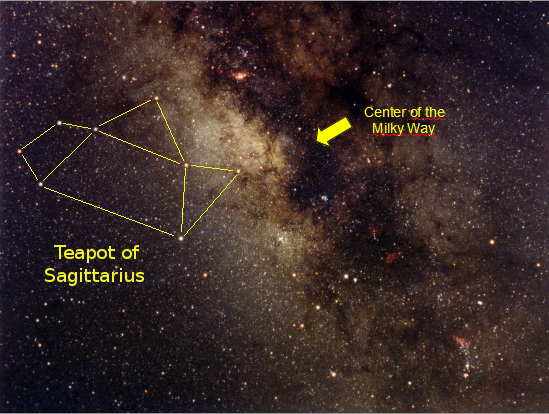
Location of the center of the Milky Way and the Teapot of Sagittarius. It’s behind that dark cloud.
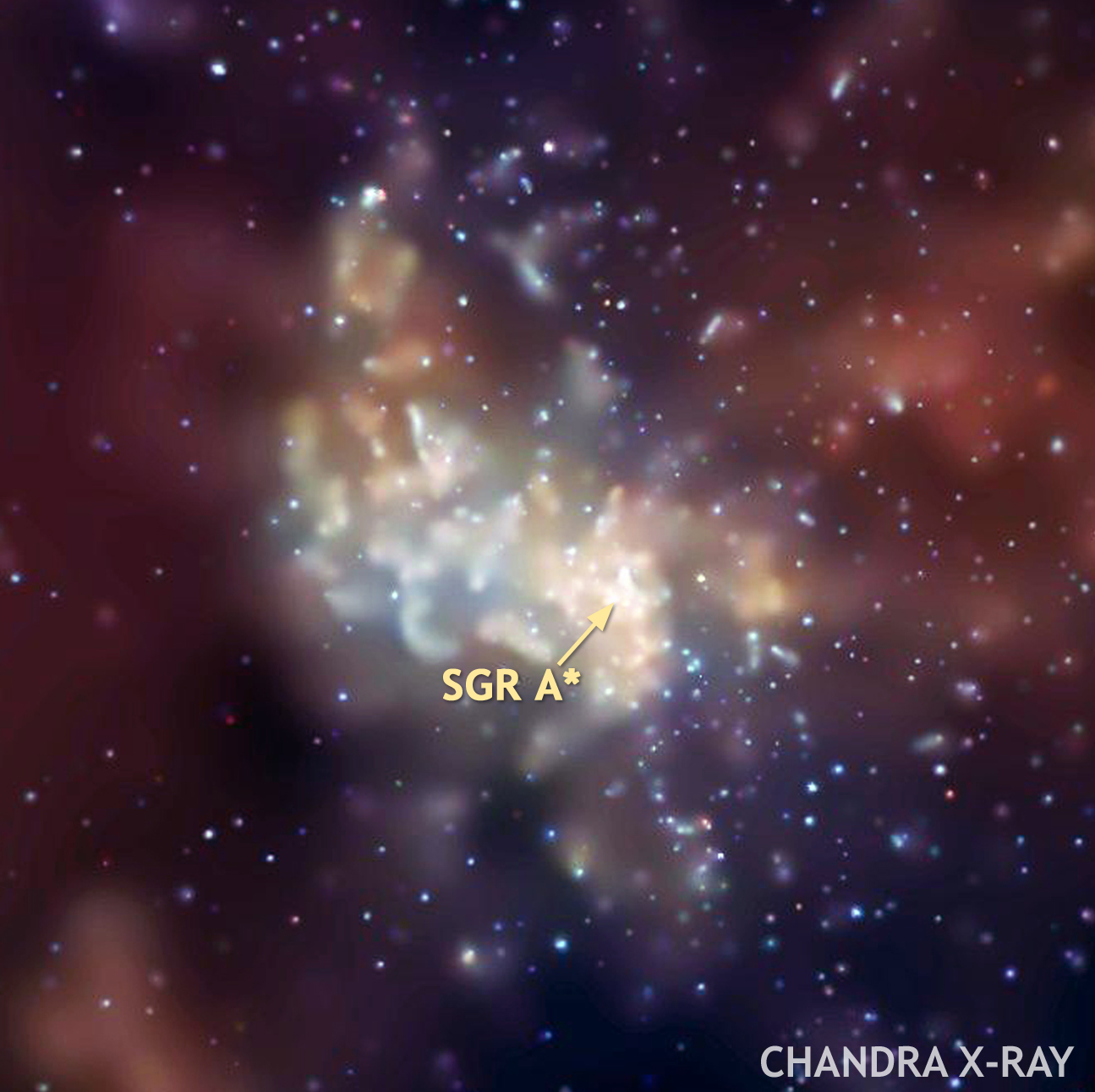
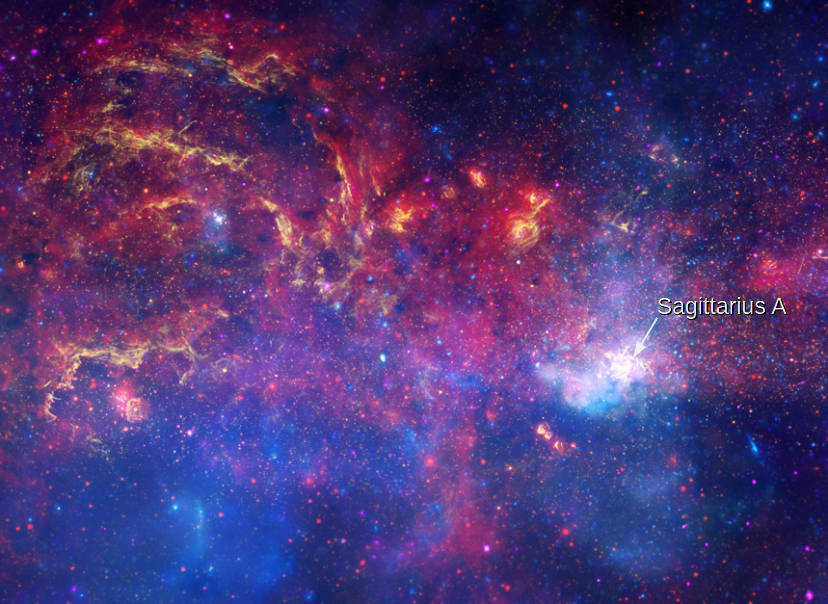
An image from the Chandra X-ray Telescope of the center of the Milky Way. SGR A or Sagittarius A is a radio source. SGR A*, pronounced Sagittarius A Star, is the 4 million solar mass black hole in the center of the Milky Way Galaxy. Credit NASA.
M87* size compared to Sagittarius A*. The size of a black hole is directly related to its mass. The asterisk * is pronounced “Star”. Credit: Event Horizon Telescope Collaboration.
The black hole images were reconstructed from data from 8 sub millimeter radio telescopes and arrays of the Event Horizon Telescope Collaboration. The telescopes were located from Greenland to the South Pole and From Hawai’i to Europe. The data from the telescopes, observing the black holes simultaneously, were combined to act like a single telescope with the diameter of the Earth in order to resolve the black holes.
05/16/2022 – Ephemeris – A peek at the monster at the center of the Milky Way
This is Ephemeris for Tuesday, May 17th. Today the Sun will be up for 14 hours and 54 minutes, setting at 9:06, and it will rise tomorrow at 6:11. The Moon, 1 day past full, will rise at 11:33 this evening.
This past Thursday the Event Horizon Telescope Collaboration released an image of the black hole at the center of the Milky Way, 27,000 light years away In the direction of the constellation of Sagittarius, which is currently visible low in the south in the morning hours. How they got the image is too complex to explain here, not that I know how they did it. It appears as a fuzzy donut with three bright areas around the edges. The dark center is the shadow of the black hole, because no light can escape it, plus it severely bends any light that comes near it. The light we’re seeing it is in millimeter microwaves, rather than the nanometer wavelengths of visible light. Part of the fuzziness of the image is due to the motion of the material surrounding it.
The astronomical event times given are for the Traverse City/Interlochen area of Michigan (EDT, UT – 4 hours). They may be different for your location.
Addendum
This is the image released May 12, 2022 by the Event Horizon Telescope Collaboration.
M87* size compared to Sagittarius A*. The size of a black hole is directly related to its mass. The asterisk * is pronounced “Star”. Credit: Event Horizon Telescope Collaboration.
It looks like I’ll have to update my presentation, What Lurks in the Center of the Milky Way? Astronomers were already sure it was a black hole, but the donut appearance of Sagittarius A* clinched it.
Off topic
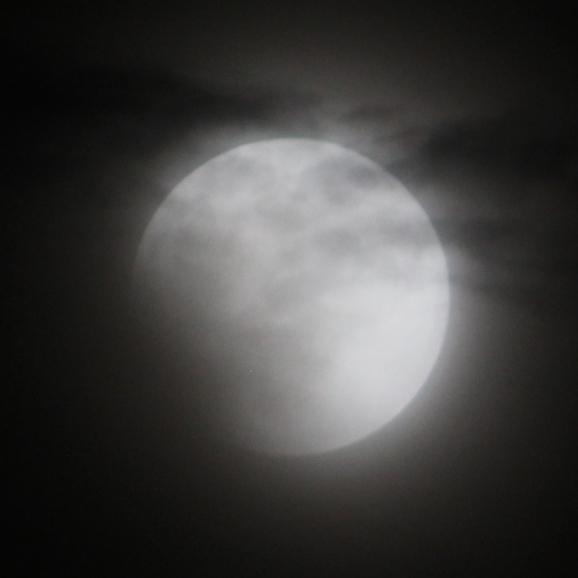
Last night’s (May 15/16) lunar eclipse, shortly after the partial eclipse began behind clouds. I often checked until totality, but it seems to get worse. I may have missed brief clearings. When I got up, it was clear… Figures.
 Bob Moler's Ephemeris Blog