Archive
Ephemeris: 09/08/2026 – Where is the Sun heading to?
This is Ephemeris for Tuesday, September 8th. Today the Sun will be up for 12 hours and 52 minutes, setting at 8:06, and it will rise tomorrow at 7:14. The Moon, 2 days before new, will rise at 5:18 tomorrow morning.
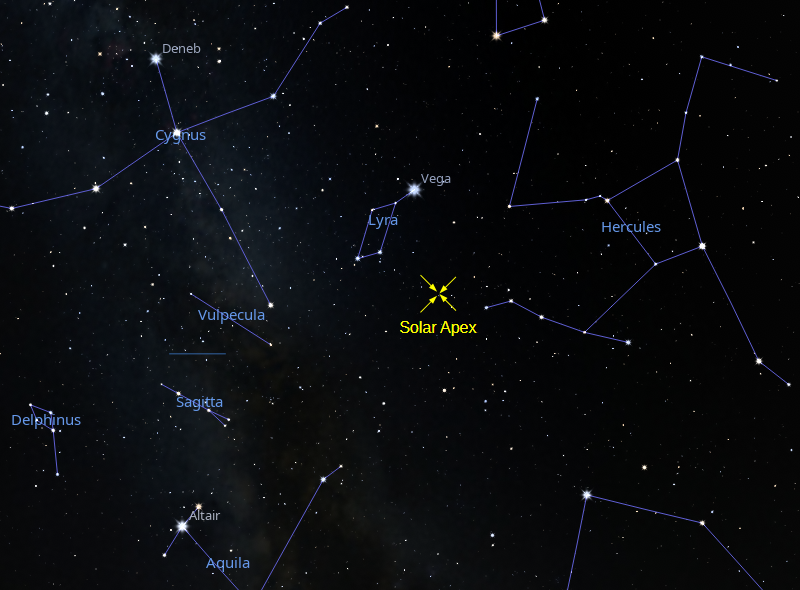
We know that the Earth orbits the sun, but where is the sun going? The sun orbits the center of the Milky Way moving something like 137 miles (220 kilometers) per second in the direction of Cygnus the Swan. It takes about 200 to 250 million years to orbit the center of the galaxy. However, the sun has a motion with respect to the general flow of stars in our neighborhood orbiting the center of the galaxy. Where the sun is heading is it called the solar apex. That point is it just a little bit south of the star Vega which is high in the south in the evening. Vega is the brightest star of this Summer Triangle, which includes Altair to the southeast and Deneb to the east. The sun’s motioned towards the apex that is about 8 miles (13 kilometers) per second.
The astronomical event times given in this blog are for the Traverse City/Interlochen area of Michigan (Lat 44.7° N, Long 85.7° W; EDT, UT – 4 hours) unless stated otherwise. Times will be different for other locations.
Addendum
Ephemeris: 08/31/2026 – September’s Milky Way
This is Ephemeris for Monday, August 31st. Today the Sun will be up for 13 hours and 17 minutes, setting at 8:21, and it will rise tomorrow at 7:05. The Moon, 3 days past full, will rise at 9:35 this evening.
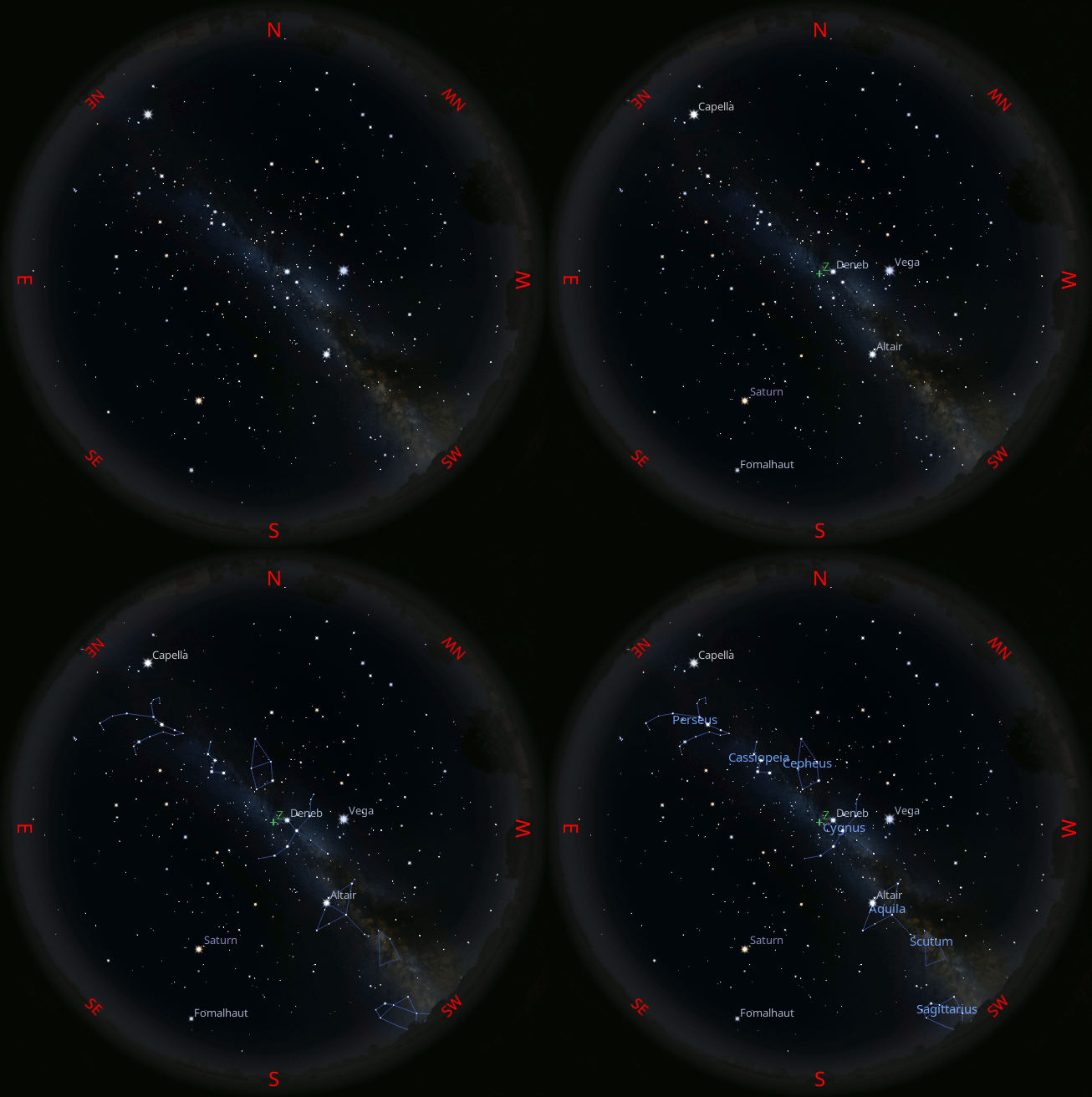
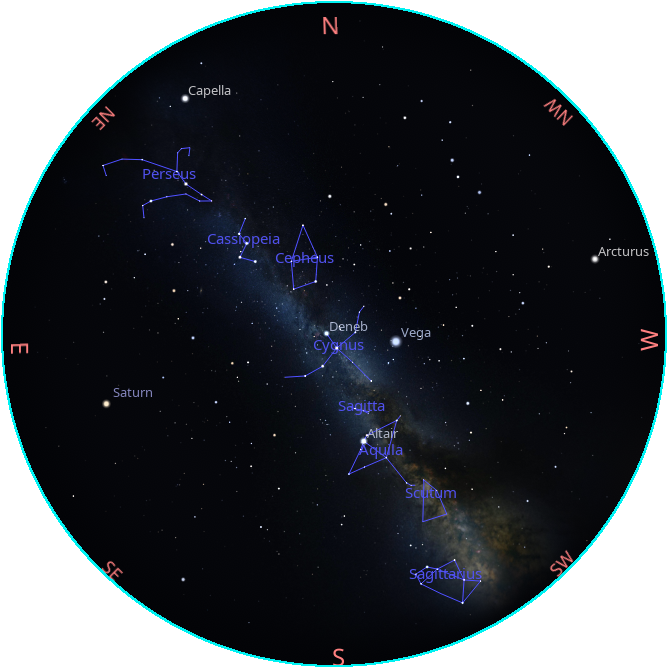
In the coming nights, as the moon leaves the evening sky, we will again be able to see the summer Milky Way. In September the Milky Way will twist from roughly northeast to south to northeast overhead to southwest. The teapot asterism of the constellation Sagittarius tilts and pours its tea onto the southwestern horizon and soon also succumbs to the rotation of the earth and sets. It will give us our last chance to see the great star clouds toward the center of our galaxy. The Milky Way will be with us until spring. Actually twisting, with new parts passing overhead. But, we will be looking out, opposite from the center, to the further reaches of the Milky Way that is not as bright, but the active star forming regions are closer.
The astronomical event times given in this blog are for the Traverse City/Interlochen area of Michigan (Lat 44.7° N, Long 85.7° W; EDT, UT – 4 hours) unless stated otherwise. Times will be different for other locations.
Addendum
Ephemeris: 08/13/2026 – The Milky Way seen in two cultures
This is Ephemeris for International Left-Handers Day, Thursday, August 13th. Today the Sun will be up for 14 hours and 8 minutes, setting at 8:51, and it will rise tomorrow at 6:44. The Moon, 1 day past new, will set at 9:22 this evening.
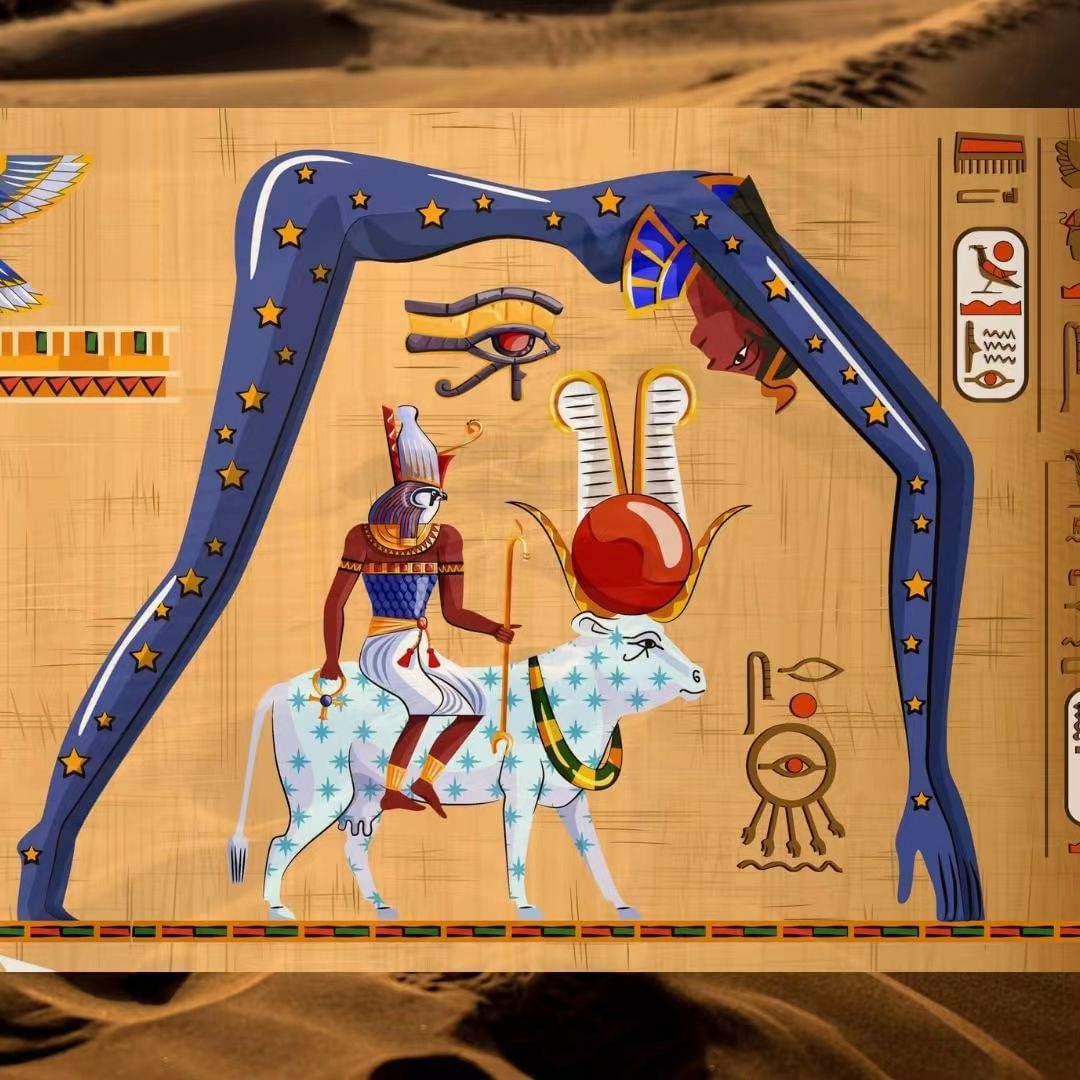
In the folk tales of many lands and cultures the Milky Way has been seen as either a stream or pathway. The term we get for it, the Milky Way, is that it is a stream of milk from the breasts of the Egyptian goddess Nut, the goddess of the sky.
The Anishinaabe native peoples of our area gave it several names: Jiibay-Miikana, The Spirit Road, or Jiibay-ziibi, River of souls, Both for the journey of souls to the afterlife. Or Binesiwi-miikana, Thunderbird’s path. This last is interesting, because in spring as the Milky Way rises from the southeast it beckons migrating birds northward, and in autumn as the Milky Way sinks to the southwest, it bids them to fly southward to warmer climes.
The astronomical event times given in this blog are for the Traverse City/Interlochen area of Michigan (Lat 44.7° N, Long 85.7° W; EDT, UT – 4 hours) unless stated otherwise. Times will be different for other locations.
Addendum
Ephemeris: 08/07/2026 – The Great Rift
This is Ephemeris for Friday, August 7th. Today the Sun will be up for 14 hours and 24 minutes, setting at 9:00, and it will rise tomorrow at 6:37. The Moon, 2 days past last quarter, will rise at 1:20 tomorrow morning.
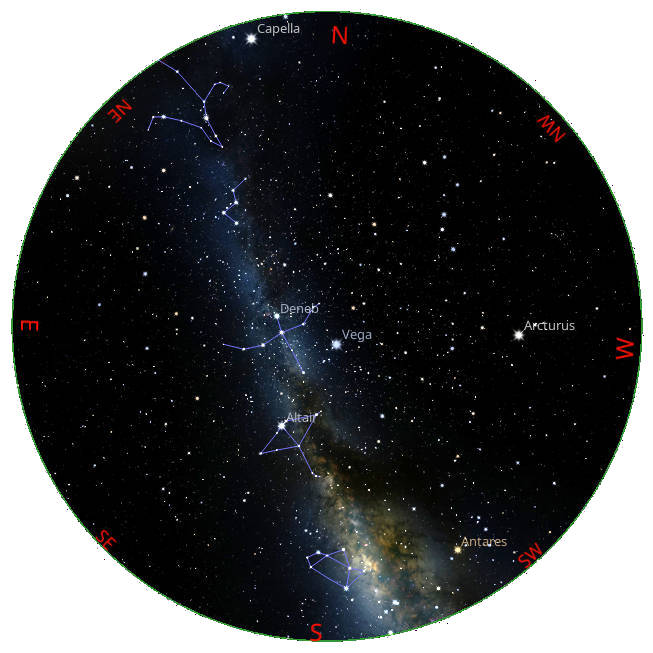
Once one finds the Milky Way which is pretty hard to miss this month, it becomes obvious that the Milky Way is split lengthwise starting near Deneb, the northernmost star of the Summer Triangle, almost all the way to the Teapot of Sagittarius low in the south. That dark split is called the Great Rift. Galileo first discovered that the hazy clouds of the Milky Way were actually made of faint stars, so it was thought the dark areas were due to a lack of stars. The great 18th century astronomer William Herschel did star counts all over the sky with his telescope. A map his sister drew of the flattened shape of his universe shows the lack of distant stars in one direction. It’s not really fewer stars, but interstellar clouds of dust blocking the light of the stars behind them.
The astronomical event times given in this blog are for the Traverse City/Interlochen area of Michigan (Lat 44.7° N, Long 85.7° W; EDT, UT – 4 hours) unless stated otherwise. Times will be different for other locations.
Addendum
Ephemeris: 07/28/2026 – The size and shape of the Milky Way
7/
This is Ephemeris for Tuesday, July 28th. Today the Sun will be up for 14 hours and 48 minutes, setting at 9:13, and it will rise tomorrow at 6:25. The Moon, 1 day before full, will set at 6:11 tomorrow morning.
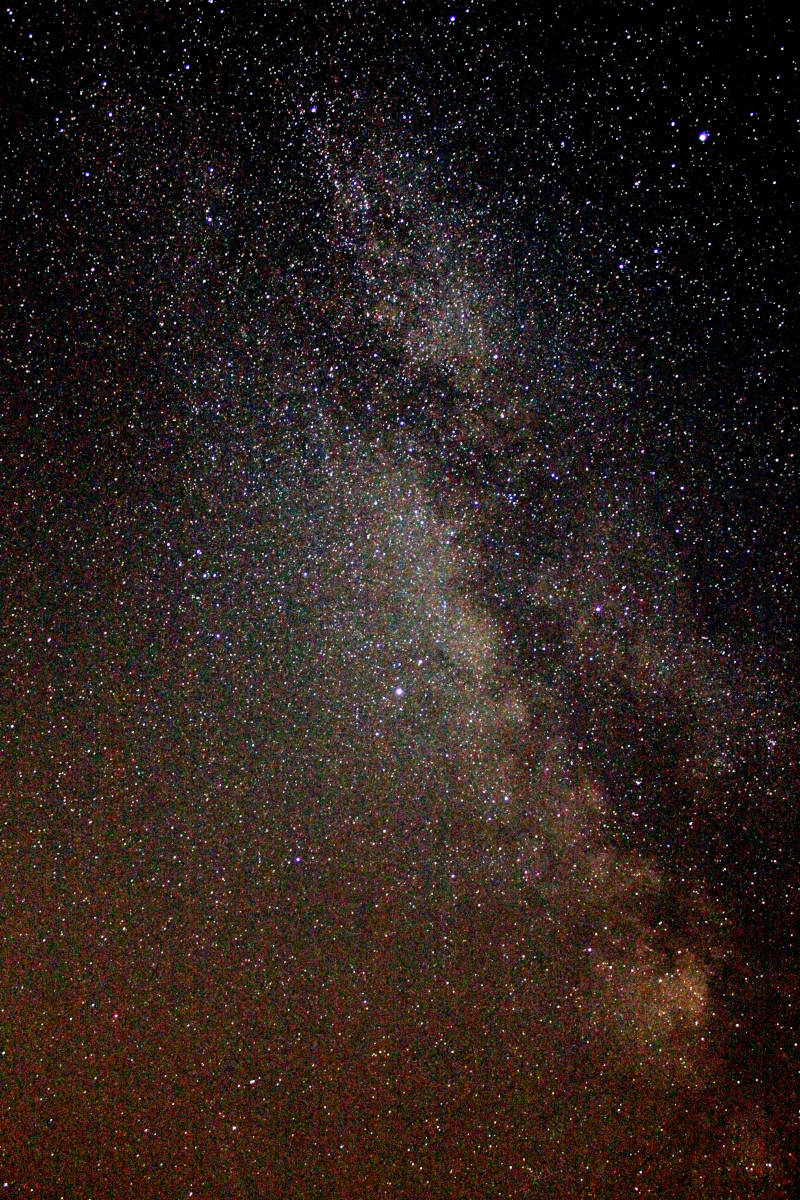
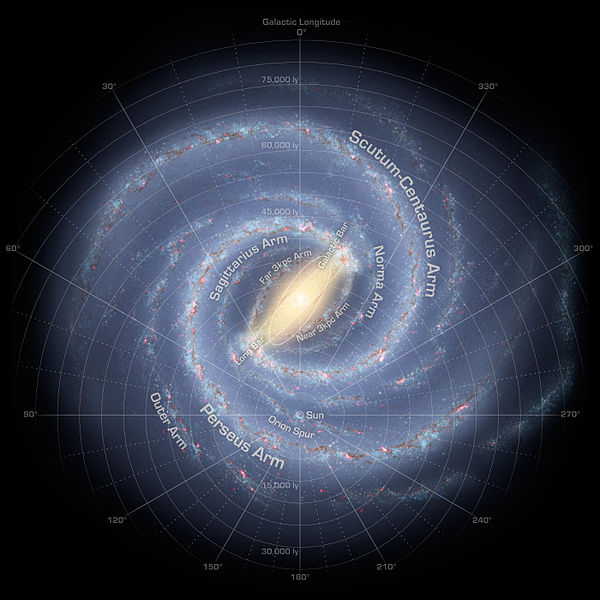
August and September are the two months in which the Milky Way dominates the evening sky. It also dominates the sky in the winter, six months from now but we’re looking out away from the center of the Milky Way. It is dimmer, an almost invisible as a band, but we have a great number of really bright stars, including those of Orion. The Milky Way is a galaxy, a large conglomeration of stars that are arranged in a disk, with the central bulge, whose diameter is about 87,400 light years. The thickness of the disk runs from 8,500 light years near the center to 1,000 light years farther out. The sun’s location is 25 to 26,000 light years from the center. From our location within the disk it appears to be a glowing band that surrounds the sky.
The astronomical event times given in this blog are for the Traverse City/Interlochen area of Michigan (Lat 44.7° N, Long 85.7° W; EDT, UT – 4 hours) unless stated otherwise. Times will be different for other locations.
Addendum
Ephemeris: 05/04/2026 – Looking out of the Milky Way
This is Bob Moler with Ephemeris for Monday, May 4th. Today the Sun will be up for 14 hours and 23 minutes, setting at 8:51, and it will rise tomorrow at 6:26. The Moon, 3 days past full, will rise at 12:25 tomorrow morning.
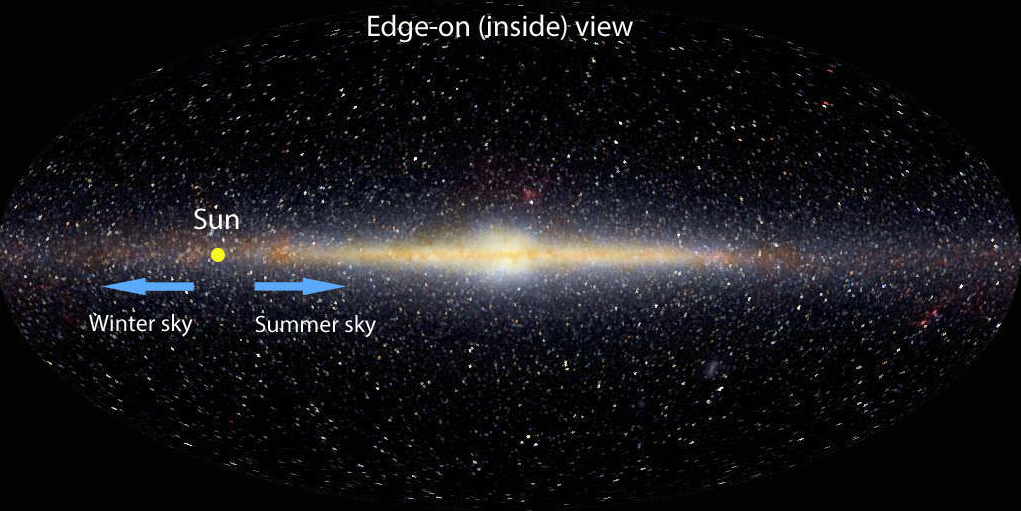
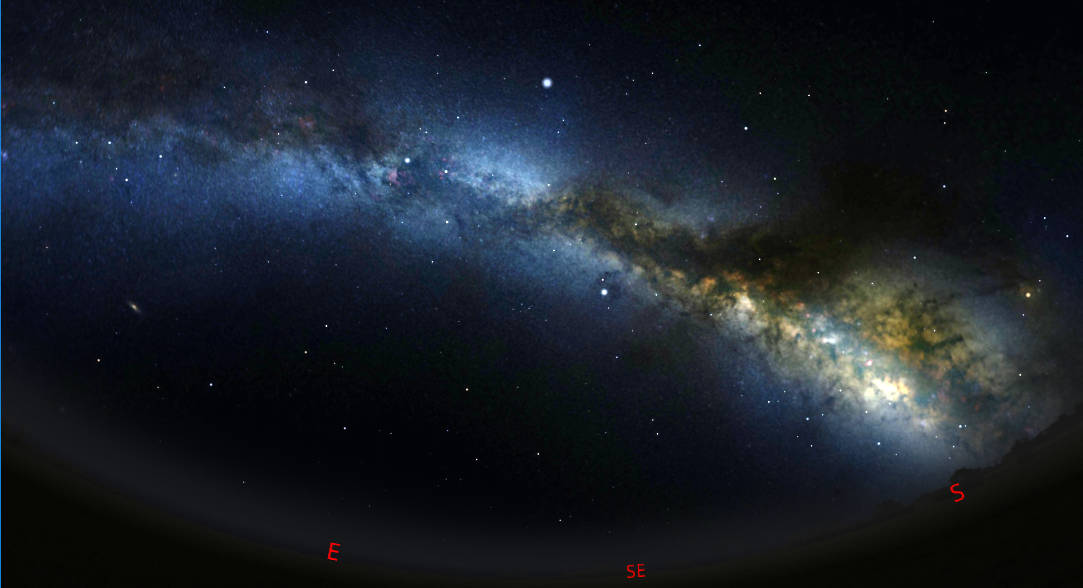
The May evening sky, when it finally gets dark, contains fewer stars than those of winter. And they’re much dimmer. The main reason for that is that we are looking out the plane of the Milky Way Galaxy. The Milky Way is no nowhere to be seen, because it rings the horizon. A bit is visible in the north. The summer triangle of bright stars is not completely up in the evening, and it straddles the Milky Way. So we are looking out to the universe beyond the Milky Way, for the most part. Even amateur telescopes will reveal a great number of galaxies, because there’s a huge cluster of galaxies in the constellation Virgo which is right behind and below Leo the lion in the sky. However, just about 90° from the plane of the Milky Way is a star cluster that looks like strands of hair.
The astronomical event times given in this blog are for the Traverse City/Interlochen area of Michigan (Lat 44.7° N, Long 85.7° W; EDT, UT – 4 hours) unless stated otherwise. Times will be different for other locations.
Addendum
Ephemeris: 03/23/2026 – Looking out beyond the spring stars
This is Ephemeris for Monday, March 23rd. Today the Sun will be up for 12 hours and 19 minutes, setting at 7:59, and it will rise tomorrow at 7:38. The Moon, 2 days before first quarter, will set at 2:23 tomorrow morning.
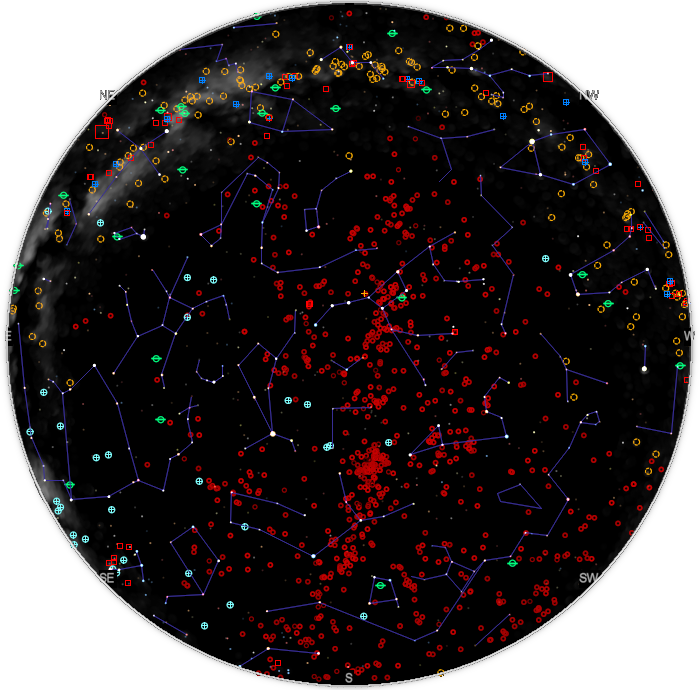
It is becoming more obvious as the Moon waxes, that there’s more bright stars in the south and southwestern part of the sky than there are in the southeastern sky. That’s because the Milky Way runs through the winter part of the sky. It’s not as bright as the Milky Way appears in the summer since we are looking away from the center of our Galaxy. The disk of our galaxy causes stars to congregate near that Milky band, whether we can see it well or not. That is the main reason the winter stars are so bright. In the southeast we are looking at the spring sky. Leo the lion and of course the Great Bear with the Big Dipper are there, but we are mostly looking outside the disk or galaxy to the universe beyond. So we’re looking through fewer nearby stars, so the spring sky seems somewhat lackluster compared to the crazy chaos of the winter sky.
The astronomical event times given in this blog are for the Traverse City/Interlochen area of Michigan (Lat 44.7° N, Long 85.7° W; EST, UT – 5 hours) unless stated otherwise. Times will be different for other locations.
Addendum
Ephemeris: 09/15/2025 – Last month to view the southern Milky Way from Michigan
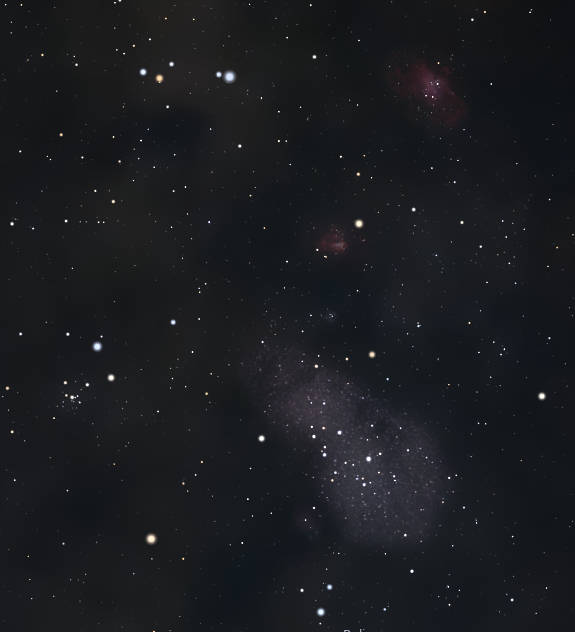
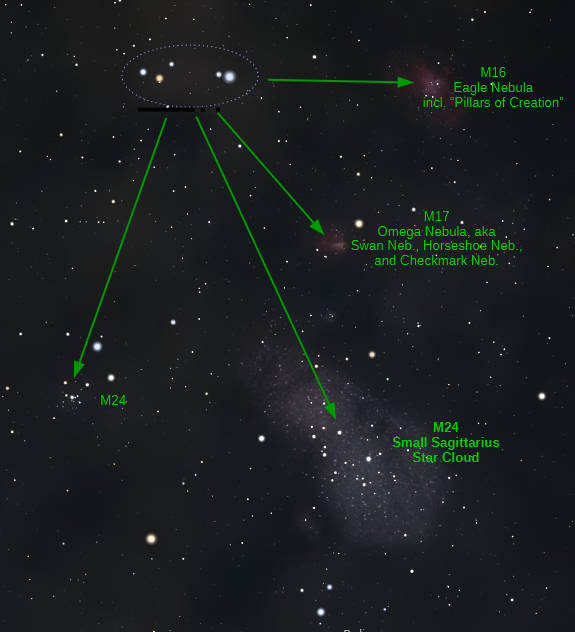
This is Bob Moler with Ephemeris for Monday, September 15th. Today the Sun will be up for 12 hours and 30 minutes, setting at 7:52, and it will rise tomorrow at 7:23. The Moon, 1 day past last quarter, will rise at 1:14 tomorrow morning.
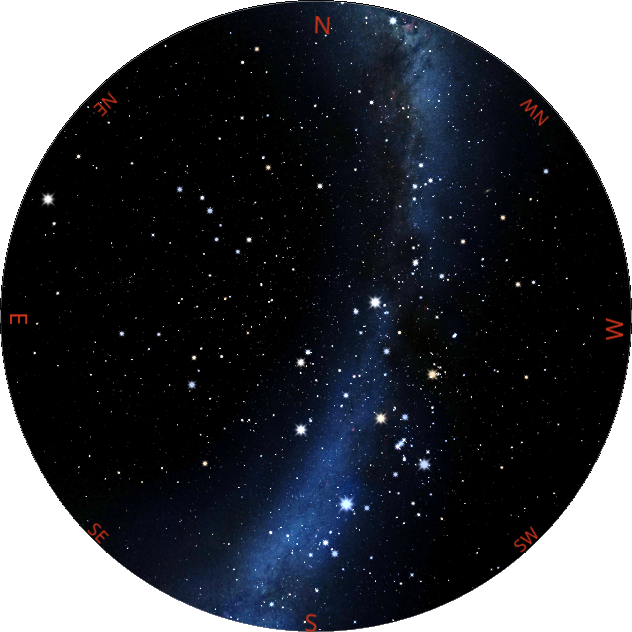
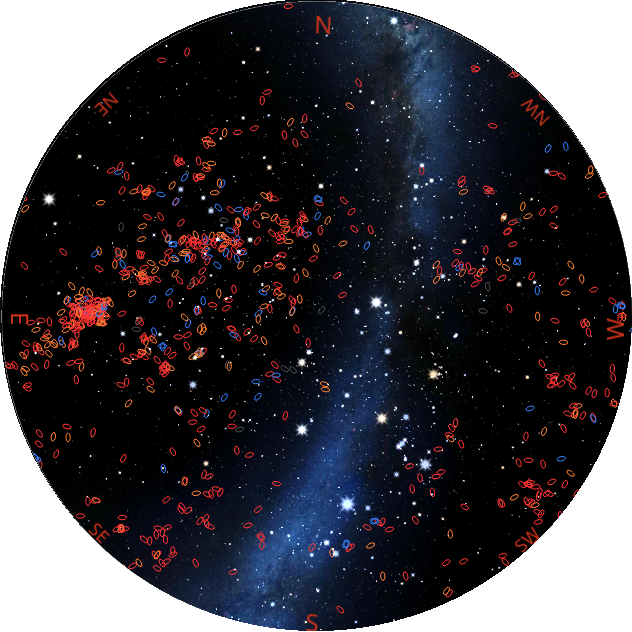
September is the second of the two months we get to see the southern part of the Milky Way in the evening sky. At 10 PM the asterism of the Teapot of the constellation Sagittarius is pouring its tea on the southwestern horizon. It is in that direction that we look to the center of the Milky Way. Unfortunately there are clouds of dust and gas between us and the center, so we cannot see it visually, though it can be seen by radio waves and other means. There are a host of objects visible in binoculars and small telescopes. One does not need a star map to be able to find them, just point a telescope at low power or binoculars in that direction and sweep around slowly. There are treasures of star clusters and nebulae to be found.
The astronomical event times given in this blog are for the Traverse City/Interlochen area of Michigan (Lat 44.7° N, Long 85.7° W; EDT, UT – 4 hours) unless stated otherwise. Times will be different for other locations.
Addendum
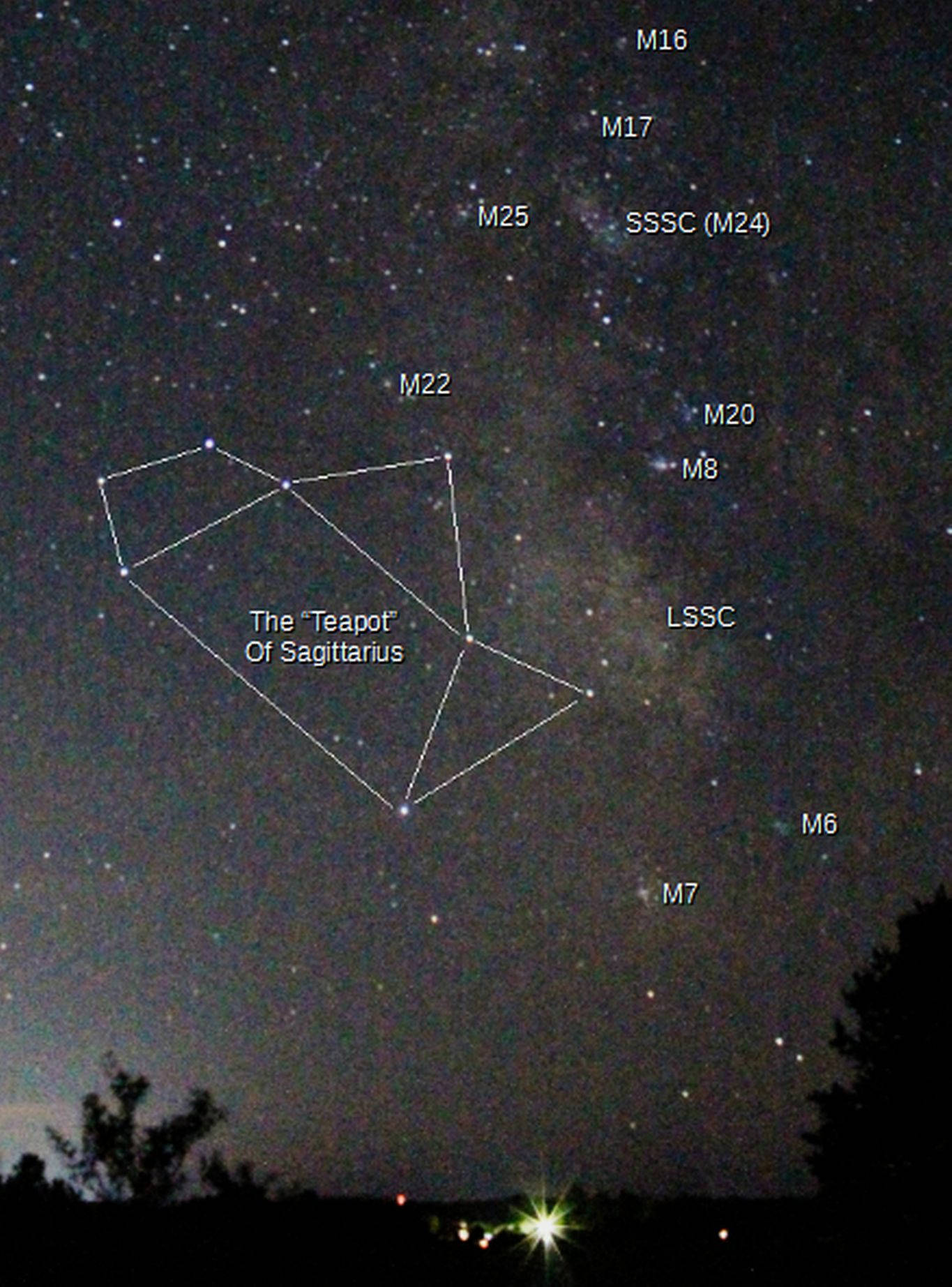
In the image above the amount of detail of the stars is approximately that of a pair of binoculars. The various nebulae and star clusters are denoted with M numbers. These are some of the brightest, what we call deep sky objects, in the catalog by Charles Messier, who is looking for comets. He numbered them as he came across them. The brightest star cluster is M7, which Claudius Ptolemy recorded in the 2nd century CE. The brightest nebula is M8, the Lagoon Nebula out of which a star cluster is being formed. In binoculars, it looks like a short horizontal gash. Next in brightness is M17, a fuzzy spot in binoculars, but appears as a glowing check mark, or swimming swan in a telescope. M20, the Trifid Nebula, is the next brightest nebula in which dark dust lanes divide it into three lobes. M16, the Eagle Nebula is very dim. Most of the time I miss the nebulosity, but its embedded star cluster is quite easily seen. The rest of the Messier objects are star clusters or a star cloud. Of these M22 is a globular star cluster and one of the easiest of these clusters to resolve, though it might take a telescope of 150 mm (6″) diameter to do it.
Ephemeris: 08/21/2025 – The Milky Way’s Great Rift
This is Ephemeris for Thursday, August 21st. Today the Sun will be up for 13 hours and 45 minutes, setting at 8:38, and it will rise tomorrow at 6:53. The Moon, 2 days before new, will rise at 5:57 tomorrow morning.
Once one finds the Milky Way which is pretty hard to miss this month, it becomes obvious that the Milky Way is split lengthwise starting near Deneb, the northernmost star of the Summer Triangle, almost all the way to the Teapot of Sagittarius low in the south. That dark split is called the Great Rift. Galileo first discovered that the hazy clouds of the Milky Way were actually made of faint stars, so it was thought the dark areas were due to a lack of stars. The great 18th century astronomer William Herschel did star counts all over the sky with his telescope. A map his sister drew of the flattened shape of his universe shows the lack of distant stars in one direction. It’s not really fewer stars, but interstellar clouds of dust blocking the light of the stars behind them.
The astronomical event times given in this blog are for the Traverse City/Interlochen area of Michigan (Lat 44.7° N, Long 85.7° W; EDT, UT – 4 hours) unless stated otherwise. Times will be different for other locations.
Addendum

Ephemeris: 11/04/2024 – The Milky Way in Autumn
This is Ephemeris for Monday, November 4th. Today the Sun will be up for 10 hours and 1 minute, setting at 5:26, and it will rise tomorrow at 7:26. The Moon, 4 days past new, will set at 6:58 this evening.
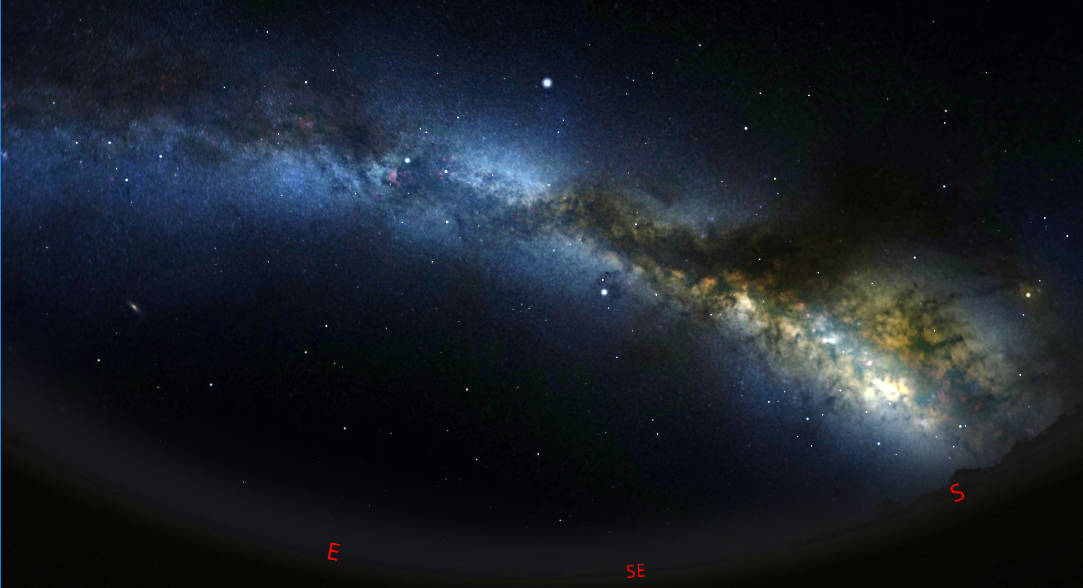
As of yesterday the sunsets and sunrises have slipped back an hour so we have darker evenings and brighter mornings, as we came back to Standard Time. It seems odd that we spend less time of the year under Standard Time than we do under Daylight Time. Anyway, looking at the evening sky we see that Venus tonight will be above the four-day-old crescent Moon in the southwest after sunset. By 7 PM the northernmost star of the Summer Triangle, Deneb in Cygnus the swan or the Northern Cross, will be almost directly overhead. And the Milky Way at that time will run from northeast, overhead to the southwestern horizon. Remember tomorrow is Election Day. Make sure you cast your ballot before the end of voting tomorrow, if you haven’t already.
The astronomical event times given are for the Traverse City/Interlochen area of Michigan (EST, UT – 5 hours). Times will be different for other locations.
Addendum