Archive
Ephemeris: 06/30/2025 – Asteroid hitting the Moon in 2032 may cause spectacular meteor shower and danger to satellites
This is Ephemeris for International Asteroid Day, Monday, June 30th. Today the Sun will be up for 15 hours and 31 minutes, setting at 9:32, and it will rise tomorrow at 6:01. The Moon, 2 days before first quarter, will set at 12:46 tomorrow morning.
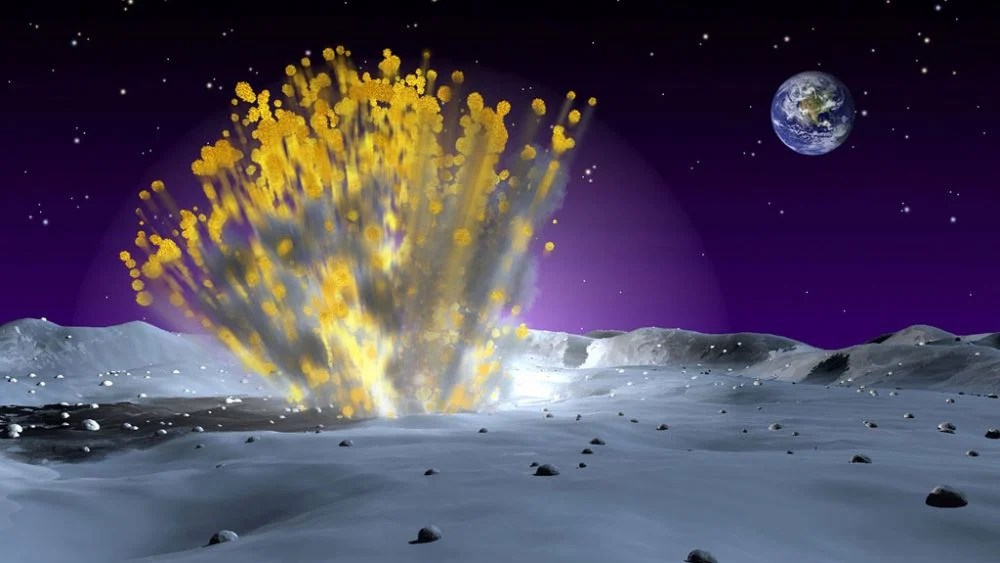
This is the 117th anniversary of the Tunguska Event, an asteroid strike that hit Siberia in 1908. An asteroid, thought to be of similar size, will pass close to the Earth, but has a 4% chance of hitting the Moon on December 22nd 2032. The asteroid was discovered near the end of last year and has the designation 2024 YR4. For a while there was a fear that this asteroid might hit the Earth. However, it was soon found that the asteroid would not hit the Earth but had a chance of hitting the Moon. Recently a paper was written that looked at what would happen to the ejecta of an impact of this asteroid on the Moon. It could be a hazard to the satellites orbiting the Earth.
The astronomical event times given in this blog are for the Traverse City/Interlochen area of Michigan (Lat 44.7° N, Long 85.7° W; EDT, UT – 4 hours) unless stated otherwise. Times will be different for other locations.
Addendum
Further reading
The Mother of All Meteor Showers Could Threaten Satellites By Evan Gough, Universe Today
Original paper: The Potential Danger to Satellites due to Ejecta from a 2032 Lunar Impact by Asteroid 2024 YR4 by Paul Wiegert et al.
03/17/2015 – Ephemeris – Jupiter’s cloud stripes
Ephemeris for St. Patrick’s Day, Tuesday, March 17th. The Sun will rise at 7:51. It’ll be up for 11 hours and 59 minutes, setting at 7:51. The Moon, 3 days before new, will rise at 6:37 tomorrow morning.
Jupiter is the one planet that we can see detail on with telescopes in the evening sky. Venus is so bright that it is hard to even see its gibbous phase. Actually the best way to see Venus is during the day with the blue sky around it. Jupiter is a big planet, 11 times the Earth’s diameter and 1,300 times it volume. Despite this it is only 318 times the Earth’s mass, so much of its mass is the atmosphere. It’s rotation rate is just under 10 hours at its equator. This drops with latitude, so its atmosphere is twisted into alternate belts and zones. The belts are dark brown while the zones are lighter. They move around the planet at different speeds causing storms that their boundaries. The Great Red Spot is a anticyclone in the south.
Times are for the Traverse City/Interlochen area of Michigan. They may be different for your location.
Addendum
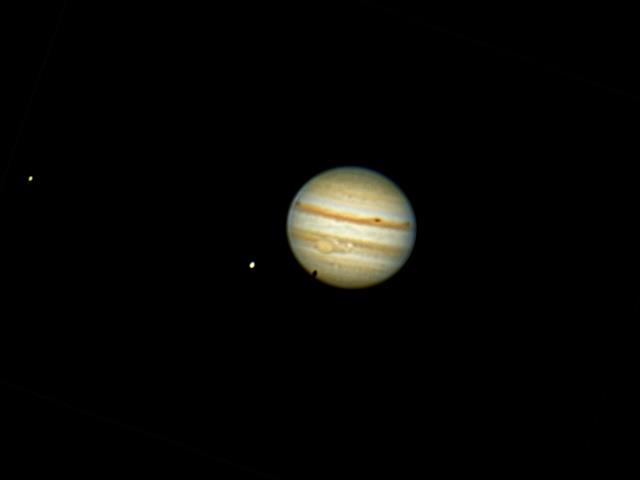
Jupiter by Scott Anttila November 14, 2011. With shadow on the planet and the Great Red Spot.
 Bob Moler's Ephemeris Blog