Archive
06/16/2016 – Ephemeris – The Moon tonight
Ephemeris for Thursday, June 16th. Today the Sun will be up for 15 hours and 34 minutes, setting at 9:30, and it will rise tomorrow at 5:56. The Moon, half way from first quarter to full, will set at 4:23 tomorrow morning.
The Moon is bright as it moves toward full. In binoculars, the brightest spot on the Moon is visible on the left edge of the Moon at 10 p.m. In telescopes it becomes a crater named Aristarchus. The sea below Aristarchus where the terminator, the sunrise line cuts across is Oceanus Procellarum, the Ocean of Storms. Below that is the small circular sea called Mare Humorum, the Sea of Moisture. Below that we’re back in the lunar highlands with lots of large craters, rather to many
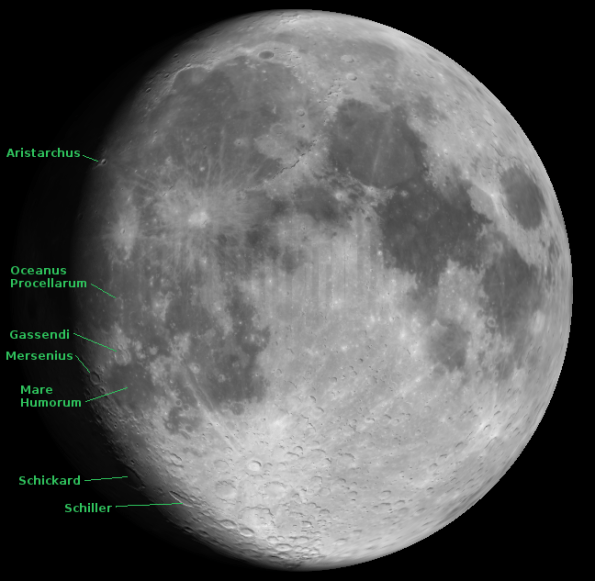
The Gibbous Moon at 10 p.m., June 16, 2016 showing some interesting features near the terminator.
to mention here. The transcripts of these programs with illustrations are available at bobmoler.wordpress.com. That’s Moler spelled simply M-O-L-E-R. The Moon illustration will point out the features I’ve discussed.
Times are for the Traverse City/Interlochen area of Michigan. They may be different for your location.
Addendum
08/07/2014 – Ephemeris – Two large craters of the lunar highlands visible tonight
Ephemeris for Thursday, August 7th. The sun rises at 6:35. It’ll be up for 14 hours and 24 minutes, setting at 8:59. The moon, 3 days before full, will set at 4:07 tomorrow morning.
The gibbous Moon is getting brighter as it becomes more sunlit from the Earth’s prospective. The disk of the Moon will be 89 percent illuminated by the sun tonight. The bright crater Aristarchus, which I’ve talked about before, on the upper left of the moon is now in sunlight. On the lower left there are two interesting craters for the small telescope. Split in half by the sunrise line terminator is the large crater Schickard 137 miles (227 km) in diameter. Craters near the limb of the Moon are foreshortened by the fact that the Moon’s nearly spherical so they there appear elongated. One, more elongated than most, is nearby Schiller which is actually 108 by 43 miles (179 by 69 km), which may be two overlapping craters or a really low angle asteroid impact.
Times are for the Traverse City/Interlochen area of Michigan. They may be different for your location.
Addendum
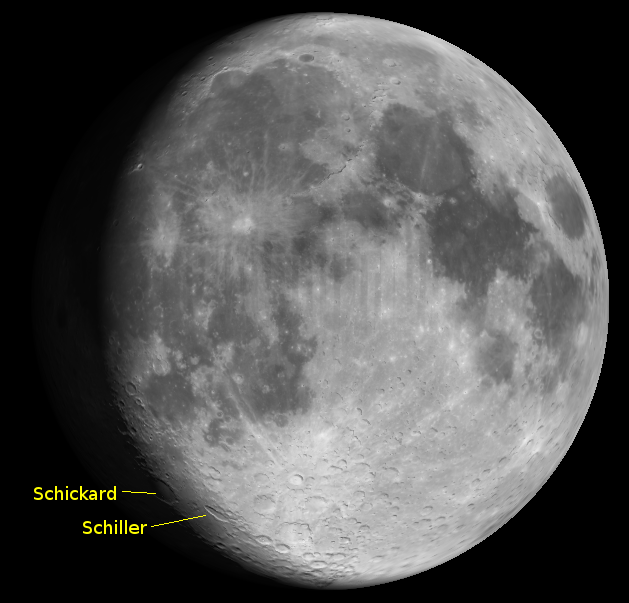
The lunar craters Schickard and Schiller on the lunar terminator at 10 p..m., August 7, 2014. Created using Virtual Moon Atlas.
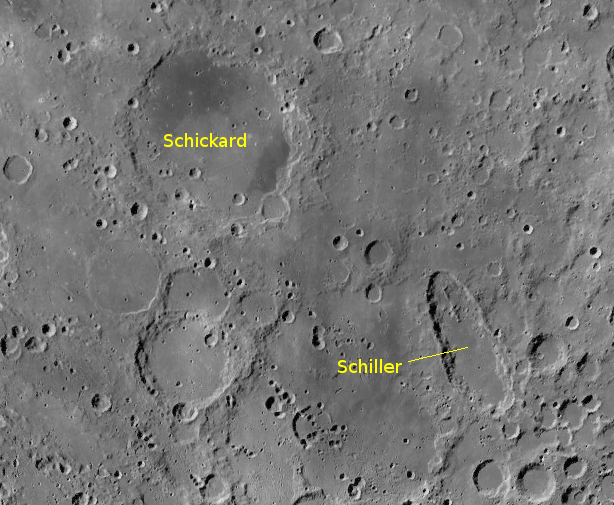
The craters Schickard and Schiller from the Lunar Reconnaissance Orbiter. Credit NASA from Virtual Moon Atlas.
 Bob Moler's Ephemeris Blog