Archive
04/07/2022 – Ephemeris – The Sun is getting active again
This is Ephemeris for Thursday, April 7th. Today the Sun will be up for 13 hours and 5 minutes, setting at 8:17, and it will rise tomorrow at 7:10. The Moon, 2 days before first quarter, will set at 3:11 tomorrow morning.
For the last year and a half, the Sun has entered a new sunspot cycle, solar cycle 25. It had been predicted to be a rather mild cycle with an average peak in sunspot numbers of around 120 in 2025, three years from now. Last Sunday’s daily sunspot number was 118. Sunspot numbers are not just the numbers of individual sunspots on the Sun. Groups of spots count for 10 before the individual spots are counted. These counts are averaged, from many observatories, over a month to chart the progress of the approximately 11 year sunspot cycle. The more sunspots, the more solar flares. The more flares, the more CMEs or coronal mass ejections. If CMEs are aimed toward the Earth, we get northern lights, and headaches for satellite operators and electric power companies.
The astronomical event times given are for the Traverse City/Interlochen area of Michigan (EDT, UT – 4 hours). They may be different for your location.
Addendum
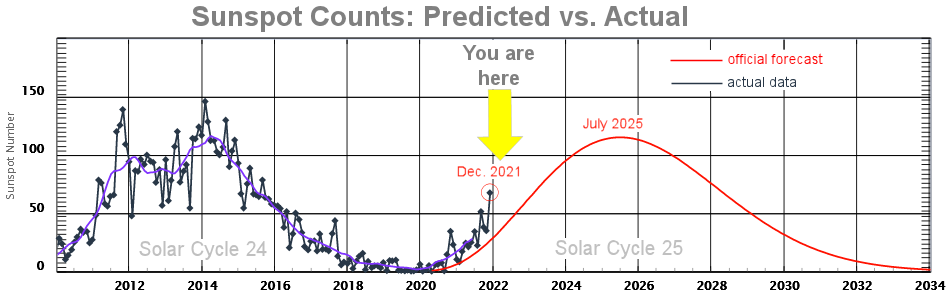
Current and last solar cycle sunspot plot. The current trend in sunspots is increasing much faster than what was predicted. Click on the image to enlarge it. Credit NOAA.
Go to spaceweather.com to keep up with what’s happening between the Sun and the Earth.
12/04/2014 – Ephemeris – What’s happening on the Sun this solar cycle
Ephemeris for Thursday, December 4th. The sun will rise at 8:02. It’ll be up for 9 hours even, setting at 5:02. The moon, 2 days before full, will set at 6:52 tomorrow morning.
It looks like maybe we’ve hit the peak of sunspots in this 11 year solar cycle. Actually this cycle had two peaks, the latter part of 2012 when the world ended. You do remember the world ending two years ago on December 21st. How soon we forget. The second peak in this solar cycle occurred in the first three months of this year. The sunspot cycle 24 so far appears to be the weakest since cycle 12 in the 1880s. The time of the peak can only be determined in hindsight. Of course this weak sunspot cycle produced the largest sunspot group, or active region, as they are now called, in 24 years, so I expect more surprises from this solar cycle. I expect to see more aurorae or northern lights as the sunspot numbers decline.
Times are for the Traverse City/Interlochen area of Michigan. They may be different for your location.
Addendum
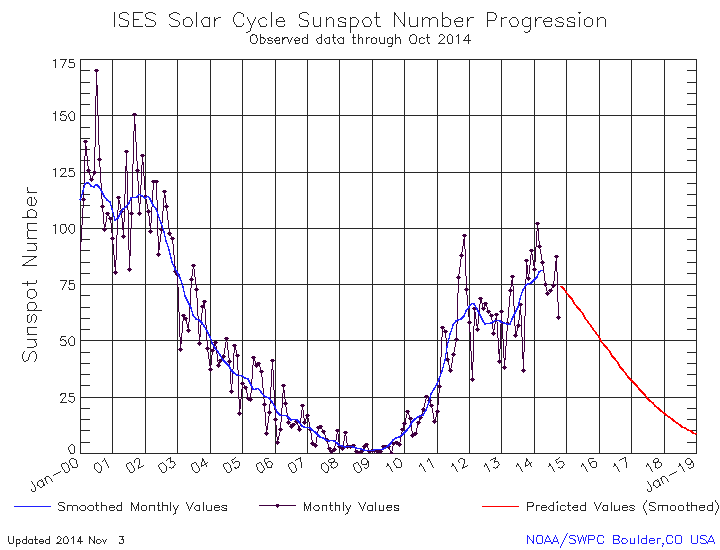
Sunspot cycle from 2000 until October 2014. Credit: NOAA/SWPC.
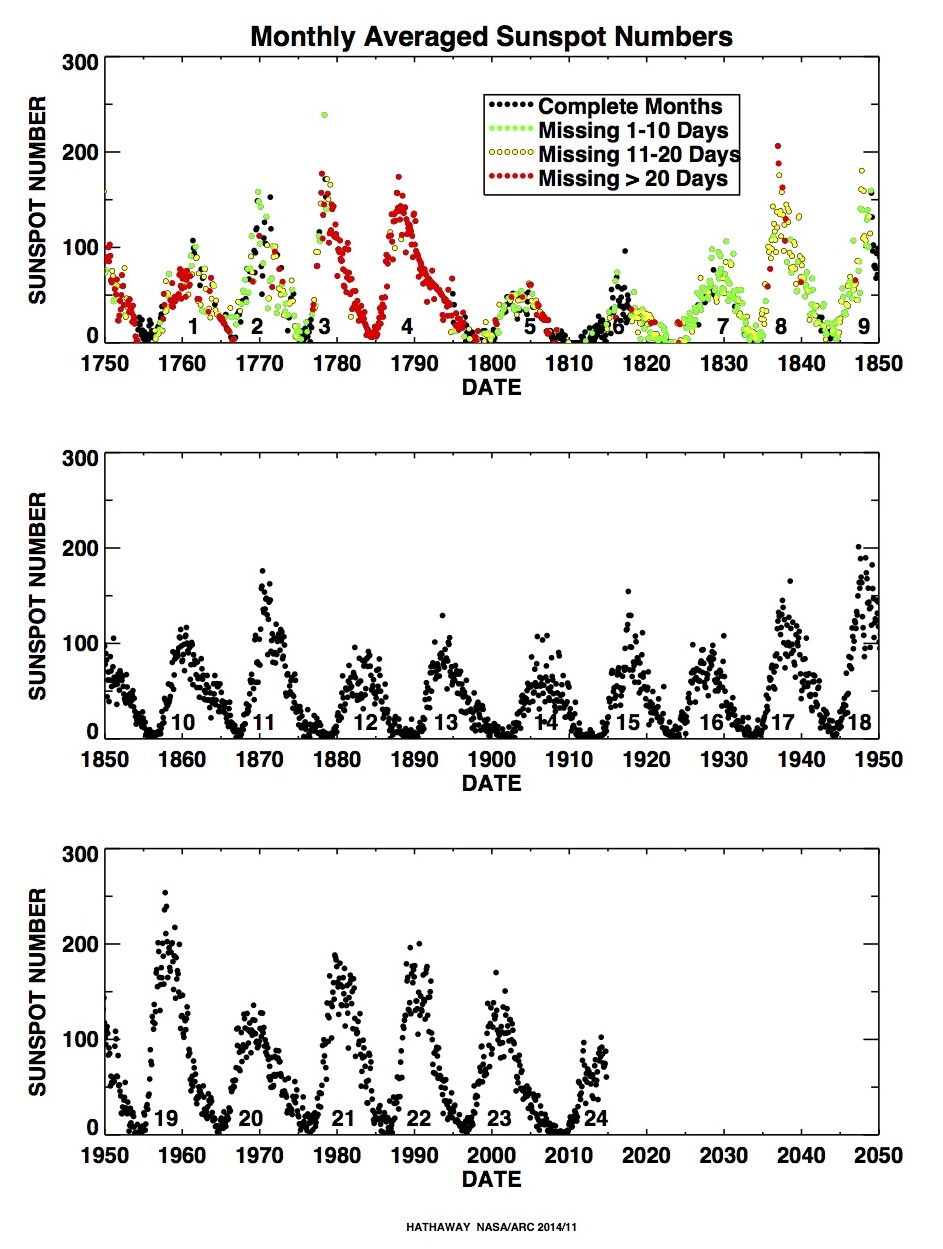
All the recorded sunspot cycles back to the 18th century. Credit: Dr. David Hathaway, NASA /ARC.
Here’s a link to NASA’s Sunspot Cycle page with a lot more information.
 Bob Moler's Ephemeris Blog