Archive
07/28/2016 – Ephemeris – Two upcoming meteor showers plus an occultation tomorrow morning
Ephemeris for Thursday, July 28th. The Sun rises at 6:25. It’ll be up for 14 hours and 47 minutes, setting at 9:12. The Moon, 2 days past last quarter, will rise at 2:31 tomorrow morning.
We have a couple of meteor showers of note coming up. The first is the Southern Delta Aquariids which will peak on the 30th. The radiant point for these meteors will rise around midnight in the southeast. Their numbers and their brightness are not very great. The Perseid meteor shower peak will have interference from the waxing gibbous moon drowning out all but the brightest meteors on the evening of August 11 and morning of he 12th. However the Perseids have a long run up to their peak, so their numbers will grow after the moon sets. The Perseid radiant is circumpolar for Northern Michigan, meaning it never sets, so some Perseid meteors can always be seen at night. Their radiant will be low in the northeastern sky in the evening and much higher in the northeast just before dawn.
Times are for the Traverse City/Interlochen area of Michigan. They may be different for your location.
Addenda
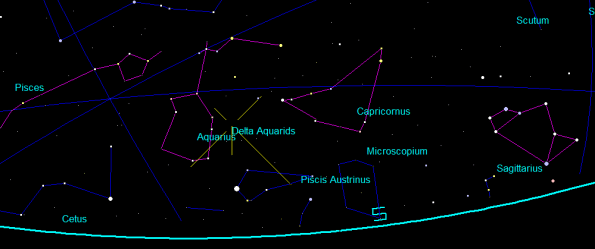
Approximate Radiant of the South Delta Aquariid meteor shower. The radiant does move over the several weeks of the shower to the east. Created using my LookingUp program.
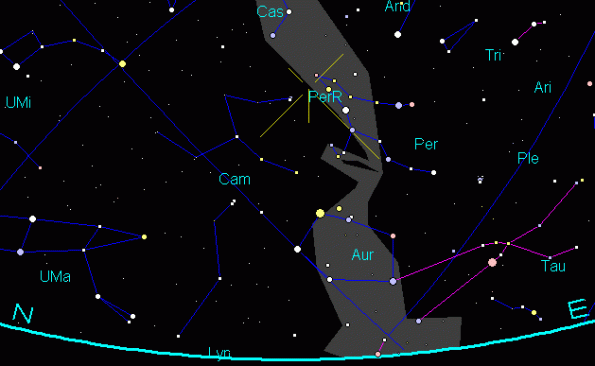
Perseid Meteor Shower radiant after midnight. Created using my LookingUp program.
Update: Occultation of Aldebaran tomorrow morning
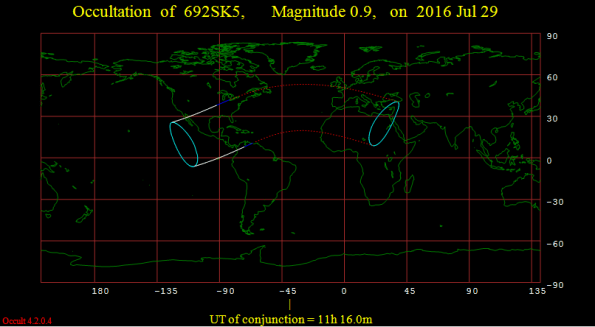
The area where the occultation of Aldebaran will be visible. The area bordered by the white lines is where the occultation will occur with the Sun below the horizon. Credit IOTA’s Occult 4 program.
There will be an occultation of Aldebaran by the Moon centered on 11:16 UT (7:16 a.m. EDT) July 29, 2016. Our area (Michigan) cannot see the event, being too far north. It will be visible south of a line containing the state of Maine down through Texas. Universe Today has information on grazing occultation possibilities: http://www.universetoday.com/129841/spectacular-aldebaran-graze-july-29/
07/02/2015 -Ephemeris – A belated preview of July’s skies
Ephemeris for Thursday, July 2nd. Today the Sun will be up for 15 hours and 30 minutes, setting at 9:31. The Moon, 1 day past full, will rise at 9:48 this evening and tomorrow the Sun will rise at 6:02.
Lets preview July’s skies a day late. Sorry, it’s been a busy week.. The sun, having reached its northern solstice, is beginning to slide southward again, at first imperceptibly, then with greater speed. The daylight hours will decrease from 15 hours and 30 minutes Today to 14 hours 44 minutes at month’s end. The daylight hours will be slightly shorter south of Interlochen, and slightly longer to the north. The altitude of the sun at local noon, when the sun is due south will decrease from 68 degrees Now to 63 degrees at month’s end. The sun will be a degree lower in the Straits area. Despite the warmth, the earth will reach its greatest distance from the sun on Monday the 6th. The range of the earth’s distance from the sun is 3 million out of 93 million miles.
Times are for the Traverse City/Interlochen area of Michigan. They may be different for your location.
Addendum
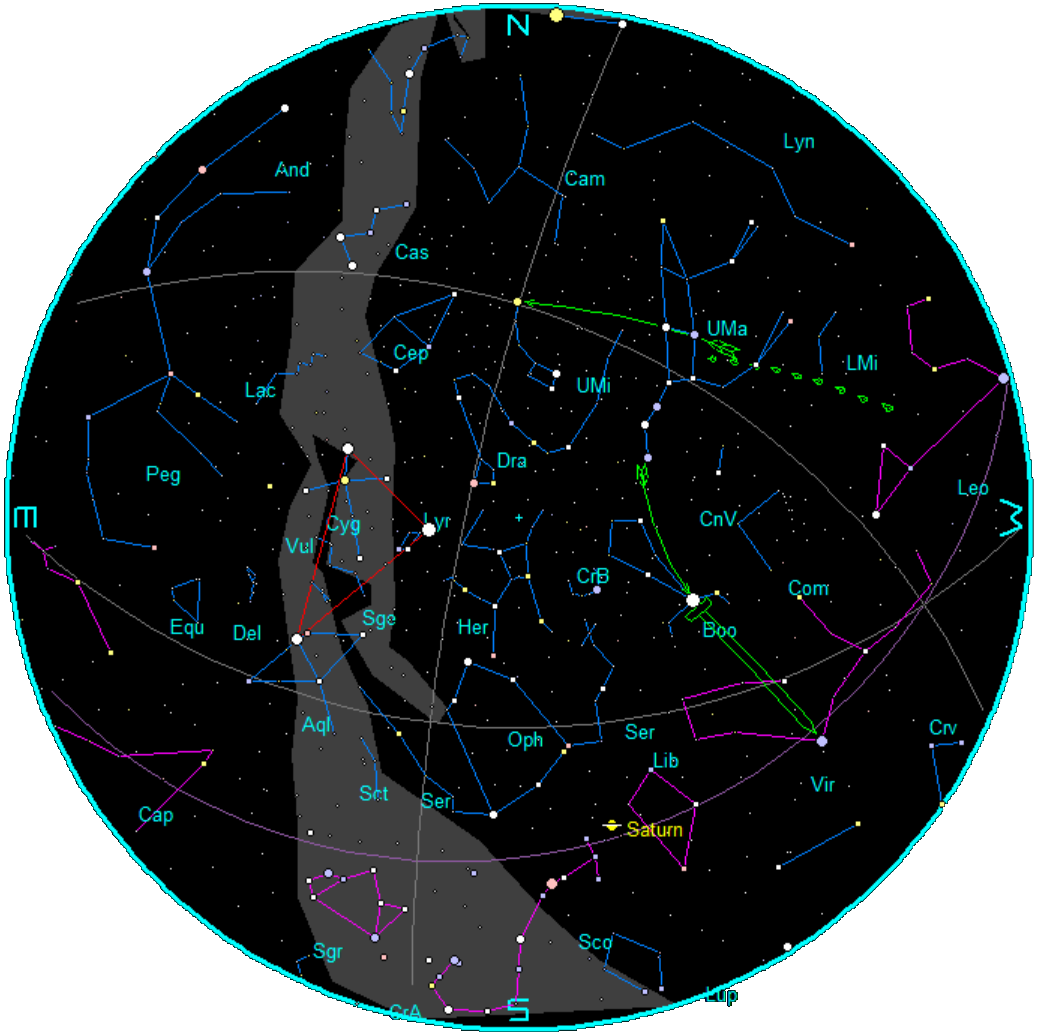
Star Chart for July 2015. Created using my LookingUp program. Click on image to enlarge.
The Moon is not plotted.
The planets and stars are plotted for the 15th at 11 p.m. EDT. That is chart time. Note, Traverse City is located 1 hour 45 minutes behind our time meridian. To duplicate the star positions on a planisphere you may have to set it to 1 hour 45 minutes earlier than the current time.
Evening Astronomical twilight ends at midnight. EDT on July 1st, decreasing to 11:14 p.m. EDT on the 31st.
Morning astronomical twilight starts at 3:32 a.m. EDT on July 1st, and increasing to 4:42 a.m. EDT on the 31st.
Add a half hour to the chart time every week before the 15th and subtract and hour for every week after the 15th.
For a list of constellation names to go with the abbreviations click here.
The green pointer from the Big Dipper is:
- Pointer stars at the front of the bowl of the Big Dipper point to Polaris the North Star.
- Drill a hole in the bowl of the Big Dipper and the water will drip on the back of Leo the Lion.
- Follow the arc of the Big Dipper’s handle to Arcturus
- Continue with a spike to Spica
- The Summer Triangle is shown in red
Calendar of Planetary Events
Credit: Sky Events Calendar by Fred Espenak and Sumit Dutta (NASA’s GSFC)
To generate your own calendar go to http://eclipse.gsfc.nasa.gov/SKYCAL/SKYCAL.html
Times are Eastern Daylight Time on a 24 hour clock. Some additions made to aid clarity.
Conjunctions like the Moon-Jupiter: 4.5° N means Jupiter will appear 4.5° north of the Moon.
 Date       Local   Event
             Time
Jul  01     We    02:48    Moon South Dec.: 18.4° S
     01     We        Venus: 42.4° E
     01     We    22:20    Full Moon
     05     Su    14:54    Moon Perigee: 367100 km
     06     Mo    08:59    Aphelion: 1.0167 AU
     07     Tu    20:07    Moon Descending Node
     08     We    16:24    Last Quarter
     12     Su    13:55    Moon-Aldebaran: 0.9° S
     14     Tu    00:24    Moon North Dec.: 18.4° N
     14     Tu    17:35    Venus-Regulus: 2.3° S
     15     We    21:24    New Moon
     18     Sa    13:34    Moon-Jupiter: 4.5° N
     18     Sa    21:06    Moon-Venus: 0.5° N
     21     Tu    07:02    Moon Apogee: 404800 km
     21     Tu    15:32    Moon Ascending Node
     23     Th    15:18    Mercury Superior Conjunction with the Sun
     24     Fr    00:04    First Quarter
     26     Su    04:43    Moon-Saturn: 2.4° S
     28     Tu    10:23    Delta Aquarid Meteor Shower: ZHR* = 20
     28     Tu    13:34    Moon South Dec.: 18.3° S
     31     Fr    06:43    Full Moon
Aug  01     Sa        Venus: 21.5° E
*ZHR – Zenithal Hourly Rate: Approximate number of meteors per hour when the shower radiant is at the zenith. For more information on this and other meteor showers in 2015 see the International Meteor Organization website calendar section: http://www.imo.net/calendar.
07/28/2014 – Ephemeris – One meteor shower is at peak and another is ramping up.
Ephemeris for Monday, July 28th. The sun rises at 6:24. It’ll be up for 14 hours and 48 minutes, setting at 9:12. The moon, 2 days past new, will set at 9:46 this evening.
We have a couple of meteor showers of note coming up. The first is the Southern Delta Aquarids which will peak on the 30th. The radiant point for these meteors will rise around midnight in the southeast. Their numbers and their brightness are not very great. The Perseid meteor shower will have the misfortune to coincide with the full moon on August 12th and 13th, drowning out all but the brightest meteors. However the Perseids have a long run up to their peak, so their numbers will grow after the moon sets until the moon sets in morning twilight. The Perseid radiant is circumpolar for Northern Michigan, meaning it never sets, so some Perseid meteors can always be seen at night. Their radiant will be in the northeastern sky in the evening.
Times are for the Traverse City/Interlochen area of Michigan. They may be different for your location.
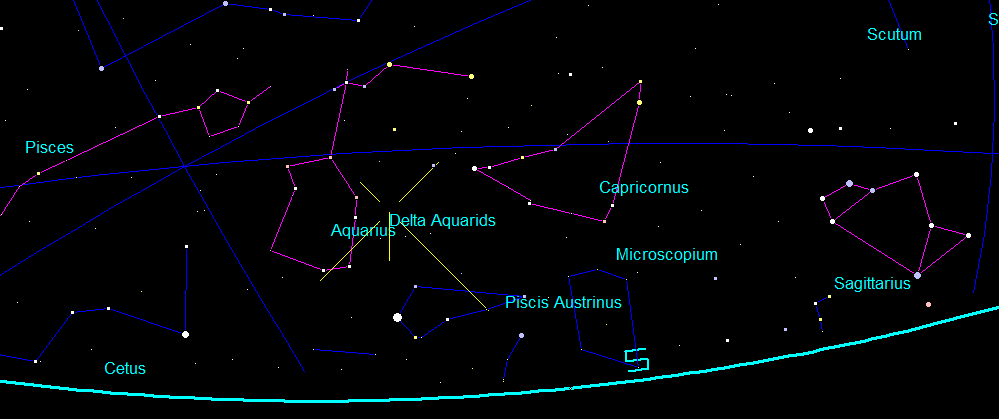
Approximate Radiant of the South Delta Aquarid meteor shower. The radiant does move over the several weeks of the shower to the east. Created using my LookinUp program.
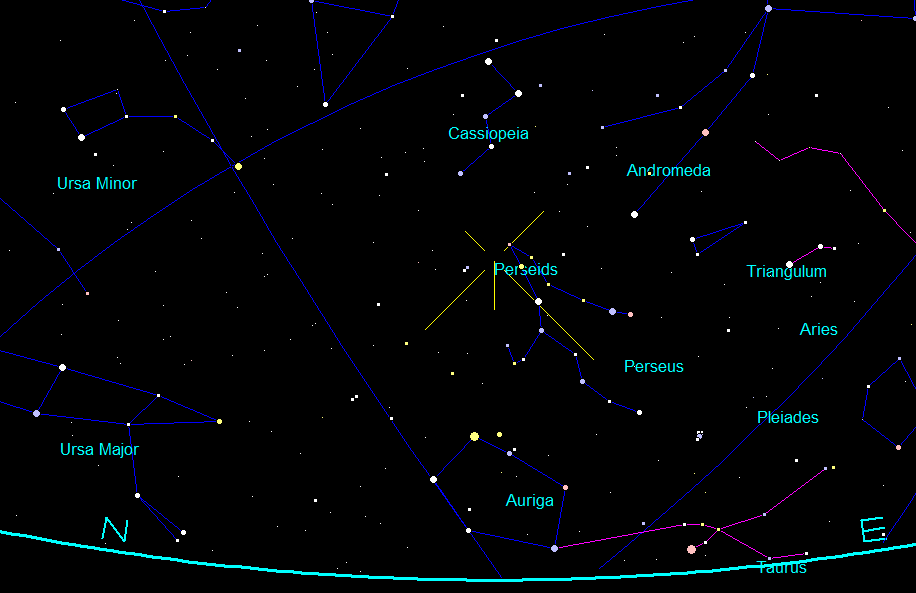
The Perseid meteor shower radiant a about 2 a,m, during the period of the shower. Created using my LookingUp program.
 Bob Moler's Ephemeris Blog