Archive
09/05/2022 – Ephemeris – It’s Labor Day, the unofficial end of summer
This is Ephemeris for Labor Day, Monday, September 5th. Today the Sun will be up for 13 hours and 2 minutes, setting at 8:12, and it will rise tomorrow at 7:11. The Moon, 2 days past first quarter, will set at 1:55 tomorrow morning.
Even though we have 17 more days officially, of summer, according to the actual seasons, today seems like it, the end of summer. Summer seems to be defined or confined to between the time that the kids get out of school, to Labor Day. Schools in many locales have been back for almost two weeks now. As far as the summer sky goes, the summer Milky Way will stick around until October, until we lose the Teapot of Sagittarius over the southwestern horizon. The Summer Triangle of bright summer stars, won’t leave the sky until December, as they move ever westward. However, in the east the autumn stars are even now rising, pushing the Milky Way to the west. The predawn sky is already featuring the winter stars.
The astronomical event times given are for the Traverse City/Interlochen area of Michigan (EDT, UT – 4 hours). They may be different for your location.
Addendum
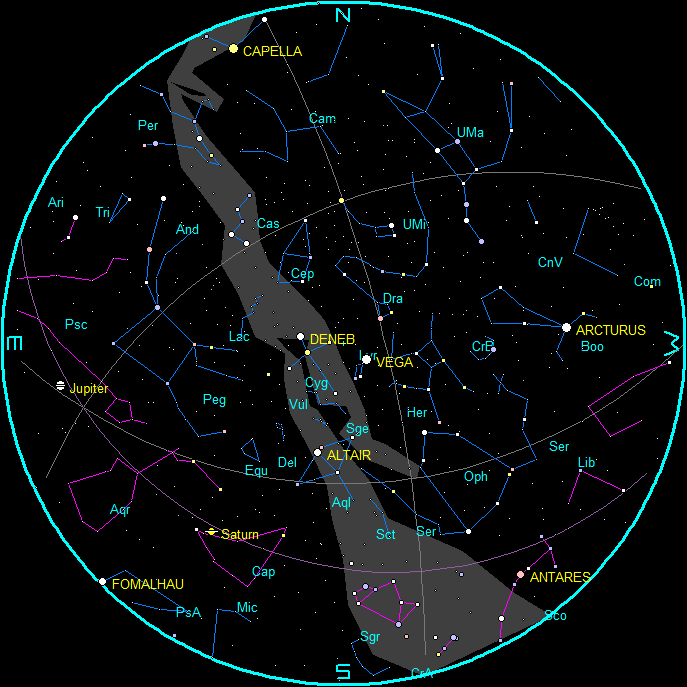
The constellations of Labor Day Evening, September 5, 2022, at 10 pm, around 2 hours after sunset. Note that the Summer Triangle Stars of Vega, Altair and Deneb are overhead. Click on the chart to enlarge it. Credit: my App LookingUp. I only allowed 8 character star names, so Fomalhaut shows up as Fomalhau.
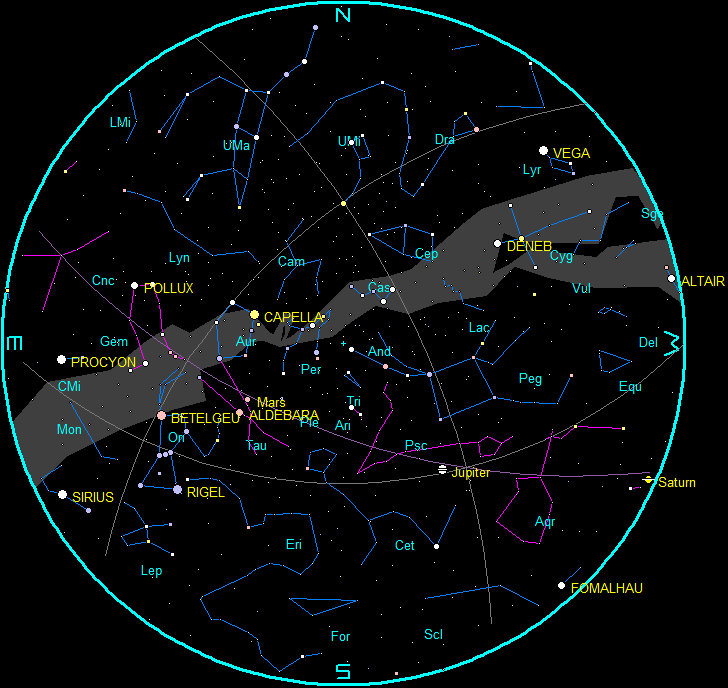
The constellations of the day after Labor Day morning, September 6, 2022, at 5 am, around 2 hours before sunrise. Note that the Summer Triangle Stars are setting in the northwest. All the brightest winter stars are now up, and constellations, except for the southern half of Canis Major, of which Sirius is a part. This is equivalent to an evening in mid-December, except the planets Mars, Jupiter and Saturn will have moved a bit. Click on the chart to enlarge it. Again, some of the star names have been truncated: Fomalhaut, Aldebaran, and Betelgeuse. Credit: my App LookingUp.
For a list of constellation names to go with the abbreviations, click here.
09/05/2016 – Ephemeris – Anticipating summer’s end
Ephemeris for Labor Day, Monday, September 5th. The Sun will rise at 7:10. It’ll be up for 13 hours and 0 minutes, setting at 8:11. The Moon, half way from new to first quarter, will set at 10:24 this evening.
Even though we have 17 more days officially, of summer, according to the actual seasons, today seems like it, the end of summer. Summer seems to be defined or confined to between the time that the kids get out of school, to Labor Day, after which the kids go back to school. Schools in other locales have been back for almost two weeks now. As far as the summer sky goes, the summer Milky Way will stick around until October, until we lose the Teapot of Sagittarius over the southwestern horizon. The Summer Triangle of bright summer stars, won’t leave the sky until December, as they move ever westward. However in the east the autumn stars are even now rising, pushing the Milky Way to the west.
Times are for the Traverse City/Interlochen area of Michigan. They may be different for your location.
Addendum
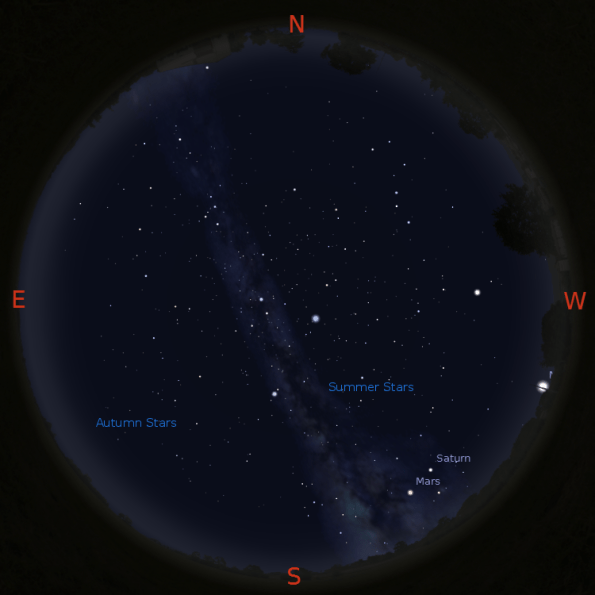
The transitional skies of 10 p.m. tonight 9/5/2016. Created using Stellarium.
06/21/11 – Ephemeris – Summer solstice is today
Tuesday, June 21st. Today the sun will be up for 15 hours and 33 minutes, setting at 9:31. The moon, 2 days before last quarter, will rise at 12:46 tomorrow morning. Tomorrow the sun will rise at 5:57.
At 1:16 this afternoon the sun will reach its greatest angle north of the celestial equator or 23 ½ degrees. The date and the point in the sky where the sun is at that instant is called the summer solstice, or summer sun standstill. It means the point at which the sun seems poised farthest north before heading southward. This would be most noticeable if you were monitoring the height of the sun at noon or the sun’s rising or setting point day by day as the ancients did. Besides being the day with the longest sunlight we, in the northern hemisphere, are also receiving more intense heat from the sun than any other day of the year. Still hotter weather is in store as the northern hemisphere continues to warm up.
* Times are for the Traverse City/Interlochen area of Michigan. They may be different for your location.
 Bob Moler's Ephemeris Blog