Archive
Ephemeris: 06/20/2025 – Summer begins tonight!
This is Ephemeris for Friday, June 20th. Today the Sun will be up for 15 hours and 34 minutes, setting at 9:31, and it will rise tomorrow at 5:57. The Moon, 2 days past last quarter, will rise at 2:38 tomorrow morning.
Summer will officially arrive for us on Earth’s Northern Hemisphere at 10:42 pm, tonight. If you are south of the equator, winter will arrive. If you are listening to this on the Internet from two time zones east of the Eastern United States it’s 2:42 UT, June 21st. And to be season agnostic, it’s the June solstice. From tonight to the December solstice, the first day of winter for us northern hemispherians, (I think that’s a word) the daylight hours will get shorter as the Sun heads south. Solstice means “Sun standstill” as it stops its northerly motion and will, after tonight, head back south again. The Northern Hemisphere will still be heating up for another month, before we begin to cool down.
The astronomical event times given in this blog are for the Traverse City/Interlochen area of Michigan (Lat 44.7° N, Long 85.7° W; EDT, UT – 4 hours) unless stated otherwise. Times will be different for other locations.
Addendum
Ephemeris: 05/21/2024 – Looking ahead to the summer solstice
This is Ephemeris for Tuesday, May 21st. Today the Sun will be up for 15 hours and 3 minutes, setting at 9:11, and it will rise tomorrow at 6:07. The Moon, 2 days before full, will set at 5:14 tomorrow morning.
Summer is coming. Days are definitely warmer. The Sun’s out longer. Yesterday we passed the 15 hours of daytime. Summer will start a month from yesterday on the 20th of June. We normally expect the solstices on the 21st of June and 21st of December and the equinoxes on the 21st of March and the 23rd of September. However, we haven’t had, in our time zone at least, spring start on the 21st of March since 1987. The slow wondering of the equinox and solstice dates are due to the fact that the seasonal year, also called the tropical year, is not exactly 365 and a quarter days long. It is slightly shorter than that, which is the reason in 1582 Pope Gregory the 13th decreed that the calendar would be reformed which is the Gregorian Calendar we have now.
The astronomical event times given are for the Traverse City/Interlochen area of Michigan (EDT, UT–4 hours). They may be different for your location.
Addendum
I talk about the calendar in much more detail in this post: https://bobmoler.wordpress.com/2016/02/28/02282016-ephemeris-extra-the-years-of-our-lives/
06/21/2022 – Ephemeris – Summer arrives today!
This is Ephemeris for Tuesday, June 21st. Today the Sun will be up for 15 hours and 34 minutes, setting at 9:32, and it will rise tomorrow at 5:57. The Moon, 1 day past last quarter, will rise at 2:28 tomorrow morning.
Summer arrived at 5:14 this morning (9:14 UT). In all the excitement, I forgot to mention that the waning Moon is passing the long line of planets in the morning. Tomorrow morning, it will be nearing Mars. Today, the Sun will be out a bit over 15 ½ hours for us in the Interlochen/Traverse City area. Also, the Sun will reach up to nearly 67 degrees altitude above the southern horizon at local noon, that’s 1:44 pm. We are now climbing down from those extreme values, at first slowly, but with increasing rapidity as summer goes on. However, the Northern Hemisphere is continuing to warm up. Our warmest average temperatures tend to be near the end of July. What’s really neat is, that the Earth is farther from the Sun than it was six months ago as winter started.
The astronomical event times given are for the Traverse City/Interlochen area of Michigan (EDT, UT – 4 hours). They may be different for your location.
Addendum
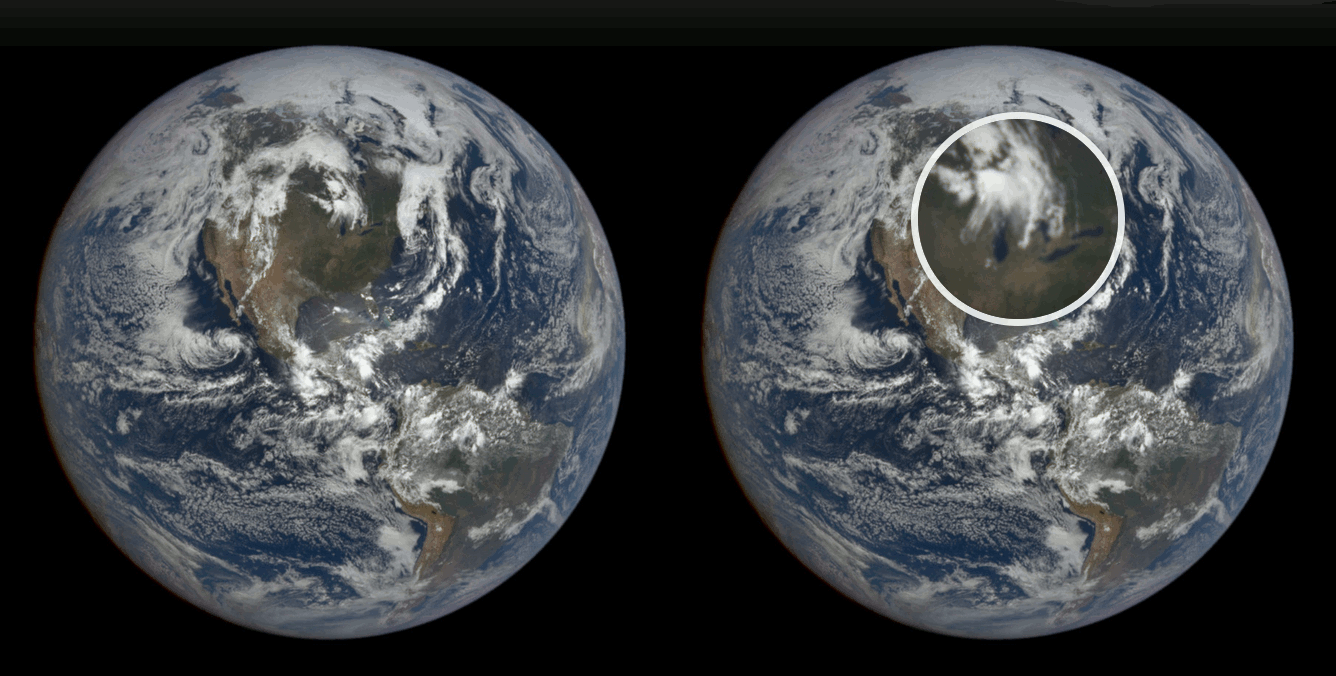
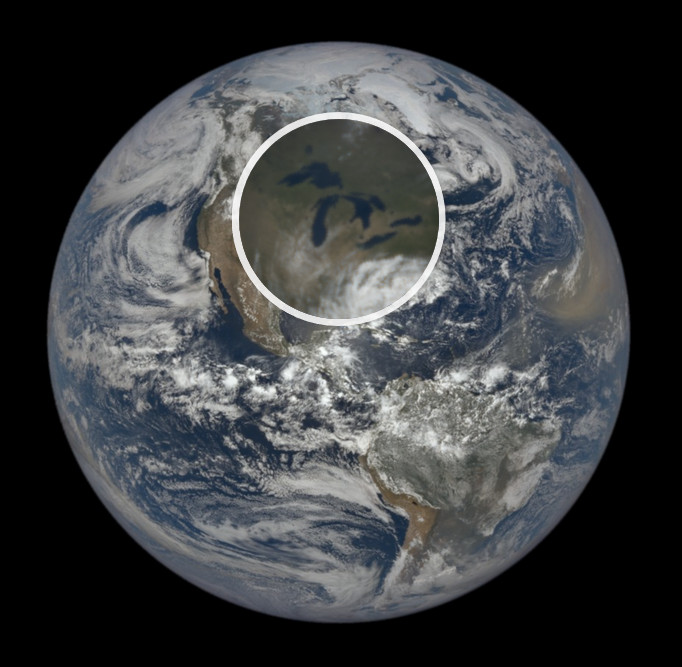
DSCOVR image of Earth near summer solstice with magnified Michigan animation. Most of Michigan’n mitt is obscured in the north where I’m located, plus the Upper Peninsula. Image taken 1:26 pm EDT, June 19, 2022. Credit NASA/NOAA DSCOVR satellite in halo orbit of Sun-Earth L1 Lagrange Point.
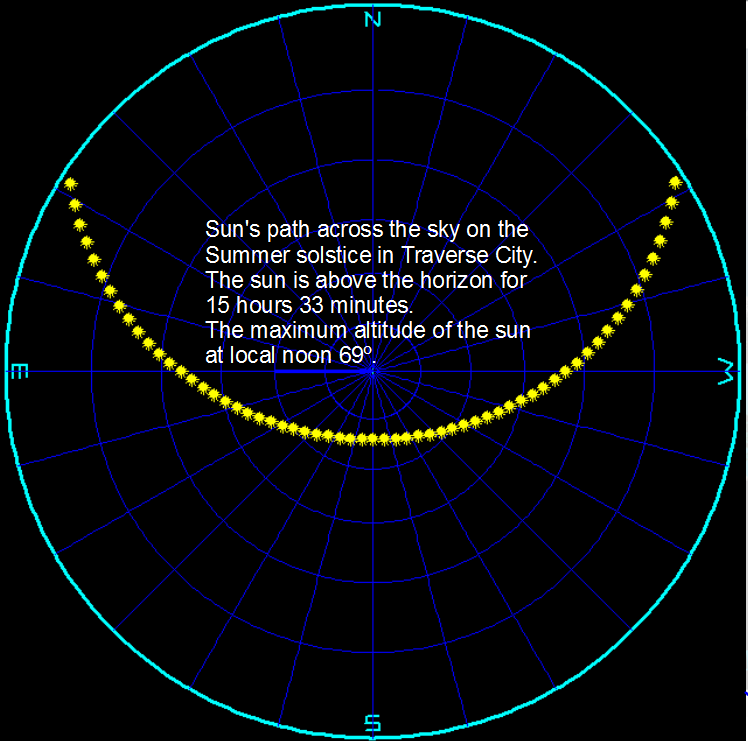
The sun’s daily path through the sky from horizon to horizon on the first day of summer, the summer solstice. Credit My LookingUp program.
06/20/2022 – Ephemeris – Here we are at the last full day of spring
This is Ephemeris for Juneteenth, Observed, Monday, June 20th. Today the Sun will be up for 15 hours and 34 minutes, setting at 9:31, and it will rise tomorrow at 5:57. The Moon, at last quarter today, will rise at 2:09 tomorrow morning.
Here we are at the last full day of spring. Summer will begin at 5:14 EDT, or 9:14 UT tomorrow morning, when the Sun reaches its highest point on the celestial sphere, and directly over the northern latitude line called the Tropic of Cancer. At that time, folks at or north of the Arctic Circle at about 66 ½ degrees north latitude won’t see the Sun set. As it is, Interlochen is only about 4 degrees latitude south of the land of the all night twilight. It’s neat, around here in the western part of the Lower Michigan, to go out around midnight and see a bit of the last twilight glow near the north. Remember that around here, local or astronomical midnight occurs around 1:45 am. Ah politicians, aren’t they wonderful. And they’ve just made Daylight Saving Time permanent.
The astronomical event times given are for the Traverse City/Interlochen area of Michigan (EDT, UT – 4 hours). They may be different for your location.
Addendum
The event at 5:14 am EDT or 9:14 UT is called the summer solstice, or in deference to our Southern Hemisphere neighbors, the June solstice, because for them winter is starting. Solstice means “Sun stands still”. It doesn’t, of course. The sun is always moving eastward against the stars. However, if one checks the altitude of the Sun in the south at local noon each day, the Sun would move higher each day since the winter solstice until around June 21st, and go no further. It would slowly begin a retreat, day by day. That pause at the highest point is the solstice.
06/18/2021 – Ephemeris – Summer* will start Sunday night
This is Bob Moler with Ephemeris for Friday, June 18th. Today the Sun will be up for 15 hours and 34 minutes, setting at 9:31, and it will rise tomorrow at 5:56. The Moon, 1 day past first quarter, will set at 2:41 tomorrow morning.
Summer is just a couple of days away, though we have already been sweltering through a very hot first half of June. Summer will officially arrive for us on Earth’s Northern Hemisphere at 11: 32 pm, June 20th. If you are south of the equator, winter will arrive. If you are listening to this on the Internet, or reading this on my blog, it’s 3:32 UT, June 21st. And to be season agnostic, it’s the June solstice. From the 20th to the December solstice, the first day of winter for we northern hemispherians, (I think that’s a word) the daylight hours will get shorter as the Sun heads south. Solstice means Sun standstill as it stops its northerly motion and will, after Sunday, head back south again. The Northern Hemisphere will still be heating up for another month.
The astronomical event times given are for the Traverse City/Interlochen area of Michigan (EDT, UT – 4hr). They may be different for your location.
* Summer in the Northern Hemisphere only. Winter starts in the Southern Hemisphere.
Addendum
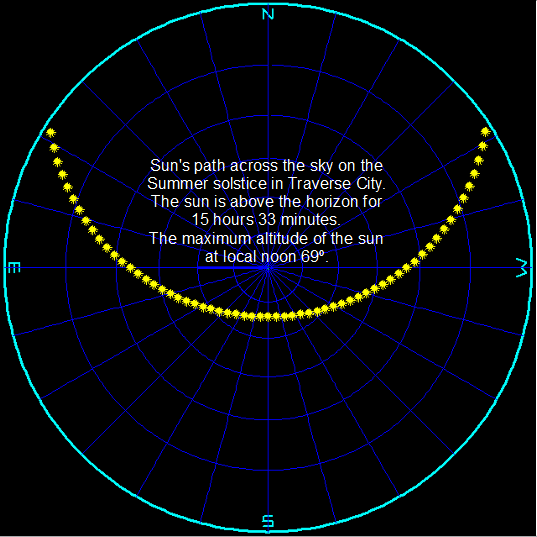
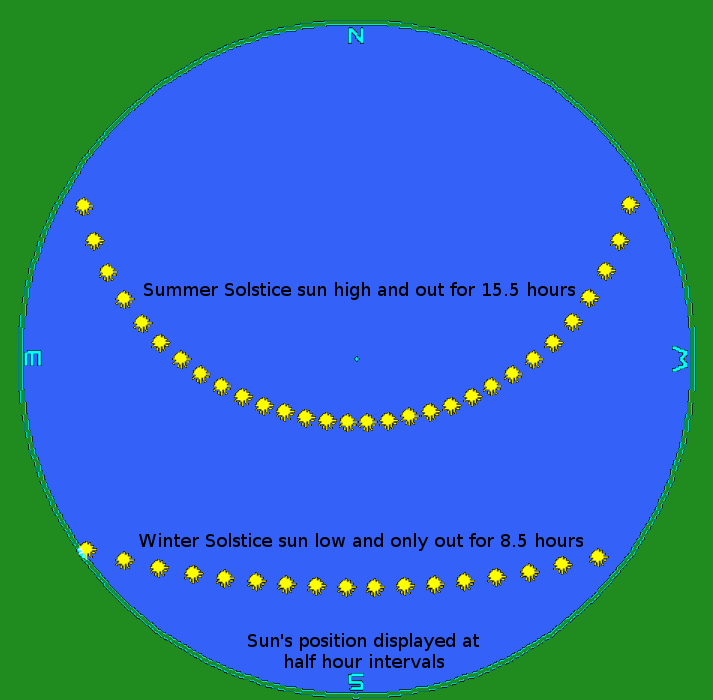
The Sun’s path through the sky on the summer solstice day from Traverse City, MI. The Sun is plotted every 15 minutes. The Sun’s motion is constant. The closeness of the Sun plots at higher altitudes is an artifact of portraying a hemispherical sky on a flat screen. It is a stereographic projection. Created using my LookingUp program.
Earth and magnified local area near summer solstice. Image taken near local noon June 17, 2020. Credit NOAA DSCOVR satellite orbiting the Sun-Earth L1 point 994,970 miles (1,601,432 kilometers) sunward from the Earth.
06/21/2019 – Ephemeris – Summer starts today!
Ephemeris for Friday, June 21st. Today the Sun will be up for 15 hours and 34 minutes, setting at 9:32, and it will rise tomorrow at 5:57. The Moon, half way from full to last quarter, will rise at 12:44 tomorrow morning.
At 11:54 (15:54 UT) this morning the Sun will reach its greatest angle north of the celestial equator or 23 ½ degrees. The date and the point in the sky where the Sun is at that instant is called the summer solstice, or summer Sun standstill. It means the point at which the Sun seems poised farthest north before heading southward. This would be most noticeable if you were monitoring the height of the Sun at noon or the Sun’s rising or setting point day by day as the ancients did. Besides being the day with the longest sunlight we, in the northern hemisphere, are also receiving more intense heat from the sun than any other day of the year. Still hotter weather is in store as the northern hemisphere continues to warm up.
The times given are for the Traverse City/Interlochen area of Michigan. They may be different for your location.
Addendum
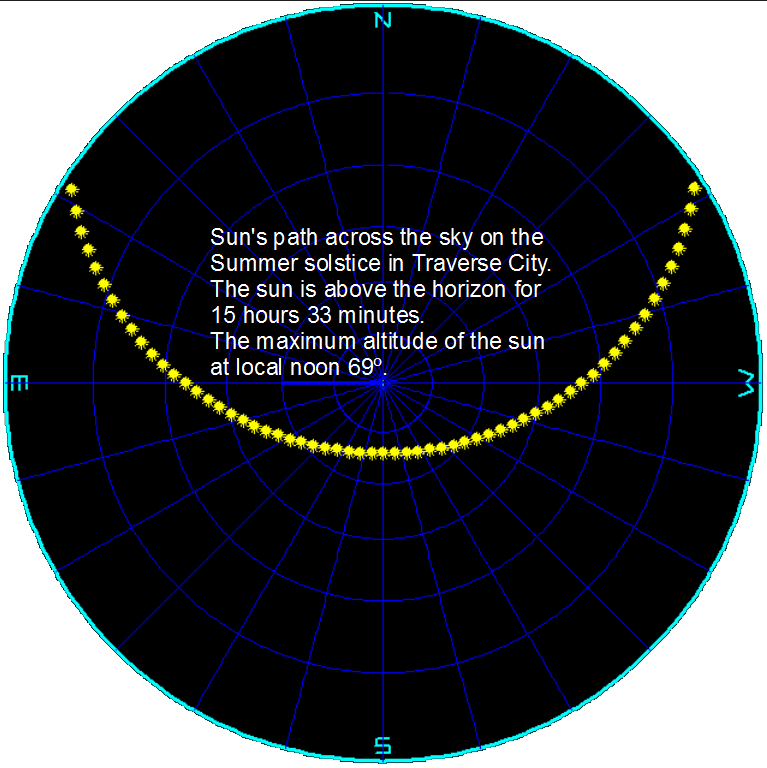
The Sun’s apparent path in the sky for the summer solstice. The cyan circle is the horizon and the Sun is plotted every 15 minutes throughout the day. Created using my LookingUp program. This is a slide from his school program on the cause of the seasons.
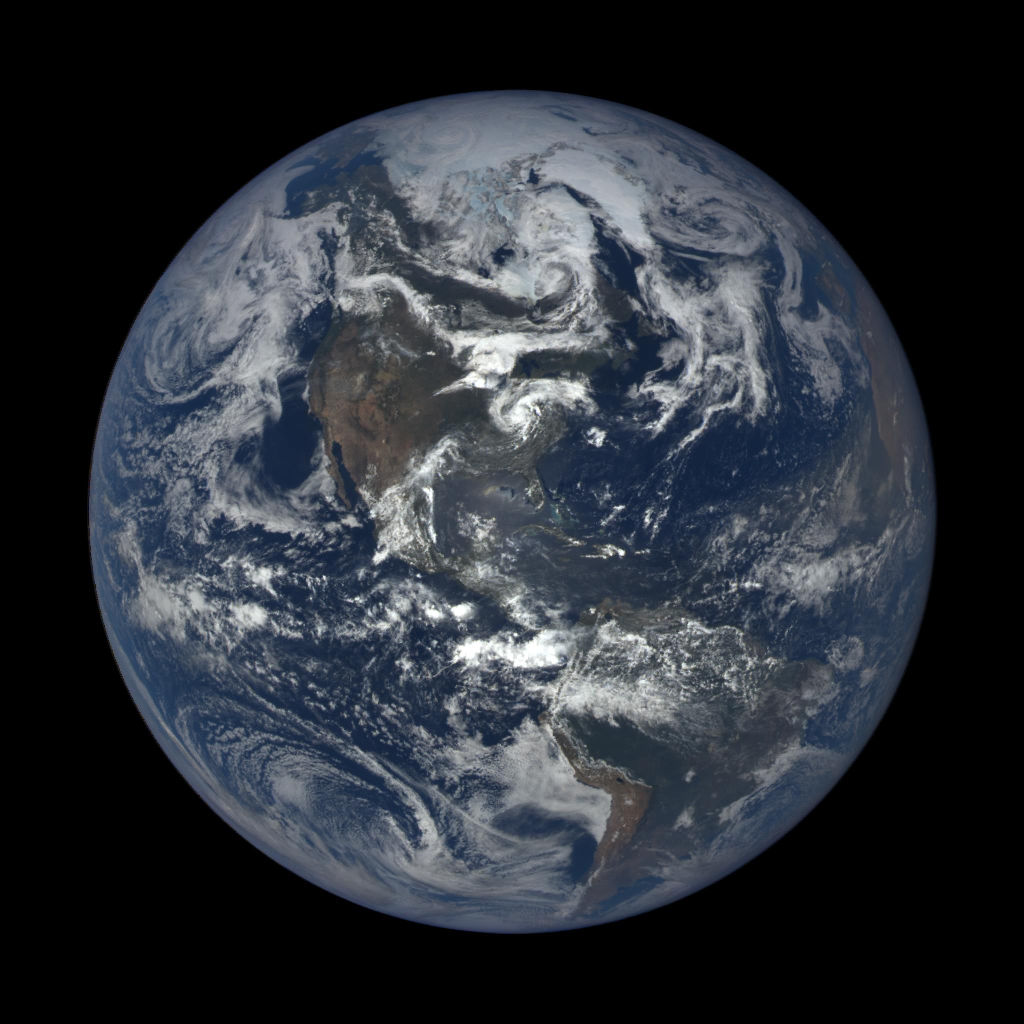
Earth from the DSCOVR satellite at the June solstice 2015. Of course we’re under a cloud. Credit NOAA
05/31/2016 – Ephemeris – Previewing June’s bright skies
Ephemeris for Tuesday, May 31st. Today the Sun will be up for 15 hours and 20 minutes, setting at 9:20, and it will rise tomorrow at 6:00. The Moon, 2 days past last quarter, will rise at 3:55 tomorrow morning.
Tomorrow will be the first of June, so let’s preview June skies. There will be a lot of sunlight in June. The daylight hours will increase a bit from 15 hours and 21 minutes tomorrow to 15 hours and 34 minutes on the 20th, the solstice, retreating back to 15 hours 31 minutes at month’s end. At this time of the year the sunset times for Ludington, Interlochen, Petoskey and Mackinaw City are very nearly the same.* However the sunrise times are at their most divergent. With Ludington’s sunrise being 14 minutes later than Mackinaw City’s. The altitude of the sun above the southern horizon at local noon will increase from about 67 and a half degrees to 68 and three-quarters on the 20th. Local noon, when the sun is actually due south will occur at about 1:43 p.m.
Times are for the Traverse City/Interlochen area of Michigan. They may be different for your location.
* See http://ephemeris.bjmoler.org/calendar.htm
Addendum
June Star Chart
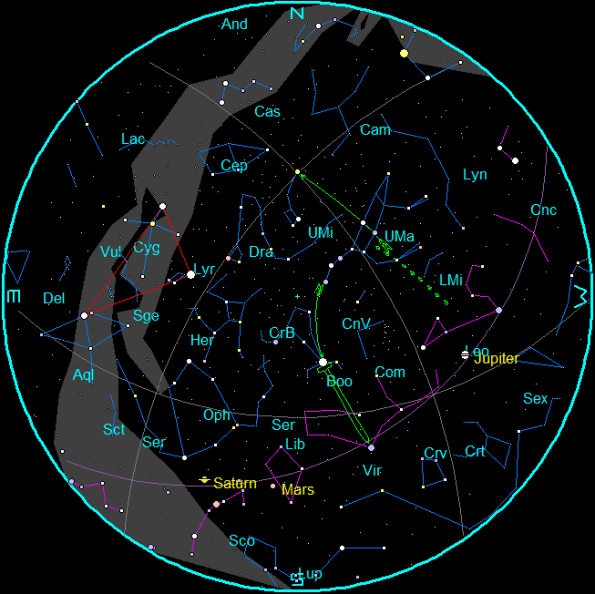
Star Chart for June 2016. Created using my LookingUp program. To enlarge in Firefox Right-click on image then click View image.
The planets and stars are plotted for the 15th at 11 p.m. EDT. That is chart time. Note, Traverse City is located approximately 45 minutes behind our time meridian. (An hour 45 minutes behind our daylight saving time meridian.) To duplicate the star positions on a planisphere you may have to set it to 1:45 earlier than the current time if you are near your time meridian.
Evening nautical twilight ends at 10:45 p.m. EDT on the 1st, increasing to 10:57 p.m. EDT on the 30th.
Morning nautical twilight starts at 4:36 a.m. EDT on the 1st, and decreasing to 4:35 a.m. EDT on the 30th.
Add a half hour to the chart time every week before the 15th and subtract a half hour for every week after the 15th. Before the 13th also subtract an hour for Standard Time.
For a list of constellation names to go with the abbreviations click here.
- Pointer stars at the front of the bowl of the Big Dipper point to Polaris the North Star
- A leaky Big Dipper drips on Leo
- Follow the arc of the handle of the Big Dipper to the star Arcturus
- Extend the arc to a spike to point to Spica.
- The Summer Triangle is outlined in red. Vega in Lyra (Lyr), Deneb in Cygnus (Cyg) and Altair in Aquila (Aql).
Calendar of Planetary Events
Credit: Sky Events Calendar by Fred Espenak and Sumit Dutta (NASA’s GSFC)
To generate your own calendar go to http://eclipse.gsfc.nasa.gov/SKYCAL/SKYCAL.html
Times are Eastern Time. Some additions made to aid clarity.
    Date    Time      Event
Jun 01  We            Venus: 1.5° W
    03  Fr  1:43 a.m. Saturn Opposition
    03  Fr  5:47 a.m. Moon-Mercury: 0.7° N
    03  Fr  6:55 a.m. Moon Perigee: 361100 km
    04  Sa 11:00 p.m. New Moon
    05  Su  4:59 a.m. Mercury Greatest Elongation: 24.2° W
    06  Mo  5:13 a.m. Moon North Dec.: 18.6° N
    06  Mo  5:34 p.m. Venus Superior Conjunction with the Sun.
    10  Fr 10:47 a.m. Moon-Regulus: 2.2° N
    11  Sa  3:35 p.m. Moon-Jupiter: 1.6° N
    11  Sa  6:20 p.m. Moon Ascending Node
    12  Su  4:10 a.m. First Quarter
    13  Mo  6:06 a.m. Mercury-Pleiades: 6.8° S
    15  We  8:00 a.m. Moon Apogee: 405000 km
    18  Sa  8:40 p.m. Moon-Saturn: 3.6° S
    18  Sa 11:39 p.m. Mercury-Aldebaran: 3.8° N
    20  Mo  7:02 p.m. Full Moon
    20  Mo  2:52 p.m. Moon South Dec.: 18.6° S
    20  Mo  6:35 p.m. Summer Solstice
    26  Su  1:28 a.m. Moon Descending Node
    27  Mo  2:19 p.m. Last Quarter
Jul 01                Venus: 6.8° E
06/19/2015 – Ephemeris – Two events this weekend: one local, one global
Ephemeris for Friday, June 19th. Today the Sun will be up for 15 hours and 34 minutes, setting at 9:31. The Moon, 3 days past new, will set at 11:34 this evening. Tomorrow the Sun will rise at 5:56.
There’s a couple of astronomical events coming up this weekend. On Saturday there will be another Sun ‘n Star Party at the Sleeping Bear Dunes National Lakeshore if weather cooperates. This time the telescopes will be set up at the Pierce Stocking Scenic Drive, Stop 3, the Dunes Overlook from 4 to 6 p.m. and from 9 to 11 p.m. The best place to park is Picnic Mountain, just before the Dunes Overlook. On Sunday a truly global event, the Summer solstice will occur at 12:38 p.m. (16:38 UT), when the Sun will reach its farthest north signaling the start of summer in the northern hemisphere. For folks south of the equator it will be the winter solstice signaling the start of winter for them.
Times are for the Traverse City/Interlochen area of Michigan. They may be different for your location.
Addendum
The Sun’s apparent path in the sky on the summer solstice. The cyan circle is the horizon and the Sun is plotted every 15 minutes throughout the day. Created by Bob Moler using LookingUp. This is a slide from his school program on the cause of the seasons.
06/01/2015 – Ephemeris – Starting orbit 41 looking at June skies
Ephemeris for Monday, June 1st. Today the Sun will be up for 15 hours and 20 minutes, setting at 9:21. The Moon, 1 day before full, will set at 6:17 tomorrow morning and tomorrow the Sun will rise at 6:00.
We’ll start Ephemeris’ 41st orbit of the Sun by looking at the skies of June. There’ will be a lot of sun in June and very little night. The daylight hours will increase a bit from 15 hours and 20 minutes today to 15 hours and 34 minutes on the 21st, retreating back to 15 hours 31 minutes at month’s end. At this time of the year the sunset times for Ludington, Interlochen, Petoskey and Mackinaw City are very nearly the same. However the sunrise times are at their most divergent. With Ludington’s sunrise being 14 minutes later than Mackinaw City’s. The altitude of the sun above the southern horizon at local noon will hover around 68 to 69 degrees. Local noon, when the sun is actually due south will occur at about 1:43 p.m. Here’s what we’ve been waiting for: Summer will start on the 21st at 12:38 p.m.
Times are for the Traverse City/Interlochen area of Michigan. They may be different for your location.
Addendum
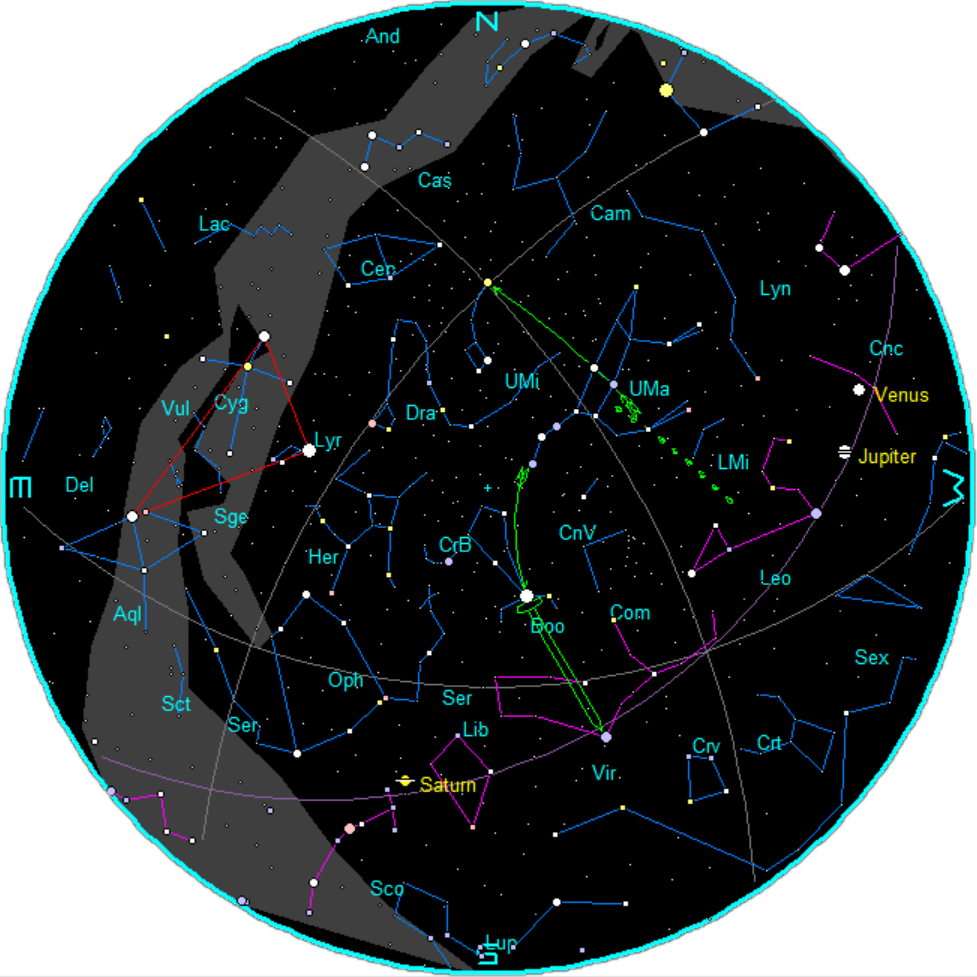
Star Chart for June 2015. Created using my LookingUp program.
The Moon is not plotted.
The planets and stars are plotted for the 15th at 11 p.m. EDT. That is chart time. Note, Traverse City is located 1 hour 45 minutes behind our time meridian. To duplicate the star positions on a planisphere set it to 1 hour 45 minutes earlier than the current time.
Evening Astronomical twilight ends at 11:43 p.m. EDT on June 1st, increasing to midnight EDT on the 30th.
Morning astronomical twilight starts at 4:38 a.m. EDT on June 1st, and decreasing to 3:31 a.m. EDT on the 30th.
Add a half hour to the chart time every week before the 15th and subtract and hour for every week after the 15th.
For a list of constellation names to go with the abbreviations click here.
The green pointer from the Big Dipper is:
- Pointer stars at the front of the bowl of the Big Dipper point to Polaris the North Star.
- Drill a hole in the bowl of the Big Dipper and the water will drip on the back of Leo the Lion.
- Follow the arc of the Big Dipper’s handle to Arcturus
- Continue with a spike to Spica
- The Summer Triangle is shown in red
Calendar of Planetary Events
Credit: Sky Events Calendar by Fred Espenak and Sumit Dutta (NASA’s GSFC)
To generate your own calendar go to http://eclipse.gsfc.nasa.gov/SKYCAL/SKYCAL.html
Times are Eastern Daylight Time on a 24 hour clock. Some additions made to aid clarity.
Conjunctions like the Moon-Saturn: 2.1° S means Saturn will appear 2.3° south of the Moon.
| Jun | 01 | Mo | Venus: 45.3° E | |
| 01 | Mo | 16:02 | Moon-Saturn: 2° S | |
| 02 | Tu | 12:19 | Full Moon | |
| 03 | We | 17:10 | Moon South Dec.: 18.4° S | |
| 06 | Sa | 14:59 | Venus Elongation: 45.4° E | |
| 09 | Tu | 11:42 | Last Quarter | |
| 10 | We | 00:39 | Moon Perigee: 369700 km | |
| 10 | We | 19:29 | Moon Descending Node | |
| 13 | Sa | 04:59 | Venus-Beehive: 0.6° N | |
| 14 | Su | 10:39 | Mars Solar Conjunction | |
| 16 | Tu | 10:05 | New Moon | |
| 16 | Tu | 15:47 | Moon North Dec.: 18.5° N | |
| 20 | Sa | 07:28 | Moon-Venus: 6.3° N | |
| 21 | Su | 12:38 | Summer Solstice | |
| 23 | Tu | 05:39 | Mercury-Aldebaran: 1.9° N | |
| 23 | Tu | 13:01 | Moon Apogee: 404100 km | |
| 24 | We | 07:03 | First Quarter | |
| 24 | We | 12:59 | Mercury Elongation: 22.5° W | |
| 24 | We | 13:23 | Moon Ascending Node | |
| 28 | Su | 21:27 | Moon-Saturn: 2.1° S | |
| 30 | Tu | 22:14 | Venus-Jupiter: 0.3° N | |
| Jul | 01 | We | 02:48 | Moon South Dec.: 18.4° S |
| 01 | We | Venus: 42.4° E | ||
06/20/2014 – Ephemeris – Summer is almost here!
Ephemeris for Friday, June 20th. Today the sun will be up for 15 hours and 33 minutes, setting at 9:31. The moon, 1 day past last quarter, will rise at 2:21 tomorrow morning. Tomorrow the sun will rise at 5:57.
Summer will begin at 6:52 tomorrow morning. Great I can’t wait. Summer is my favorite season, and it is especially welcome after the long and cold winter, and a not especially warm spring. In the summer I move my operations to a table under a tree in the back yard, with a laptop and my radio tuned to IPR, of course. There I conduct my research, take online teleconferences and courses and do my writing. The summer solstice for us in the northern hemisphere is when the sun reaches its farthest north in the sky. Around the Interlochen/Traverse City area that’s about 68.5 degrees above the southern horizon at solar noon, which is about 1:43 p.m. and staying up 15 hours and 33 minutes.
Times are for the Traverse City/Interlochen area of Michigan. They may be different for your location.
Addendum
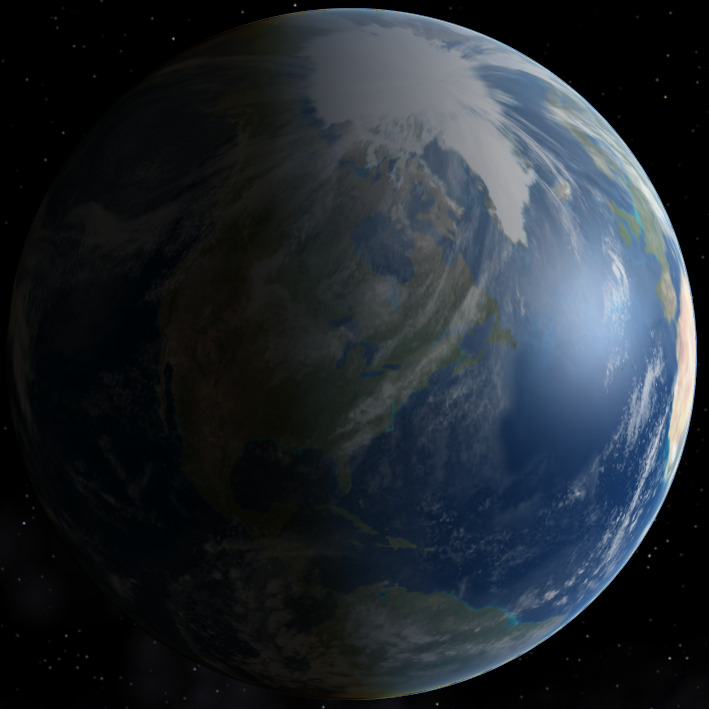
The earth centered on Michigan at 6:52 a.m. EDT, June 21, 2014 the moment of the summer solstice. Created using Celestia.
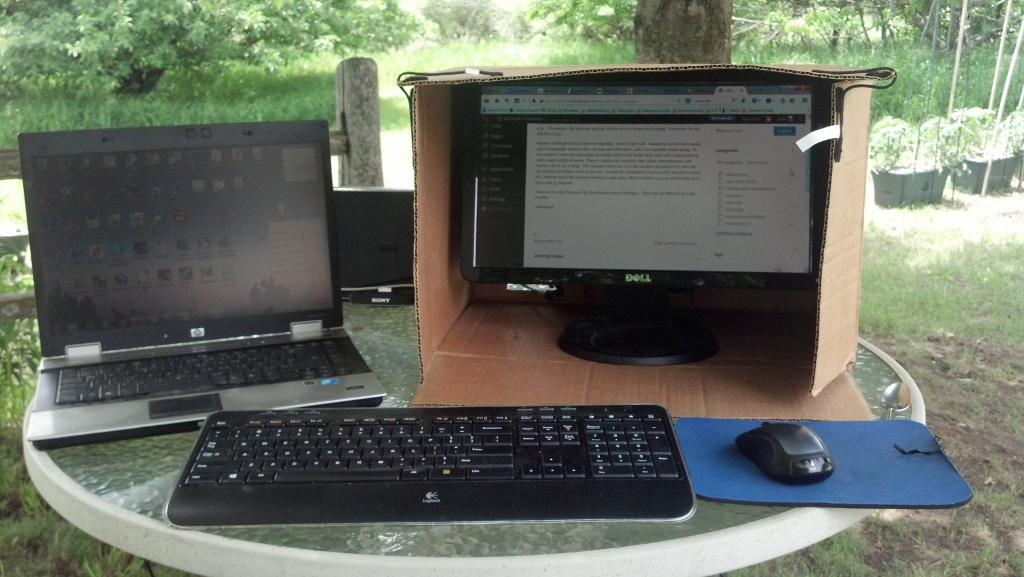
My summer office
 Bob Moler's Ephemeris Blog