Archive
Ephemeris: 05/20/2024 – Sunspots
This is Ephemeris for Monday, May 20th. Today the Sun will be up for 15 hours and 1 minute, setting at 9:10, and it will rise tomorrow at 6:07. The Moon, 3 days before full, will set at 4:52 tomorrow morning.
As can be seen with the northern light display more than a week ago that the Sun is becoming more active. It’s because particles, mostly protons, from the Sun in the form of the solar wind and enhancements in the solar wind called coronal mass ejections, tangle with the Earth’s magnetic field and stream through the upper atmosphere. The activity on the Sun is signaled by the ebb and flow of the number of dark spots called sunspots. Individual sunspots or sunspot groups only last for, maybe, a couple of weeks. They’re caused by the magnetic fields being generated in the Sun causing the gas to cool a bit and making them darker. Sunspot numbers ebb flow in a period of about 11 years, called a sunspot cycle. This sunspot cycle is reaching a higher peak than expected.
The astronomical event times given are for the Traverse City/Interlochen area of Michigan (EDT, UT–4 hours). They may be different for your location.
Addendum
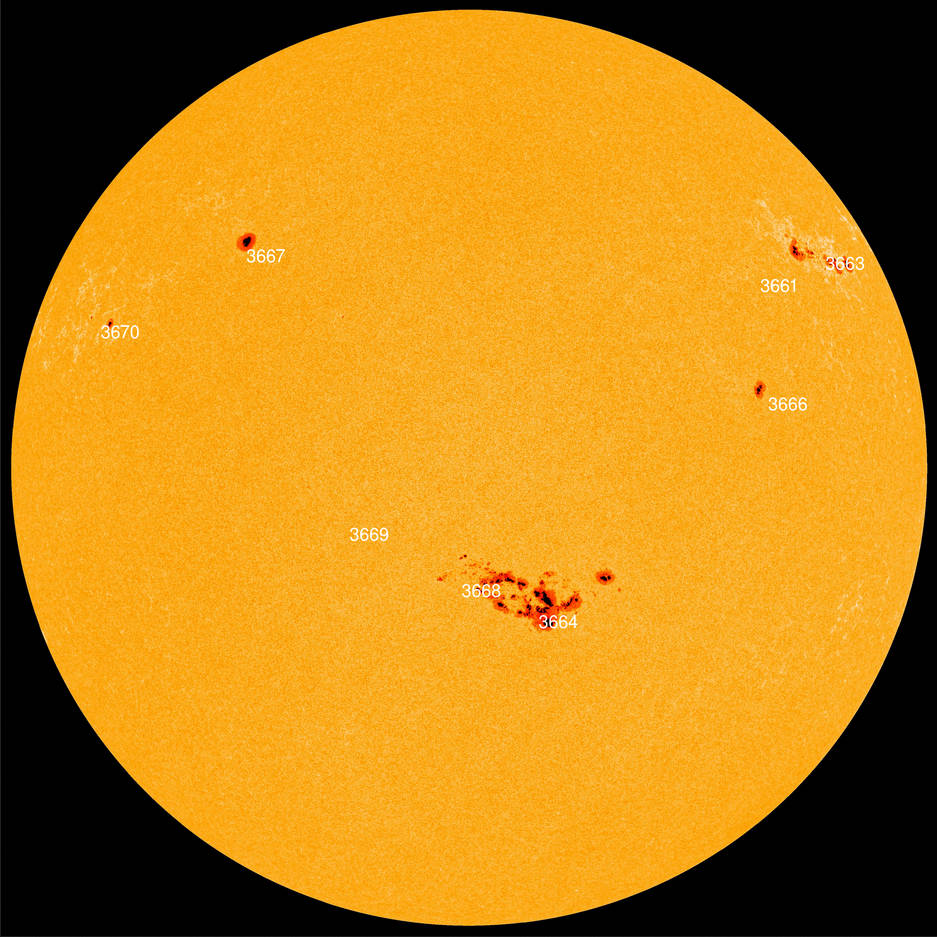
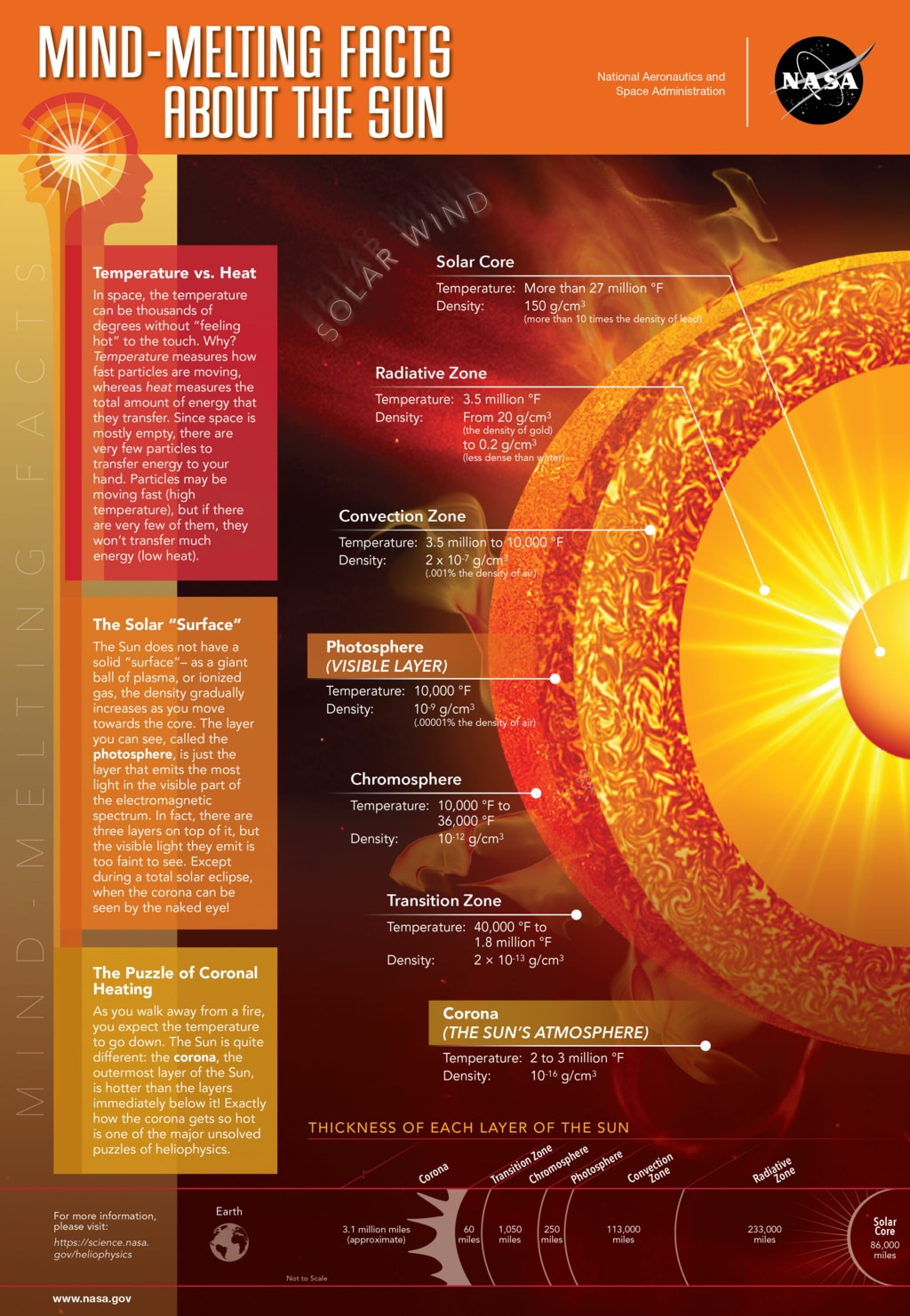
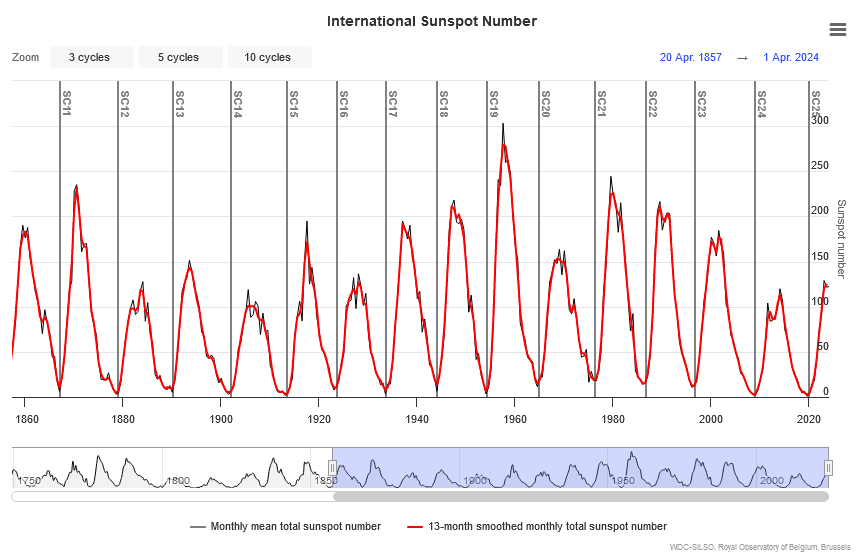
06/29/2023 – Ephemeris – Learning about the Sun – sunspots
This is Ephemeris for Thursday, June 29th. Today the Sun will be up for 15 hours and 32 minutes, setting at 9:32, and it will rise tomorrow at 6:00. The Moon, 3 days past first quarter, will set at 3:10 tomorrow morning.
The face of the Sun is populated, from time to time, with dark spots, simply called sunspots. It is rare that a sunspot or sunspot group is large enough to see with eclipse glasses. Sunspots normally form in groups, and are called active regions, because they are sites of solar flares, explosions that would put the world’s entire nuclear arsenals to shame in a single explosion. The bright ball of the Sun that is sometimes called a surface is called the photosphere, a region of the Sun, where the gases are of low enough density so the transportation of energy from the Sun’s core changes from convection to radiation. It is within this convective region that magnetic fields form that cool the gas, making it darker, by restricting their movement.
The astronomical event times given are for the Traverse City/Interlochen area of Michigan (EDT, UT –4 hours). They may be different for your location.
Addendum
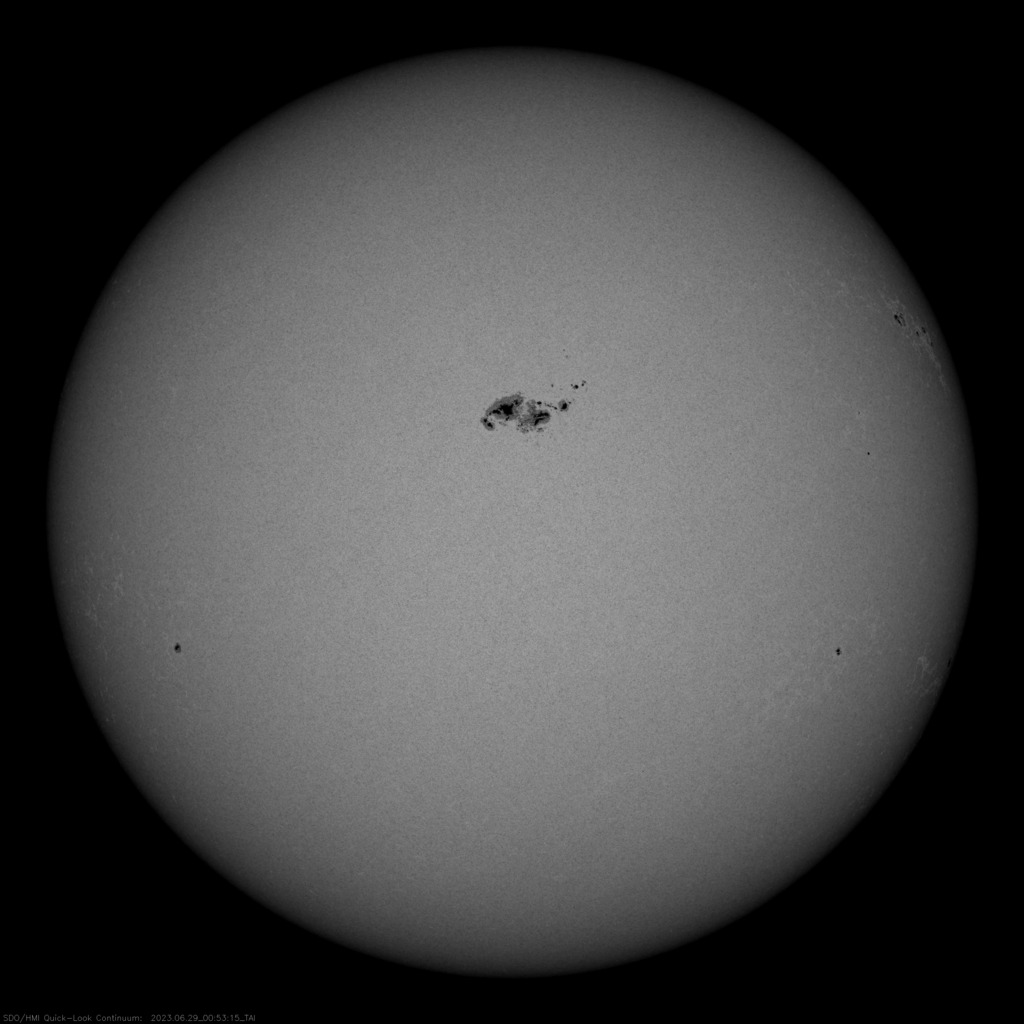
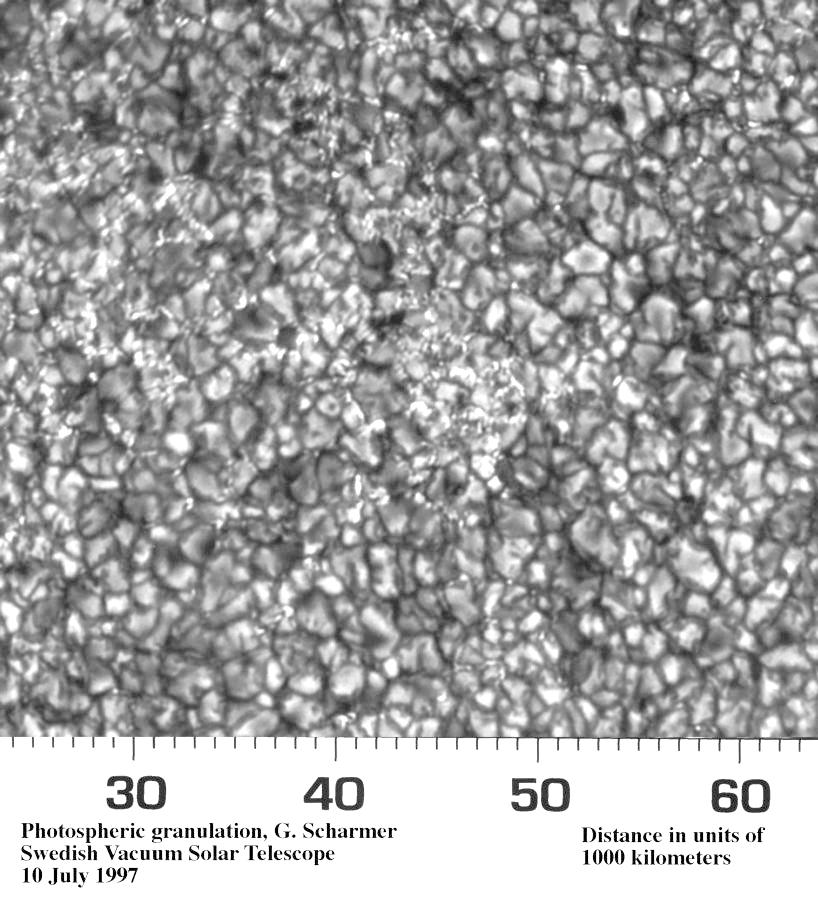
Other features of the photosphere are faculae (plural of facula), brighter areas of the photosphere, often associated with or are a precursor to sunspots. Faculae are best seen near the Sun’s limb (edge), as can be seen above. If the photosphere doesn’t appear smooth, that’s because it isn’t. The photosphere lies atop the convective zone of the Sun. The photosphere is populated by the tops of convection cells called granules, approximately 600 miles, or 1,000 kilometers wide and last only about 20 minutes.
01/17/2023 – Ephemeris – The Sun is getting active again
/
This is Ephemeris for Tuesday, January 17th. Today the Sun will be up for 9 hours and 15 minutes, setting at 5:30, and it will rise tomorrow at 8:14. The Moon, 3 days past last quarter, will rise at 5:11 tomorrow morning.
The Sun is getting active again, there are a lot of sunspots on the sun today. The sunspot number which isn’t really a count of the sunspots on the face of the Sun, but it’s sort of a weighted average was 177 yesterday, which is a really high number even for the last few sunspot cycle peaks, and we haven’t reached the peak yet. You can find this number on the website called spaceweather.com. These sunspots cannot be seen with solar eclipse glasses that we had for the last eclipse back in 2017 because they are too small, even though they are much larger than the Earth. For the most part it would require a telescope with an approved solar filter in front to see them or go to that aforementioned website to see a daily picture from them.
The astronomical event times given are for the Traverse City/Interlochen area of Michigan (EST, UT –5 hours). They may be different for your location.
Addendum
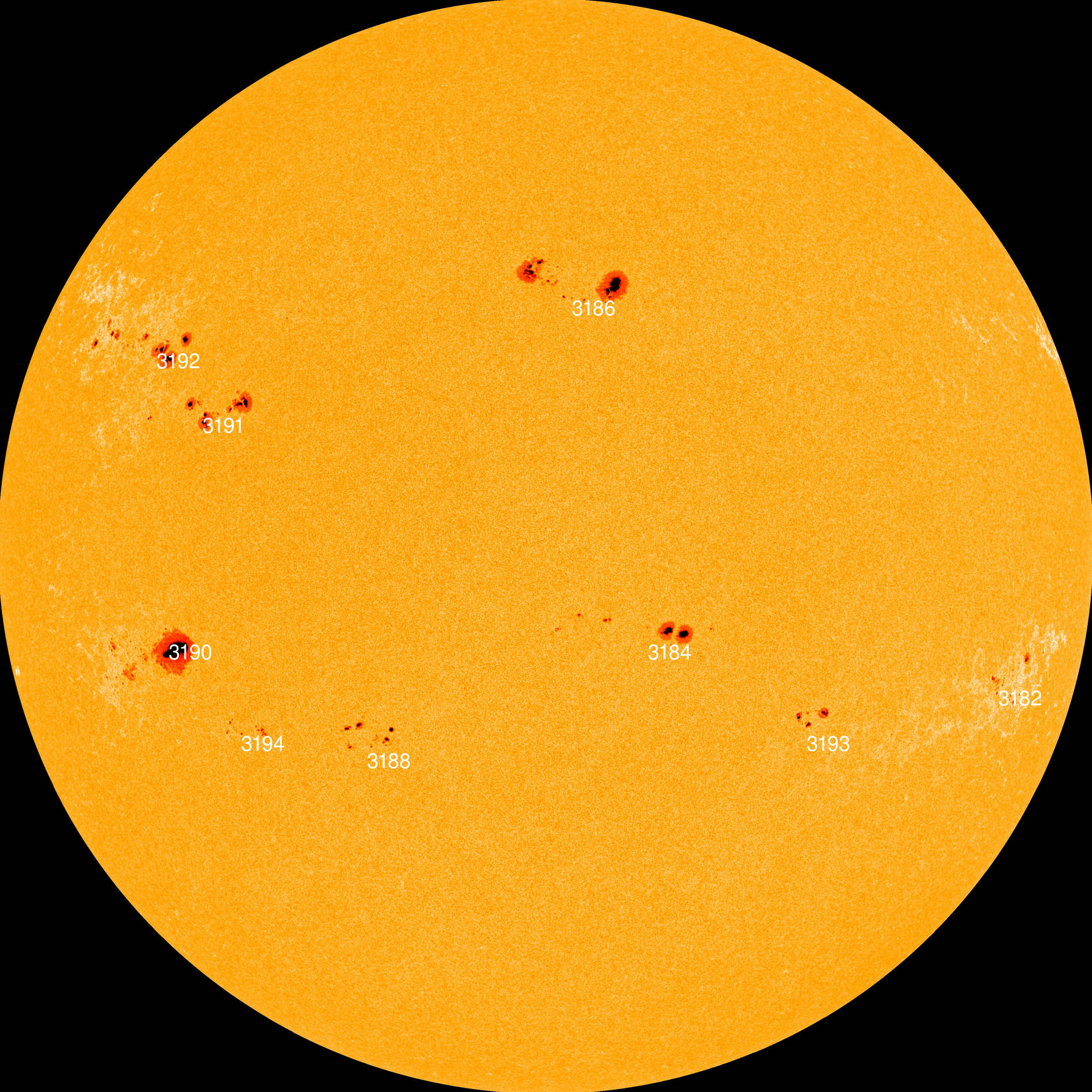
This image, from NOAA’s Solar Dynamics Observatory (SDO) downloaded last night, shows a many spotted Sun. The sunspot number by this time was up to 186. Sunspot groups are numbered as active regions. The most active region is AR 3190. Click on the image to enlarge it. Credit: NOAA’s SDO via spaceweather.com.
04/07/2022 – Ephemeris – The Sun is getting active again
This is Ephemeris for Thursday, April 7th. Today the Sun will be up for 13 hours and 5 minutes, setting at 8:17, and it will rise tomorrow at 7:10. The Moon, 2 days before first quarter, will set at 3:11 tomorrow morning.
For the last year and a half, the Sun has entered a new sunspot cycle, solar cycle 25. It had been predicted to be a rather mild cycle with an average peak in sunspot numbers of around 120 in 2025, three years from now. Last Sunday’s daily sunspot number was 118. Sunspot numbers are not just the numbers of individual sunspots on the Sun. Groups of spots count for 10 before the individual spots are counted. These counts are averaged, from many observatories, over a month to chart the progress of the approximately 11 year sunspot cycle. The more sunspots, the more solar flares. The more flares, the more CMEs or coronal mass ejections. If CMEs are aimed toward the Earth, we get northern lights, and headaches for satellite operators and electric power companies.
The astronomical event times given are for the Traverse City/Interlochen area of Michigan (EDT, UT – 4 hours). They may be different for your location.
Addendum
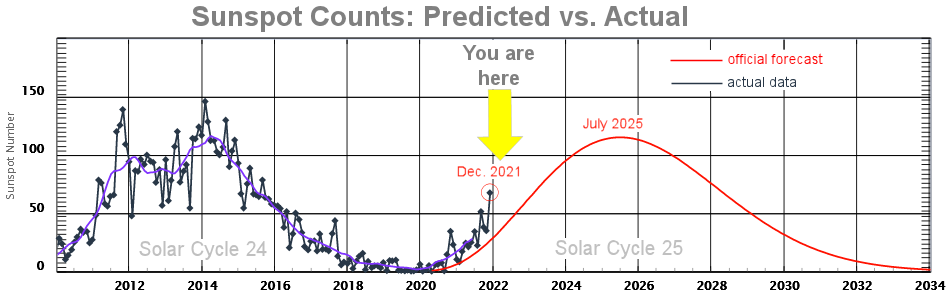
Current and last solar cycle sunspot plot. The current trend in sunspots is increasing much faster than what was predicted. Click on the image to enlarge it. Credit NOAA.
Go to spaceweather.com to keep up with what’s happening between the Sun and the Earth.
12/04/2014 – Ephemeris – What’s happening on the Sun this solar cycle
Ephemeris for Thursday, December 4th. The sun will rise at 8:02. It’ll be up for 9 hours even, setting at 5:02. The moon, 2 days before full, will set at 6:52 tomorrow morning.
It looks like maybe we’ve hit the peak of sunspots in this 11 year solar cycle. Actually this cycle had two peaks, the latter part of 2012 when the world ended. You do remember the world ending two years ago on December 21st. How soon we forget. The second peak in this solar cycle occurred in the first three months of this year. The sunspot cycle 24 so far appears to be the weakest since cycle 12 in the 1880s. The time of the peak can only be determined in hindsight. Of course this weak sunspot cycle produced the largest sunspot group, or active region, as they are now called, in 24 years, so I expect more surprises from this solar cycle. I expect to see more aurorae or northern lights as the sunspot numbers decline.
Times are for the Traverse City/Interlochen area of Michigan. They may be different for your location.
Addendum
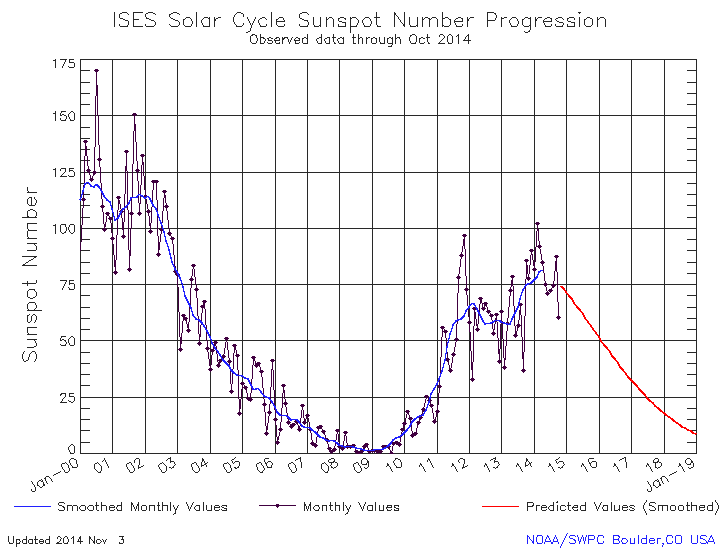
Sunspot cycle from 2000 until October 2014. Credit: NOAA/SWPC.
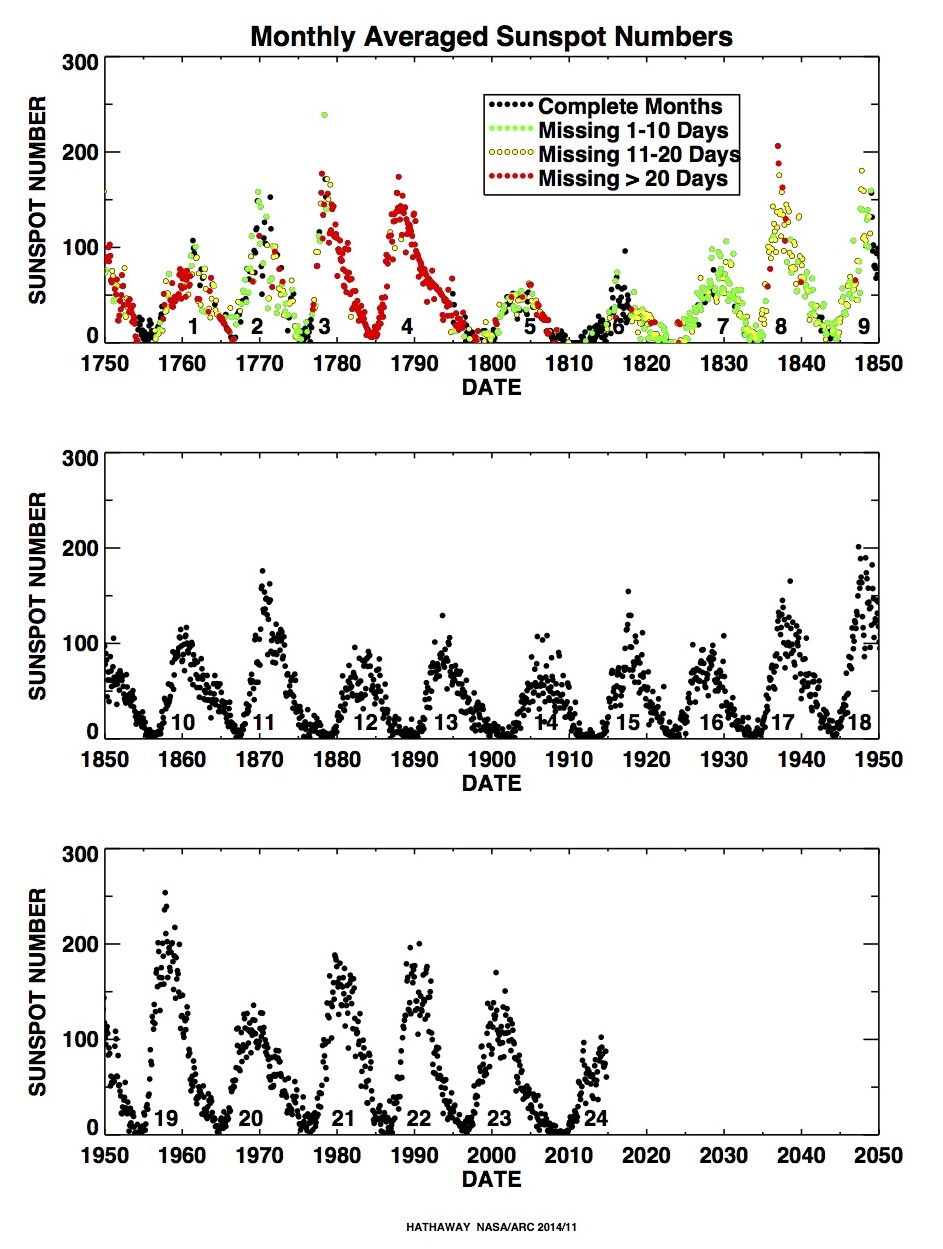
All the recorded sunspot cycles back to the 18th century. Credit: Dr. David Hathaway, NASA /ARC.
Here’s a link to NASA’s Sunspot Cycle page with a lot more information.
10/23/2014 – Ephemeris – Partial solar eclipse tonight for most of the US
Ephemeris for Thursday, October 23rd. The sun will rise at 8:08. It’ll be up for 10 hours and 36 minutes, setting at 6:44. The moon is new today, and won’t be visible.
This evening there will be a partial solar eclipse, in which we will see only the first part before the sun sets. The eclipse will be visible for all but the extreme eastern part of the country. It will be a partial eclipse for all who can see it because the core of the Moon’s shadow will miss the Earth to the north. For the Interlochen Public Radio listening area (Northwestern Lower Michigan) the eclipse will star a couple of minutes before or after 5:32 p.m. and will end at sunset around 6:44 p.m. The low position of the sun make a lack of cloud cover necessary to be able to see it. Proper approved solar filters, or a projection method are necessary to view the eclipse. Do Not Look Directly at the Sun! The NMC Observatory south of Traverse City will be open, weather permitting starting at 5 p.m. Also the Platte River Point location at the Sleeping Bear Dunes National Lakeshore will also be available.
An added attraction for this eclipse is the appearance of the largest sunspot group to appear on the sun in years.
Times are for the Traverse City/Interlochen area of Michigan. They may be different for your location.
Addendum
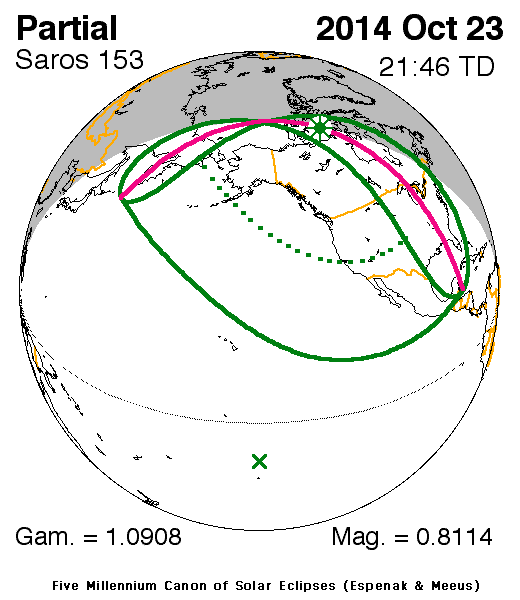
Coverage of the partial solar eclipse of October 23, 2014. Credit: NASA.

The setting partially eclipsed sun from Traverse City. Created using Stellarium.
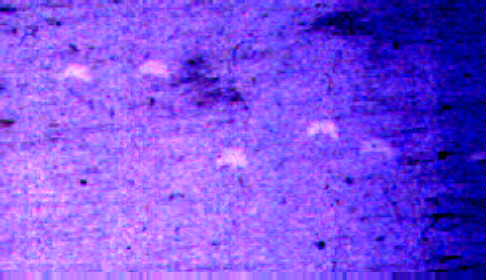
Partially eclipsed sun using a series of pinholes projected on a reasonably white surface.
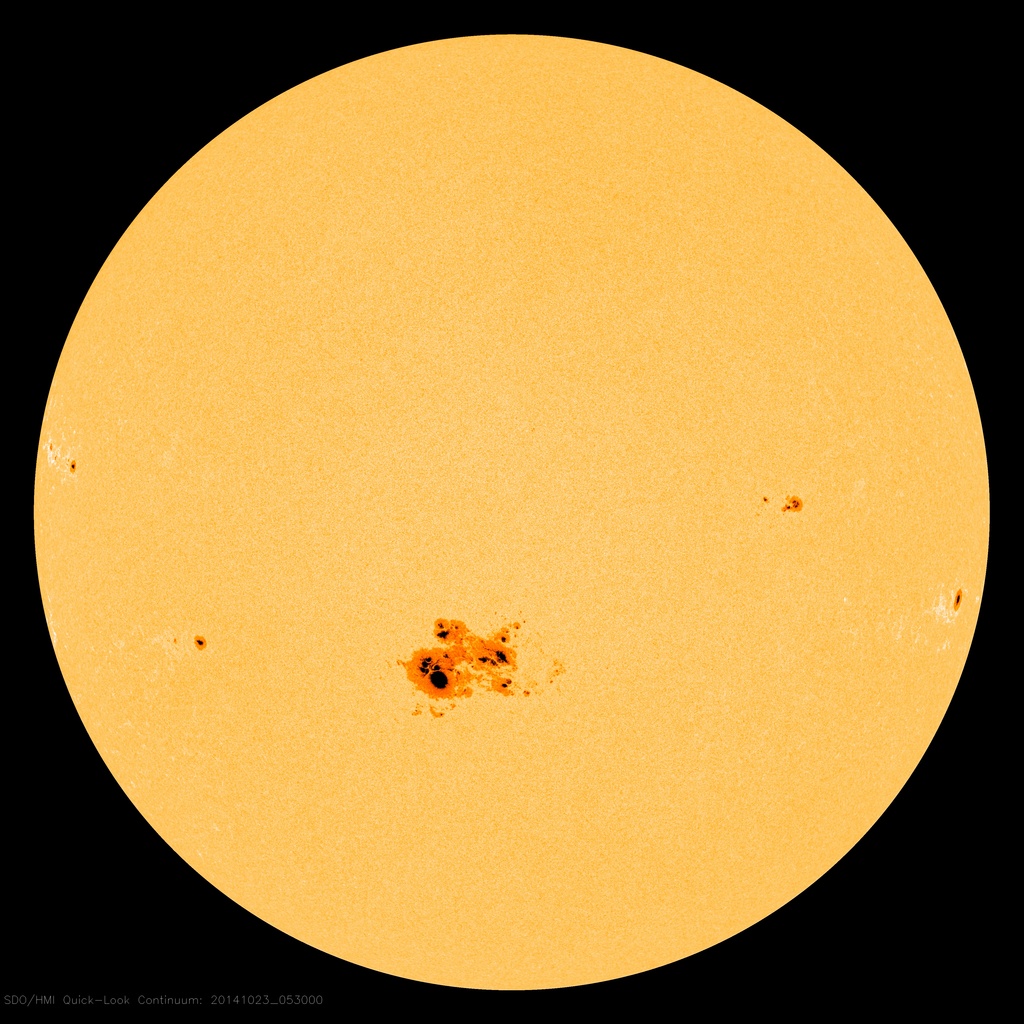
The Sun at 1:30 a.m. 10/23/2014 with large sunspot group AR 2192. Credit NASA – Solar Dynamics Observatory.
This baby gave off a X Class flare yesterday (10/22/2014). Could be more in store. Maybe we’ll see an aurora later this week.
08/02/2012 – Ephemeris – The sun’s kicking up again this week
Thursday, August 2nd. The sun rises at 6:30. It’ll be up for 14 hours and 35 minutes, setting at 9:05. The moon, 1 day past full, will rise at 9:05 this evening.
With the sun really being active, there’s a good chance we’ll see several displays of the northern lights of aurora borealis. Those south of the equator will see the southern equivalent, the aurora australis. There’s an active group of sunspots rotating onto the earth-side face of the sun that should give us a chance to see the aurora in the next week or so. Sunspots are caused by tremendous magnetic fields generated below the bright photosphere we rather improperly call the sun’s surface. The sun has no solid surface, it’s all gas. The magnetic fields cool the gas, making it darker. The spots are maybe at a temperature 2,000 degrees cooler than the rest of the photosphere which is about 10,000 degrees Fahrenheit. In complex sunspot groups there is a potential for huge explosions.
Times are for the Traverse City/Interlochen area of Michigan. They may be different for your location.
Addendum
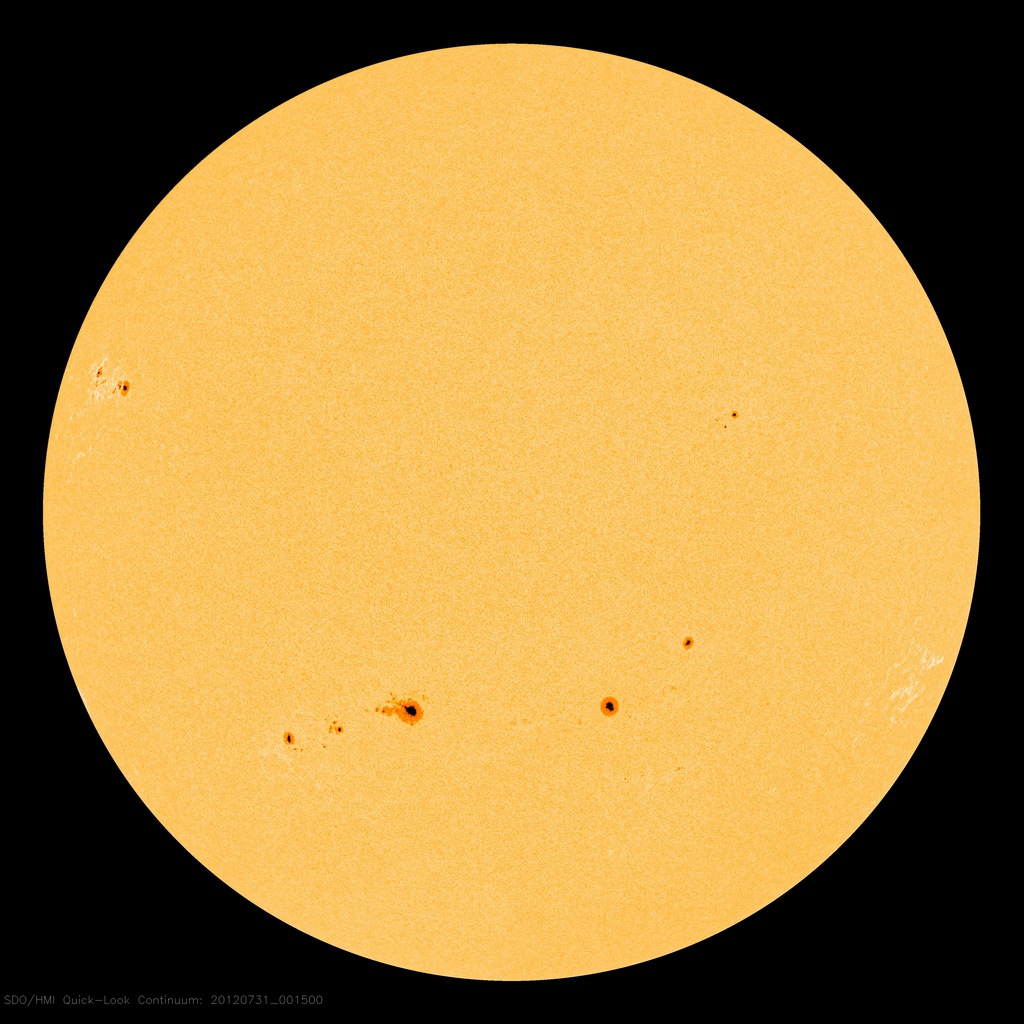
Solar Dynamics Observatory white light image of the sun from Monday. Credits NASA / SDO. Click on image to enlarge.
09/26/11 – Ephemeris – The sun is getting very active again
Monday, September 26th. The sun will rise at 7:34. It’ll be up for 11 hours and 58 minutes, setting at 7:32. The moon, 1 day before new, will rise at 7:53 tomorrow morning.
There is a large sunspot group rotating onto the earth facing side of the sun. It has already produced two large solar flares. Flares are explosions caused by the snapping of the magnetic field lines that cause the sunspots in the first place. The most energetic of these throw off a huge cloud of charged particles, protons, electrons, and alpha particles called a coronal mass ejection or CME at a couple of million miles an hour. It takes 36 to 48 hours for the cloud to reach the earth. Then it tangles with the earth’s magnetic field causing a geomagnetic storm. This is not good news for satellite operators and power and phone companies in the north. However for the rest of us, we get a chance to see the northern lights or Aurora Borealis. Saturday’s two flares from that sunspot group sent out a CME that we may catch the tail of later today.
* Times are for the Traverse City/Interlochen area of Michigan. They may be different for your location.
 Bob Moler's Ephemeris Blog