Archive
Ephemeris: 08/12/2024 – Expect a stellar explosion soon
This is Ephemeris for Monday, August 12th. Today the Sun will be up for 14 hours and 9 minutes, setting at 8:52, and it will rise tomorrow at 6:43. The Moon, at first quarter today, will set at 12:07 tomorrow morning.
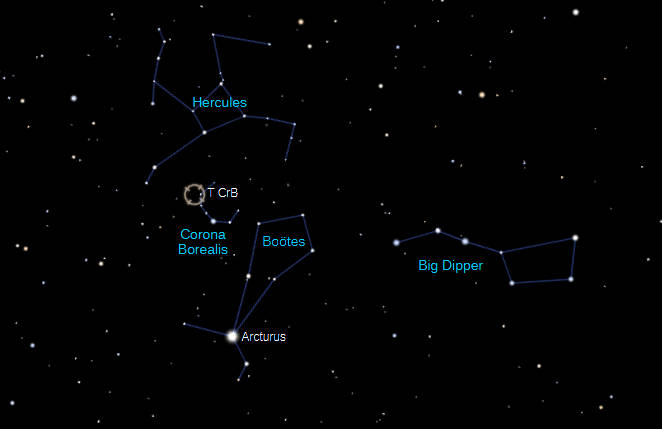
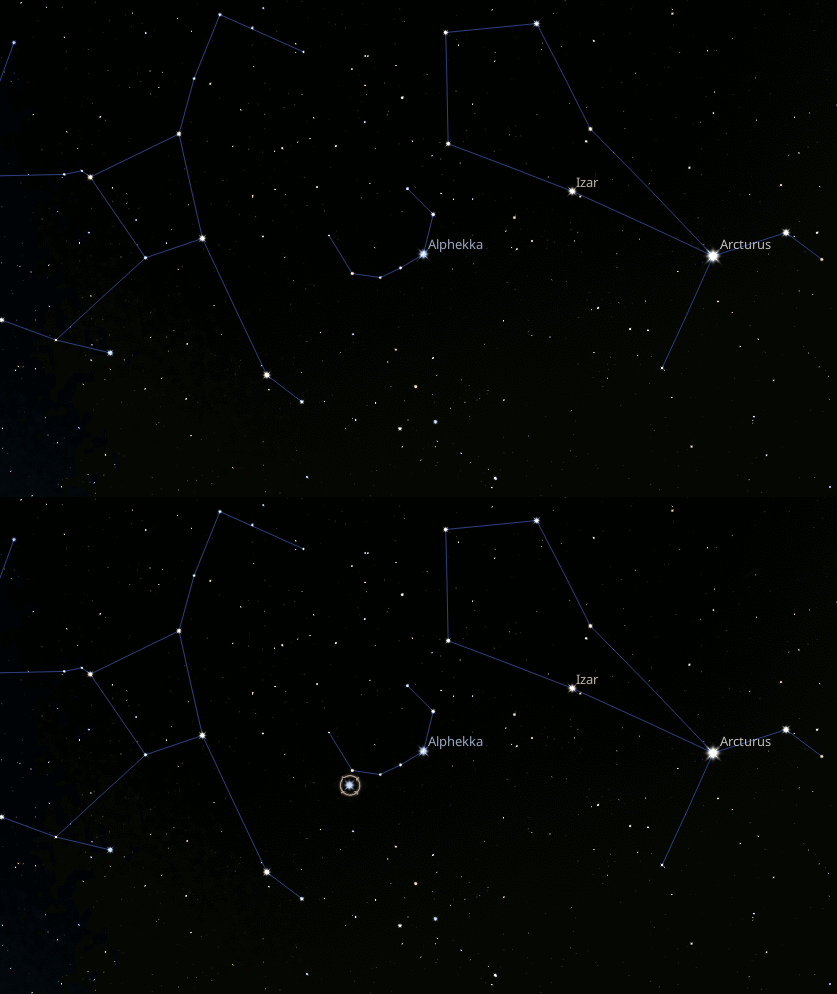
This is a reminder that we are expecting a once in a lifetime nova or exploding star in our skies fairly soon, maybe in a month or two. At least we’re hoping. Unlike many reoccurring events in astronomy this one cannot be predicted exactly since we’re not really sure what is happening. We have a general idea. The star is T Coronae Borealis which is in the Northern Crown constellation, which is a small semicircular stellar group near the star Arcturus which is a bright star found off the end of the handle of the Big Dipper. It is to the upper left of that star and the kite shaped constellation of Boötes of which Arcturus is at the base. The nova will appear as bright as Corona’s brightest star, but will fade in about 8 days below naked eye visibility. So it will be easy to miss.
The astronomical event times given are for the Traverse City/Interlochen area of Michigan (EDT, UT–4 hours). Times will be different for other locations.
Addendum
Ephemeris: 10/24/2023 – We might see a bright nova soon
This is Ephemeris for Tuesday, October 24th. Today the Sun will be up for 10 hours and 33 minutes, setting at 6:43, and it will rise tomorrow at 8:11. The Moon, 3 days past first quarter, will set at 3:57 tomorrow morning.
There is a star in the northern constellation of Corona Borealis the Northern Crown which we see normally on spring and summer evenings that is a recurring nova. A nova is a star that suddenly brightens from invisibility to visibility and soon fades. It is caused by a white dwarf orbiting with a larger, star siphoning off gases from the larger star until it builds up enough to create a thermonuclear explosion. This may not affect the star and may run through the process repeatedly. These are called reoccurring novae, and this one is designated T Coronae Borealis. It’s usually close to 11th magnitude which is hard to find even in binoculars to become one of the 50 brightest stars in the sky, as early as next year.
The astronomical event times given are for the Traverse City/Interlochen area of Michigan (EDT, UT –4 hours). They may be different for your location.
Addendum
What got me onto this is an article from Universe Today for September 8th by Jon Voisey: A Medieval Manuscript Likely Hides a Record of an Impending Recurrent Nova. Another source for this Nova is to look up T CrB on Wikipedia. See below:
 Bob Moler's Ephemeris Blog