Archive
Ephemeris: 10/23/2023 – Venus is at its greatest separation from the Sun in the morning
This is Ephemeris for Monday, October 23rd. Today the Sun will be up for 10 hours and 36 minutes, setting at 6:45, and it will rise tomorrow at 8:09. The Moon, 2 days past first quarter, will set at 2:36 tomorrow morning.
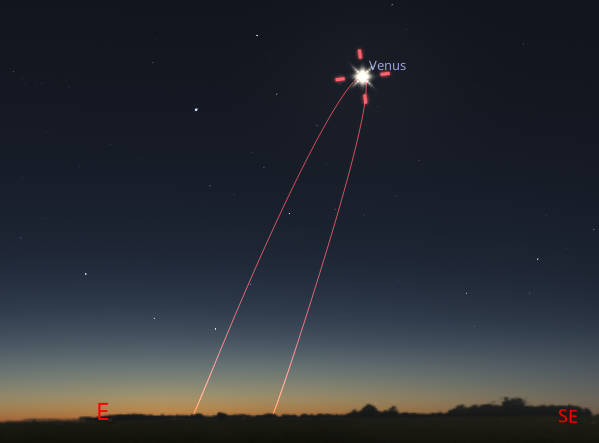
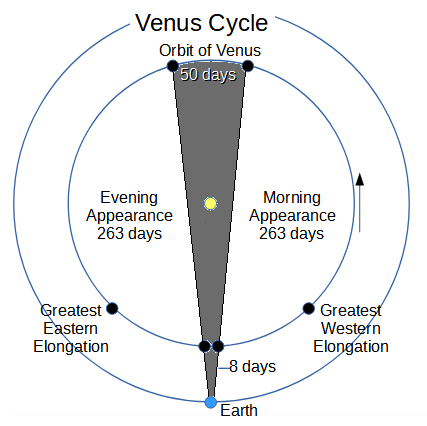
Our brilliant morning planet Venus will reach its greatest apparent angle from the Sun later today. It’s called the greatest western elongation because it’s west of the Sun and rises before the Sun. From now until its superior conjunction next year, on June 4th. It will move closer and closer to the Sun from our vantage point. But it’s just moving around behind the Sun. The Mayans at the peak of their civilization were diligent observers of Venus. They found the Venus cycle, what we would call synodic period of Venus of 584 days, from the heliacal rising of Venus, its first appearance in the morning sky after disappearing in the evening, to the next heliacal rising. Venus would reach its greatest elongation from the Sun about 66 days after its heliacal rising.
The astronomical event times given are for the Traverse City/Interlochen area of Michigan (EDT, UT –4 hours). They may be different for your location.
Addendum
03/21/2014 – Ephemeris – Star party and Venus this weekend
Ephemeris for Friday, March 21st. The sun will rise at 7:43. It’ll be up for 12 hours and 12 minutes, setting at 7:56. The moon, 2 days before last quarter, will rise at 1:27 tomorrow morning.
Tomorrow evening the Grand Traverse Astronomical Society will host a star party at Northwestern Michigan College’s Rogers Observatory starting at 9 p.m. On tap if it’s clear will be the planets Jupiter and Mars. As it gets darker, the wonders of the winter sky will still be visible, along with those of the spring skies. The observatory is located south of Traverse City, on Brimley Road between Garfield and Keystone roads. There is a small admission charge for the college. For early morning risers the planet Venus will reach its greatest elongation west of the sun tomorrow at an angle of 47 degrees. From there on late October Venus will appear to be approaching the sun, before emerging into the evening sky.
Times are for the Traverse City/Interlochen area of Michigan. They may be different for your location.
Addendum
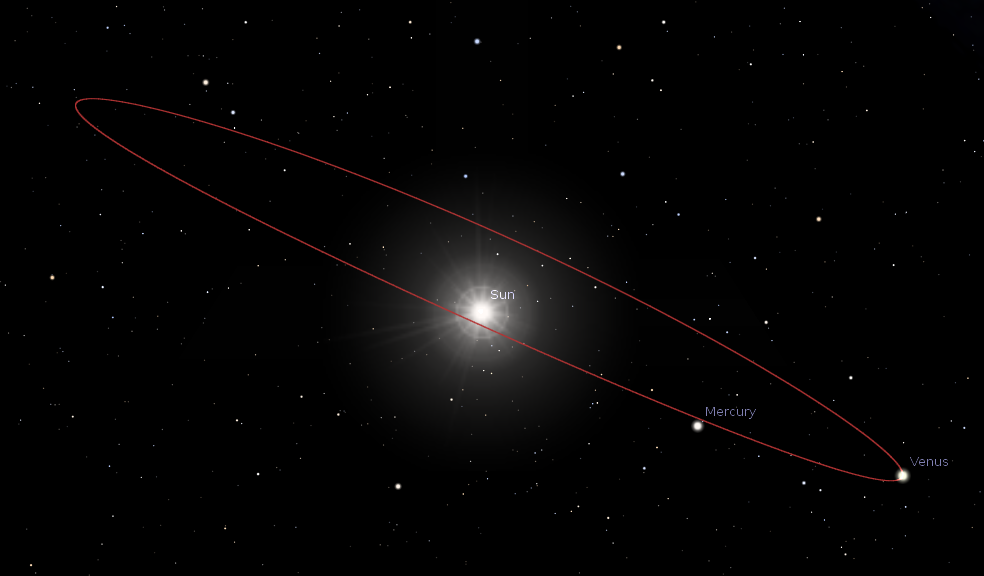
Venus at greatest western elongation and its orbit as seen from the earth on March 22, 2014. Created using Stellarium.
The sun looks off-center because we are looking at the orbit from the Earth, and Venus’ orbit is inclined by about 3º from our orbit. The near side of the orbit is only 25 million miles (40 million km) from Earth and is thus foreshortened. The part of the orbit right below the Sun is beyond the Sun and about 93 million miles (150 million km) away from us. Mercury is shown, but not its orbit.
 Bob Moler's Ephemeris Blog