Archive
01/16/2023 – Ephemeris – Orion’s great nebula
This is Bob Moler with Ephemeris for Dr. Martin Luther King Jr. Day, Monday, January 16th. Today the Sun will be up for 9 hours and 13 minutes, setting at 5:29, and it will rise tomorrow at 8:15. The Moon, 2 days past last quarter, will rise at 3:52 tomorrow morning.
The brightest interstellar cloud visible in our skies is the Great Orion Nebula. The word nebula is related to the Latin “nebulum” for cloud. The constellation of Orion is filled with nebulae, most of it are dim or dark. The Great Orion Nebula is in Orion’s sword. The sword is what looks like three stars that look dimmer than the three belt stars hanging from the belt. And there are more than three stars here. Around the stars that appear as the center of the sword stars, to the eye, can be seen a haze in binoculars. A telescope with a wider aperture and low power can see detail in the cloud. With more magnification, a clutch of four baby stars can be spotted in the brightest part of the nebula. They light up the nebula and are called the Trapezium.
The astronomical event times given are for the Traverse City/Interlochen area of Michigan (EST, UT –5 hours). They may be different for your location.
Addendum
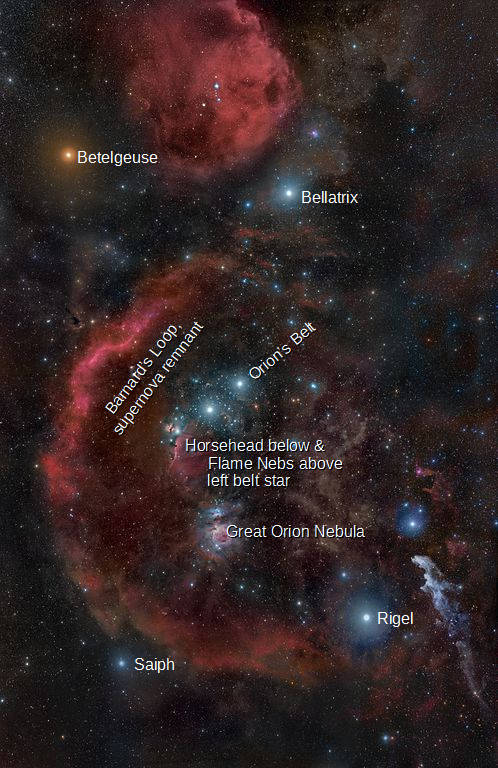
Orion is lousy with gas and dust. A regular star factory, or nursery. The red nebulae show the predominance of hydrogen in here. In actuality, the Great Orion Nebula vastly outshines all the other nebulae in Orion. The white nebulosity to the right of Rigel is the Witches Head nebula, probably the reflection of Rigel’s light off a dust cloud. Base image by Bernal Andreo, via Wikipedia. Annotations were created by myself.
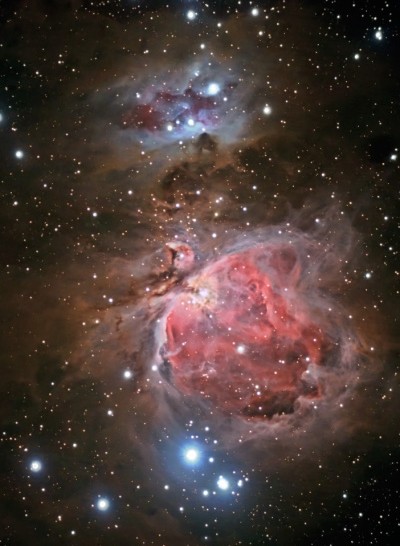
The Great Orion Nebula (M42) long exposure photograph by Scott Anttila. Includes all the sword stars.
02/04/2016 – Ephemeris – Orion is visible from everywhere
Ephemeris for Thursday, February 4th. The Sun will rise at 7:58. It’ll be up for 9 hours and 56 minutes, setting at 5:55. The Moon, half way from last quarter to new, will rise at 5:21 tomorrow morning.
The constellation of Orion the hunter is now due south at 9 p.m. It is an upright rectangle of bright stars, the shoulders and knees of this giant. In the center are three stars in a straight line, his belt, and from his belt hangs a sword. Orion is the most famous of all constellations world-wide, due to its bright stars, and straddles the celestial equator, so that it is visible at least in part from pole to pole. It contains the closest star forming region to us, the Great Orion Nebula seen easily in his sword with binoculars or small telescope. The Horse Head Nebula is found below the left belt star, but only in photographs. Another photographic feature is Barnard’s Loop, the partial shell of an ancient supernova to the left of Orion.
Times are for the Traverse City/Interlochen area of Michigan. They may be different for your location.
Addendum
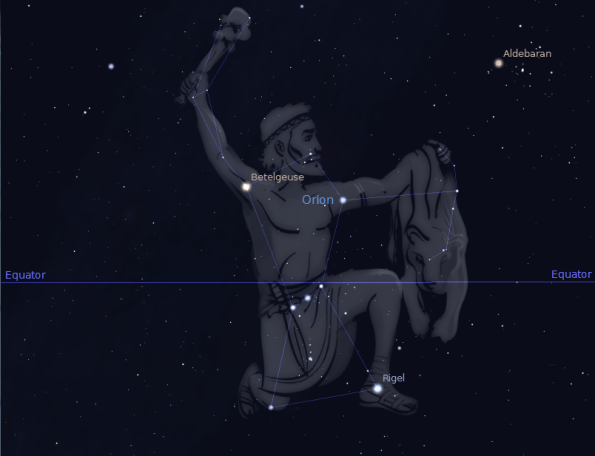
Orion from mid latitudes north of the equator. Orion would be upside down if viewed south of the equator. Created using Stellarium.
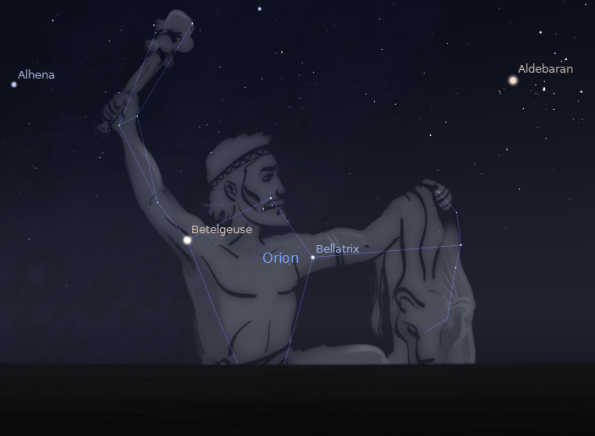
Orion from near the north pole. Created using Stellarium.
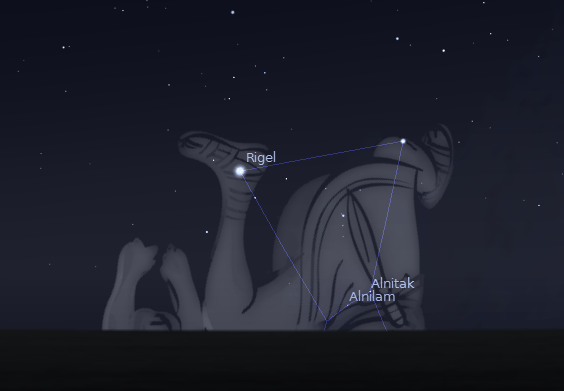
Orion from near the south pole. Created using Stellarium.
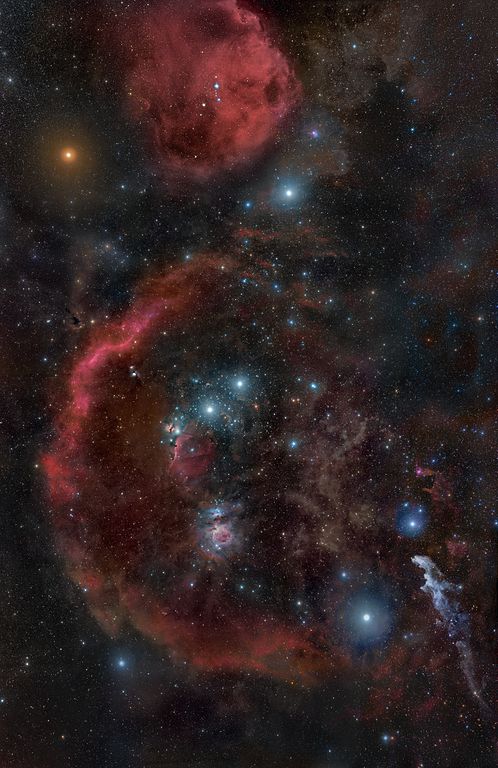
The nebulae in Orion including the Great Orion Nebula in the sword, the Horse Head Nebula below the leftmost star of Orion’s Belt named Alnitak. Barnard’s loop is the big arc on the left. Just above Alnitak is the Flame Nebula, I neglected to mention it in the program. It can be spotted in a telescope, especially if Alnitak is moved off the edge of the field of view. Credit Rogelio Bernal Andreo, via Wikipedia.
Note the nebula at the lower right. It’s the Witch’s Head Nebula, which I believe is shown brighter than it actually is. It’s being illuminated by the blue giant star Rigel to the left of it.
 Bob Moler's Ephemeris Blog