Archive
04/01/2014 – Ephemeris – Viewing Zodiacal Light
Ephemeris for April Fools Day, Tuesday, April 1st. The sun will rise at 7:23. It’ll be up for 12 hours and 46 minutes, setting at 8:09. The Moon, 2 days past new, will set at 10:37 this evening.
There is a faint glow visible to the careful observer at twilight’s end at 9:51 p.m. This glow is in the west. It’s Zodiacal Light, the reflected glow from countless bits of cometary dust in the plane of the solar system. You’ll need to go to a spot with no towns or cities immediately to the west of you. The glow will appear as a thin pyramidal glow tilted to the left. It’s tough to find the first time, but once seen you’ll easily find it again. A recent study of the glow confirms the source of it. While bright comets are fairly rare, small comets are very plentiful, including plenty that graze the sun and evaporate liberating their dust into interplanetary space. After tomorrow night the Moon will interfere for two weeks.
Times are for the Traverse City/Interlochen area of Michigan. They may be different for your location.
Addendum
I could never photograph Zodiacal Light when I wanted to. However I did catch it inadvertently.
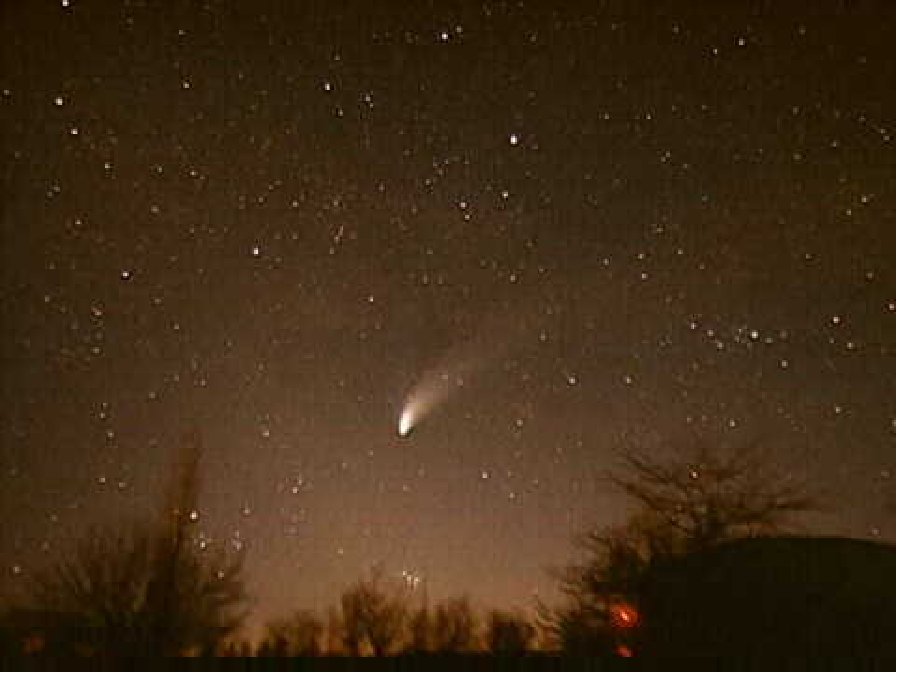
Zodiacal Light and Comet Hale-Bopp April 1997. My image.
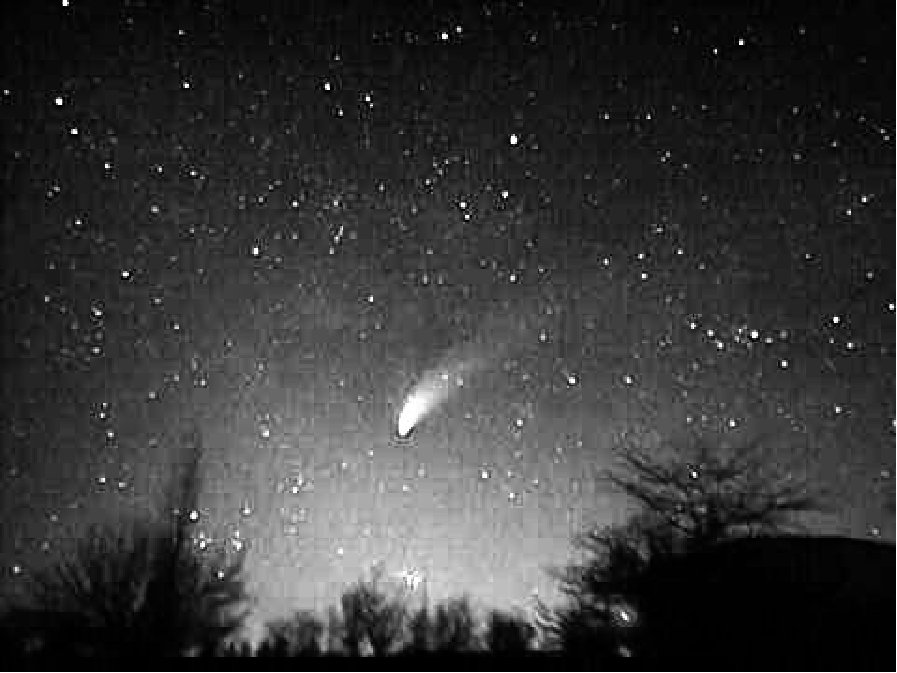
Zodiacal Light and Comet Hale-Bopp April 1997. Enhanced contrast.
04/04/2013 – Ephemeris – Can you spot Zodiacal Light?
Ephemeris for Thursday, April 4th. The sun will rise at 7:17. It’ll be up for 12 hours and 56 minutes, setting at 8:14. The moon, 1 day past last quarter, will rise at 4:34 tomorrow morning.
After you try to spot Jupiter tonight, or hang around outside at the end of astronomical twilight, about 10 p.m. look to the west at Taurus the bull and Gemini. Then broaden your gaze. There will be a very faint triangular glow with broad base at the horizon leaning a bit to the left, with its apex near Jupiter and the V of the face of Taurus the bull and the bright star Aldebaran to the right of Orion. This glow is called Zodiacal Light, caused by the reflected sunlight off a cloud of dust located in the plane of the solar system. Most of the large bodies of the solar system orbit the sun in a single plane. The one exception to this are comets, which orbit at all angles to the sun. Zodiacal Light is best seen on spring evenings and autumn mornings.
Addendum
It seems the only good photographs of zodiacal light I get is when there’s a comet in that direction. It happened a year before with Comet Hyakutake. The images here were taken later in the month when the Hyades and the Pleiades were lower in the sky.
Zodiacal Light and Comet Hale-Bopp April 1997. My image.
Here’s a black and white image with enhanced contrast.
Zodiacal Light and Comet Hale-Bopp April 1997. Enhanced contrast.
04/05/11 – Ephemeris – Zodiacal Light
Tuesday, April 5th. The sun will rise at 7:16. It’ll be up for 12 hours and 58 minutes, setting at 8:14. The moon, 2 days past new, will set at 10:45 this evening.
After you spot the moon tonight, hang around outside at the end of astronomical twilight, about 9:37 p.m. look to the west at Taurus the bull and Gemini. Then broaden your gaze. There will be a very faint triangular glow with broad base at the horizon leaning a bit to the left, with its apex near the V of the face of Taurus the bull and the bright star Aldebaran to the right of Orion. This glow is called Zodiacal Light, caused by the reflected sunlight off a cloud of dust located in the plane of the solar system. Most of the large bodies of the solar system orbit the sun close to a single plane. The exceptions to this are comets, which orbit at all angles to the sun and Kuiper belt objects. Zodiacal Light is best seen on spring evenings and autumn mornings.
* Times are for the Traverse City/Interlochen area of Michigan. They may be different for your location.
Addendum
Back in 1997 I caught the zodiacal light when I photographed Comet Hale-Bopp. This was taken later in April when the apex of the zodiacal glow extended almost to Gemini. Click on the image to enlarge.
IZodiacal Light and Comet Hale-Bopp April 1997. My image.
Here is an enhanced image in black and white.
Zodiacal Light and Comet Hale-Bopp April 1997. Enhanced contrast.
 Bob Moler's Ephemeris Blog